Nicole Cherubini: I was reading some of these dialogues this morning and everyone talks about how they met. I was trying to think of how we met.
Kate Gilmore: Jeffrey Gibson and I were in Art Omi [Residency] and you came up to visit with Malachi [Cherubini’s son]. He was super young and he was wearing this white flowy dashiki like linen outfit.
NC: He was two.
KG: And you seemed really frazzled, understandably, traveling alone with a two-year-old. That’s how I think we met.
NC: Yeah, I can remember that now. That was 19 years ago.
KG: Wow. But I have always followed your work. Big fan.
NC: I always followed yours too – I loved it. And I learned so much from it!
KG: Well, I wish I could say that I learned any proper clay technique from you.
NC: But your improper clay technique is what I’ve learned from.
KG: [Laughs] Well, there you go. I actually wanted to talk to you about clay. I do think there’s a connection between the material and the performative practice. I enter clay as a performative practice and then it turns into something else – how I use the body and how it transforms. For me, this intermediary process is the most interesting thing about it – not the beginning and not the end. You’re a very technical person and I wonder how you approach the material. How do you engage with clay, outside of it just being a material for making?
NC: Well, the thing I love about clay is that it records every moment. It records presence and touch. Sometimes when I look at pots or sculptures I’ve made, I can tell on some days I have a Band-Aid on or rings on and stuff like that. That’s what keeps me coming back to it. The recording of an actual moment of my day is exactly what attracts me to performance – it’s just then and there. As I get older, another thing I love about it is that there’s no storage [laughs]. But clay has this malleability and an actual relationship to the body. And it has memory. Have you ever read about that?
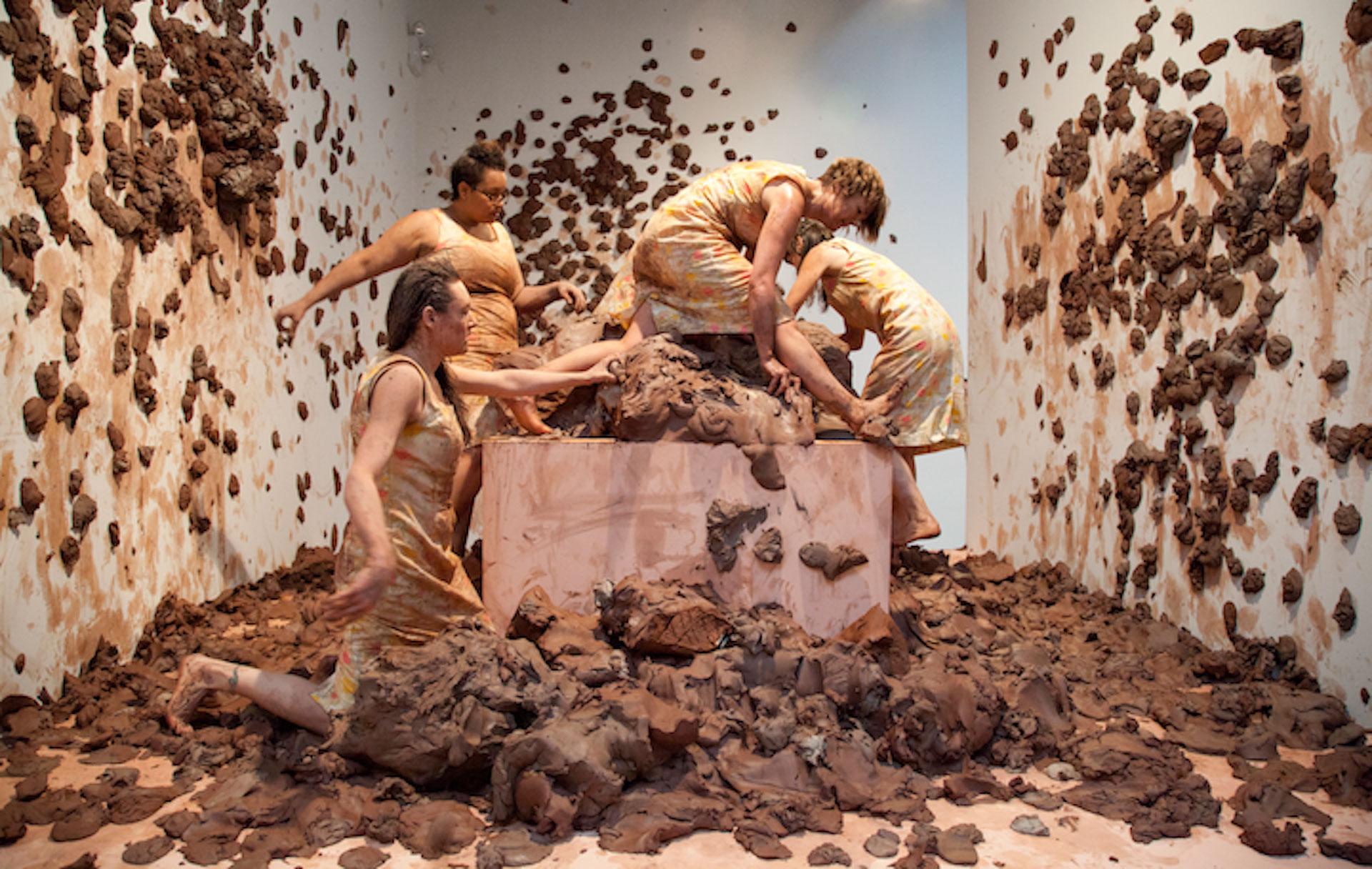
Kate Gilmore, Through the Claw, 2011. Performance/Installation- Pace Gallery, New York, New York. Video still. Courtesy of the artist.
KG: I’ve thought about it in relation to my own practice and that’s what I’m drawn to, but haven’t necessarily read about it.
NC: Yes. So, there’s memory to it in terms of the history of material, but apparently its molecular composition has memory. So a lot of times, when something warps or cracks, it is because the molecules haven’t been compressed or changed enough to actually keep the shape that you’re asking of it. So you’re in this actual conversation with the material. I almost think of it as a collaboration with the material. You’re in a relationship with the earth constantly.
KG: Interesting. It makes me think of people like Ana Mendieta… Just because so much of the body was embedded into the earth, like on those tree pieces in her Silueta Series (1973-1978). Clay seems to be so connected to the history of performance, especially feminist performance. But I’d also like to ask you about the failure of clay and your performances in relation to preciousness – failure and potential for breakage. Like that piece I saw in September at THE MOTHERLODE. The performer was like: is it okay if I touch this? And you said things are supposed to be broken or something like that. What did you say?
NC: Oh, whenever we would break something my mother would say dishes were made to be broken.
KG: Right. You know what, I think about this a lot. I have a bunch of my grandmother’s dishes and I’m always thinking whether it’s better to keep them intact in a box in the basement or actually use them and remember her every day. It’s about the potential for life to happen, right? Is there a connection between the making of things and the breaking of things and then the failure of the material and the failure of the body? For me, they seem very interconnected.
NC: Yes. They are. I think I have embraced the failure of clay and that has allowed me to really expand it into the spaces – with scale and everything. I’m not trying to control it. And, in a weird way, the failure of clay has also taught me about life.
KG: I’m going to let you elaborate on that.
NC: Absolutely. It’s like having different expectations. You have to give up control. In performance, you have to give up the ability to control the whole moment.
KG: You know, I fell in love with your work before I knew you when I saw your pieces with chains at the Make it Now show at the Sculpture Center. These were elements that I was using in performance, but to see it in relation to clay – the ornamentation dressing it up like such a traditional object… that seemed to be a much more controlled vision. Like, controlling the pot and these elements of stereotypical beauty or class. And now it’s kind of embedded into the way the piece is made. It’s interesting to see how your idea of control or giving up control has progressed over the years.
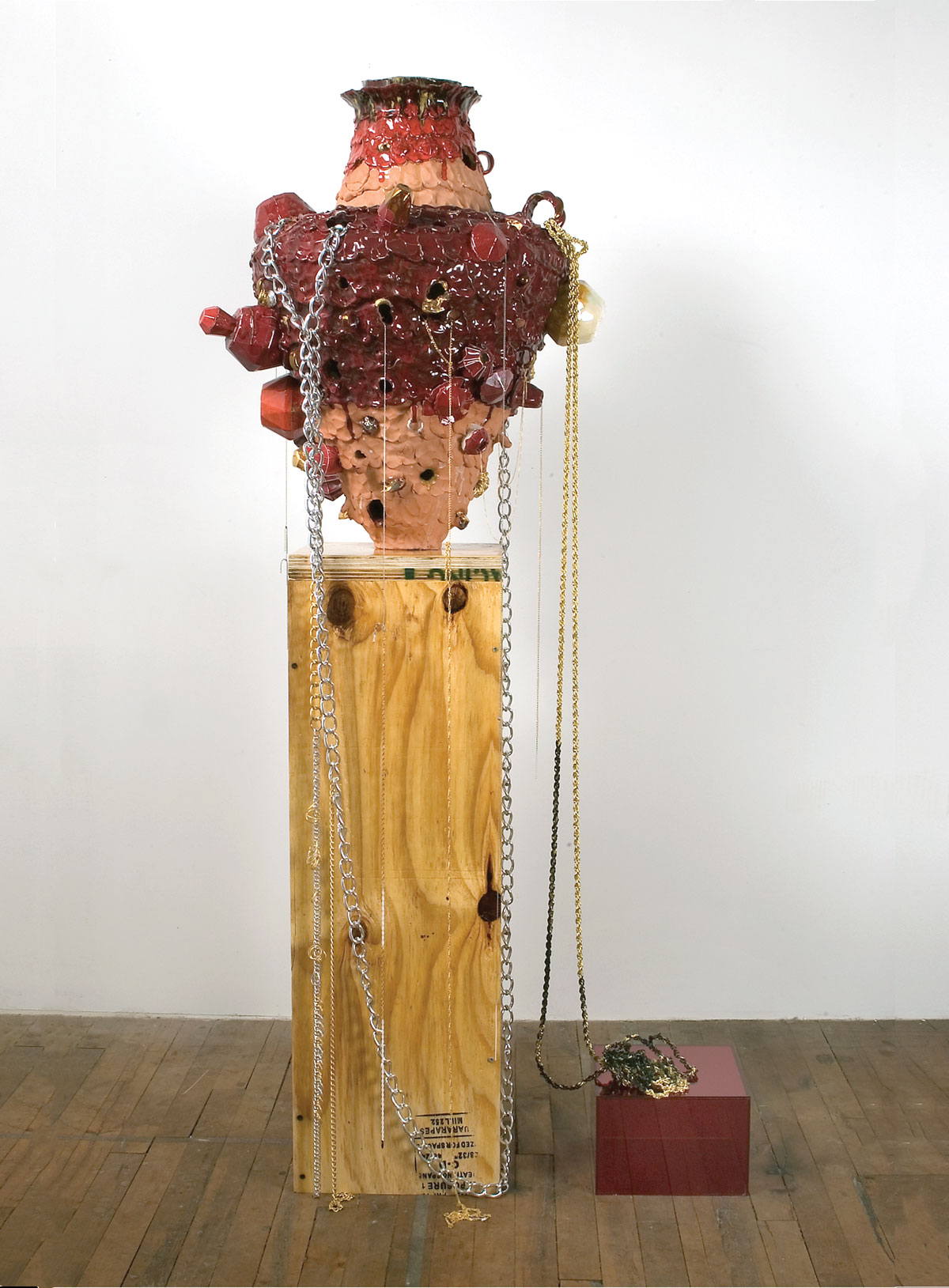
Nicole Cherubini, Vanitas #3, 2005. Ceramic, terra-cotta, luster, yellow and crystal ice, fake gold and silver jewelry, chain,
purple rabbit fur, plywood, polyurethane, enamel and red plexiglass, 62 × 25 × 25 in. Courtesy of the artist.
NC: Funnily, in my last show at Friedman Benda, the past winter, I thought of bringing back the chain. A lot of those pieces had a chain pressed into them. And I actually started using glaze as an adornment per se, so the clay and the glaze became separate materials.
KG: Were your early pieces painted or glazed?
NC: They were glazed, but they had some paint. But because they had many many layers of glaze, the color was very poppy and intense.
KG: It was poppy! I always thought of Marilyn Minter in relation to those. Like, hippie meets the city.
NC: Totally [laughs]. But a little sexy.
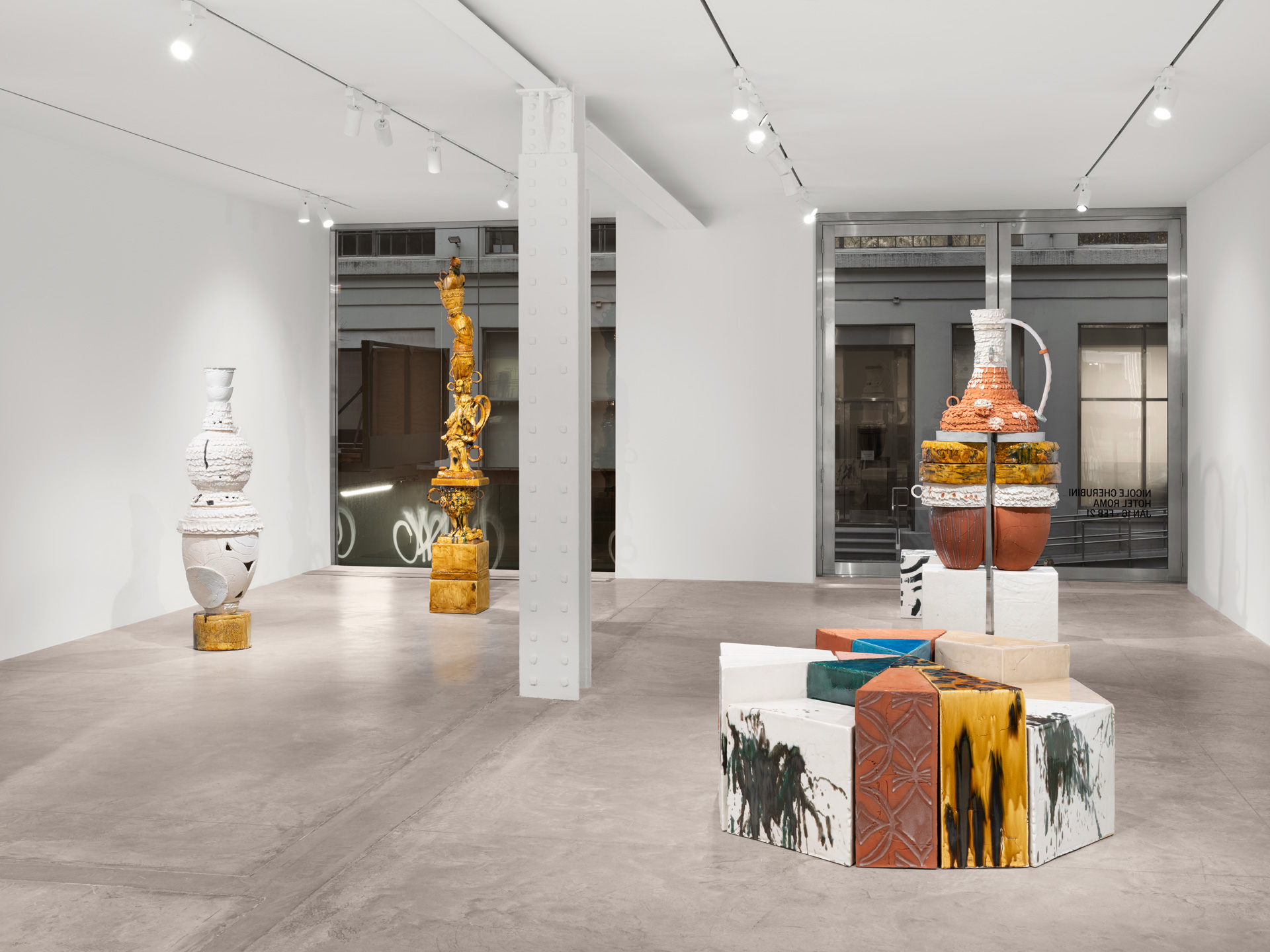
Nicole Cherubini, Hotel Roma exhibition at Friedman Benda Gallery, 2025. Earthenware, terracotta, sculpture clay, glaze,
epoxy resin, Magic Sculpt acrylic paint, steel rod, hardware 87 x 146 x 26 inches. Photo: Pierre Le Hors. Courtesy of the artist.
KG: So sexy! Now, talking about furniture, fashion and beauty… You’re not a design person, but you can make a bench or a vase and you always wear these beautiful flowy dresses that match the visuals of your show. It’s a whole aesthetic really and it works. What does it mean to you to have the body physically engage with the objects in that way? Like, your body. You’ve been doing that way before you started doing the dance performances.
NC: They kind of came together slowly. I think I started making the benches first, in 2016. Trump had just gotten elected and I couldn’t really figure out why one would make art anymore. Around the same time, materials were becoming harder to get. The mine where an ingredient of my clay that I had used forever was empty. We were using all of our resources.
KG: Okay, wow.
NC: Yeah, it’s been a consistent thing over the past ten years. Even my favorite turquoise glaze… we can’t really make it anymore. This process of loss and our political situation made me go deep down and challenge what I was doing and why I was doing it. I’ve always made work in relation and discussion of function, and I decided to change it to purpose. I realized I could never make a dish because it would be so heavy and big no one could carry it [laughs], so that’s how I started making the benches. I wanted the work to be about someone looking and interacting with the work as a viewer, so I gave a place for the viewer to exist. I really liked this back and forth because the work has such a bodily reference.
KG: I mean, all your work has always offered a direct engagement. Even your earlier work. It would still make me think about the body even if I wouldn’t sit on the piece.
NC: And I guess we want to touch clay, right? We’re constantly relating to it – we’re drinking our coffee right now on something made out of clay; this house is made out of it. Our body directly relates to it – touching it, feeling it, holding it, so when we see an artwork made of clay, we want to touch it. And in this case, you can actually sit on it. And I love to address that moment of hesitation everyone has, thinking: can I really sit on this?
KG: But you made some ceramic chairs you couldn’t sit on, right?
NC: Correct, those were the first ones I made, around 2016. That was the beginning of it. The first time I made ones that people could actually sit on was for my show at Mass MoCA, in 2021. It was a little side thing but they slowly took over.
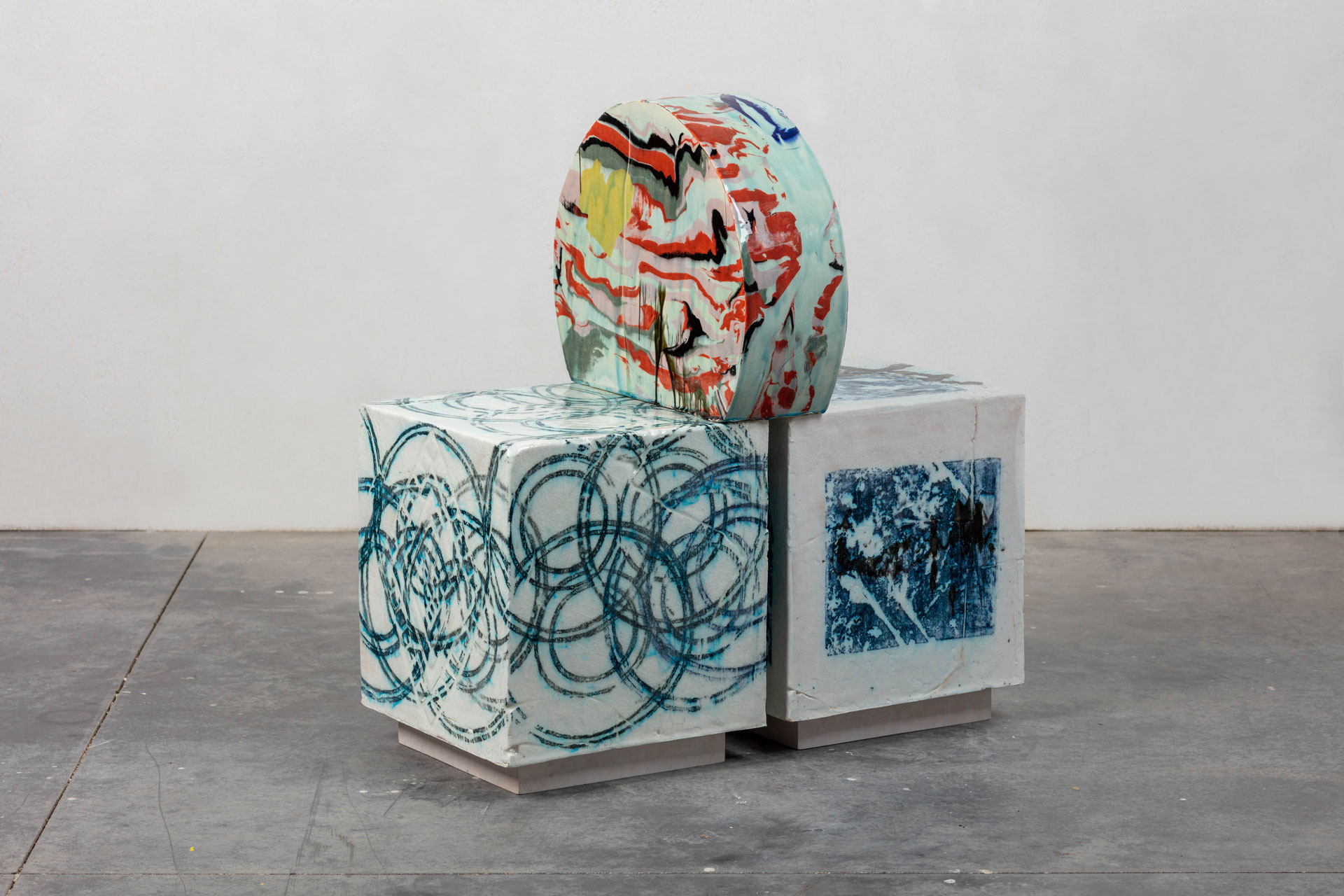
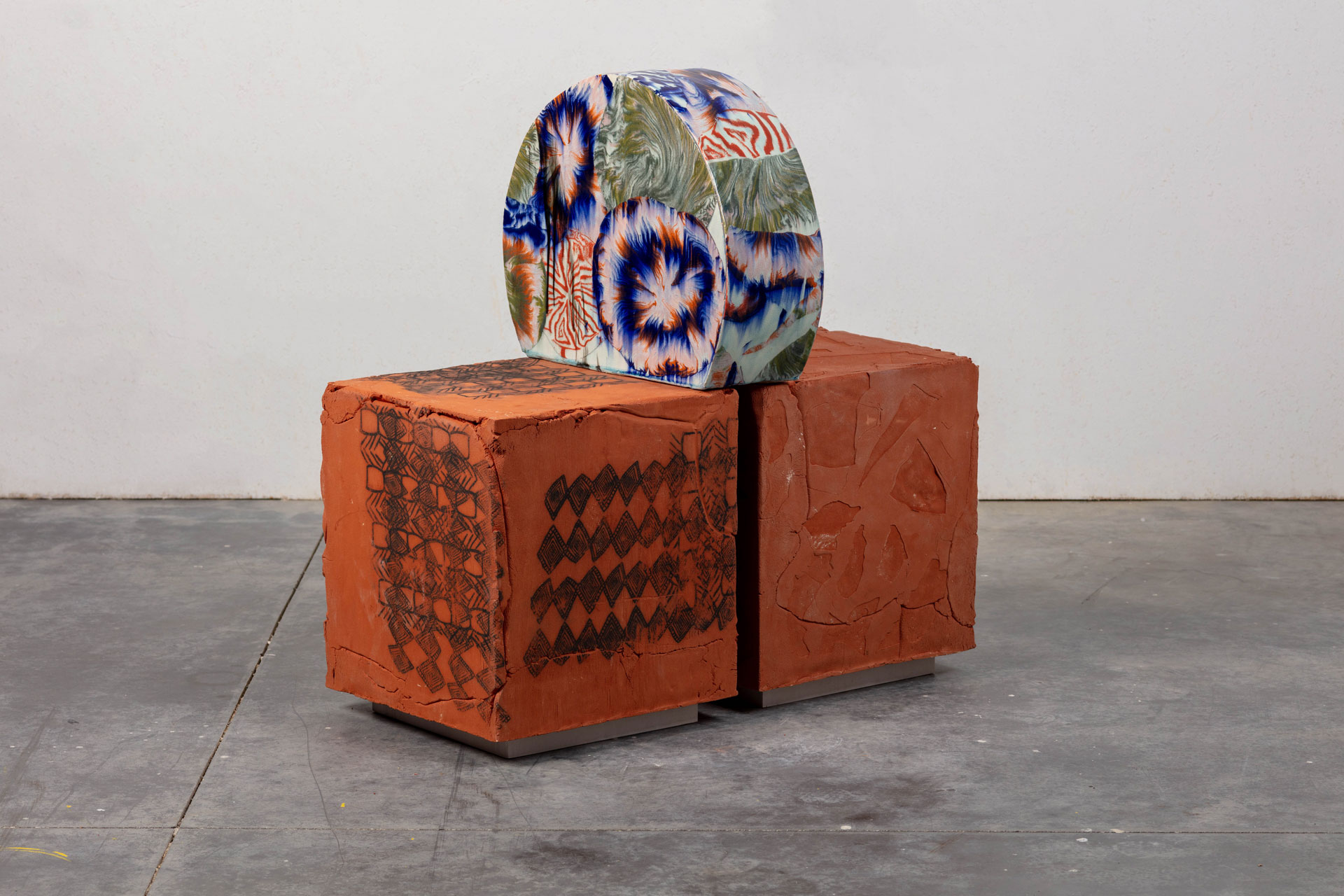
Left image: Nicole Cherubini, Antiquities Bench, Circles, Double, 2023. Earthenware, paper clay, mason stains, glaze, underglaze, plywood, PC-11, liquid nails, epoxy, steel rod, magic sculpt, pigmented epoxy, wood, stain, 35 x 33 x 20 in. Right image: Nicole Cherubini, Antiquities Bench, Double, 2022. Terracotta, earthenware, mason stains, glaze, underglaze, plywood, PC-11, liquid nails, epoxy, steel rod, magic sculpt, pigmented epoxy, wood, stain, 32.75 x 34 x 20 in. Photos: Bryan Zimmerman. Courtesy of September Gallery and the artist.
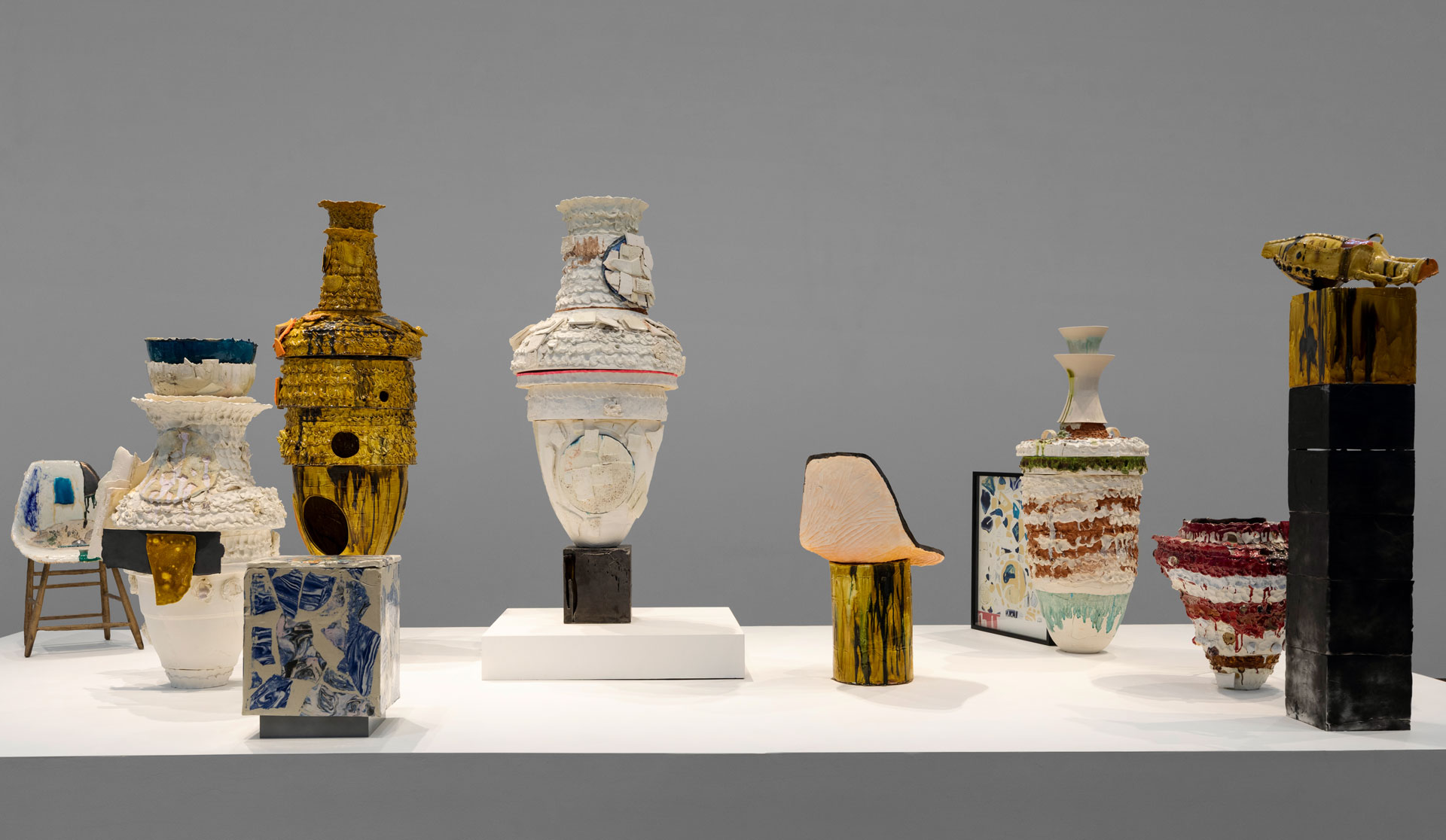
Nicole Cherubini, Ceramics in the Expanded Field, at MASS MoCA, 2021. Peter Kaiser; Pete Mauney. Courtesy of the artist.
KG: The way you talk about size and heaviness is interesting to me because you’re very petite. How tall are you?
NC: 5’4’’, sometimes.
KG: You’re not that small, but I see you as petite. I have this theory that artists make their own bodies all the time – either the scale of their body or something that looks like their body, in a weird way. And I find it interesting that you said you could never make something small or light.
NC: Clay is a heavy and weighty material. There’s something quite visceral about the moment you are making the work and you are relating to this material that is so luscious and gorgeous looking and then it just becomes dry, static and lifeless. You work the clay like a fluid drawing and then it becomes this dry heavy object and then, I believe, glaze can reintroduce life into it. I think you can maybe relate to this in your performances with clay?
KG: Interesting. I kind of think of it as armor. I’m very interested in the idea of beauty and humor as a way of enticing someone and then once you have them, you can deceive them. So there’s real potential in using that element of initial beauty as seduction. There’s a lot of sensuality to it.
NC: Definitely. There are not many people who have actually shown the messiness of the material – the dirtiness, the visceral relation to it, but you have, so honestly. I would love for you to speak a bit about this.
KG: Yeah. Honestly, I’m more into this now than I’ve ever been really. I’ve had so many people in the art world come and tell me the work is too messy or that they’re waiting for me to finish it or clean it up. For years I was like: What the fuck? Maybe the reality is I’m a total fucking mess, you know? I think the more I get that sort of pushback, the more I realize that’s where it is. My studio is insane, my process is insane, so the piece that is created within this space and from this process isn’t that much different. That’s a big part of it. And not only with clay. I think we’ve become very cleaned up in the art world and as people. We have to speak a certain way, be careful, be appropriate. We have to perform a certain way, especially as women. This younger generation maybe not so much – I’m super in love with this younger generation. They’re more of a mess. At least my students are. But, yeah, that space in between the making and the being done with it, whatever that means, is where the gold is. For years, I tried to figure out how to clean up my work, and every time I did clean it up, it didn’t feel alive at all. It just felt wrong.
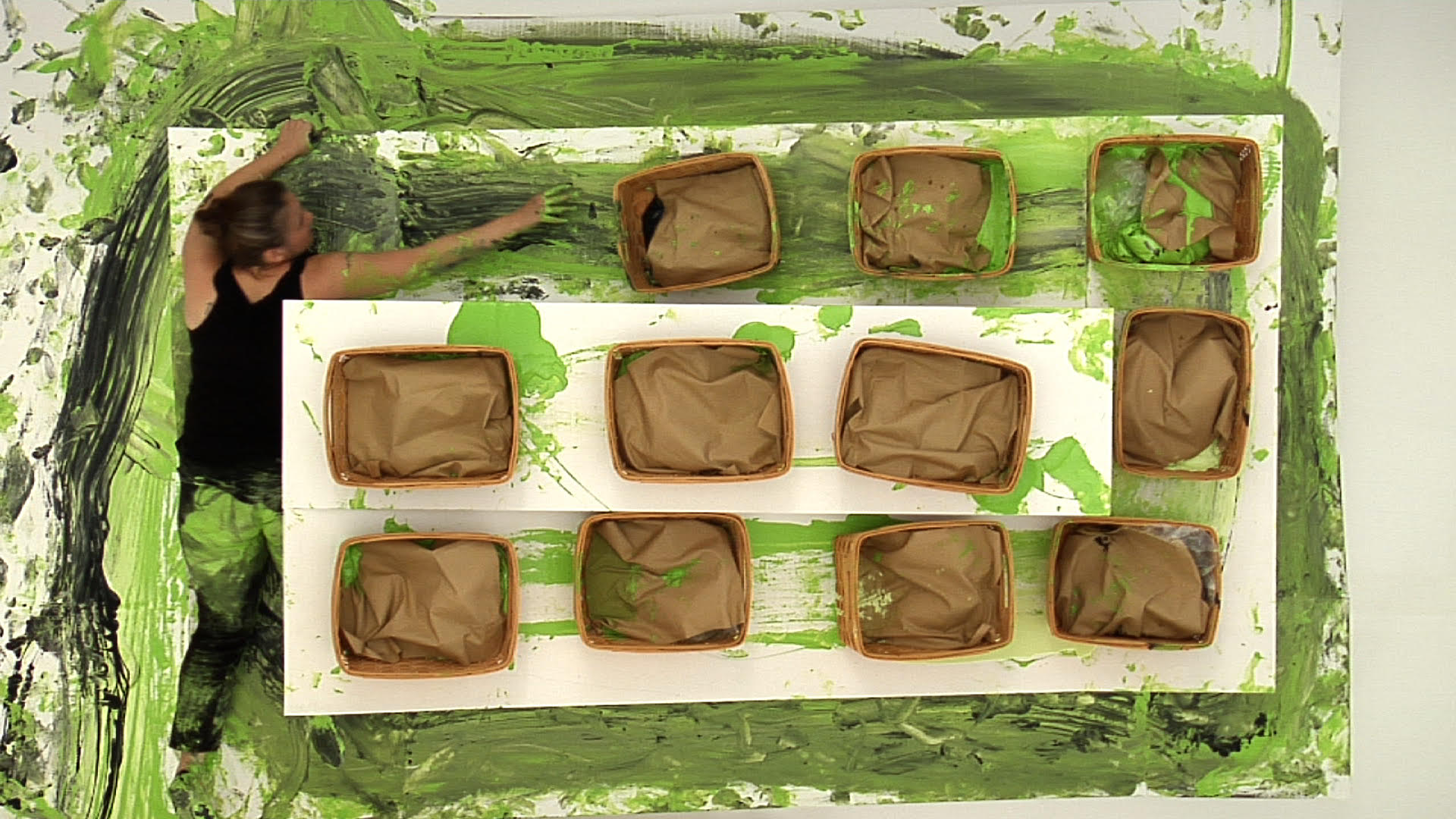
Kate Gilmore, A Tisket , a Tasket, 2013. Video still, University Art Museum, University at Albany, Albany, NY. Courtesy of the artist.
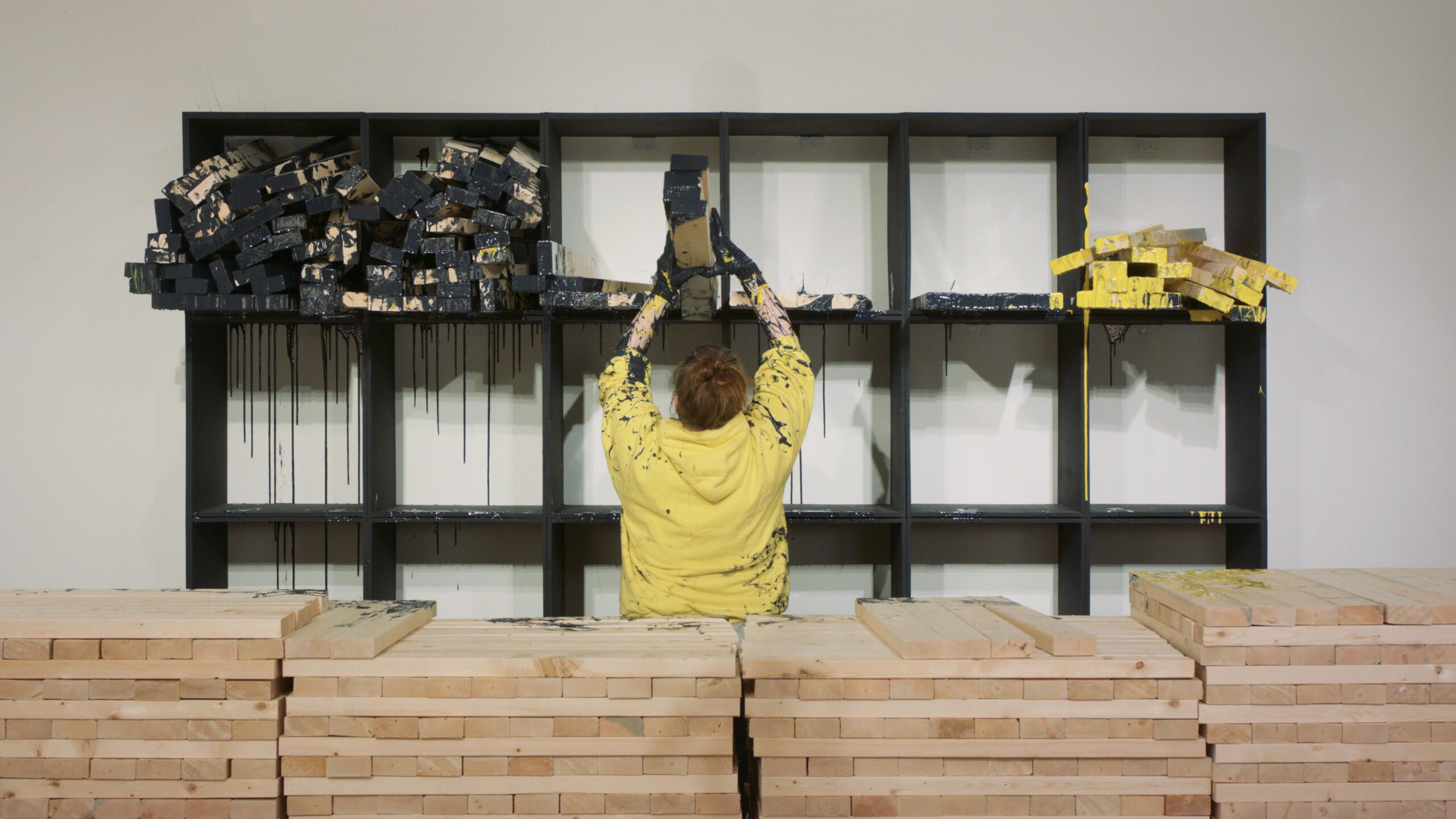
Kate Gilmore, It needs Louise, 2018. Video still, Museum of Contemporary Art, Jacksonville, Florida. Courtesy of the artist.
NC: Can you give me an example of what you’re talking about?
KG: Just in terms of thinking more commercially. For instance, taking a piece and making it have a perfect frame or the perfect line. I’m right handed and I realized I hate it when I use my right hand to draw, but when I use my left hand, I find the result really beautiful. The line is fucked up, the drip is wrong. The mess happens more! And it happens because there’s less control and self-consciousness. The joy I get from making art is precisely that elimination of self-consciousness. I know it’s totally impossible to fully have that, but that emotional quality is really important. You know, our bodies are broken, our bodies change. I’m too loud, I’m too obnoxious, and my hair isn’t brushed the right way. I’m going to come in like a tornado and I’m going to scream and yell and cry. I’m a living person. That’s what makes us human beings.
NC: For sure.
KG: I’m definitely focused on what a woman’s body does. I’m in my 50s and I have finally realized that this messiness and incompleteness is actually where I want to be. I want to be more messy. It’s the most important part of my art making. But to be fair there’s an order to it too. What about you? I don’t see you as messy.
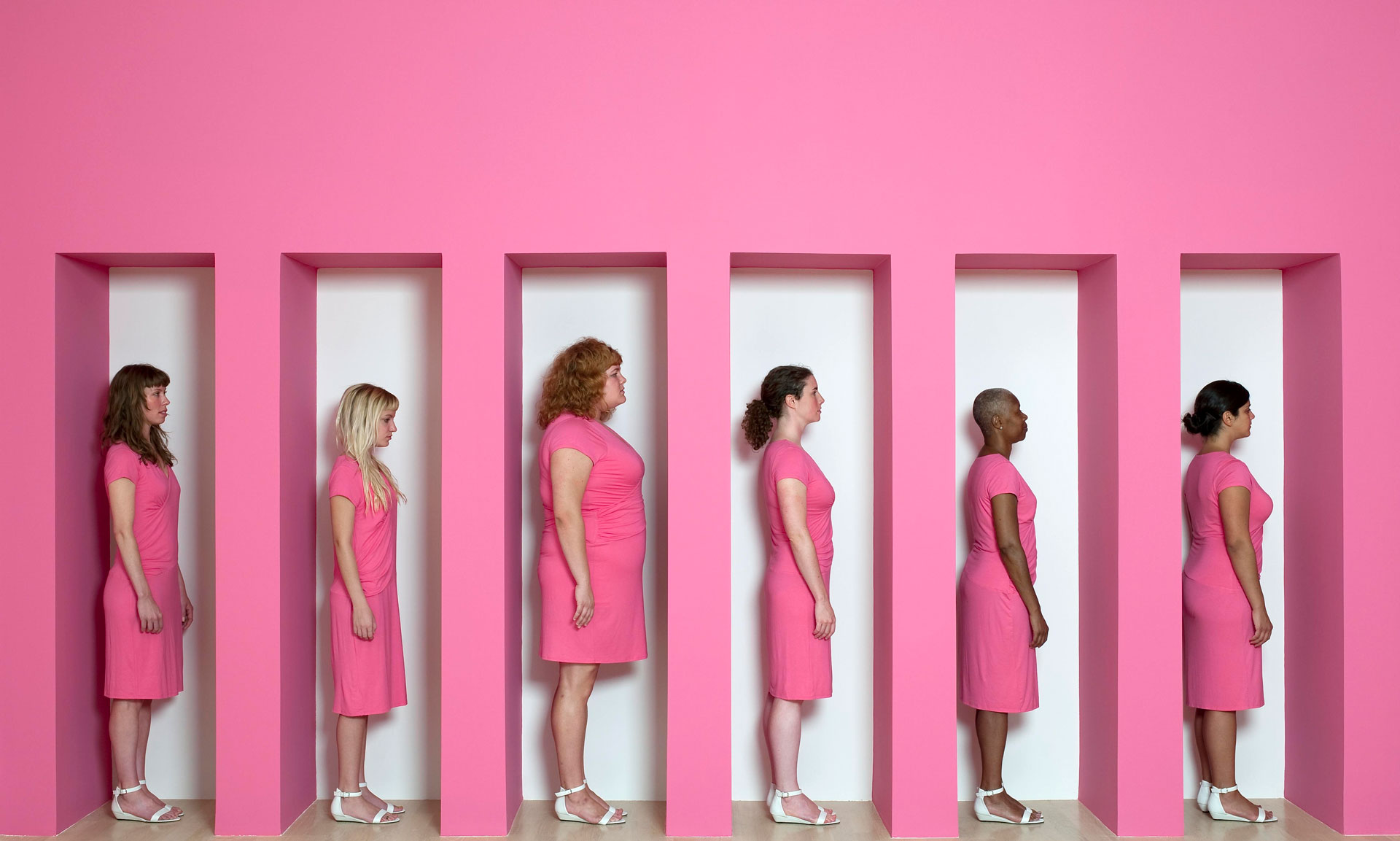
Kate Gilmore, Wallbearer, 2011. Digital C-print, variable sizes. Courtesy of artist.
NC: Oh, I’m so messy [laughs].
KG: I’m sure your process is really messy, but your pieces are so beautiful. There’s something so flowy and gorgeous about them. I don’t see them as messy and it’s interesting that you’re attracted to that aspect. Maybe that’s where the performance is starting to grow from.
NC: I think that’s where the performance lives. The messiness has always been in the collaborative work I have done through the years. I love collaboration because it inherently gets messy. When you’re trying to make a piece with someone else, you can’t go to what you know or what’s recorded in your muscle memory. It’s kind of like working with your left hand, or maybe better working what is uncomfortable.
KG: Were you a dancer?
NC: No. I danced a lot when I was little and then puberty hit. But Roma, my 16 year old daughter was dancing a lot, I was just sitting through so many hours of ballet class. But I’ve always been attracted to dance. When I was in grad school, I did costumes for a couple of dance performances at Tisch [School of Arts], and it was one of my favorite things I’ve ever done. So I kind of wanted to go back to that and that’s how dance resurfaced in my work.
KG: I do think the costumes you make are probably more messy than your sculptures. Like, the rips and ties and this weird bonnet in 46 Gordon (2025-26).
NC: Yeah [laughs]. I love the costumes. The bonnet is Madonna’s, from Borderline.
KG: Have you listened to Madonna’s new album? It’s like a revelation.
NC: I know, it’s really great dance music. When I was making the costume, I told the dancer wearing it that it was in reference to Madonna’s hat from Borderline. They had never seen the video so I had everyone watch it. Do you remember this video? She spray paints a bunch of Greek sculptures and then the photographer’s fancy car, kind of making her own mark in history. He is okay with her spray painting the sculptures, but the second she touches his property [laughs]… Anyway, that’s why the hat was there.
KG: I would not have gotten that, but I like it. What’s the music you used for that piece?
NC: We’ve used a lot of different music. I really love it when we pull in Alice Coltrane, but that’s hard because it is such a given. For the past two pieces, we have had a live cellist.
KG: Do you want to do more costuming?
NC: Yeah, I love it. And I love your costuming. I was going back through some of your images and you’ve always done such a good job with costuming.
KG: Thank you. I mean, I’m sort of in a sweatsuit stage, because I’ve been trying to understand gender in a different way – where we are and what it means.
NC: Can you speak more about that? I’m doing my first non-dance performance piece this fall in an exhibition at September Gallery about literature. The dance performance has been based on Virginia Woolf’s A Room of One’s Own, so Roma and her friends have agreed to do a live reading of this book. This text/lecture was written almost 100 years ago and I wanted to explore the idea of them reading it at this particular moment in time where their rights are being diminished, a century after it was written. It feels needed, creating a space to emotionally feel the impact of Woolf’s words and political agendas.
KG: So they’re going to be in the gallery reading?
NC: It’s going to be a five hour live reading at September Gallery, as part of September Sometimes on September 19th. I’m very excited to dress them [laughs]. I’m going to pull from some of the dance performance outfits.
KG: What’s their vibe?
NC: I don’t know. It will be three of her friends who are studying acting and then I’m going to try to get maybe three other students from the area who are in the same age group. Virginia Woolf is hard to read and even more so to read out loud.
KG: What else is going to be there?
NC: There are many interesting artists and works. There will be a beautiful Taylor Davis text drawing. I always love showing with her, we had a very committed collaboration for 7 years, Davis,Cherubini. I am making a kissing bench that the performance will take place on, and then there’s a small viewing room in which I’ll project the dance performance 46 Down Below from my show Hotel Roma this past winter (2026). But, truly, the part I am most excited about is dressing them!
KG: The dressing is hard. I’m always thinking about the formal stuff, like the way the garment matches or goes against the sculpture and such, but I also have to think about who I want the audience to think the performers are. I don’t remember anyone’s name, but I always remember what they wore. So much of the way we analyze a person is based on seeing them and what they’ve decided to wear. So you have to decide on who the audience is going to see.
NC: Yeah, I know, because they become characters. Signifiers, really.
KG: I’m trying to think of an artist who does this really well. But even when you look at someone like Rick Owens [fashion designer]… he is so performative but also expensive, but not in an Upper East Side way. And then his wife, Michelle Lamy, is so fabulous looking. Have you seen her? You would love her. Is there a performance person you like in that sense or anything you look at in terms of costuming that you’re really drawn to? Or even in fashion?
NC: The performance work I’m the most drawn to and spend the most time with is the 1970s work by artists like Carolee Schneemann, Hannah Wilke and Ana Mendieta. And then I also think a lot about Leonor Fini and all of her crazy outfits. There was a lot of weird performance art going on in Italy at the end of the 1960s and early 1970s that I look at often too. But then fashion wise, for the past year I was kind of obsessed with Pucci.
KG: That makes a lot of sense.
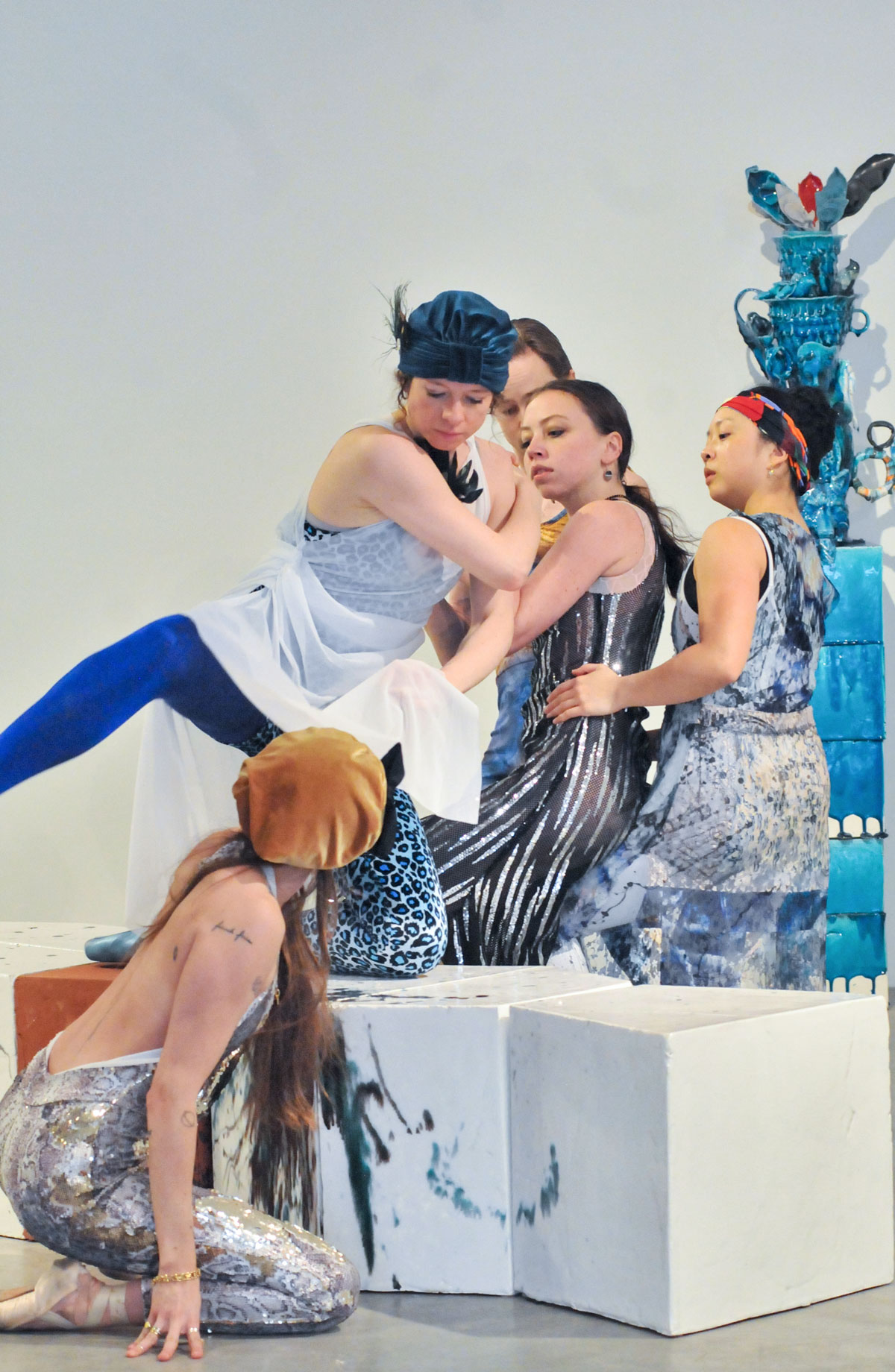
Nicole Cherubini, perfomance during Hotel Roma exhibition at Friedman Benda Gallery, 2025. Courtesy of the artist.
NC: It’s just an unbelievable repeated pattern that you can’t figure out, not even in the repetition of it. And it just gets better and better the more patterns you add to the mix. A Pucci outfit just gets better and better the more one combines different patterns and articles of clothing, it just gets more layered and dense. You almost lose the sense that it’s a pattern, if that makes any sense.
KG: It really does. Do you ever perform?
NC: No. But I think of giving an artist talk as a performance. That’s about the best I can do.
KG: It is a performance. I used to love it and now I hate it. I’ve stopped doing the traditional ones.
NC: Me too. It’s awful. Once I started seeing it as a performance, I’ve gotten a little better at it. But I hate doing it.
KG: So what do you do now?
NC: I usually script something. Sometimes I’ll talk about an interest of mine, a topic or idea I often think about, and I’ll go deep down into it and write about it. And then I’ll just throw in images of my work. I’ve been to so many artist talks and it’s really hard to make them interesting.
KG: I feel that performance people are at an advantage because they know how to control the space in the room. I try to make it as interactive as possible, because I’m so sick of hearing myself talk and I am more interested in what people want to know. But I think I could get better with it.
NC: Like, opening it up to questions?
KG: Well, yeah, just encouraging more of an engagement in some way. Maybe laying out the chairs differently, having a conversation… We’re stuck in these modes of doing things in a way we’re told we’re supposed to do. We do the talks the way we’re supposed to do. We do the gallery system the way we’re supposed to do. We do education the way it’s supposed to be. There’s an advantage in being a grand dame, a big mama of the art world. I’m not, but I’m all up for being one in a sense. Because maybe then we have some control to change the way things are done altogether, you know?
NC: Yeah. I am constantly trying to think of how I can do things in a way I can enjoy them and that actually puts forth what I’m trying to discuss.
KG: But I think you’ve always done things your way. You’ve shared work with a lot of different people in a lot of different places. I remember one time you apologized for not having seen me in a while because you “had been mothering”. I loved that. You have this clear understanding that life actually dictates a lot of things. You’re not blinded by the art world ambition.
NC: Well, the system the art world operates by wasn’t created to include many people.
KG: But also every time you talk to a New York artist, they’re always so, so busy. Everyone’s in their studio working so hard for hours and hours. And you know what? They’re actually not, they’re lying. All my friends are artists and they’re not working all the time. They’re wasting a shitload of time on their fucking Instagram or out drinking. Or they’re dealing with their lives – their kids, their dogs, whatever. I understand being an artist means we’re always working in a way, but it doesn’t mean we’re like painting all the time.
NC: Sure, that’s not the way we work. All the non-working and the other things going on in our lives are what become part of the work. These things actually make the work richer and give it more depth and life.
KG: Yes, we’re not robots, we’re not in a corporate system. So, if I don’t want to go in the studio for a week, I’m not going to go in the studio for a week. Over Covid, I didn’t go to my studio for a year and a half. It was terrible.
NC: I know. I didn’t work at all during Covid either. I couldn’t.
KG: I mean, we had to deal with Covid and a shithole as president. Real stuff that was happening in the world.
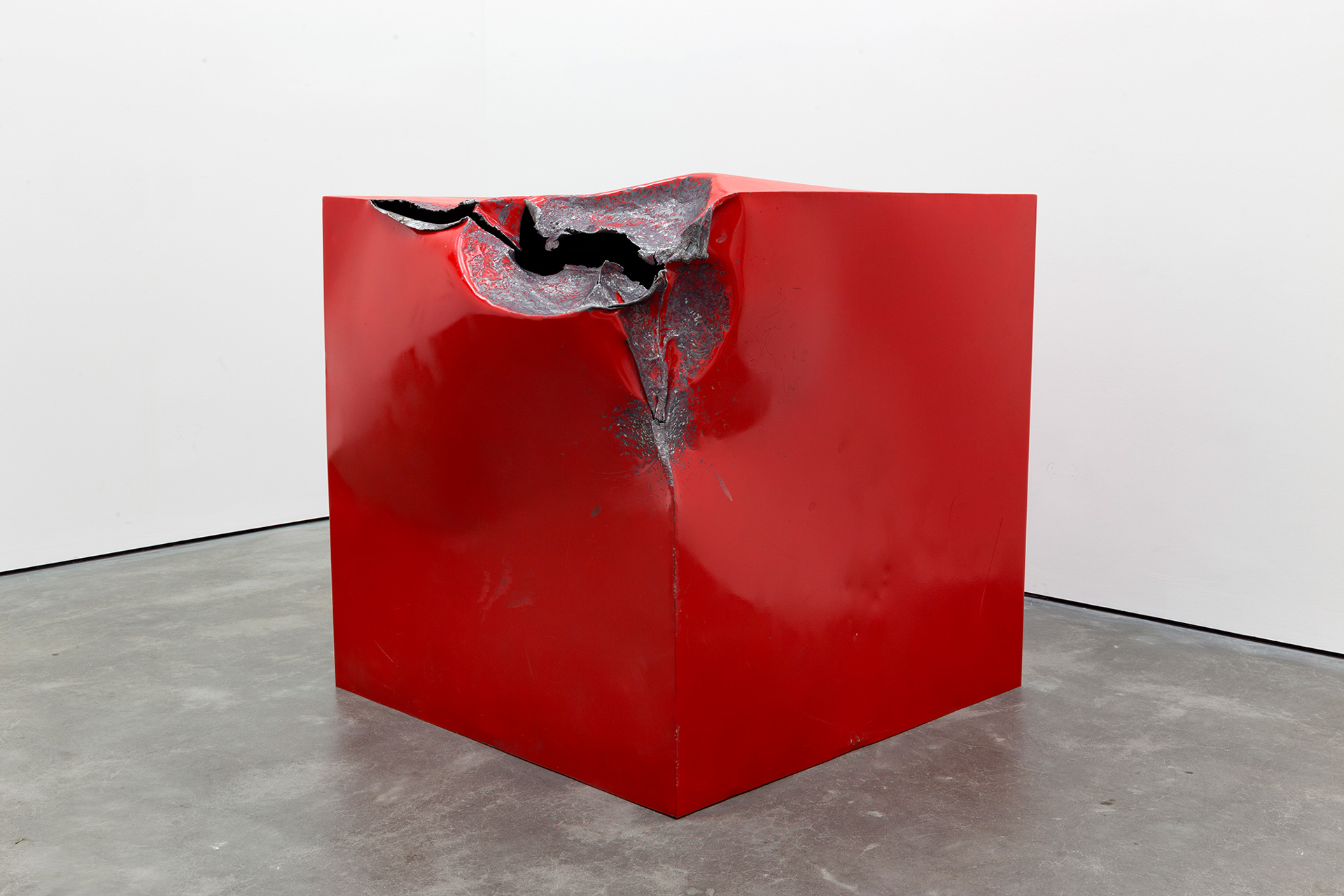
Kate Gilmore, Bend, Motherfucker, 2017. Steel and enamel, 36x42x36 in. Courtesy of the artist.
NC: I have a question for you. How do you think moving up to the Hudson Valley has changed your practice? I’ve been thinking about this a lot since I moved back to the city.
KG: I don’t live up here full time, but my studio’s here. I’m going to be honest, it’s not ideal. It’s great in terms of size – it’s a big space and I can’t afford that in the city. But because I’m not here full time, I don’t have access to it all the time. And also I realized that I am so inspired by different people of different ages speaking different languages. Just stuff happening and all the different colors, the shit, and the mess of the city. So it’s been really difficult. But it’s been great to move my things out of storage and to save money and do big stuff. What about you? You’ve been up here a long time.
NC: I was up here full time for ten years and then I really needed to get back to the city for much of what you’re talking about. I felt life had been snapped out of me. Even just walking around Soho and going into stores and looking at fabrics and the way colors are in a space… But production up here is so much easier. If it didn’t cost as much as it cost in the city, I’d love to be producing there.
KG: But you would prefer to have a larger studio there.
NC: If I had a larger studio and the kilns and everything… I just got a new studio in Brooklyn and it’s really beautiful. I need to spend my working time in the city for the next two years. Roma is a junior in high school, I need to be here with her as a single parent.
KG: And can you have a kiln in the city?
NC: I can, but it is in no way big enough or equipped enough to make large-scale sculpture. I’m getting less and less attached to actually constructing the clay things. Especially with the benches, they are not that much fun to make – they are so physical and they’re exhausting. I might be getting too old [laughs].
KG: Pay someone else to do it. That’s the way it goes.
NC: Yeah. And I actually get a lot from watching people do it and seeing how they’re handling the material. But, I think when I first got up here, I really loved it because it actually allowed the marketplace to leave my studio, which was really nice. And then I kind of needed it back to some degree. Or I just needed the city back. I love the city. I so love New York.
KG: I know. God bless New York, in every way. And you don’t really have to do that much in the city to be inspired. You can sit on a train or walk down the street or go down Soho, like you were saying. I live in Jackson Heights which is such a diverse area and I love the aesthetic and the understanding of the vastness of what culture is that it gives me… When I’m up here, I don’t think about performance that much, I’m mostly making sculptures, but the second I go into the city I think about performance a lot because the city is a navigating space. It’s kind of one enormous installation where each neighborhood has a way of functioning and people are the core of it. So it’s interesting that you started doing performance when you went back to the city.
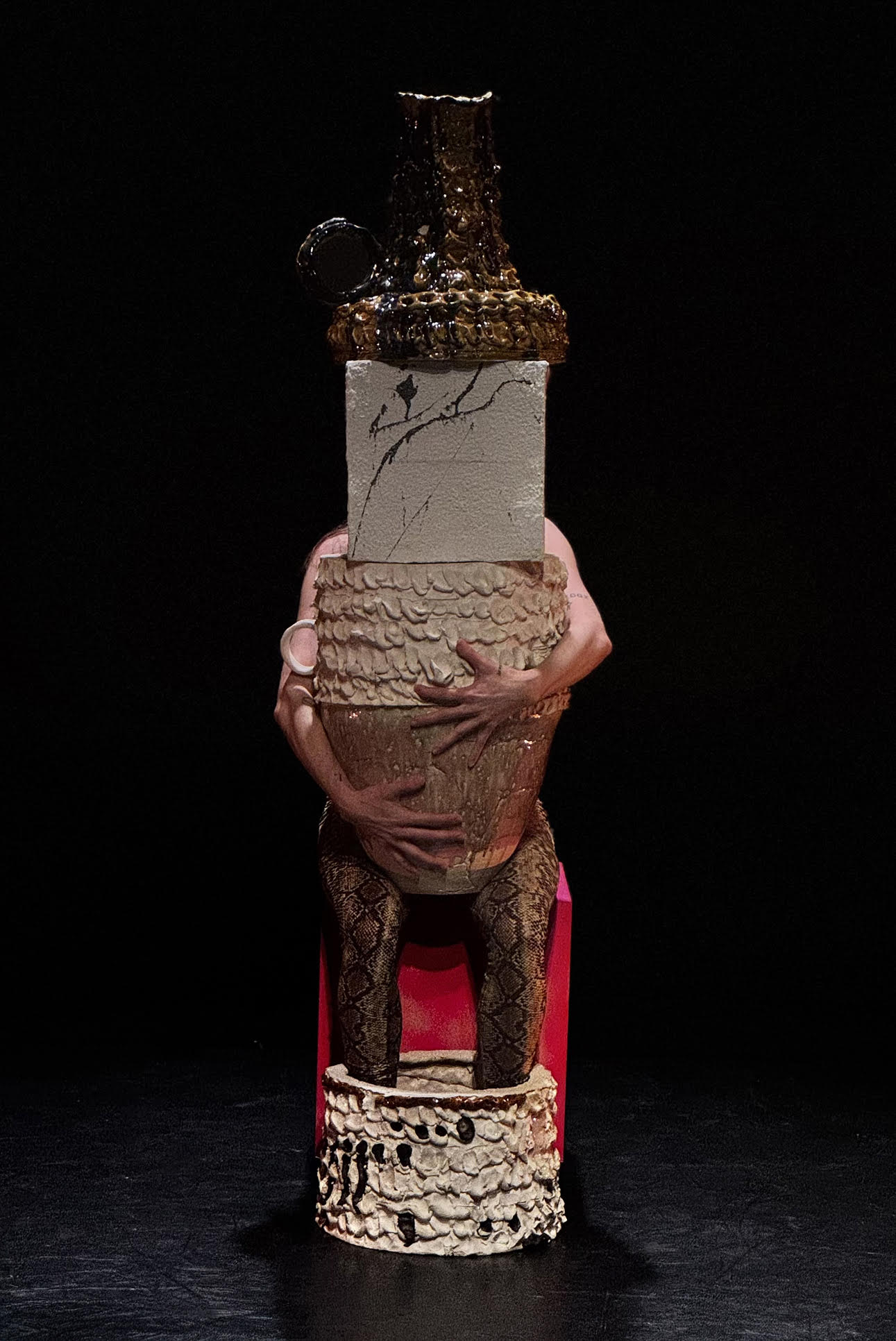
Nicole Cherubini. 46 Gordon at the Mark O’Donnell Theater, Brooklyn, New York. 2025. Nicole Cherubini, Julia Gleich. Dancer: Amber Neff. Courtesy of the artist.
NC: But I also think this decision came out of my years of collaborative projects and realizing the time spent together was usually more valuable to me than the actual production process or what became of it. That’s what I love about performance. It becomes a relationship between you and a collaborator and then it turns into a relationship with the audience.
KG: So you’re not dictating what the performers do? Just setting the parameters and the core?
NC: I do a lot of work with the choreographer, Julia Gleich, and we talk a lot about the feelings and ideas we’re trying to put through. I’m there for the whole process, her movement expertise and my use of physical space.
KG: Have you ever done something without a choreographer?
NC: No, but I would love to.
KG: I would be curious to see what your work would look like without a choreographer. Without sound too. You’ve been through all the process: the rehearsals, the object making. I think you could do a performance without the choreographer – I mean, I know you love her.
NC: I like the challenge.
KG: I don’t know, but actors and dancers are hard to work with, because it’s all about how they’re being seen – they’re always acting. When you work with a performance artist, it’s a very different move. There is an ‘everydayness’ to someone who’s not necessarily trained in acting or dance.
NC: And it goes back to the idea of beauty and cleanliness we were discussing. The dancer is safe to get on that sculpture because they know what to do and they know what’s behind them. They know how to exist in space. And this has taught me so much more about how one exists in space, how an object exists in space, and how we relate to objects in space. That’s just what sculpture is.
KG: That’s true. Anything that engages with the body and the making of something has a level of that, but sculpture inherently has much more of a performative element than painting, for instance, because this object is automatically a body.
NC: And then the viewer has to walk around it.
KG: Your stuff is scary to walk around. At least for someone with a bull in a China shop energy like me. I am terrified. I’m always so aware of my body, controlling it, which is not a natural state.
NC: [Laughs] That’s what it’s all about. So you’re mostly working on sculpture right now?
KG: Mostly sculpture. It’s a mess, but I realized that the mess looks exactly like the sculpture. I have to find a way to discern the wrong mess from the right mess [laughs]. I would like to do some of the performance stuff again – the bigger performances, but they’re expensive and they need space and support. And, as we know, the art world is really into showing flower paintings right now.
NC: They are! Brightly colored.
KG: I was once so annoyed by this. Now I get it. People are so terrified with everything that’s going on and maybe they just want to look at that. It’s so dark right now.
NC: It is really dark. Maybe people just need a little pleasure.
KG: Do you feel art has purpose?
NC: I do. I think it’s to get us out of that. What I’ve come around to is that creativity is our only way out of this darkness. And, not to sound totally cheesy, but engaging the energy of creativity can actually bring people together and make them see beauty. I think we’ve lost beauty – that’s really what it comes down to. We have created a culture that has taken away the power and importance of beauty.
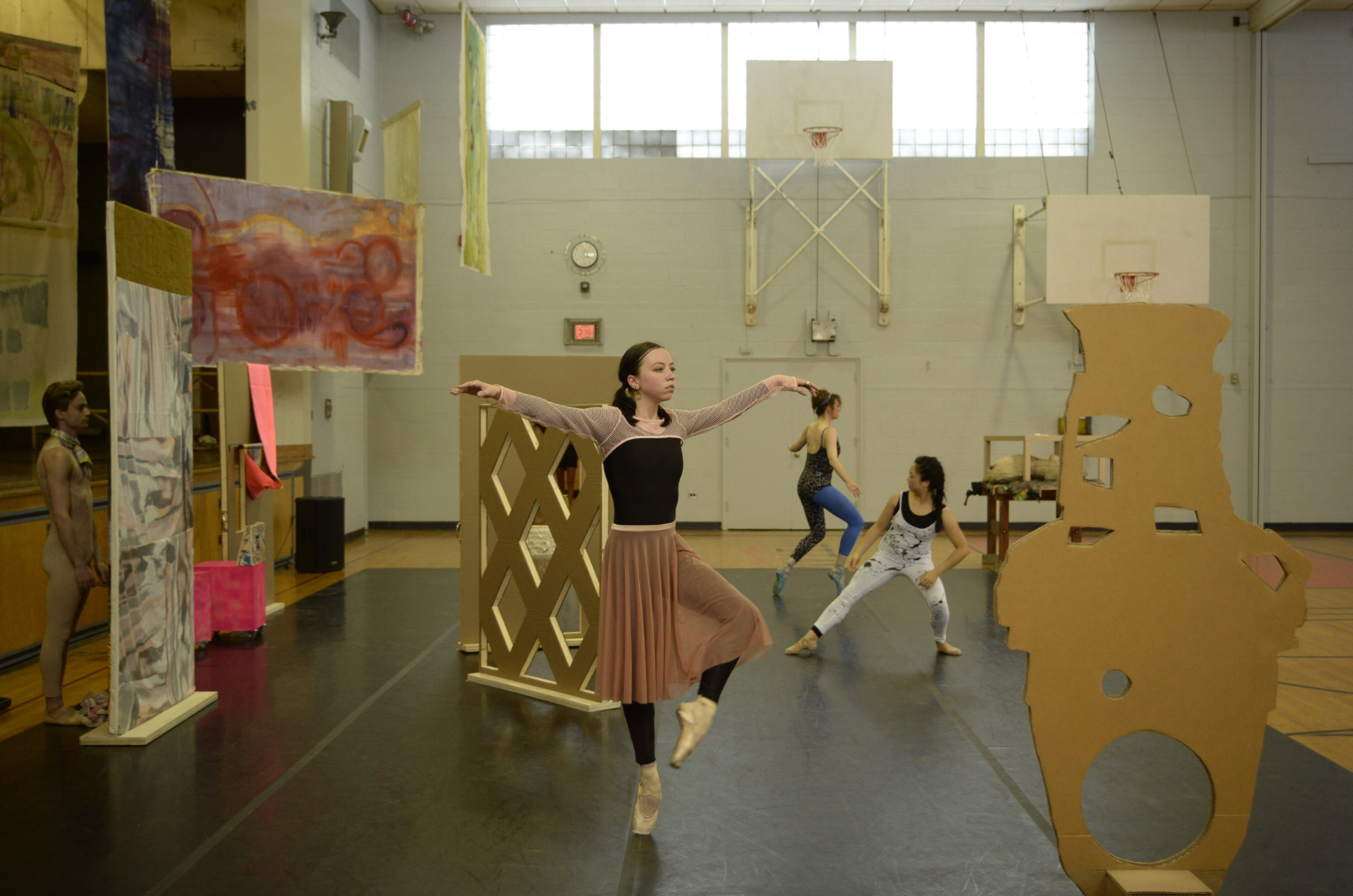
Nicole Cherubini, 46 Gordon at The Campus, Hudson, New York. 2025. Nicole Cherubini, Julia Gleich.
Dancers: Michelle Buckley, Kara Chan, Annie Freeman, Ethan Schweitzer-Gaslin. Courtesy of the Artist.
KG: Yeah. And I would add it has taken away the power and importance of emotion too. – when engaging with art and creativity, I mean. And that’s something you can’t replace. The thing is, there’s so much cruelty everywhere, I don’t even know if the beauty or the emotion does penetrate anymore.
NC: I don’t know either. It’s been such a systematic, long process of taking this away from us that people don’t even know how to access it. That’s what scares me the most. People don’t even know that this is important or that there is a way out. Going dancing helps though. I go out dancing all the time.
KG: Oh my God. Where do you go?
NC: Well, I’m a huge Prince fan, so I’ve been going to a lot of Prince dance parties in the city. It helps a lot, actually. I think dancing changed my life.
KG: I love that. Good for you. This is what Madonna’s album’s about! Dancing.
NC: Yeah. When I was going through a truly rough time, I literally started dancing for 30 minutes a day in my bedroom. I put on a fancy outfit – you know me, I love my gowns – and I would just listen to music and dance. I did it for 30 minutes anytime during the day, every day, and it changed my body and my mind. It changed my soul.
KG: That’s amazing. What made you decide to do that?
NC: I just needed a serious change and some enjoyment and that was the only thing I could think of. It made me happy when I did it.
KG: Do you still do it?
NC: I do. Not as religiously as I used to. But it really changed me.
KG: What do you mean?
NC: It just gave me freedom back.
KG: That’s beautiful! And, you know, bringing fantasy to real life is so important. I love that you dress up to dance. And that actually makes a lot of sense when you think about your early work.
NC: Yeah. I feel like the new sculptures are more exquisitely dressed though.
KG: That’s a good way to put it. There’s a classiness to everything you do in the most awesome way. I love it. I want to be classy at every moment. I just don’t know how to do it.
NC: What a nice thing to say. I always think of it as overriding the Italian-American mess, you know [laughs]. Oh, we need to head to the train station now.
KG: How long did we talk for? Let’s get going.
To learn more about Nicole Cherubini’s work: @nicolecherubinistudio // friedmanbenda.com
To know more about Kate Gilmore: @katehgilmore // kategilmore.com
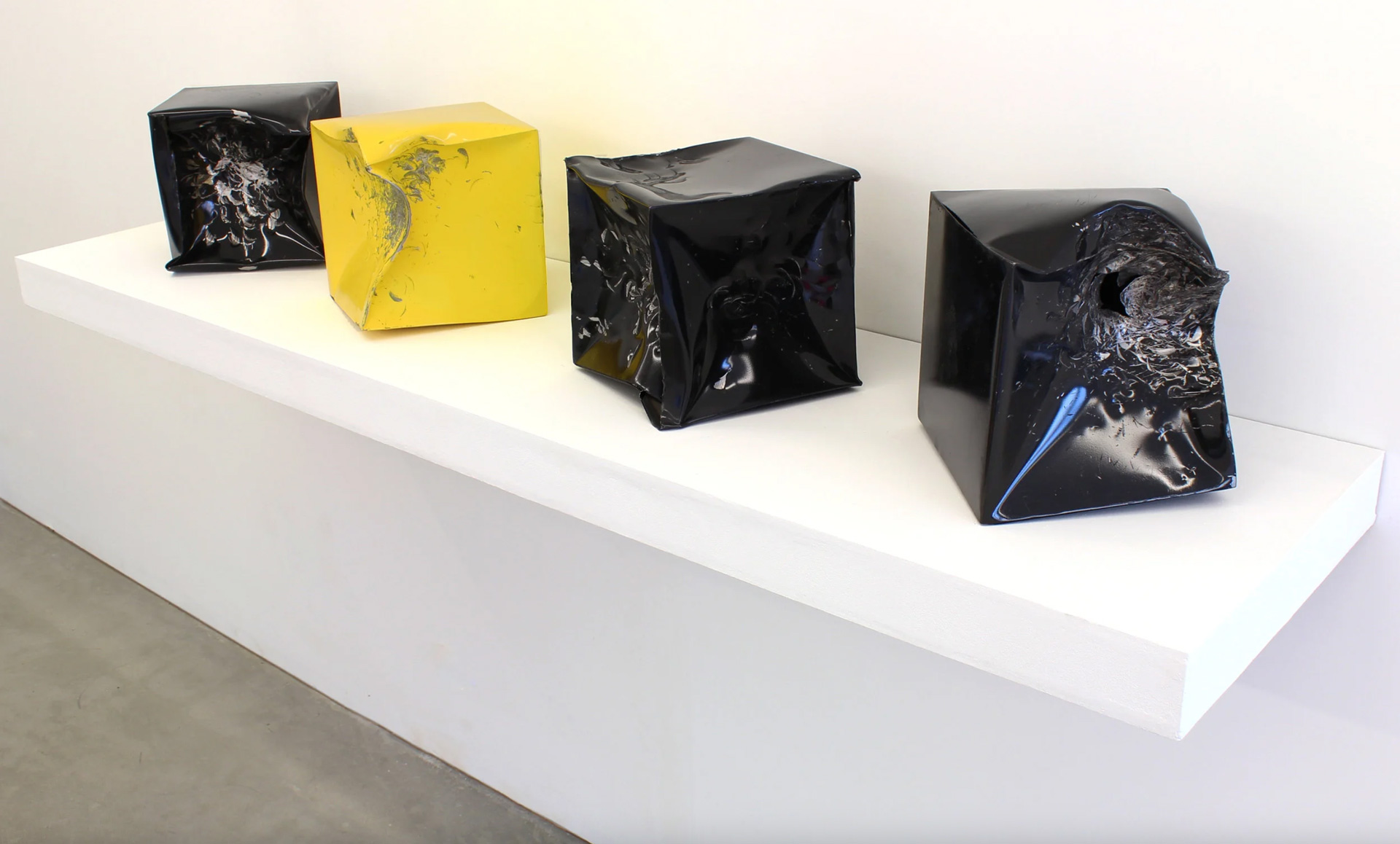
Kate Gilmore, Morning Rage, 2018. Steel Sculpture. Aspect Ratio Gallery (solo exhibition), Chicago, Illinois. Courtesy of the artist.
Photo: Pierre Le HorsPierre Le Hors. Courtesy of the artist.