Juliana Cerqueira Leite: What have you got going on right now?
Clare Celeste Börsch: I recently created a site-specific artwork in a church – a big fine art installation. They gave me a production budget and I spent all of it and didn’t pay myself anything, which is why I really need my commercial art commissions. [laughs]
JL: I like that within the same practice you get to have a commercial branch and a more fine art branch. Maybe it’s not fair the way I’m categorizing them…
CC: No, I think it’s fair. I mean, there is a difference. But sometimes I don’t even know if you can necessarily see the difference. When I look at my portfolio, for example, I love the installation that I did for Cartier so much. I like it as a fine art piece.
JL: Yeah, it’s very beautiful.
CC: I’m really happy with it. Sometimes the commercial gigs feed the art practice. I learn stuff and it’s also fun and can be creatively satisfying, you know. The creative team for that project was awesome. But then there’s a fair amount of the commercial work where I feel like I’m just kind of recreating works I’ve already done, but that allows me the financial stability to do more experimental work which is nice. But it also means that I don’t really fit into the art world. Although I just found out I was invited to the Cheekwood Artist-In-Residence Program in Nashville. I have family there and I love their artist roster, which has lots of people I’ve been following since my 20s and whose work I really admire – some of my heroes. And then I was like: wait, me? I’m so excited.
JL: The old imposter syndrome.
CC: I’m sure you get this too. Like, oh wow, I’m in this company? That’s amazing.
JL: I often feel like someone sent me the wrong invitation. But that’s very exciting.
CC: Yes! The large installation in the church was the last project I worked on. It was such an unusual and beautiful experience to create an installation in that setting. I spent a lot of time with the Reverend, who was incredibly kind and had such a gentle presence. She actually reminded me of a Buddhist monk I met when my father and I used to visit a monastery in São Paulo.
JL: Are we talking about Monja Cohen?
CC: I think so, yes.
JL: She’s super famous in Brazil.
CC: Oh wow, yeah, her! This Reverend had a very similar presence and it was amazing. The artwork was only up for three days as part of an artist festival and it was very much inspired by this woman called Hildegard von Bingen, who was this German mystic.
JL: She was a nun, wasn’t she?
CC: Yes, she was wonderful. They actually held the church service around my installation, with music and an organist playing throughout. The sermon was about nature, our relationship to the natural world, and the ecological crisis, it was incredibly moving. And then I spontaneously asked them if I could stand up and read the text that I’d prepared for the art piece, in German. So I read my essay which was all about our connection to the natural world, portals and thin places in the landscape, the material and immaterial and the self and the external and how these boundaries become porous. It was a beautiful moment in this tiny German medieval wine village. And then the photographer ghosted me and never sent me any photos [laughs]. So I just reinstalled it in another church outside Berlin. Luckily I’m in Europe and there are churches everywhere. So that’s what I’ve been up to. How about you?
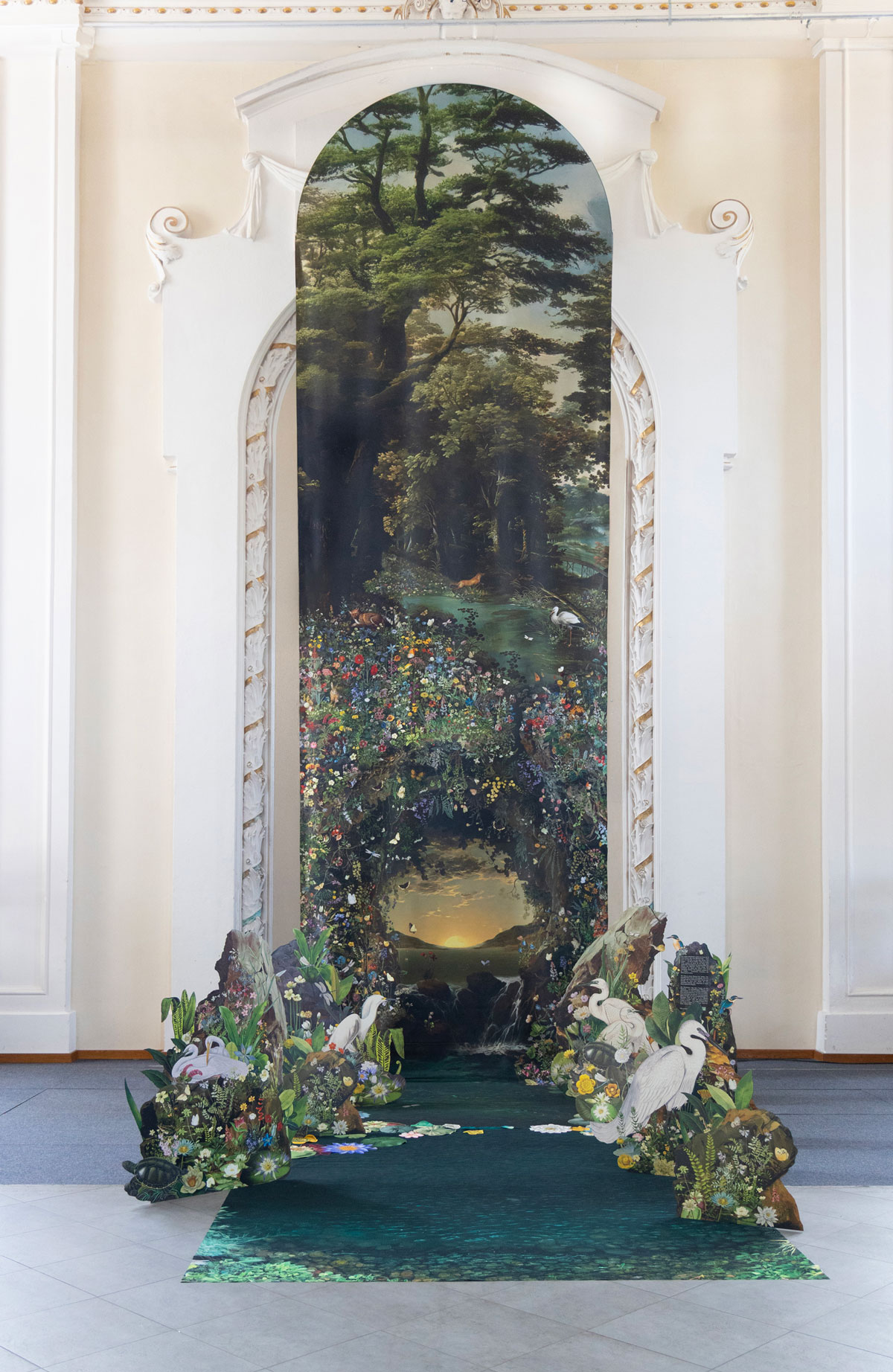
Clare Celeste Börsch, Viriditas, Kunsttage Winningen, Germany, 2026. Commissioned by Kunsttage Winningen. 12-meter, double-sided printed fabric installation suspended within a twelfth-century church. Courtesy of the artist.
JL: Ah, that all sounds really amazing! Here in Brooklyn I shot a film this weekend.
CC: Wow! Tell me about it.
JL: It’s a 16mm film. I shot another one a couple of years ago called Labor – I don’t know if I showed it to you. I put little lights on the index fingers of four people who worked assembly line jobs and had them reproduce their movements from memory.
CC: Oh, I haven’t seen it.
JL: I have to send you a link. So now I just shot the continuation of that body of work, so the new film is about office work. This whole cycle is based on research I was doing about a couple called Frank and Lillian Gilbreth. Do you know them? Did I tell you about this?
CC: No, tell me.
JL: So they generated long exposure photos in the late 1800s/early 1900s of workers in different contexts, mostly industrial but also clerical type jobs and then eventually housekeeping. And the whole goal of these photos was to come up with ways to make workers move faster and more efficiently in factories to shave off seconds in the production line. It was in the really early days of mass production, like Henry Ford and Frederick Winslow Taylor days.
CC: Interesting.
JL: If a worker is taking three seconds to do something that used to take them five – bingo, you are now able to produce almost twice as much for the same salary. You’re squeezing more out of the same worker. So there’s this kind of choreography of industrialization. Workers are dissociated to the point they’re actually turning up to work and reproducing a choreography for eight hours that’s been very precisely designed by engineers and industrial managers. That choreography is really interesting to me. And also terrifying. So I’ve been filming those movements and how they interface with office supplies and equipment, even laptops. It’s been enlightening to shoot people who have these jobs, like mail room clerks, typists, and secretarial roles. Everyone was lovely and really psyched about the project. It was so nice to meet people who aren’t in my social bubble.
CC: How did you find them?
JL: I put an ad up on Indeed.com, which is a website where you would look for these jobs.
CC: I’ve had a lot of office jobs I know all about Indeed.com [laughs].
JL: I had about 80 people respond, but I asked a lot of questions before they were brought on board so it was actually pretty natural to filter people out. Some people fell off very quickly, like: this is too complicated for me, I just want a gig [laughs].
CC: And it’s really interesting because these jobs are going to be taken away by robots very, very soon.
JL: Yes, maybe! AI and robotic automation is happening on both ends – office work and the industrial assembly line…
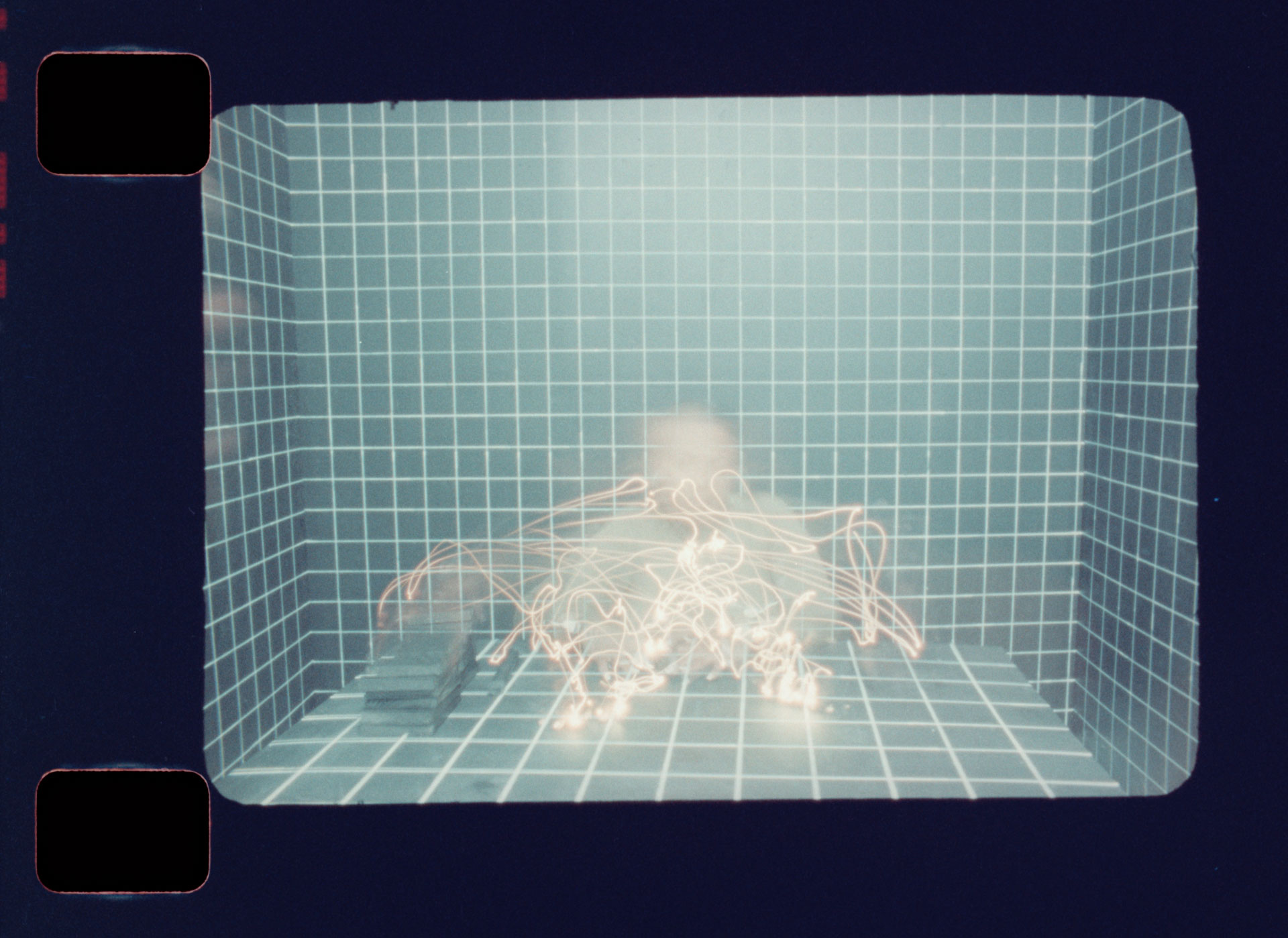
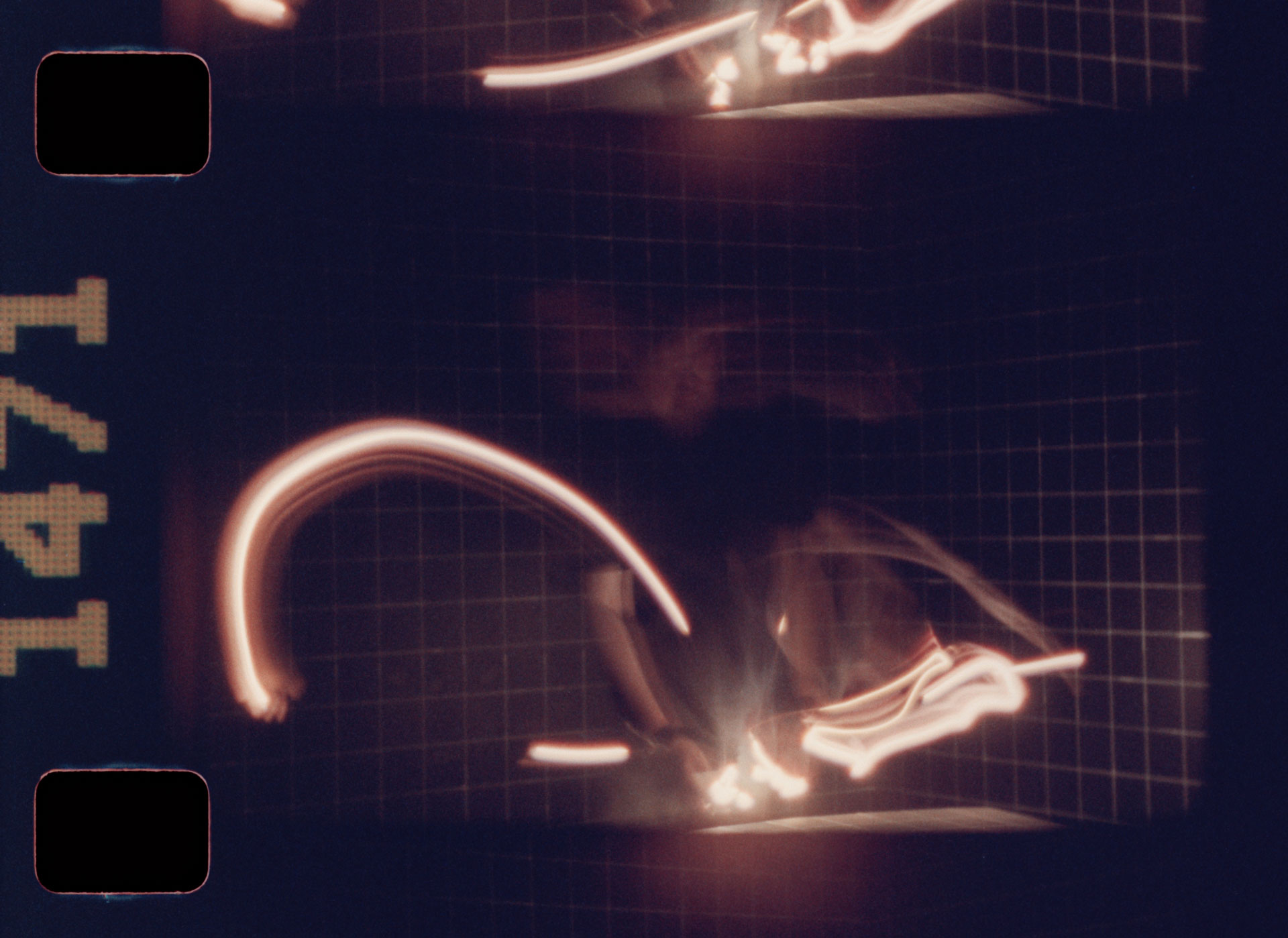
Juliana Cerqueira Leite, Labor, 16mm film. Courtesy of the artist.
CC: It’s so incredible that you’re doing that. I’ve been thinking a lot about velocity these days. You know, I’m self-employed and I’m trying to keep up with things. And there are so many conflicts. I have a hard time reconciling my ambition with the ecological crisis, for example. Like, why am I making all this and helping people sell more stuff? I recently read this book called From What Is to What If: Unleashing the Power of Imagination to Create the Future We Want, by Rob Hopkins, and it’s a really great book, very optimistic, but there was one line that I bookmarked. I don’t remember the exact phrase, but it’s something like: we’re giving away our imagination in service of our own extinction.
JL: Woah.
CC: That is exactly what it feels like to do commercial work sometimes. And, as you know, I really struggled with depression and panic and the reason why that kicked off is because of ecological anxiety. I spent a whole year where I basically stopped making art and slowed everything down, but that was a very bad financial decision.
JL: I think you became very uncomfortable with every job that you were finding.
CC: Every single job. No matter what, and it can get really paralyzing. During the time I was depressed, I remember having this urgent, almost desperate feeling that we needed to stop and slow down. And now that I’m back on my feet, I’m working and I feel myself getting whipped into more and more speed and more velocity. It’s almost like it has a force of its own, a forward propulsion. In some ways I’m happy because I’m reaching goals I wanted to reach, but at the same time I’m yearning for slowness. Maybe I’m romanticizing, but I’ve been thinking about times in my life when things felt different and slower. I mean, not surprisingly, these were chapters in my life that were pre-smartphone.
JL: Oh God, I remember how resistant I was to getting a phone in the beginning. Why would I want to have something that is essentially trapping me, forcing me to be available to my parents or whomever? Why would I want people to be able to know where I am? And now it’s such an essential tool.
CC: And it creates and maintains a permanent sense of urgency in me. I really miss slowness. And these two aspects are very intrinsically connected. We all contain so many paradoxes though. Sometimes I really want to slow down, but then I’m ambitious and that implies a certain velocity and forward motion.
JL: What I realized is that if you slow down, the world doesn’t fall apart. I was feeling really burnt out in 2023. I had just come off the back of a solo show in New York and was dealing with some extremely difficult personal challenges, and I had a solo show in Spain and only two months to produce it and it was just so stressful.
CC: Two months? Oh my God.
JL: I remember coming into that borrowed studio in Madrid, a city where I barely knew anybody, and I would just stare at the wall for three hours before I’d be able to do anything. I was feeling so unproductive. And this was also when everything kicked off in Gaza. All this horrible shit was going on in the world and I also had some very difficult things going on… I just did not have the mental bandwidth to process what was happening because I was expected to be productive. When I finished making that show, I postponed my next one by a year. Like, I need a fucking break. I called it my sabbatical, I needed to stare at a wall and stop making work for a while! It was so frightening to take my foot off the gas pedal, but when I stopped pushing so hard, I was really amazed by how many opportunities came my way.

Juliana, Wash Hands, 2023. Jesmonite, steel, glass fiber, burlap, pigment. Photo Roberto Ruiz. Courtesy Prats Nogueras Blanchard.
CC: It’s such a smart move, though. Because when you did that, you opened up space for something.
JL: Yeah, I started writing more and actually submitted my writing to an academic journal for peer review, I was reading more, thinking more about what I wanted to do, reaching out to people and trying new things and this started to generate some kind of space or energy. Suddenly, people started reaching out to me to do residencies and I was so surprised they had even heard about my work. I also met my fiancée. But maybe it was all because of momentum that I built when I was rushing.
CC: It still lands differently though. After getting over my anxiety disorder, I’m all about acceptance and dropping the resistance to things. It is what it is. And this may sound counterintuitive, but I think the rushing is a form of resistance because you’re resisting slowing down and you might even be a little afraid of radio silence.
JL: At the end of the day, we’re self-employed.
CC: Yeah. The other day I was googling: “how to work with a lot of focus for one year as an artist.” [laughs] I’m not really into woo woo stuff, but when I’m always on and pushing I think there’s something in my energy that comes from a place of insecurity. I feel the need to recalibrate the energy I bring to my work. I’m working with this coach and I recently rewrote my website to position myself as a studio, since I now work with a team, rather than as an independent artist. It was scary, but the truth is if you shift the way you talk about yourself, things change. I needed this shift for myself personally, but eventually it gave me more financial stability.
JL: When you have a yes mentality, it makes you more exploitable. Like: “There’s not enough, I have to say yes even though I have weird, icky feelings about this commission or this person or this gallery.” And, also, I get invited to do group shows and I’m always saying yes, but sometimes I’m not that enthusiastic about the project and it ends up taking so much more energy than it’s actually worth.
CC: It’s so hard to say no. I want 2027 to be the year of…
JL: The year of NO!
CC: [Laughs] I think the year of no sounds a bit negative, but maybe the year of boundaries! When you say no to some things, you make space for other things.
JL: Yeah. But I think it’s also important to get to a place where I’m comfortable being honest when I’m not interested. There’s a certain honesty in being true to your own drive and concepts as an artist. Saying no to things that don’t make sense to you creates space for more truthful ones.
CC: And is also more coherent, right?
JL: Yeah, exactly. Pulling back is not bad. I got to a point where I was starting to resent the ways in which I was expected to work.
CC: Oh, I’m there. When you get hired as an artist, they give you the littlest budget possible and then they’re like: “Go, amaze us!” [laughs] Thanks, no pressure.
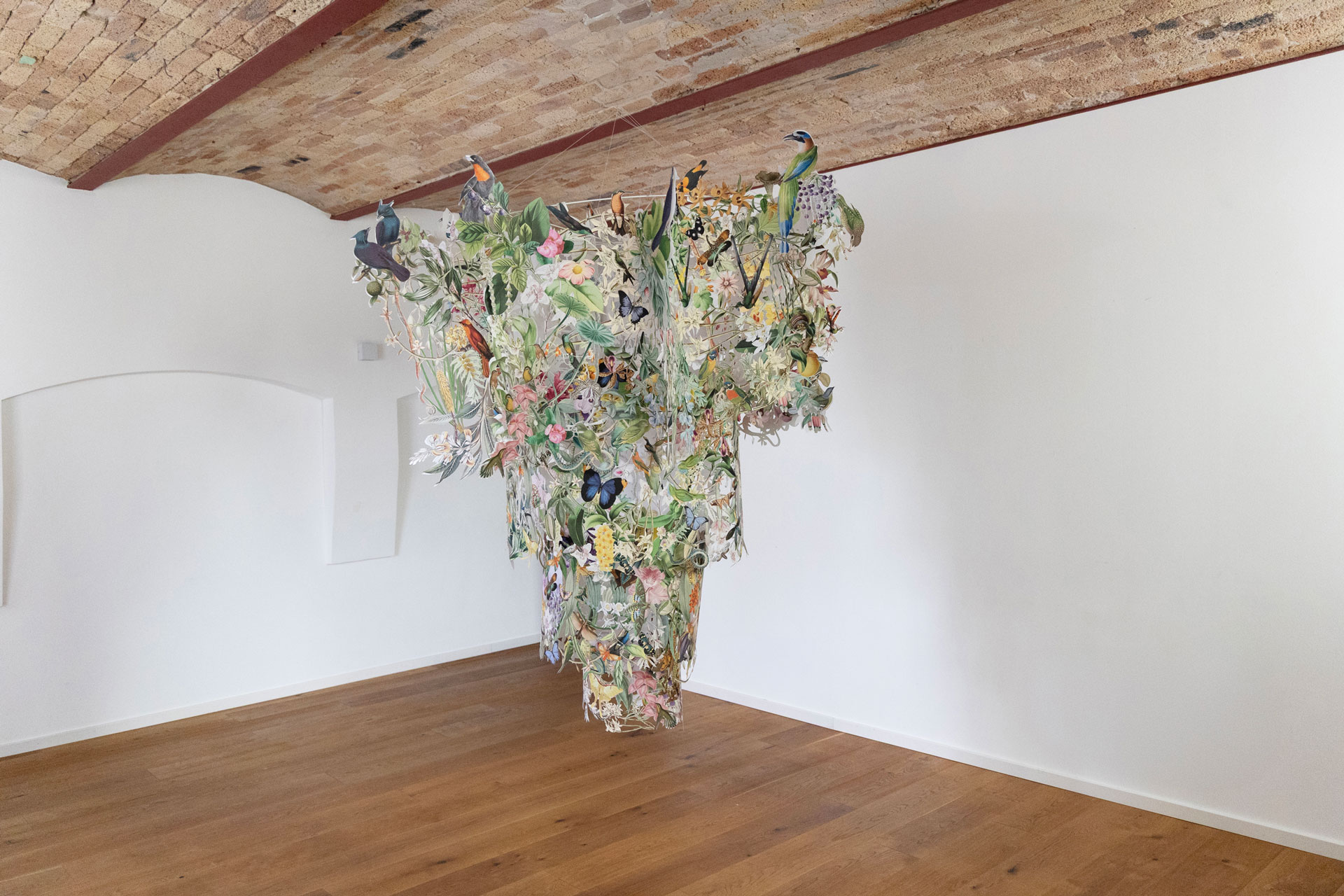
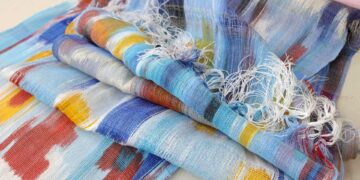
Clare Celeste Börsch, Interwoven. Courtesy of the artist.
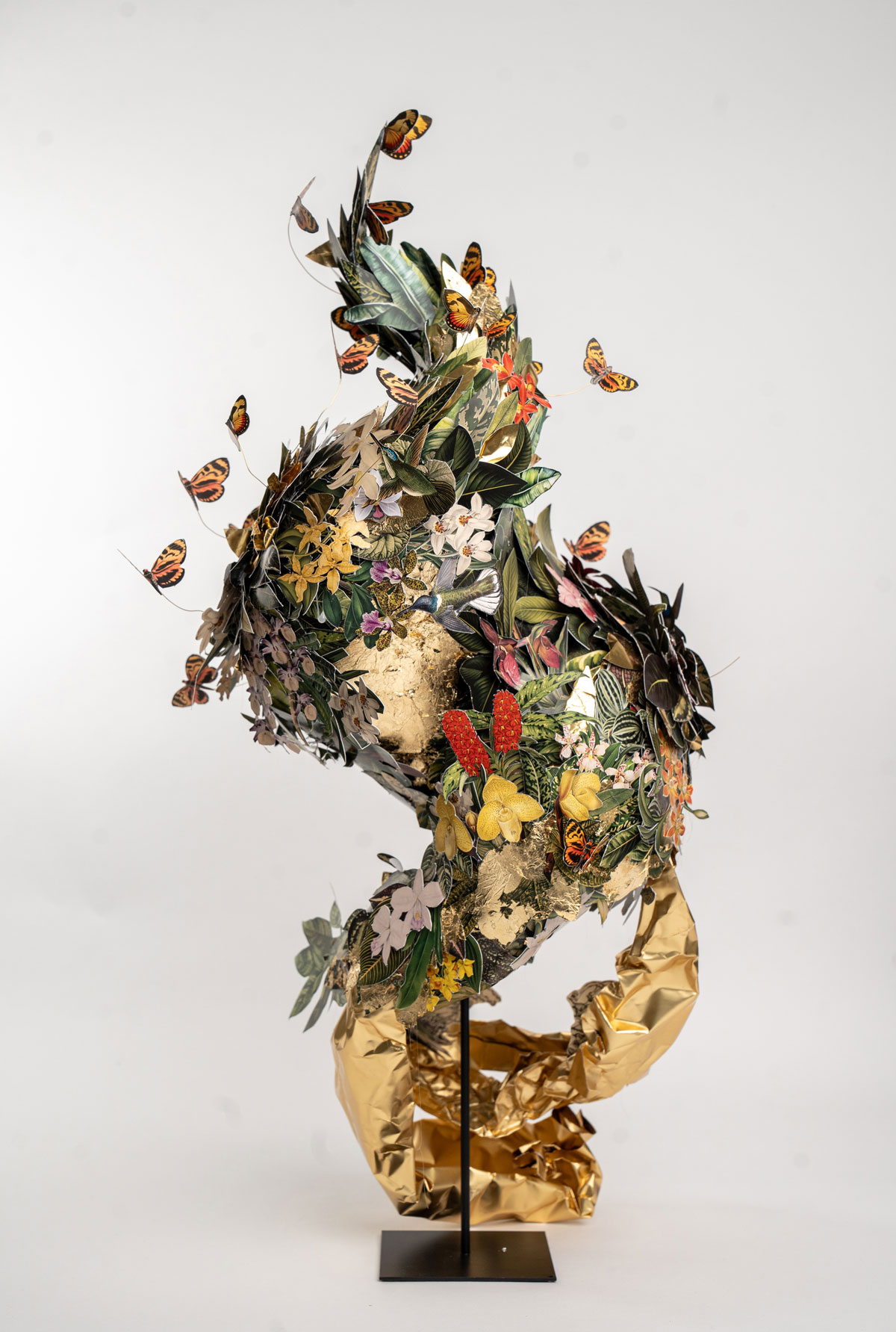
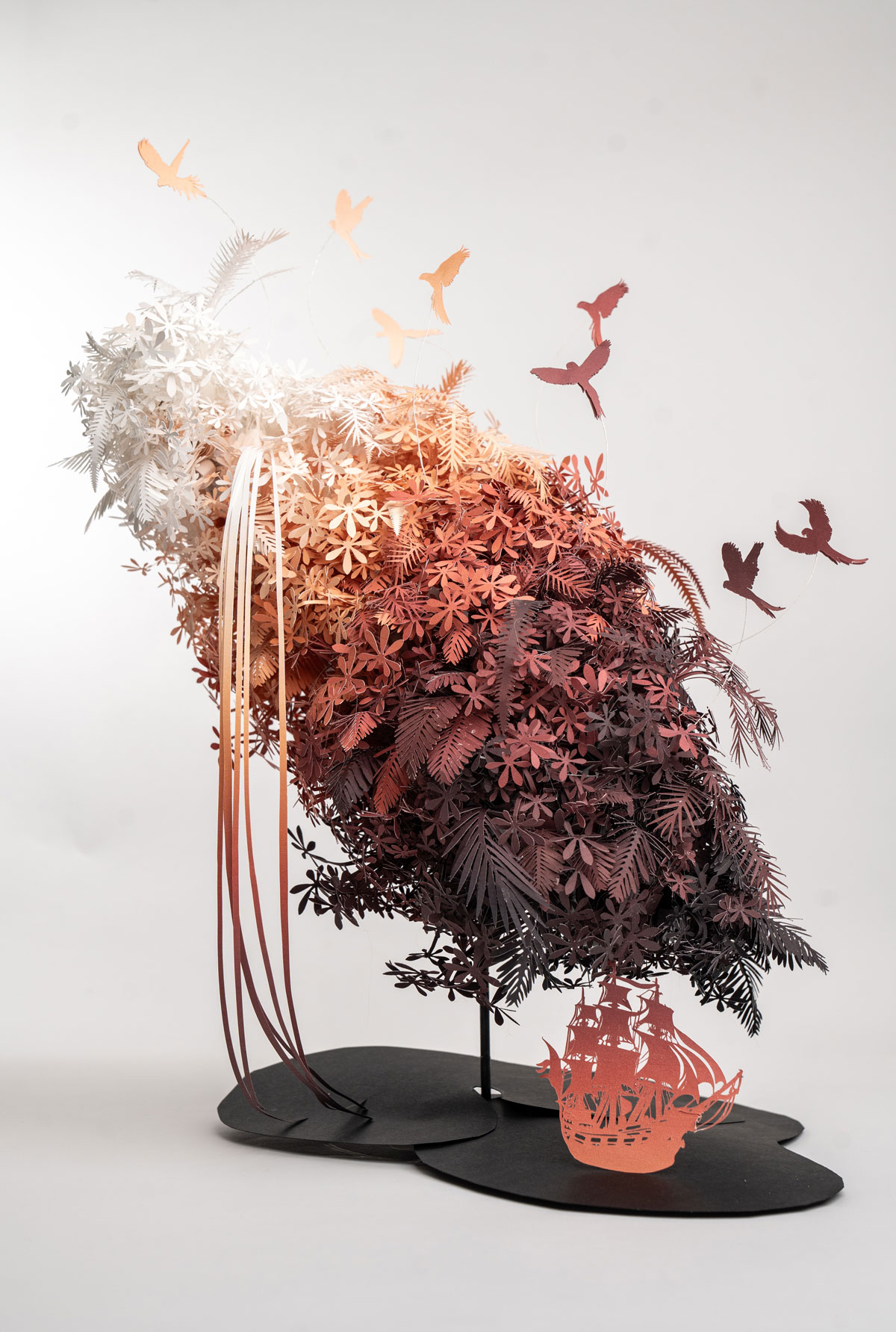
Left image: Clare Celeste Börsch, Plunder I, Right Image: Plunder II. Courtesy of the artist.
JL: In some ways, the commercial side of your work allows you to tap into business structures and self-advocacy. It’s normal practice for a business to have rush rates, for example, right?
CC: I’m getting closer. I am now officially working with rush rates.
JL: Yeah, we all should have that. But it feels like artists have zero leverage.
CC: It does feel like that.
JL: Assuming that this is a business and running it as a business allows you to do that. I once had a gallery take 13 years to return my artwork. I am extremely persistent but it can be so frustrating.
CC: Because I do so much commercial work, I’m used to keeping all my money and am resistant to sharing a high percentage of my revenue with a gallery. I seem to be able to represent myself quite successfully so the need for a gallery has never felt urgent. But, of course, like everything, there’s multiple truths. On one hand, I like how I’m treated better when I have a contract and a client and things are clear and business-like. But on the other hand, I really do miss the freedom I get when I do something purely in the fine art realm, like the church installation. This was the first time in a while that I could be conceptual and dive in and enjoy the artistic process. And it felt like artwork as opposed to briefed work.
JL: The business model of art is really untenable. It’s the auction house and collector that eventually sells the work to a secondary market that really makes the killing. Since last year, when I took that ‘sabbatical’, I’ve been trying to restructure how I bring money into my practice and how I relate to money emotionally. You see a model of what the art world is supposed to be and then you’re supposed to fit into that model, right? Getting a gallery, doing these fairs, maintaining your Instagram, etc. I realized this model didn’t really work for me. I was kind of miserable all the time. And getting towards middle age feeling kind of miserable after 20 something years of work… I couldn’t imagine doing this for another 20! My London gallery closed at around that time, a solo show I did in Brazil didn’t sell much, which was heartbreaking. I thought: “What am I doing with my life?” I started to think of ways to separate myself financially from needing income from my art and how to support my practice without being so reliant on this model. I realized I could get grants and that I felt more creative freedom this way.
CC: I was teaching a class and one of my students said something really smart. She made a case for how it’s really hard when you try to fill a need with another need. For you and I both, I think we make art because we need to. There’s this need for self-expression, but then we have a need for financial stability too.
JL: That’s very insightful.
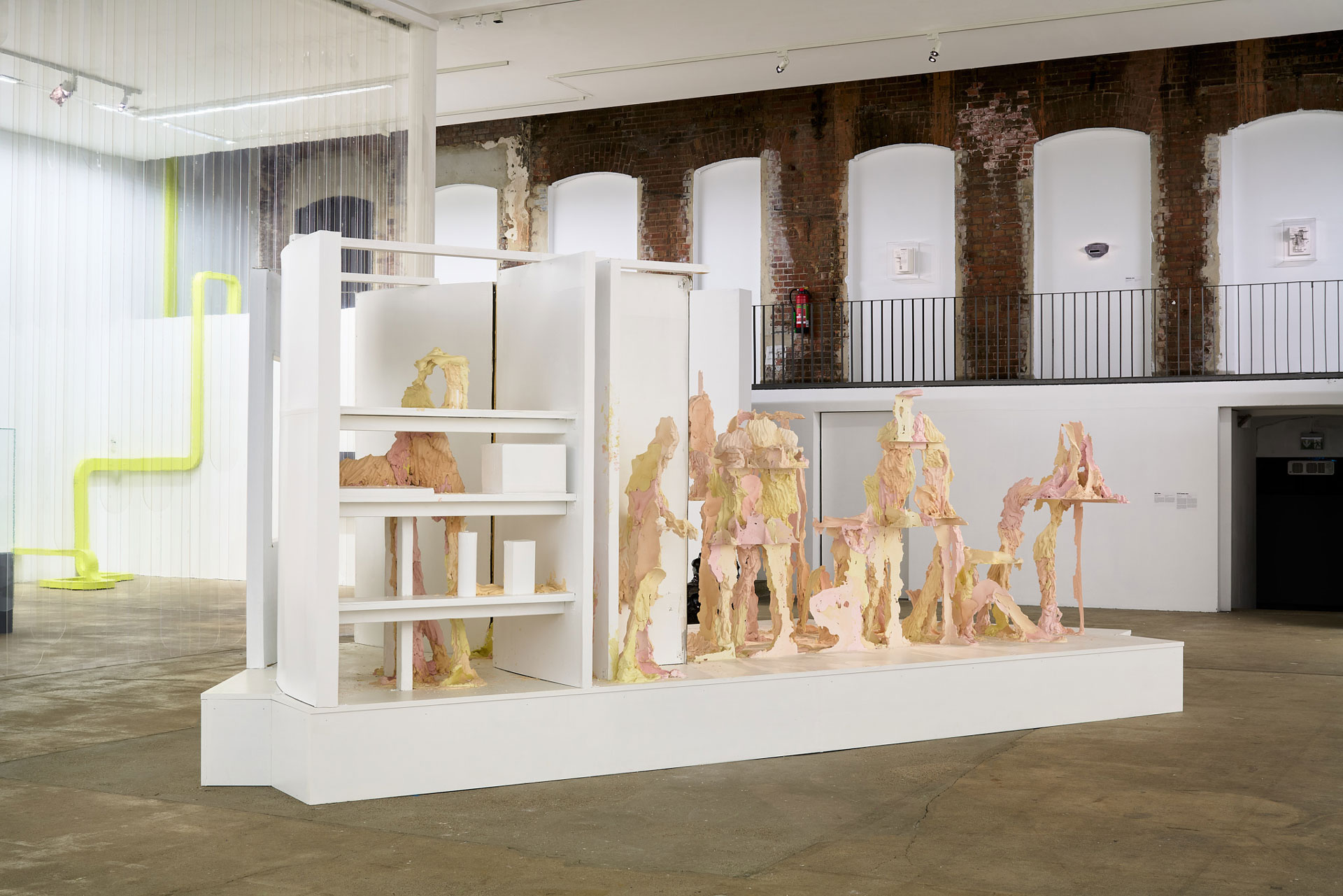
Juliana Cerqueira Leite, SHEE, 2024. Durational, site-specific sculpture, installed at KW Institute, Berlin. Photo: Joe Clark. Courtesy of the artist.
CC: Right? It’s one of the reasons why things get hard. And I don’t know the way to solve this. When it comes to my work and practice, I have this spark in me, this creative drive to make stuff. I’ve had it since I was little and it’s a bit ethereal. I can’t pin it down. And then I gave this ethereal light the biggest backpack in the world and asked it to save money for our retirement. Like, “Do you like daydreaming? That’s cute!” [laughs]. It’s problematic.
JL: Yep. I’ve been reading a lot of artist biographies to see how they navigate middle age and frustrations with the art world, especially women, and I’m finding out that a lot of people stopped working for extended periods of time. Louise Bourgeois apparently stopped making work and was in a deep depression for a decade when she was in her 40s. So many artists have gone through this. I went to visit an older sculptor upstate and he asked me how old I was. I said 45 and he was like: “Oh, that’s such a hard age to be an artist!” [laughs] I felt so seen! Just looking at the past and imagining the future becomes so untenable. How am I going to get old at such breakneck speed, working so precariously?
CC: I changed the way I work and found a production partner because I don’t want to be on tall ladders using my hands all the time. It’s insane.
JL: I’ve recently come to the conclusion that I always want to be involved in making my work. I’d rather work slower and be physically involved in all the steps. Obviously, if I need an engineer or foundry to do certain things, for example, I’ll hire one. But I’d like to be physically involved in all the processes as much as I can because that’s where I get a lot of joy from. I realize that means I can only produce a limited amount of sculptures per year.
CC: Oh, I’m so down to outsource it all [laughs].
JL: [Laughs] That’s great! I’ve realized I’d like to be this old woman who’s still working, but maybe my arms are so weak that people literally have to hold them up while I move my hands! [laughs]
CC: Oh, wow! [laughs] Okay. I want to wear huge glasses and oversized jewelry and just tell folks what to do. [laughs]Honestly, though, my favorite part is coming up with the idea – I love to see the idea and then I love designing it, and then there’s a certain point where I feel I’m done and someone else can finish it for me.
JL: It’s good that you know that. I get the most pleasure from not knowing what I’m doing until it’s done, so delegating is really difficult for me. I find out what I’m doing by doing it, you know? I mostly don’t start off with a preset image, so the process of discovery is what it’s all about. Delegating that would destroy my practice.
CC: You know, every once in a while, I’m lying in bed and I just see an installation in my mind and then it’s like: “Fuck, now I have to make this.” My brain won’t let me go until it’s done.
JL: That’s not how my brain works. That’s so not where art comes from me. In fact, when I get images like that, I’m suspicious of them and I tell them to go somewhere else! [laughs] They’re not for me. My work starts with a question, and it’s usually about how environments are designed to inform me about what my body is – and therefore what I am – and how that changes as we interact with different objects or people. It can also start with a sensation or an emotional state. If I am deeply wounded, what is it doing to my body? How am I curling? How am I bending, distorting, and stretching? That’s where I’m coming from.
CC: I just had this flashback to us as teenagers in high school. I feel you were so grounded. So curious and embodied. There was something very earthy about you.
JL: Interesting. It has always been such a struggle for me to be embodied and I’ve always wanted to be embodied. That’s my goal.
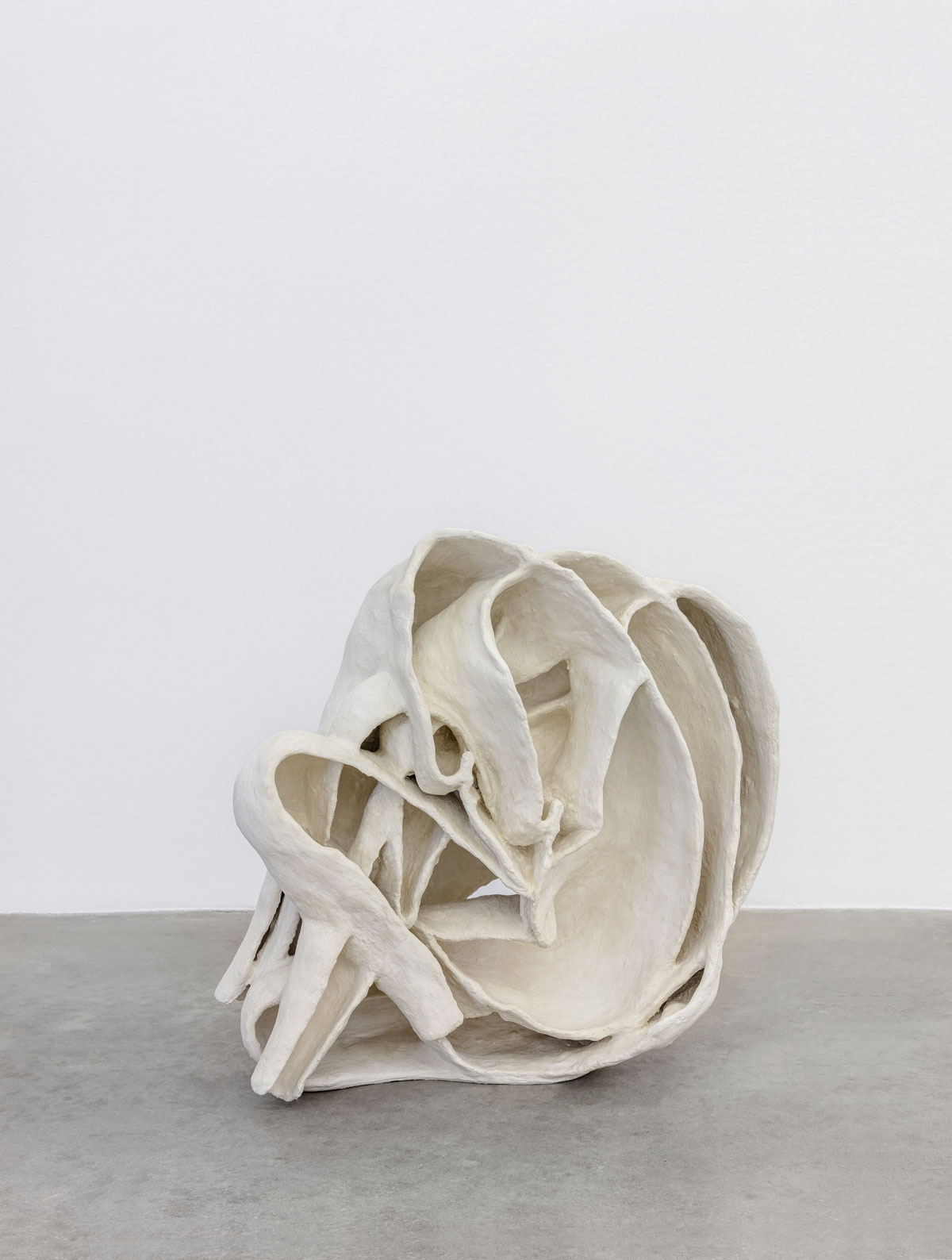
Juliana Cerqueira Leite, Curl 5, 2024. Dental plaster, glass fiber, plaster bandages. Photo Felipe Berndt. Courtesy of Casa Triangulo.
CC: I think you are! And I think it really makes sense that you work with clay and your hands and you’re curious about the process. I was always in my head.
JL: You were more diaphanous. And your drawings were like that too. There were always bodies floating…
CC: Yes! Drawing, man. I don’t do it anymore.
JL: You made such beautiful drawings, and they would just come right out of your head.
CC: Yeah, I was drawing all the time. But I got my confidence knocked out of me in college by this really catty art teacher. There was this guy in the class that could draw without even trying, like photorealistic stuff. He was the class pet. And my stuff is not like that at all. It’s super expressive. I need to find that in me. But, again, this is the problem with speed and velocity, right? I always joke that I have vampire plans and I have my actual plans. My vampire plans involve gettting a PhD, learning how to draw again, learning Japanese, and doing all these things I would love to do.
JL: You’d need an eternal life! [laughs]
CC: Exactly, my vampire plans. But I just don’t have the time and then, I don’t know, I’m not as fascinated by human bodies as I used to be. I used to love drawing people. Now, there are no people at my work.
JL: It’s plants, insects, and animals. In some ways, I have picked my battle and it is human bodies, whatever that means. Bodies – plural. That’s the way it should be said. What is happening to our bodies while we’re staring at screens? It’s very easy to be distracted from our it.
CC: I know. But, honestly, this is so important. The main crisis of the moment is that nobody is in their bodies.
JL: Absolutely!


Juliana Cerqueira Leite in her studio, 2018. Photo: Lizzie Hollins, Courtesy the artist and Arsenal Contemporary NY.
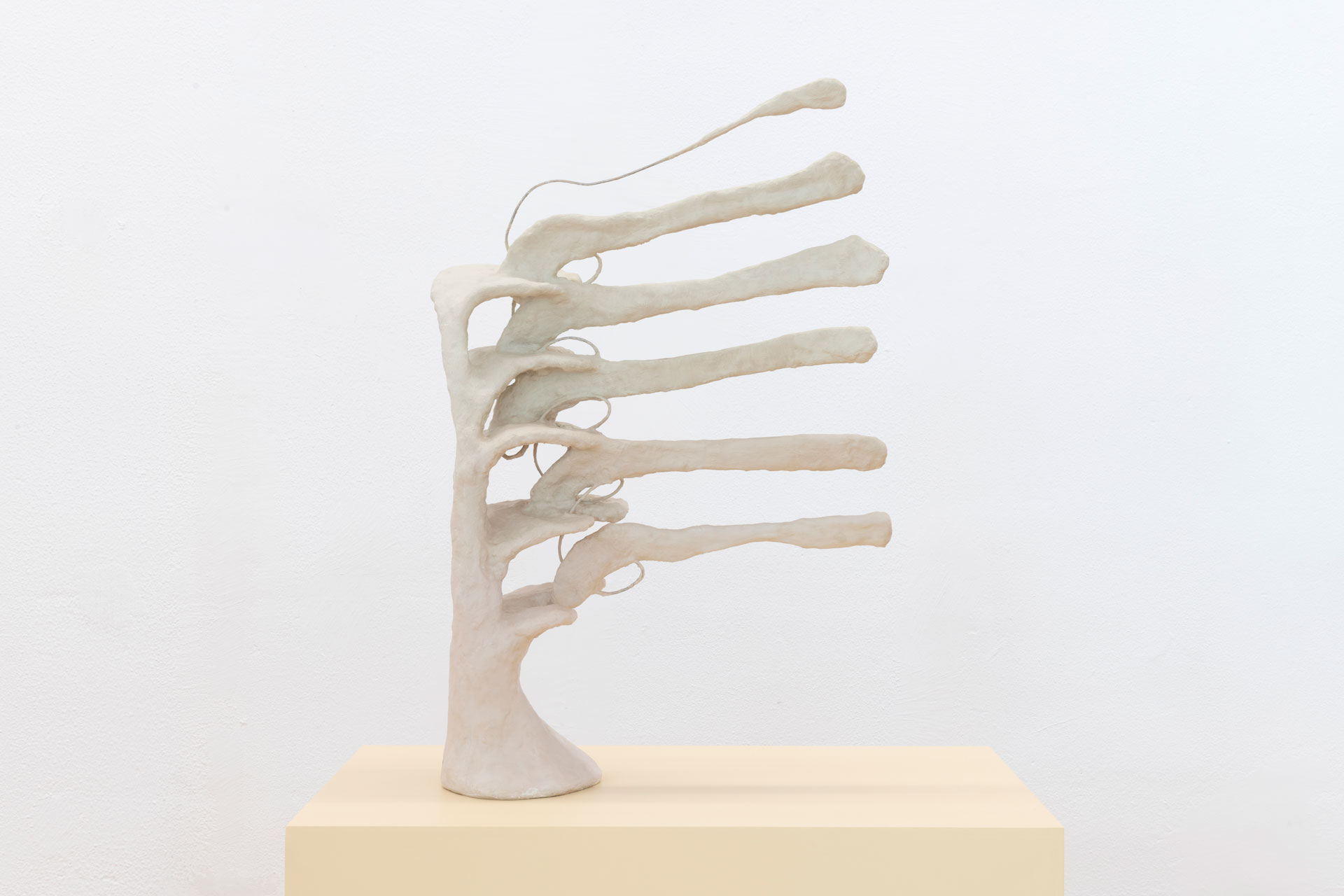
Juliana Cerqueira Leite, Stir, 2023. Jesmonite, stainless steel, burlap, glass fiber, pigment. Photo: Roberto Ruiz. Courtesy Prats Nogueras Blanchard.
There’s a certain degree of privilege in going to live somewhere more natural or rural and still getting to live off of art. Or not, I don’t know. A friend was just telling me that John Chamberlain, the famous sculptor, used to live in a scrapyard because he couldn’t afford to live anywhere else. That sounds kind of awful but I thought “at least he got to make his art there!” I guess there are ways in which artists can carry on through crises, I just don’t know how useful that is in terms of solving anything.
CC: Yeah. It’s interesting. Before I decided to be an artist, I was in public policy and worked for the Los Angeles County Arts Commission in their grants department, supporting non-profit arts organizations. I gave a damn about wanting to make the world a little bit better and I had no delusions of grandeur in that role. Maybe I’m idealizing that time but I don’t think I had the self-reflective moral questioning that I have as an artist. I just felt a little bit clearer. And it was absolutely fine that I was being paid. Sometimes, in art, people think we should do things for free just because we care so much about things. And we do, but people in policy care about making the world a better place and they’re not working for free. That would be insane.
JL: Art is labor. It’s work!
CC: People have to live. Because of that, coming from another sector into the art sector was so bizarre to me. But then, also, am I doing my small part to make the world a little bit better? I can’t answer that question with any clarity since I switched careers.
JL: Maybe there’s something more direct about policy too, right? It’s actionable. With art, we engage politically by appealing to reason, to the senses, to emotion, and empathy. It feels like a much less direct process.
CC: Maybe it’s a soft power.
JL: Yeah, when it works, it can be phenomenally powerful. It can be community building, action building, inspiring at its best.
CC: When I got to do the installation at the church, I talked a lot about the biodiversity crisis. And there was this quote, I’ll paraphrase it: “a species goes extinct twice – once the last of its species dies in the wild and the second time when it’s forgotten.” The piece I made mentioned this endemic butterfly from Winningen that is going extinct because of climate change. It’s called Parnassius Apollo and it’s super specific to this tiny piece of land and people really love it. It was so meaningful to me because while I can’t stop the actual extinction, I can make sure that we remember this butterfly in this church. This one woman told me I was building a memory ark. And I was like: yes! The world is vanishing in front of our eyes and we really underestimate how much of it is gone.
JL: All the biodiversity.
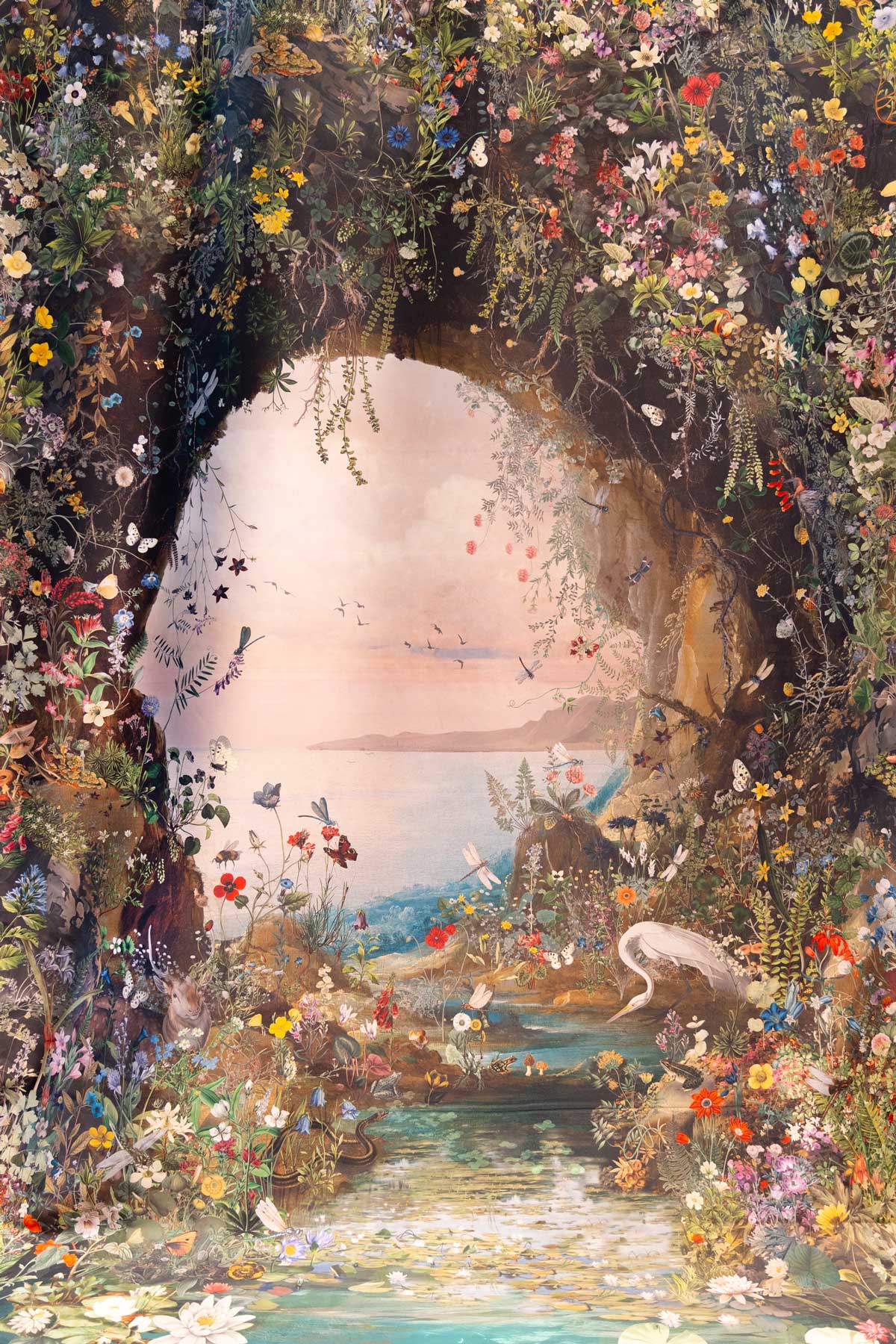
12-meter, double-sided printed fabric installation suspended within a twelfth-century church. Courtesy of the artist.
CC: I’m making portraits of a world that no longer exists. It’s lush and full. Many of the illustrations I base my work on are pre-Industrial Revolution – they’re all from the Holocene, not from the Anthropocene. And it was really nice to be able to actually slow down and talk about that, especially in a church. People felt really connected to the message. These days I’m trying not to worry too much about anything, but I do worry that my work has the opposite effect and people think this world still exists and that I’m giving everyone a really false sense of security and abundance when there is none of that anymore.
JL: As opposed to realizing we’ve never been somewhere that diverse in our lifetimes. I never feel more present and embodied than when I am hot, muddy, and wet, covered in leaves and bugs. You’re in dialogue with life on all surfaces. It’s so beautiful. For most people, that level of immersion is repulsive or unattractive.
CC: I remember driving back to the city from these trips to the jungle, in Brazil. It was just so sad to fade into this industrial sprawl after being in such a beautiful place.
JL: We were probably going through Cubatão. Wrapping up our conversation, if we were back in our teenage years hanging out in the art room at school, would you have imagined that 20 or 30 years on we’d both be making art and talking about it?
CC: Oh my God, I think we would be so proud of ourselves.
JL: Me too.
CC: I think our teenage selves would be very taken by the adults we have become. I don’t know if I would have been surprised, but I’d be excited and happy to see the work that we’re doing. When we were in high school, there was the São Paulo Biennale and Judy Pfaff, the American sculptor, came. Do you remember this?
JL: No, I wasn’t there.
CC: Oh yeah. So I met her and her absolutely gorgeous artist assistant boyfriend in Sao Paulo. My sister and I very vividly remember him [laughs]. Anyway, my dad got me and my sister to come to the São Paulo Biennale before the opening and watch her and all the artists install. I remember wishing one day to be part of something like that.
JL: The São Paulo Biennale was such an important element in me wanting to be an artist. There are works that I remember so well: walking into some of Cildo Meireles’ installations, or seeing Louise Bourgeois’ work for the first time, or Helen Chadwick’s chocolate fountain. I will never ever forget those experiences. It felt like there was this whole world out there, and that was lifesaving for me.
CC: Yeah. Our high school was so constrictive and square and we didn’t quite fit in, so the world felt very small. And even when we got out into the world, the party scene was also sort of self-revolving and a bit destructive.
JL: There was something brilliantly creative about the rave scene and the way people, our friends, would organize parties and forest gatherings. At the same time, there was an underlying sense of despair because there was not enough financial support for the arts locally, the support you need for creative people to be able to grow. When I’m away from Brazil, I feel things are way harder for me, personally, but at the same time I’m constantly pushed to develop and I have room to grow. Sometimes leaving home may be the hardest and best thing to do.
CC: I’m from everywhere and nowhere [laughs].
JL: I know. When people ask me where you’re from, I say you were born in Thailand.
CC: I’ve finally made peace with that question because I used to get really nervous when people asked me that. Do I list everywhere? They would get so bored. So now I just say I’m from everywhere and nowhere. And people seem to accept that.
JL: I love you, Clarita. We’ll talk soon. Thanks for doing this with me.
CC: Thank you, Ju. Tchau!
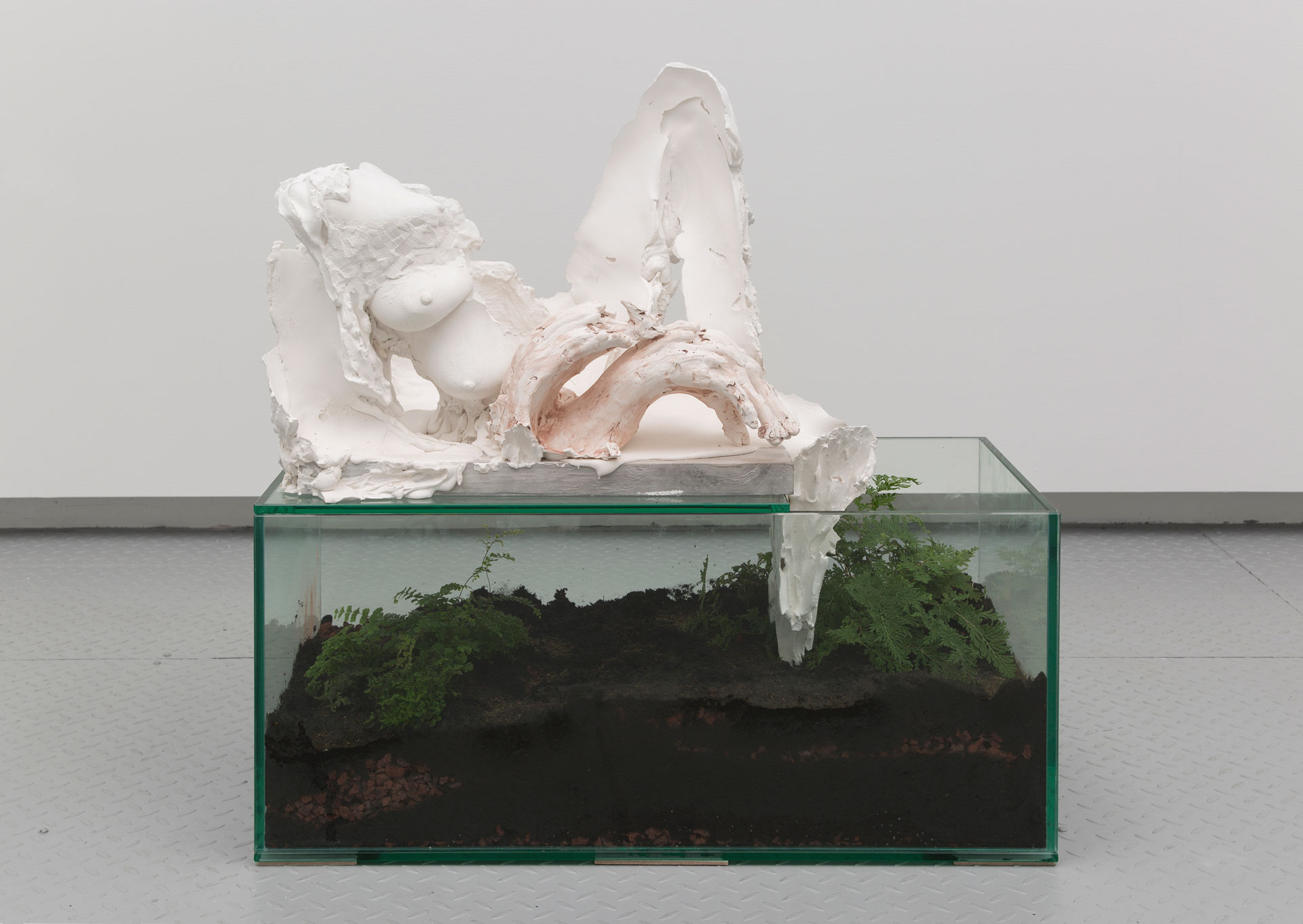
Juliana Cerqueira Leite, Urn 4, 2018, Hydrocal, clay residue, steel, glass, live terrarium, pigment. Photo: Greg Carideo. Courtesy Arsenal Contemporary NY.
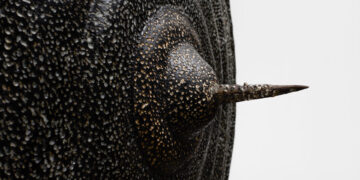
Hero image: Juliana Cerqueira Leite, installation view Outras Simetrias at Casa Triângulo Gallery, São Paulo, 2024. Photo: Felipe Berndt. Courtesy: Casa Triângulo.
To learn more about Cerqueira Leite’s work: @julianacerqueiraleite
To know more about Clare Celeste Börsch: clareceleste.com // @clarecelesteart