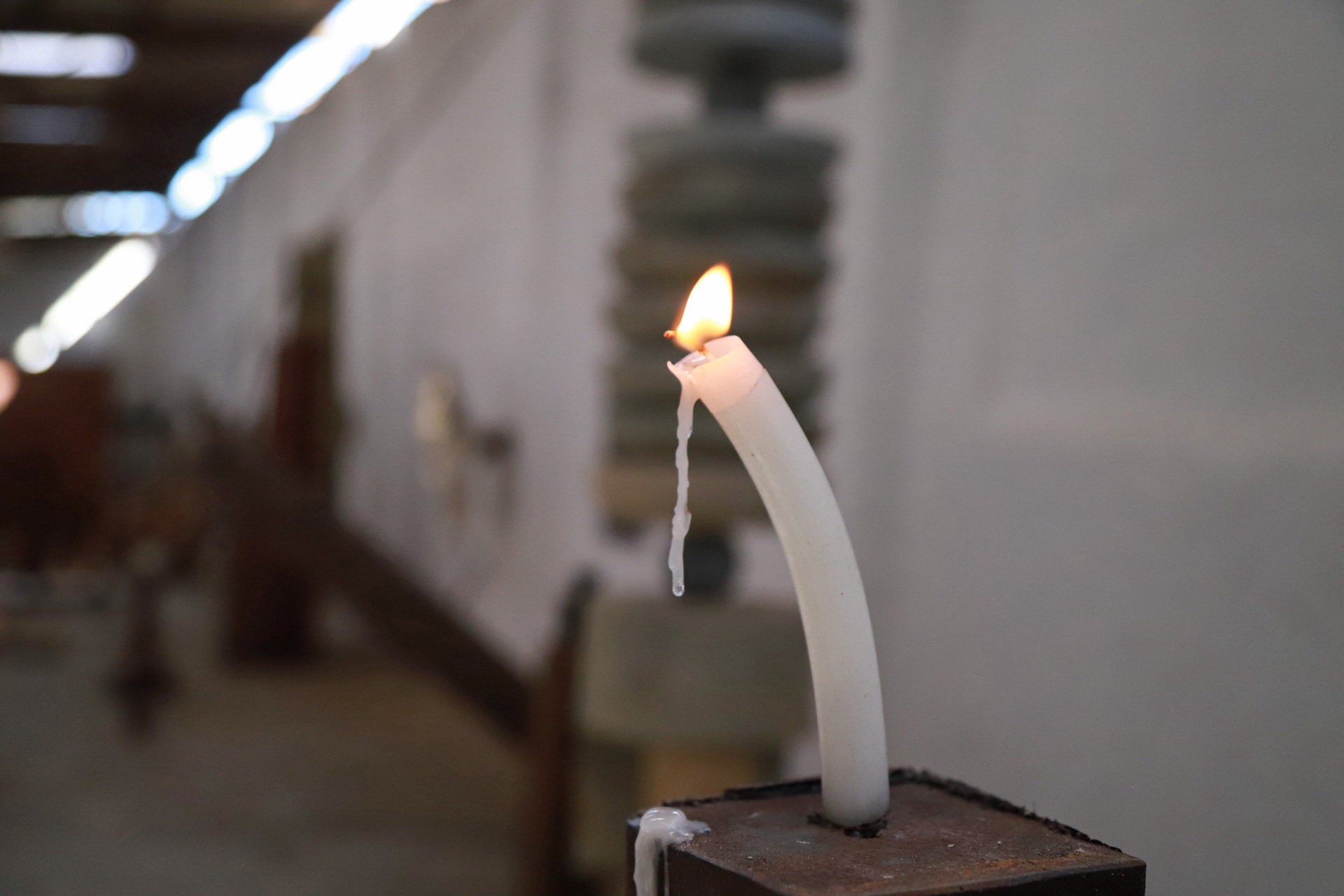
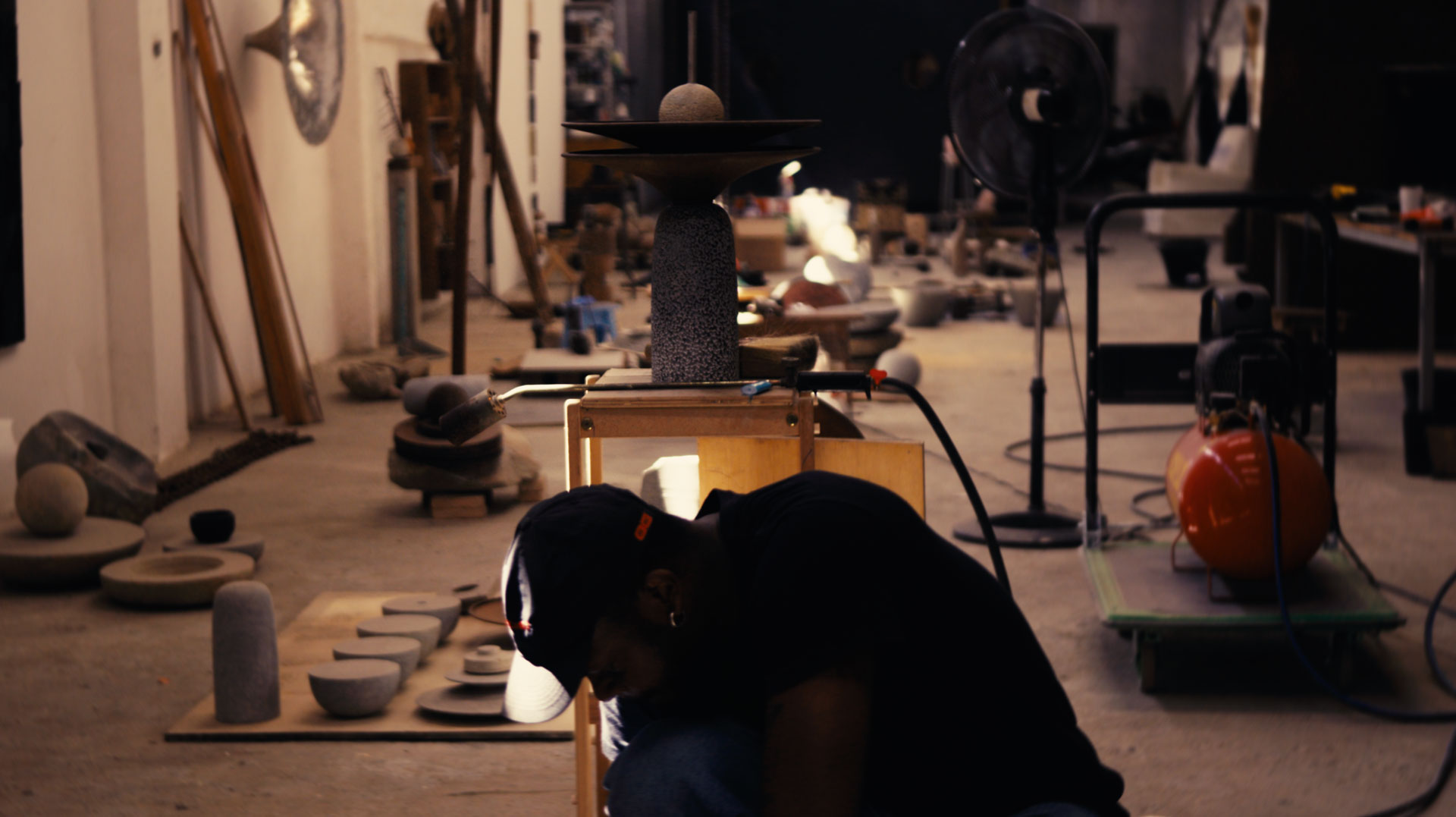
When I arrive at the studio, I light a candle. I spend some time in contemplation, make coffee or tea, and only then do I touch the stone. Process is a word I rarely use; I tend to think of my practice more as a ritual.
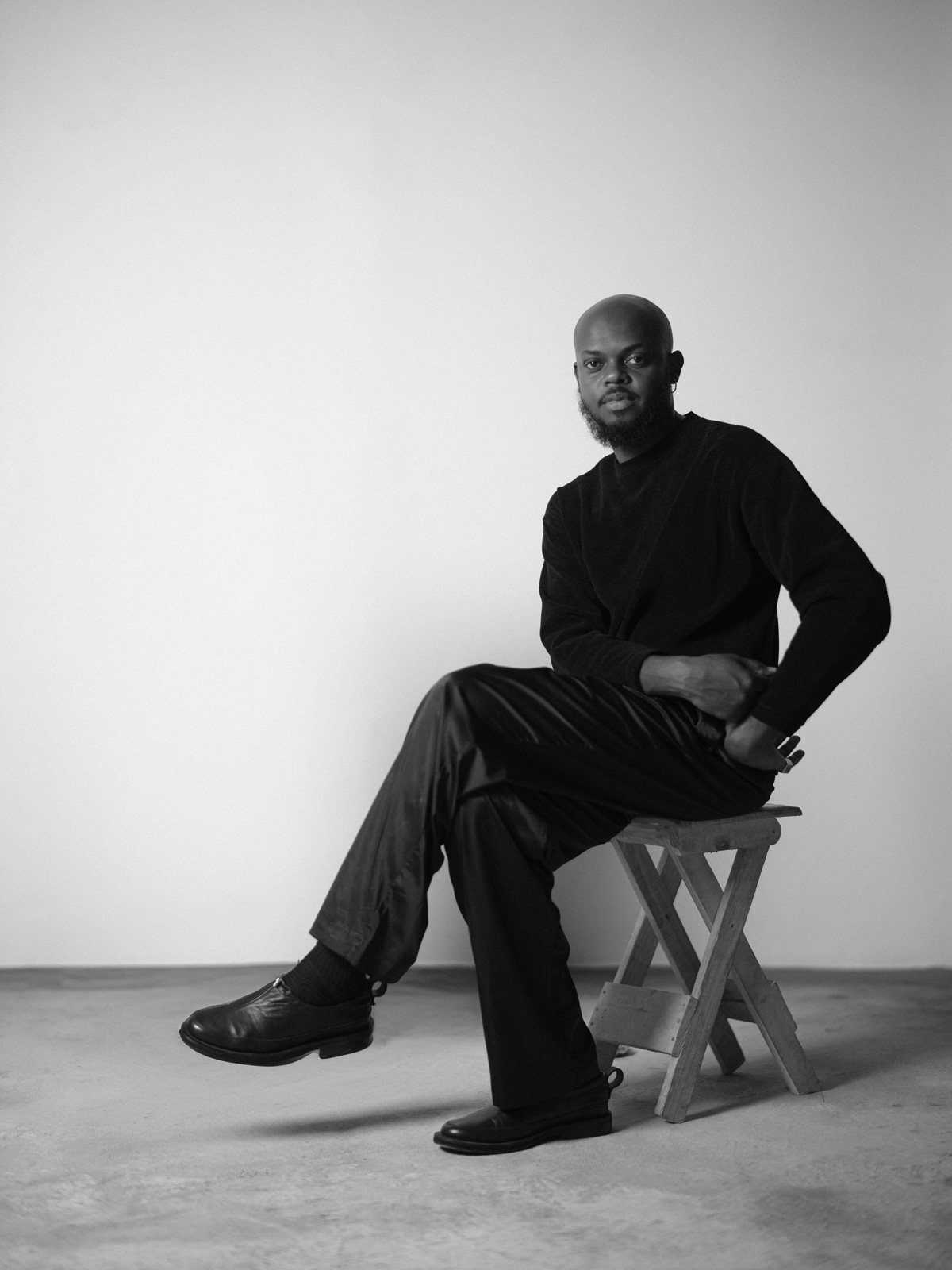
My studio is in Barbalho, a neighborhood in Salvador’s historic district. I have been working there for five years and living in the city for six. I think of the studio as a space for learning: I learn there, as do the people who share the space with me, and it is through this exchange of knowledge that the work unfolds.
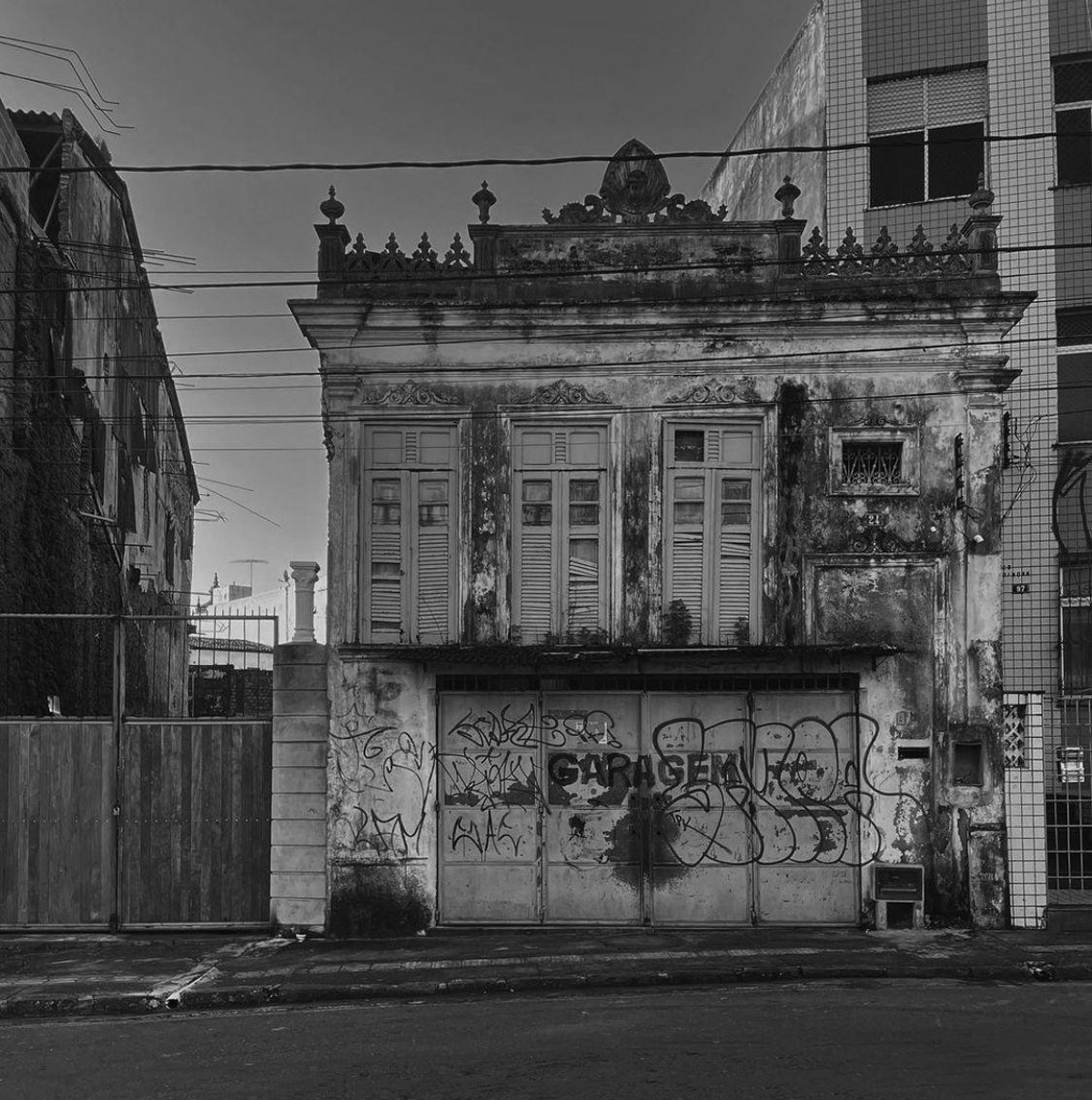
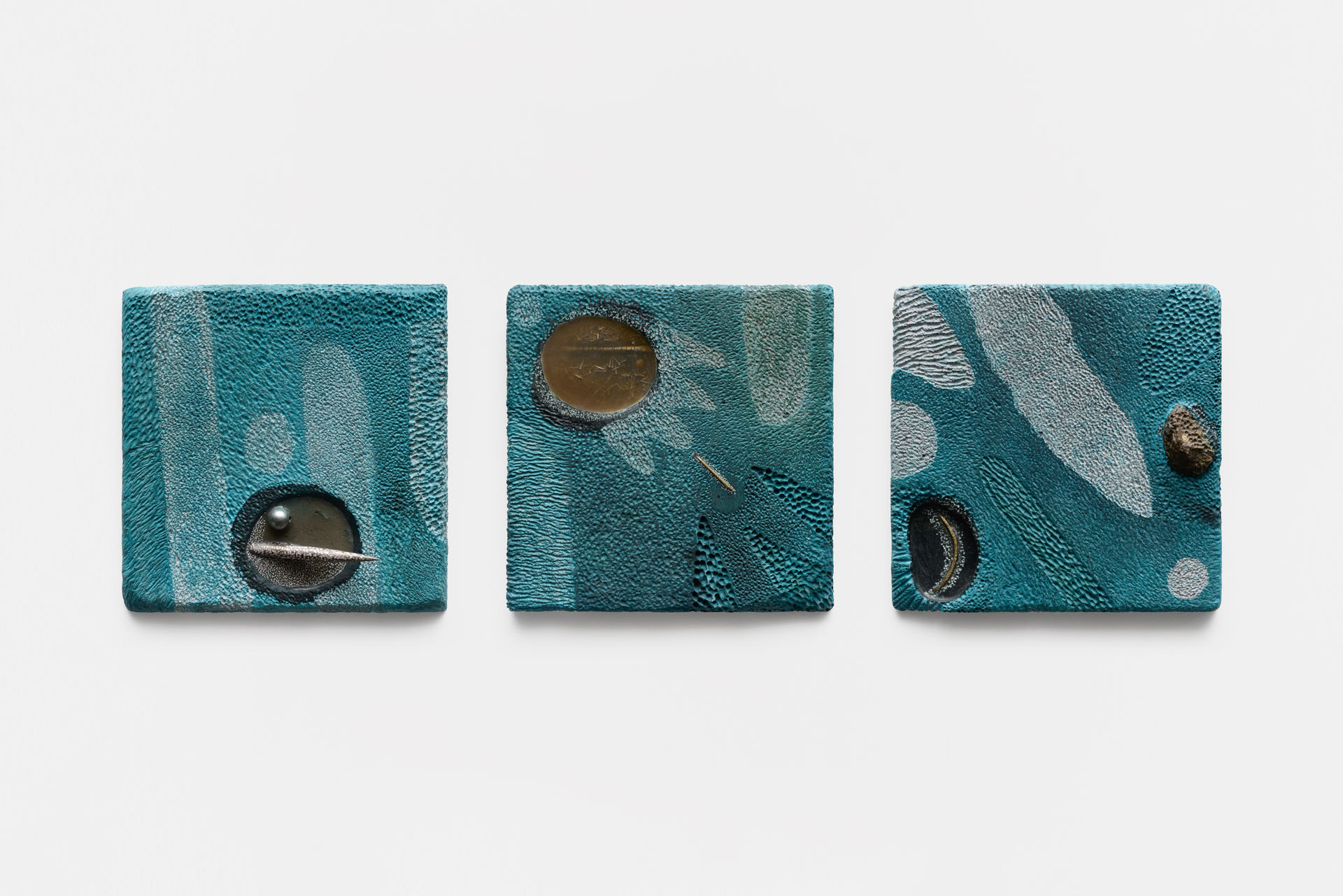
My relationship with materials is one of negotiation, and it begins in the street. I walk a great deal, sometimes for kilometers, as a way of fabulating, and it is through walking that things appear. The pitch I use is asphalt emulsion, the same material used in roadwork and to waterproof concrete slabs and roofs. I once passed a crew paving a street here in the neighborhood and found myself looking at the tone of that black, at the movements of the people applying it. The exchange came later, on a Friday: twenty liters for a few cases of beer. The blue comes from leftover printing ink; the iron comes from scrapyards or the streets; the stone comes from Minas Gerais, sourced directly from the people who quarry it. I call this escambo: currencies created through workers and communities.
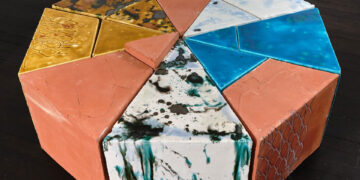
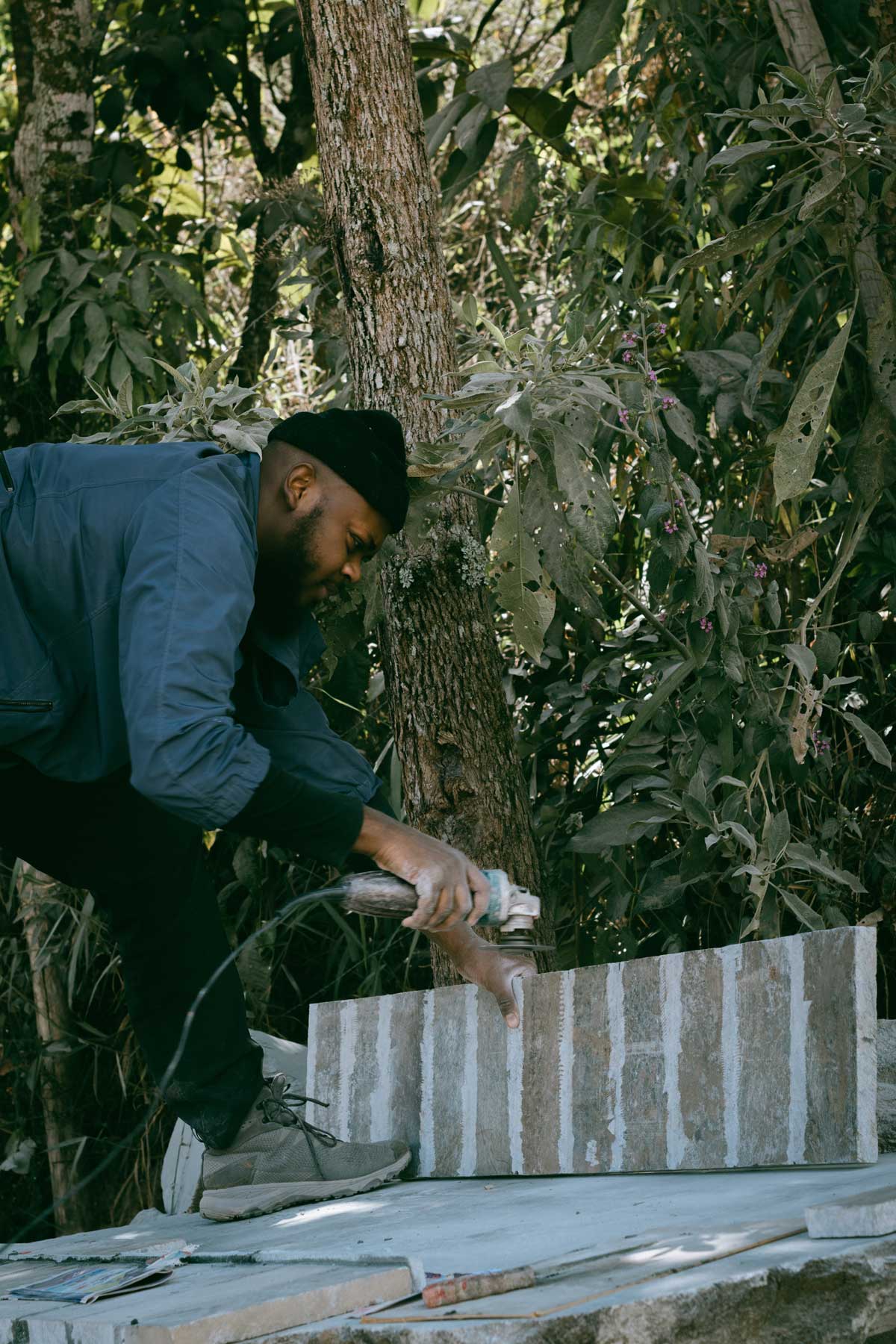
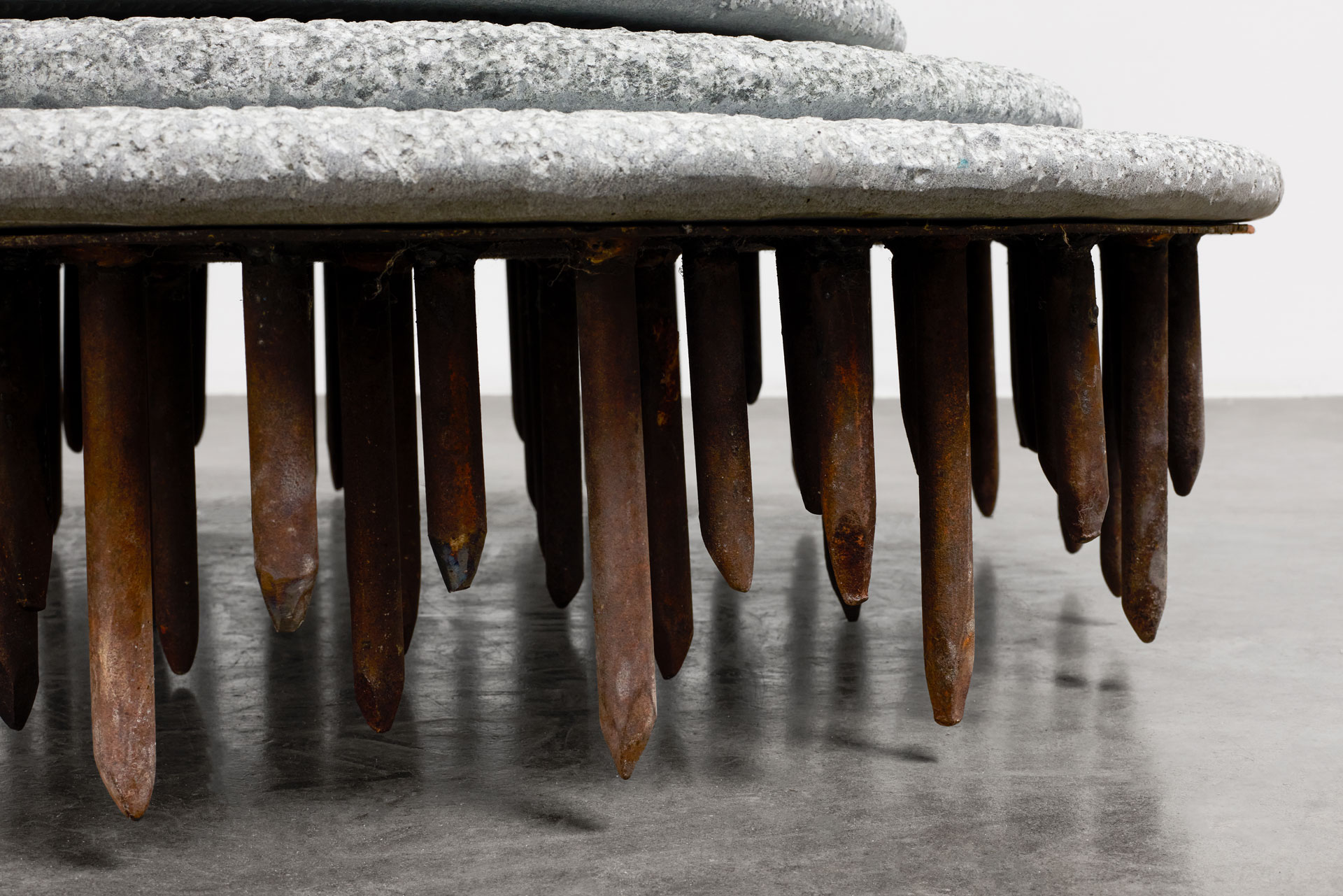
Inside the studio, the negotiation continues because the material responds. The pitch that paves roads and seals roofs on the street becomes a thin skin on the stone. When the blue encounters the charcoal, it reveals the quartzite held within the stone, and the surface begins to shine in a way I cannot control. I oxidize the iron with salt, water, and vinegar, or sometimes with chemical solutions, and on those days the entire studio smells of vinegar. For me, painting the stone means having a conversation with it.
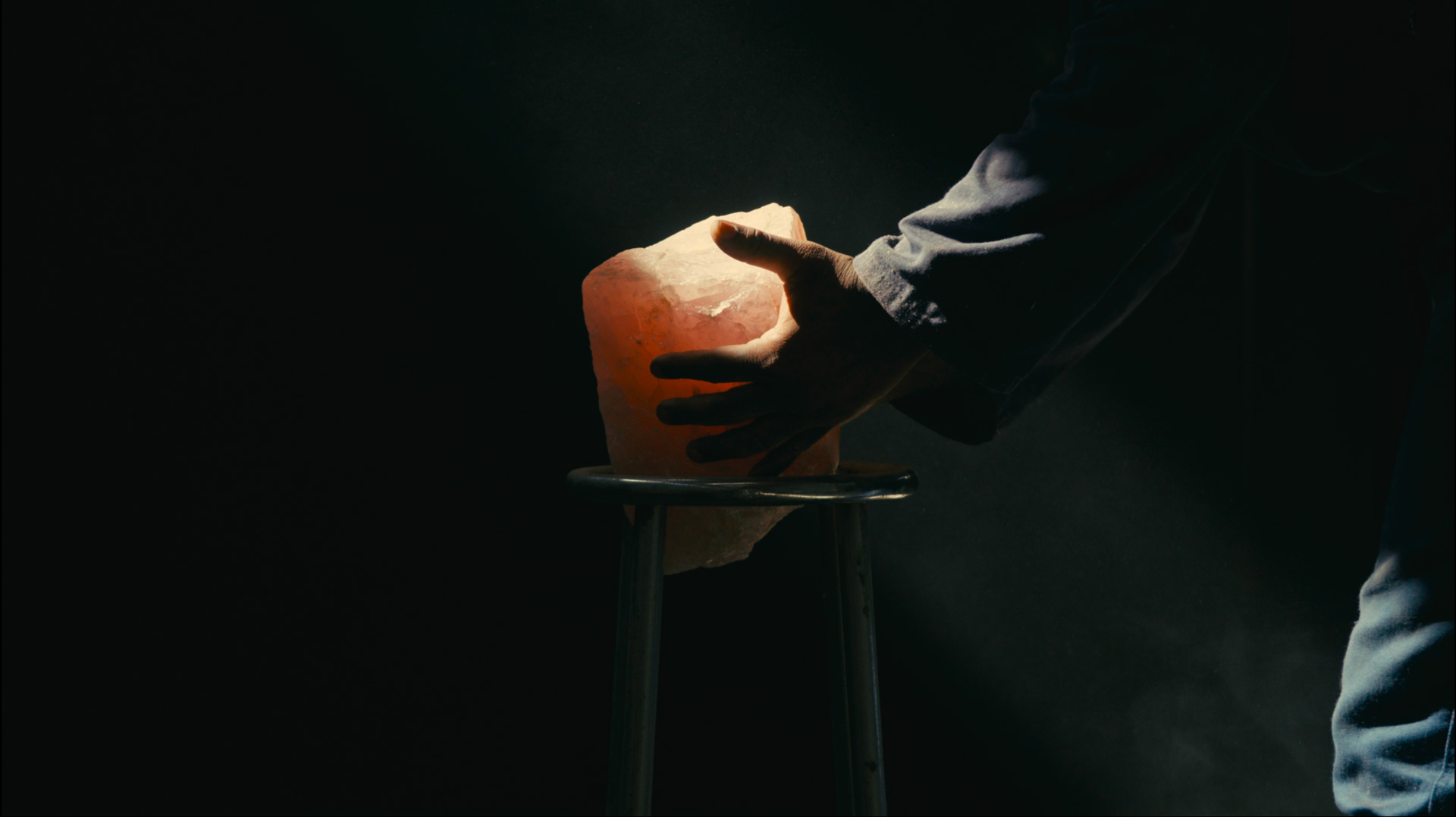
Soapstone is soft; you can scratch it with a fingernail. I remove it point by point: the tool strikes, dislodges a grain, leaves a hollow. On one small piece alone, I counted more than ten thousand strikes. This repetition belongs to the ritual. There is music playing and food nearby, all the time. Cantaria is the name for the craft of working and carving stone, and within that word I hear canto—song.
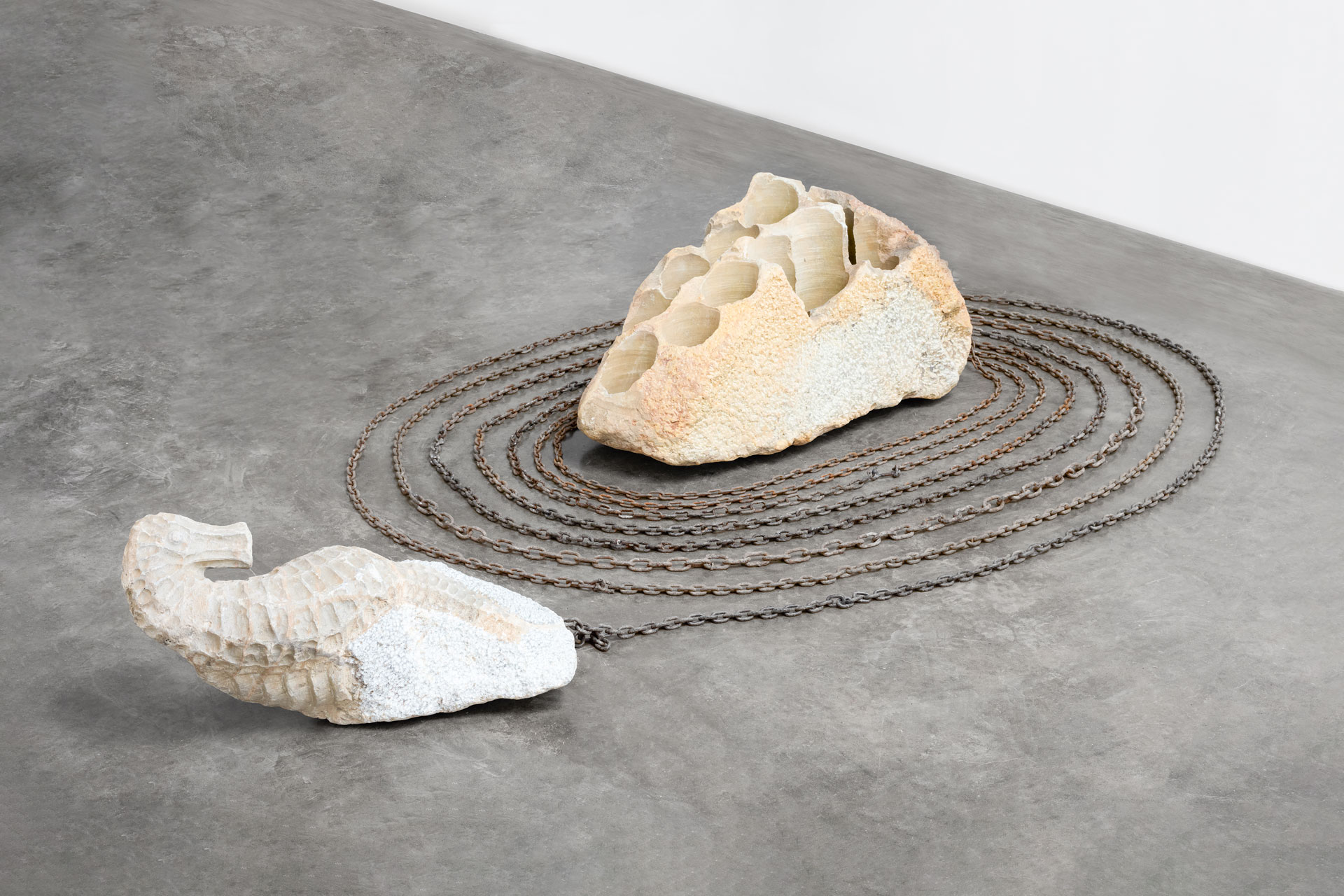
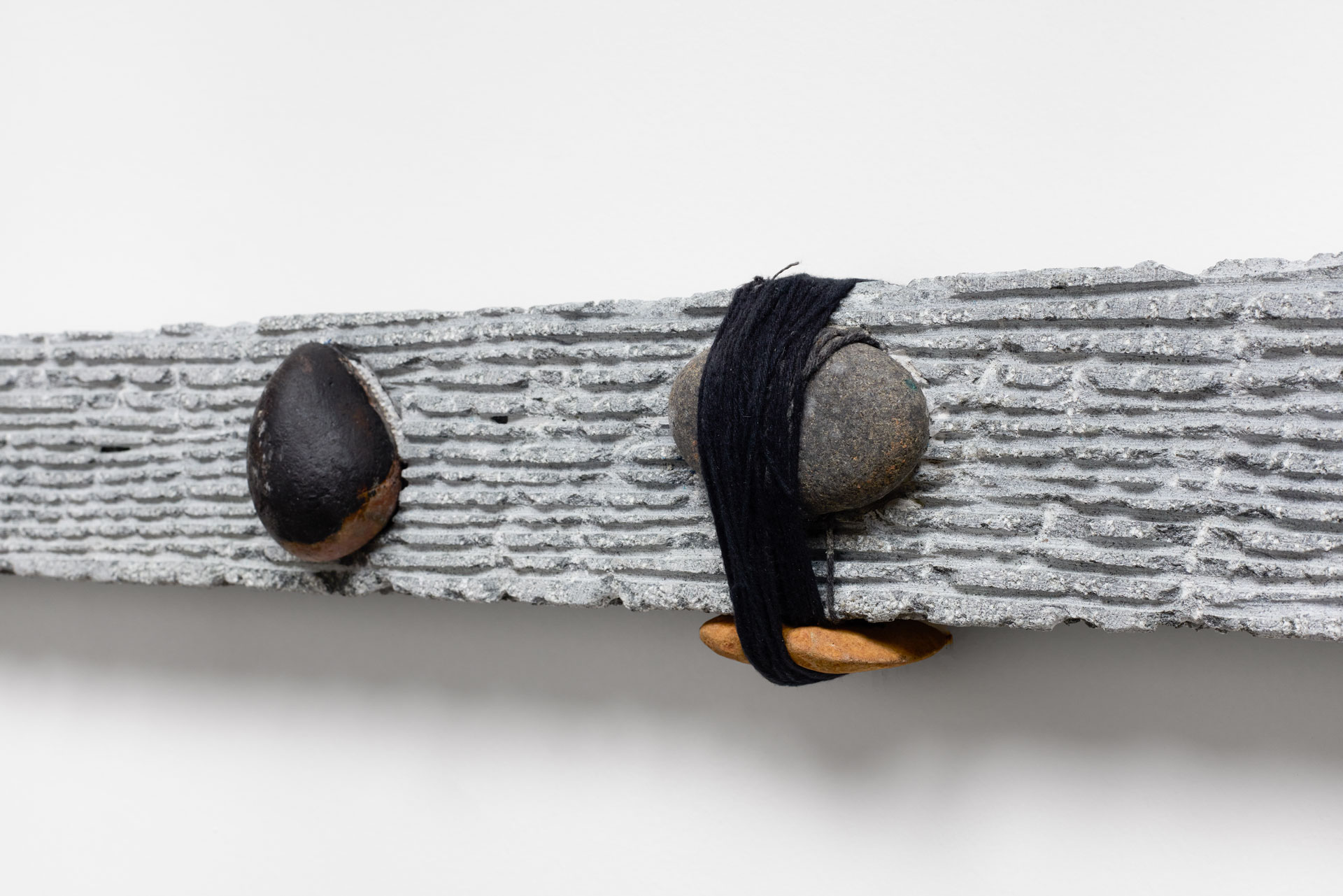
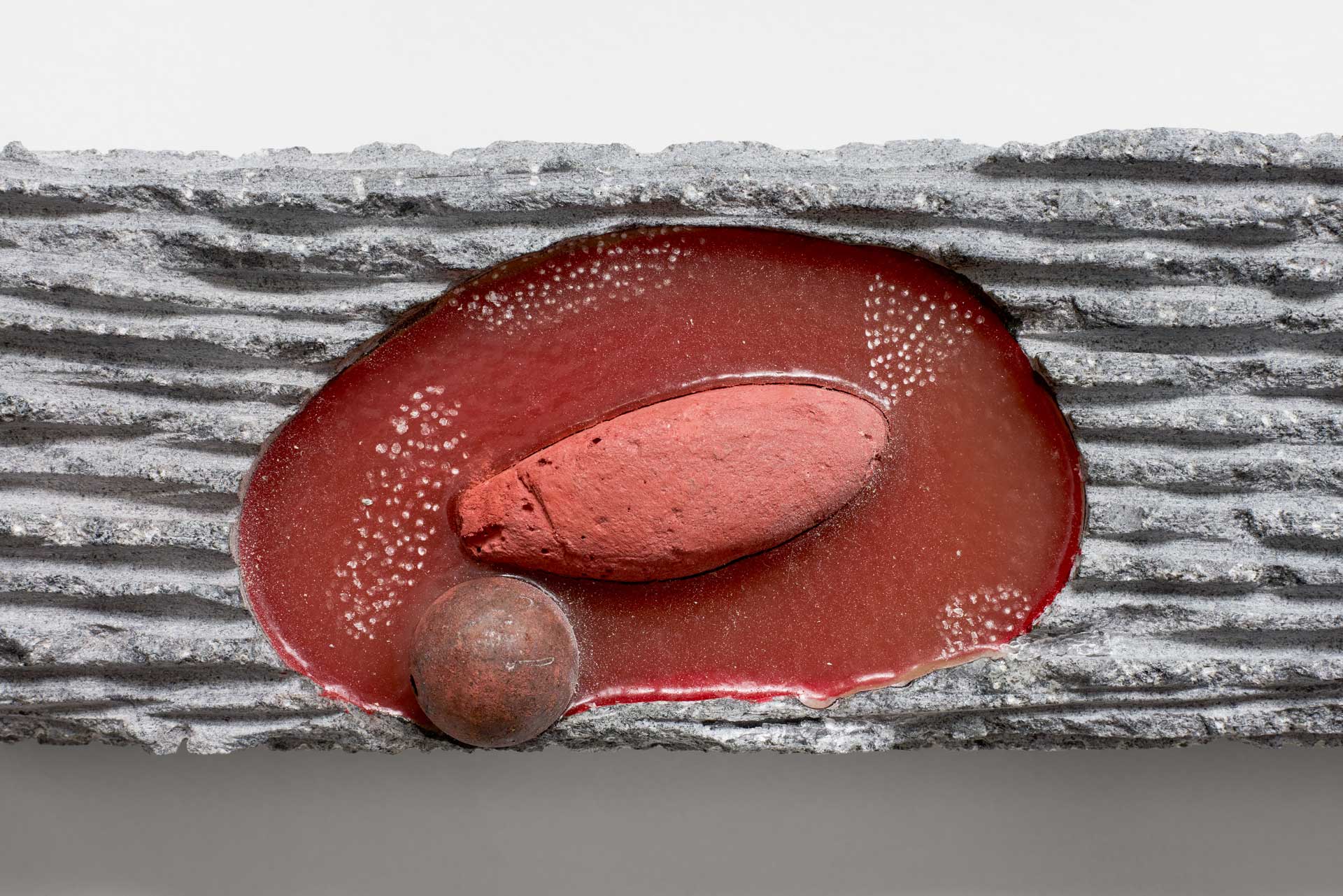
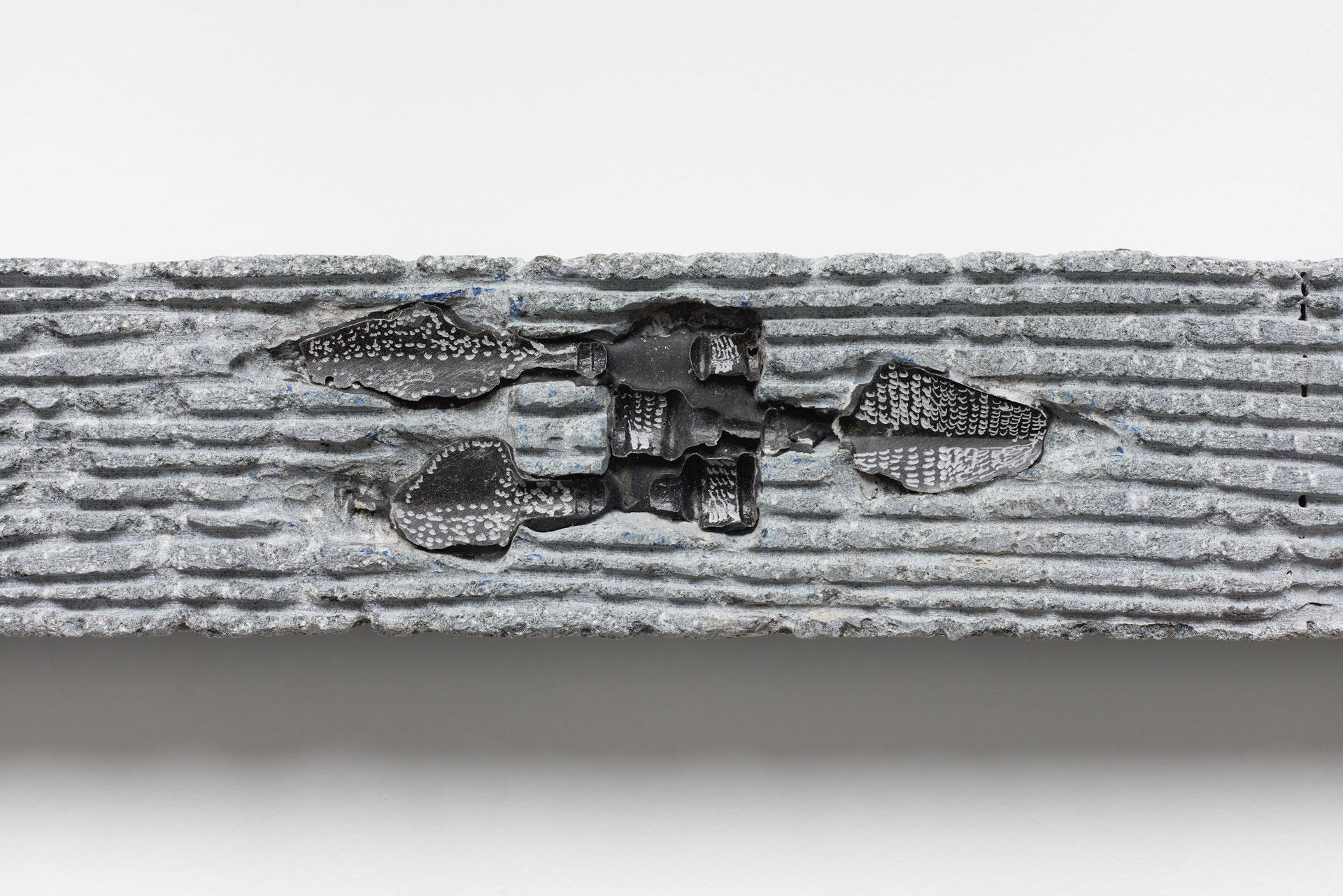
The technique has a name, apicoamento—a form of point chiseling—but I call it scarification. When the cut runs along the length of the stone, it becomes a groove, a continuous scarification. A keloid moves in the opposite direction: it is a relief that grows outward. The first one I ever knew was my own. When I was five years old, I fell chin-first onto a stone and cut my tongue. There was no hospital, and it healed on its own.
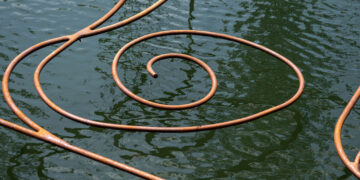
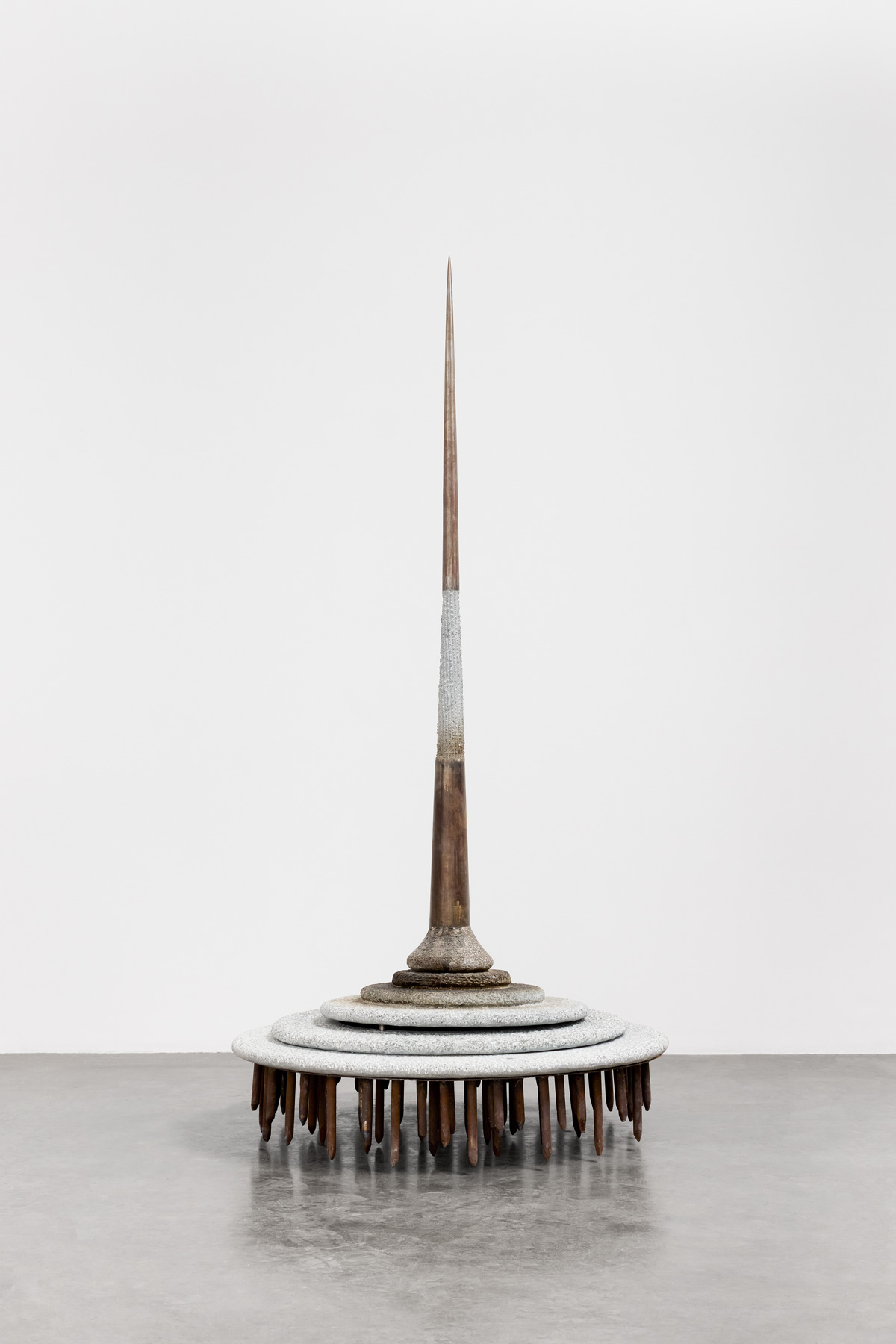
I have three places of birth, and all three enter the studio with me. Recreio, in the Zona da Mata region of Minas Gerais, is the one on my birth certificate, in 1991. It is the town of my grandfather Sebastião, a shoemaker who lost his sight and for whom I made drawings in relief so that he could read them with his hands. The wall reliefs come from those drawings. Curumaú, in Rio de Janeiro’s West Zone, is where I was raised, in a flat neighborhood of alleys and narrow passageways, built collectively through mutirão. From there came the bricklayer’s verb—the trade of my father: assentar, to lay, set, or place. Salvador was a choice. It was there that I learned to float, which means surrendering your weight to the current, and the balance of some of my sculptures comes from this: stone and iron chain supporting one another through weight alone.
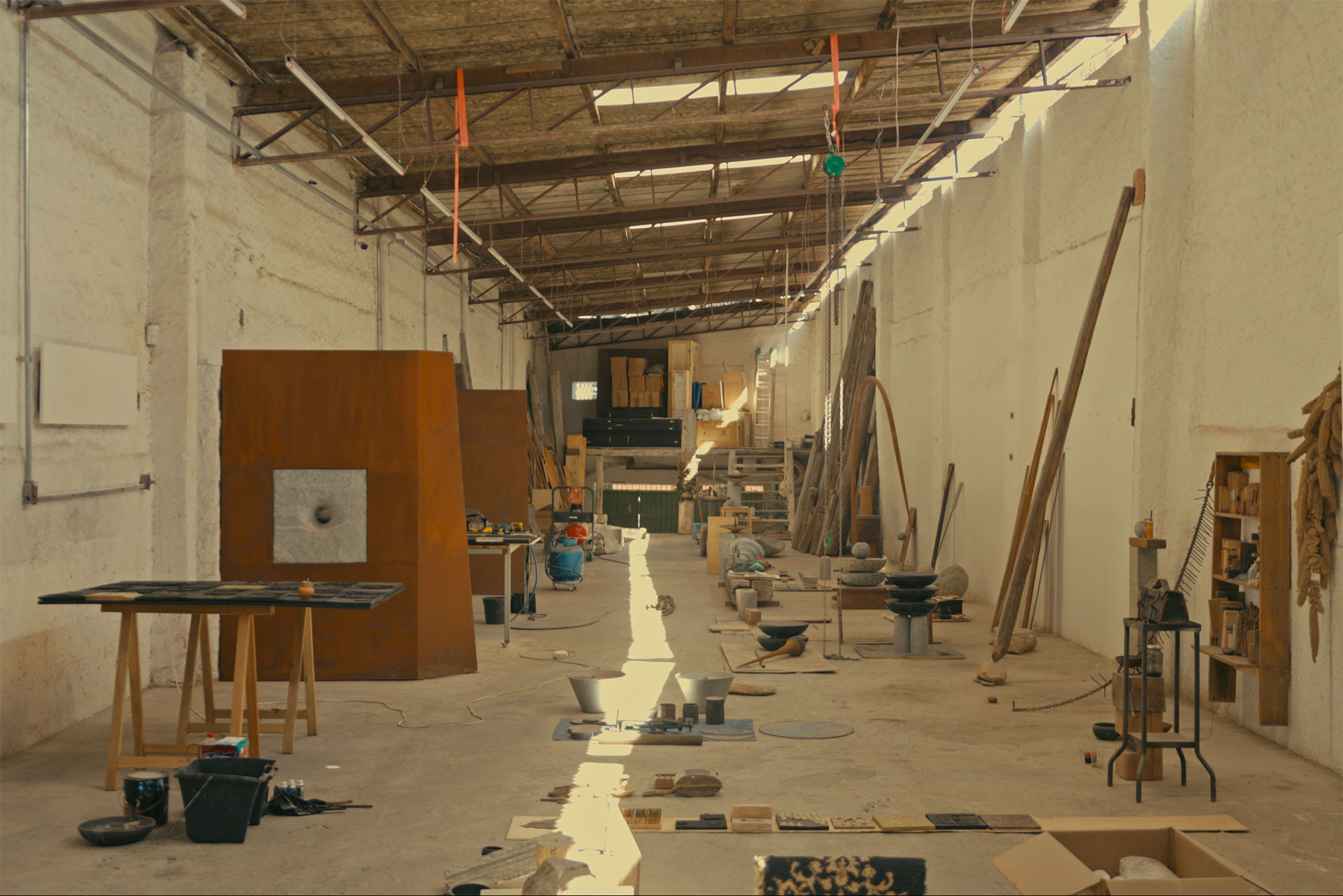
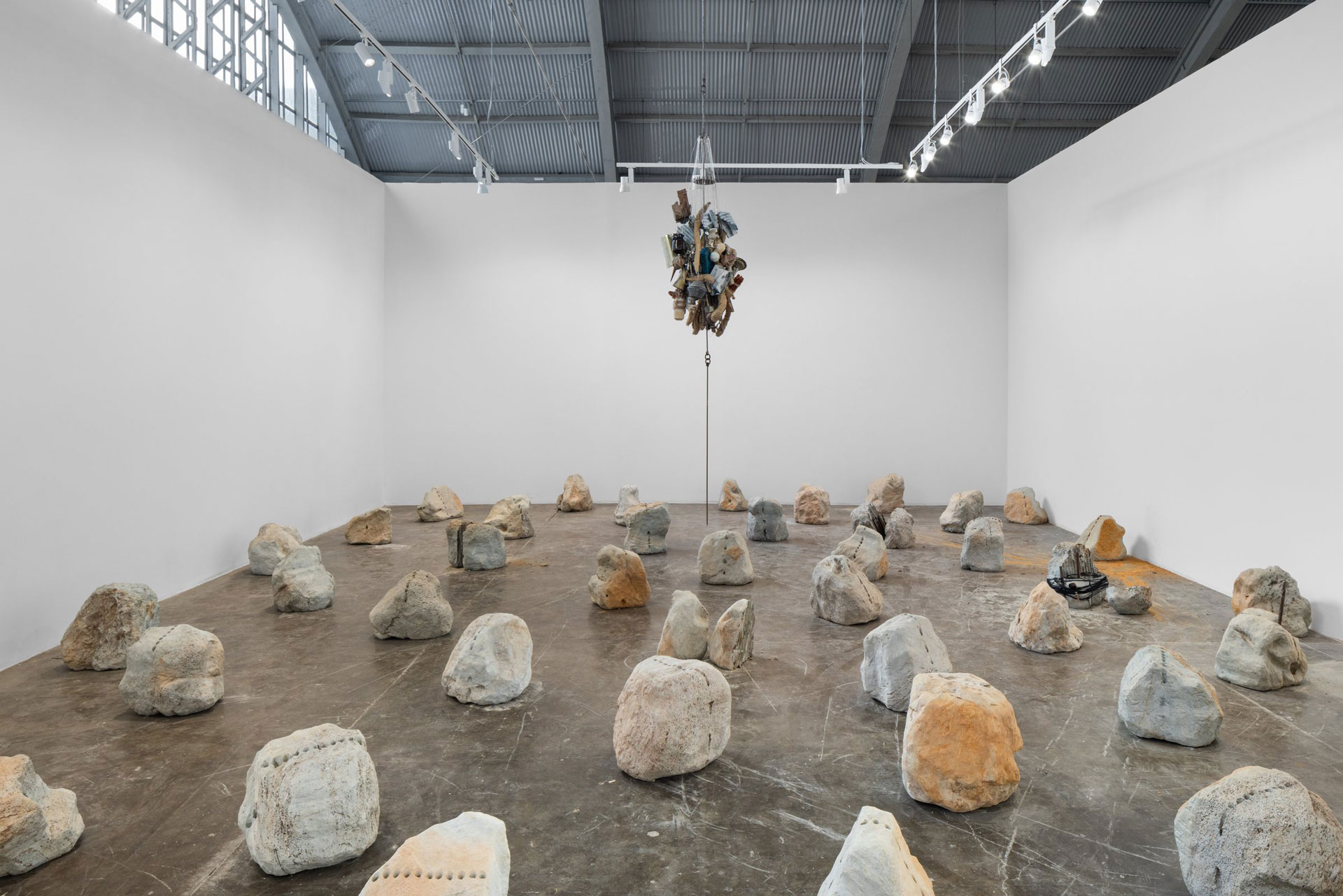
In what I make, all three places arrive together and contaminate one another. The festivities do too: Folia de Reis and Mineiro-pau, bate-bola, and Nego Fugido form the same triad for me. My grandfather led Folia de Reis processions and planted the ceremonial flag during the festivities, which is why I call my freestanding sculptures bandeiras—flags. I encounter my work because I am constantly encountering myself.
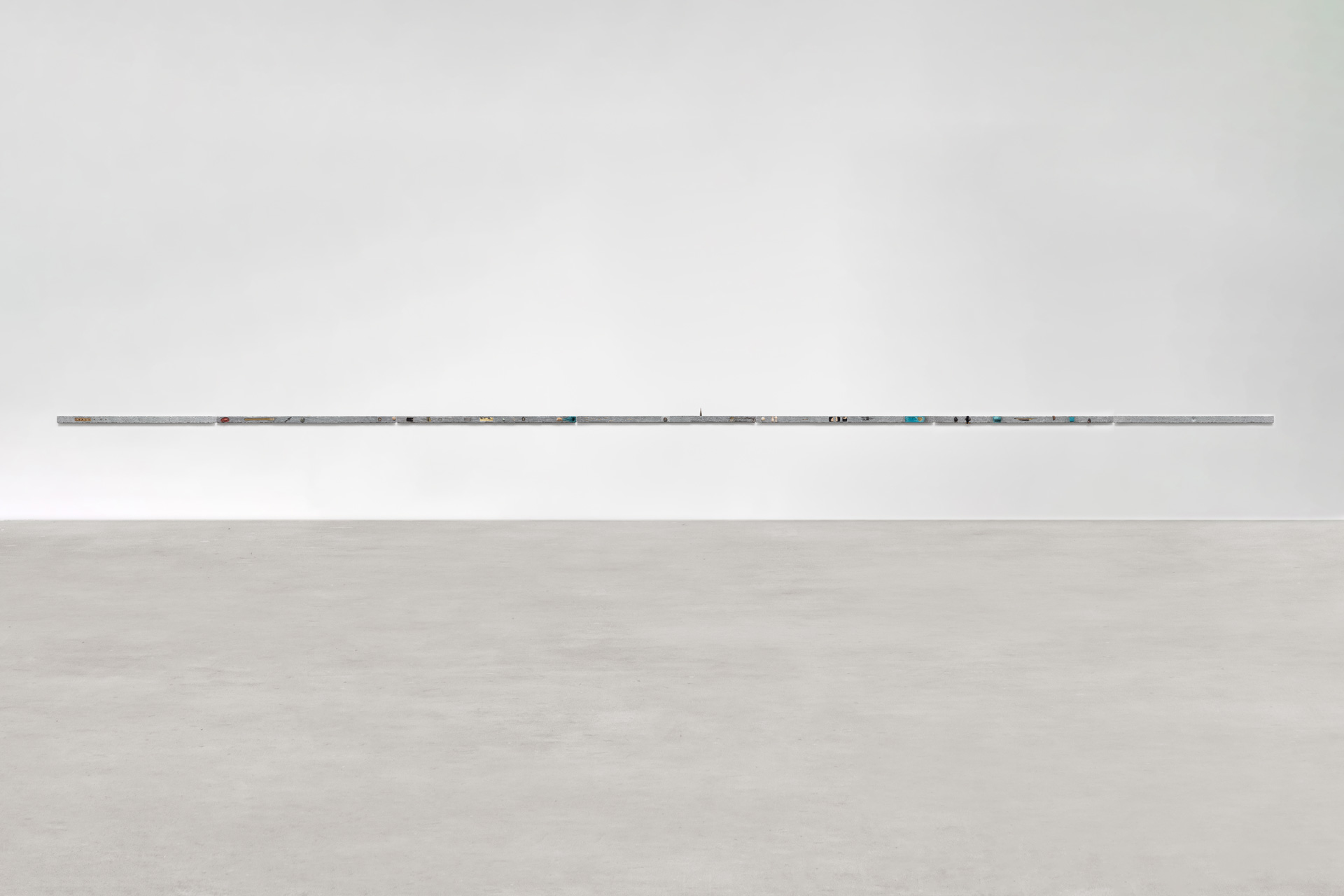
In Cantaria, my exhibition at Mendes Wood DM in São Paulo, a line of soapstone runs along eighteen meters of wall. It is titled Arquivo, Estrada, Rio (Archive, Road, River). The grooves are these continuous scarifications, and within them I carved niches and placed things: a coin, a row of nails, a ring, a piece of carpet, pebbles. A river is also a road. It has bifurcations, it has a mouth, and almost no one can say exactly where a river begins and where it ends. In one sketch, I wrote that those who navigate a river know how to read its currents. In Portuguese, correnteza—current—leads to corrente—chain—and a chain is made of links. That is why a road is also a river.
It was on the beach in Salvador that I understood that, in Minas Gerais, we also had a right to water: it was the river.
You can find out more about Daniel Jorge at @daniel.jorge_
Photos: Isadora Mourão, Renan Benedito, StudioEmObra, Gui Gomes. Courtesy of the artist and Mendes Wood Gallery.
Editorial Notes
Curumaú. A locality within Taquara, in Jacarepaguá, Rio de Janeiro, centered around Estrada Curumaú. The area has historically been considered part of Rio’s West Zone; a 2025 municipal law reclassified it as part of the city’s Southwest Zone.
Folia de Reis. A celebration rooted in Iberian popular Catholicism in which groups of singers and musicians travel from house to house between Christmas and Epiphany, January 6, carrying the flag of the Three Kings and singing verses led by a mestre, or master. The tradition is particularly prevalent in the interior of Minas Gerais.
Escambo. The direct exchange of goods or services without the use of money. In Brazil, the word also refers to exchanges that took place at the beginning of colonization in the sixteenth century, when Portuguese colonizers obtained brazilwood and labor from Indigenous peoples in exchange for tools and other objects. In the artist’s practice, escambo describes his way of obtaining materials through direct negotiation with the people who work with them and of establishing a new economy through the word itself: escambo.
Piche. The common Brazilian Portuguese term for bitumen, a dark, viscous petroleum derivative used to pave streets and waterproof concrete slabs and roofs. The Portuguese word pichação, referring to a distinctive form of writing on walls, derives from piche. The material used by the artist is asphalt emulsion, a water-based dispersion of bitumen used in road paving.
Soapstone from Minas Gerais. Steatite, a talc-rich metamorphic rock soft enough to be scratched with a fingernail and resistant to heat. It is quarried in the Ouro Preto region of Minas Gerais, where it has been used for centuries in sculpture—the Prophets by Aleijadinho in Congonhas are carved from soapstone—as well as in the production of cookware.
Bate-bola. Also known as clóvis. A masked Carnival performer associated with the suburbs of Rio de Janeiro who takes to the streets in groups wearing matching costumes and striking a ball against the ground. The tradition has been recognized as intangible cultural heritage of the city since 2012.
Nego Fugido. A street performance staged for more than a century by residents of Acupe, a quilombola community in Santo Amaro, in Bahia’s Recôncavo region, on Sundays in July. It recounts the struggle of enslaved people who defeat the king of Portugal and demand their letters of manumission.
Language operates in Jorge’s work both as a point of origin and as an organizing structure. As a child, the artist carved relief drawings into wood for his grandfather, who was visually impaired, so that the images could be read with the fingertips—an early understanding of form as something made to be touched rather than seen, and the beginning of his sculptural practice. From this emerged MkCode, a co-language constructed between mim, from Brazilian vernacular speech and classified by the school system as a grammatical error, and Khar, from an imagined Africa. At once sign, syntax, accent, and map, MkCode establishes the terms through which the work addresses its viewers.
Rather than treating material as a fixed support, Jorge subjects each material to the same principle: testing how far matter can go and allowing it to respond. Soapstone is split with wedges, carved, and scarified through incisions, perforations, and grooves—a gesture later inverted into keloid-like protrusions that make it difficult to determine whether the form results from subtraction or addition. Charcoal produced in the studio oxidizes the surface and reveals the quartzite running through the stone, giving the pigmented works a luminosity that no gesture could deliberately plan, while asphalt emulsion deposits a thin black skin over the material. Iron is oxidized with salt, water, and vinegar until it reaches the brown tone of rust, then embedded into carved stone or driven into wood; at times, it constitutes the entire work, or nearly all of it. Moving between image, sound, video, performance, drawing, sculpture, and installation, the artist organizes, reorganizes, and disorganizes the relationships and images that can exist—or create friction—within the triad of language, geography, and labor. In his work, these form a body and an economy in which almost nothing repeats itself and all matter is mutable.
Recent solo exhibitions include Cantaria, Mendes Wood DM, São Paulo (2026); Geografias de um Corpo Bússola, Caixa Cultural, Rio de Janeiro (2026); and Era do Escambo, Paulo Darzé Galeria, Salvador (2025). His work has also been included in group exhibitions such as Aberto 5, Casa Bola, São Paulo (2026); Aberto Rua, São Paulo (2026); Afro-brasilidade, FGV Arte, Rio de Janeiro (2025); Tempo Composto, Galeria Athena, Rio de Janeiro (2025); Conspiração dos Ícones, Carpintaria, Rio de Janeiro (2024); Ecos Malês, Casa das Histórias de Salvador, Salvador (2024); Raízes: Começo, Meio e Começo, MUNCAB, Salvador (2024); and Um Defeito de Cor, MUNCAB, Salvador, and Sesc Pinheiros, São Paulo (2023).