Isabella Indolfi: Hi, Paige.
Paige King: Hiii, Isa!
II: Thank you for having this conversation with me. To give everyone a sense of where we are, we’re in the historic Old American Can Factory building, in Gowanus Bklyn, near the canal.
PK: My grandmother was raised two blocks from here. These factories sprang up in the mid-1800s, when the Gowanus was dredged into a commercial waterway connecting the area to New York Harbor. Today, the Old American Can Factory feels like a campus. We’re surrounded by people who are industrious in a different way. The building is teeming with artists, publishers, designers, educators, trapezists, even. It’s a generative, familial place to work and be, and I love thinking about all the different lives this factory has held. AND who was here long before the factories–the Lenape people, from which the word Gowanus derives.
II: Oh! Interesting. As an Italian who moved here five years ago, land acknowledgments are helpful for my orientation. Yes, this building and area holds so much. We have some great neighbors like Rooftop Films, McNally Jackson publishers, Ugly Duckling Presse, Center for Urban Pedagogy across the hallway. It’s a vibrant community.
II: So, what brought us here in April?
PK: MESH officially formed in April 2026, but in many ways, it started a few months before that. We spent about three months getting to know the building, the community around it, and Nathan, the building’s creative director, who has been incredibly supportive from the beginning. His support has been not only instrumental, but also pretty unique. It’s rare to find someone outside of a project who is genuinely invested in helping make it work, someone willing to figure out the obstacles and parameters alongside you, and then find a way forward that works for everyone. Opening an art space in New York is a substantial undertaking. It usually requires investors, resources. You and I came to MESH with a lot of passion and a clear sense of what we wanted to build, but not necessarily a lot of resources. Having Nathan’s support has made that process feel much more possible, and it’s been really meaningful to become part of the larger OACF community as MESH continues to take shape.
II: Yeah. And Nathan is not the only one who really supported us at the beginning when we didn’t know exactly what to do or how to do it. We also relied on the network that we have built throughout the years, including friends and colleagues.
PK: Exactly. For the last ten to fifteen years, you and I have both been working at this niche intersection of art, research, technology, and science. When we began building MESH, we were able to draw from our community that had developed over the years, a network of practitioners working in a similar space, who were incredibly generous with their guidance and support. That’s been huge for us. MESH didn’t emerge in isolation, it grew out of conversations, collaborations, and relationships with people who have helped us think through what this could become. People like Ellen Pearlman, Alexandra Dementieva, Patricia Olynyk, Dylan Gauthier, and others have been part of that extended community, sharing their experience, and acting as informal advisors along the way. That kind of generosity has really shaped how we’ve approached building MESH.
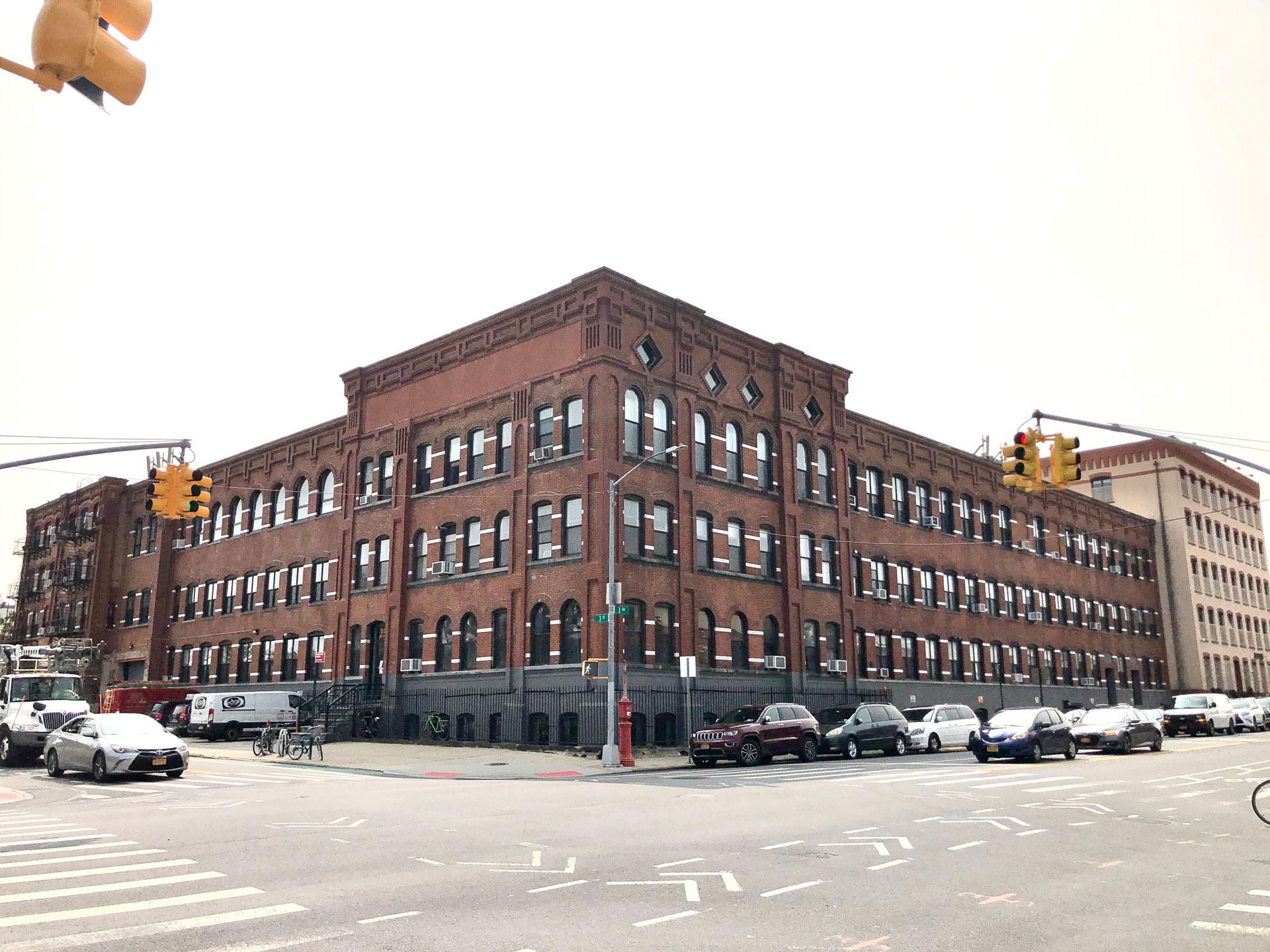
Old American Can Factory building, 2026. View Southeast to 3rd St and 3rd Ave. Photo and courtesy of Justine Cooper Photography.
II: Also, Toby Heys, director of the School of Digital Arts, in Manchester, Alain Thibault, director of Elektra, in Montreal, and Elena Soterakis, director of BioBAT, in New York. These are all people who we consulted with before starting this adventure with MESH. A lot of people ask us how we met, so it might be a good idea to talk about this. I think the first time we met was in Saint Petersburg?
PK: Actually, I believe the first time we met was back in 2018 at the Media Center by IFP, in Dumbo, which has since closed, due the pandemic. There you and I worked on the Cosmos & Chaos exhibition, as curators, for CYFEST-13. You invited Donato Piccolo who made that unreal installation of robotic feet walking on clouds. I loved that piece so much. But, yes, we have a long running history of working on various projects together.
II: Yes, first at the Media Center and then in 2019 in Saint Petersburg, Russia, working on CYFEST at the Stieglitz Museum. And then we saw each other a couple of years later in Armenia.
II: I would say the moment we really bonded was when I finally moved to New York City five years ago though. That’s when we really started hanging out beyond Cyland and Cyfest. And then you came to Italy to visit the festival I’m running there called Seminaria Sogninterra. I was super busy, but I believe you enjoyed it?
PK: Oh, I loved it. I was really inspired to see this festival emerge from a medieval town, Maranola, where you grew up. You had installations embedded in these ancient narrow pathways, and the entire village was involved. Your family was hugely involved. It’s a festival that brings in the art world, but it really extends into the community and this idea of collective involvement which I found incredible. It seems like a really beautiful extension of who you are.
II: Thank you. Yes, it’s really important to me. We have a lot in common. We both created residencies in our hometowns in which our families are involved. Unfortunately, I haven’t visited your residency project yet, but I have heard about it. I invited you to present Convening Bodies Residency at the TALK & COOK program that I run at the Sunview Luncheonette, in Brooklyn. Part of your family was there, and we had a nice dinner, though I had to teach Dan how to cook spaghetti al pomodoro a la italiana. Sweet memories. But one particular sentence that night resonated with me: all water everywhere touches all water everywhere. But you should tell more about your project.
PK: Haha, yes, you had to teach Dan how to cook spaghetti the Italian way! But yes, Convening Bodies is a two-part, 10-day residency on Lummi Island in the Salish Sea and in Grayland, along the southern Washington coast, two very different marine environments and experiences. I run the residency with Jenny Hawkinson, a dear friend from grad school, and sound artist who now lives in Vancouver, BC. Lummi Island is about a four-hour sail from Bellingham, where I grew up, so there’s a personal connection. My 70-year-old dad is involved too. He’ll pop over in his 30-plus-year-old faded red Achilles dinghy—the lil boat I’ve been going ashore in forever—with a crab feast in tow, talking about tidal systems, and accumulating driftwood, and ignorant neighbors who use Round-Up too close to the shore or at all. He’ll teach us about the layers of midden when the tide is out, which is a reminder of who inhabited these islands for tens of thousands of years before the atrocities of the settlers. So there’s a generational element woven into the residency too, and the complexities of ownership and property, it’s very present in the tone of the convening, at least for me. The residency takes its tagline from poet Alexis Pauline Gumbs: “trust that all water everywhere touches all water everywhere.” That idea is really at its heart. We’re interested in what happens when creative practice is informed by convening with and within bodies of water—and with others. There’s also a virtual dimension: participants have joined from Switzerland, Kenya, and the UK, gathering near a body of water wherever they are. Despite the distance, water becomes a kind of connective tissue between different places, practices, and people.
II: I love the way you’re bringing water into your curatorial artistic research. It really is something that connects us all, and the two of us. I’m also very connected to the Mediterranean Sea where I grew up, but what’s more funny is that both our fathers are sailors. We’re basically sisters [laughs].
PK: [laughs] Yes, I’m preparing to go back out to Lummi Island in early September. A pretty significant part of the residency is that we go sailing together for a day and anchor overnight, usually at Sucia Island. There’s something about being out on the water, away from land, moving with the wind and tides, that connects people to larger questions about what it means to be in relation to a body of water. When at anchor this time of year, the bioluminescence is unreal. At night, when it’s near immaculate darkness, you look into the black water and see these tiny organisms lighting up. It is like looking up at the Milky Way or shooting stars, but instead you are looking down, at the surface of the water, and beneath, a second sky. It’s devastatingly beautiful. I partly say devastatingly because these organisms and the ecosystems they belong to are increasingly affected by warming sea temperatures and other environmental changes. A lot of the residency is about creating space for that kind of awe, while recognizing the vulnerability.
II: This is so important, these lines of connection. Residencies help facilitate that, the awe you speak of. I’m getting ready for the 2027 edition of Seminaria.
PK: I have formally invited myself to return [laughs].
II: Absolutely. You’re part of the Seminaria team right now. But, in the meantime, there is a whole year of public programming at MESH which is the reason why we are here at the Old American Can Factory [laughs]. In fact, I would say the idea for MESH came from visiting the Old American Can Factory. We had talked about opening a space for a while, but we didn’t really know what that would look like or how we would make it happen. Then, when we first saw the gallery where we are now, something clicked. We realized it could become a place where the network we had been building over the years could actually have a home, a place where we could host people, bring different communities together, and create connections between artists, researchers, and practitioners. Until then, so much of our curatorial work had been independent and somewhat nomadic, moving between different spaces, organizations, and collaborations. Having a physical space gave us an opportunity to make that work more concrete, while still holding onto the networked and collaborative way we had always worked.
PK: You and I started to co-work together at the Sunview Luncheonette during the winter. For those who aren’t familiar with the Sunview Luncheonette, it is this really amazing collective of artists and poets and cultural practitioners located in Greenpoint in an old 1950s, 1960s style luncheonette. And they have a lot of events there. So, yeah, you’re a member and we were co-working there… and they didn’t have heat at that juncture.
II: It was so cold!
PK: So cold! So we started to fantasize about having our own space. And then that fantasy really turned into a conversation about how you and I were both very much at a place in our careers where we were ready to take a pretty large step and start facilitating a space that brings artists and scientists together and, for conversations, exhibitions, workshops.
II: We hope to bring activists, researchers, makers, thinkers, all kinds of people. I think one of our missions is to really weave interdisciplinary learning and events. For two child free women like us it’s meaningful to say it felt like we were giving birth to a child. And finding a name for this project was a whole process. In the common language mesh is a combination of threads of textile, right?
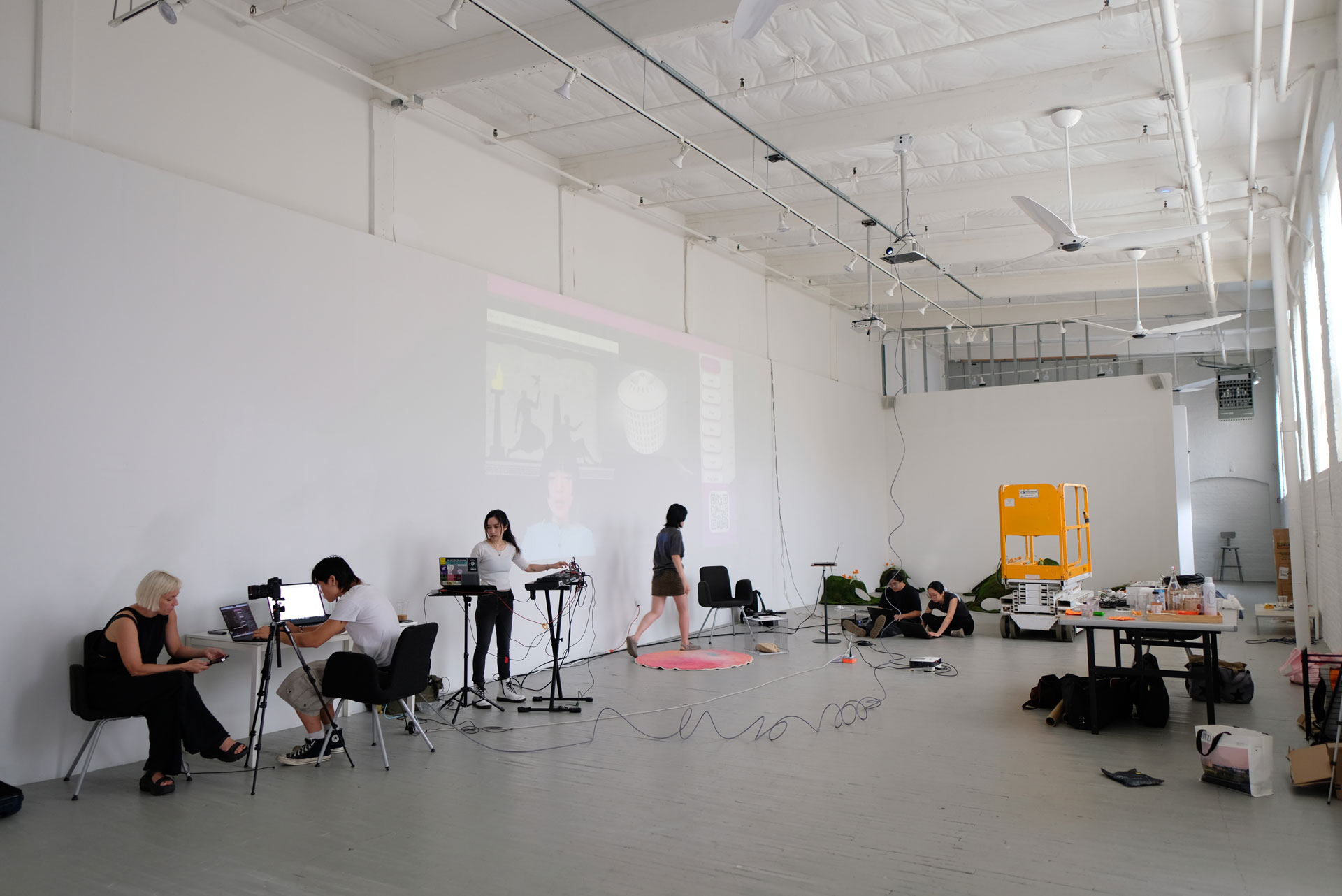
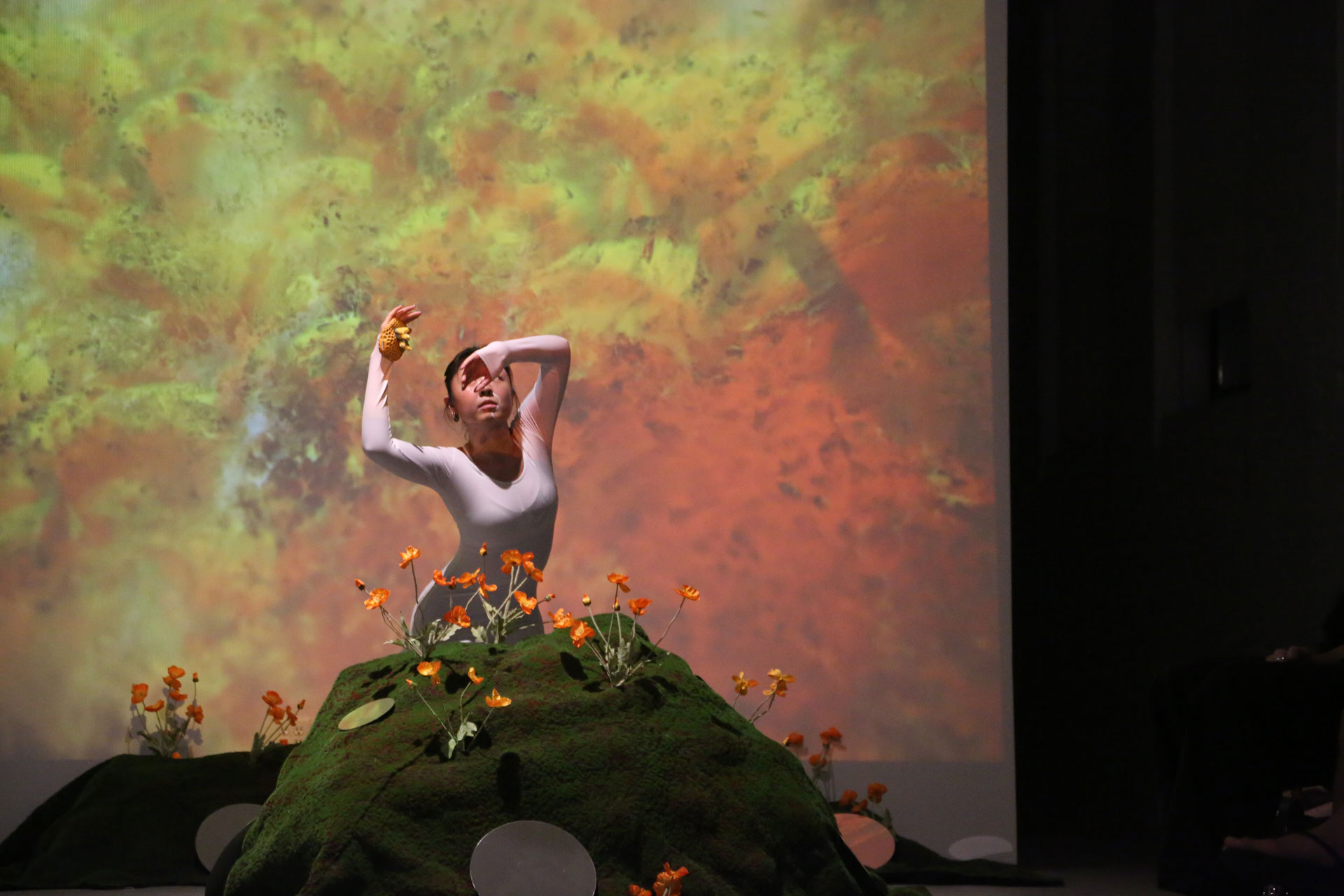
Installation for the Group Show(Dis)consent: A Night of Performance & Interactive Installations. Featured artists: Katherine Helen Fisher, Mengna Da, Shihan Zhang. Curated by: Amy Xiaofan Jiang. Courtesy of MESH.
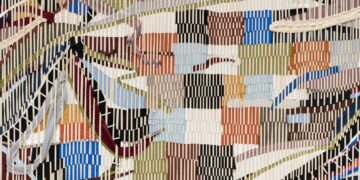
PK: Yeah, a mesh is essentially a weave, a structure made by individual threads crossing, looping, and holding onto one another. You see it in nets, textiles, even biological and technological systems. What I love about it is that its strength doesn’t come from any single thread, it comes from the relationships between them. Each point of intersection helps distribute across the whole. It became a way of thinking about what we wanted MESH to be, a mesh sculpture composed of individual artists, researchers, scientists, technologists, and communities coming together, each remaining their own distinct thread, but becoming stronger and more generative through connection. It’s not about weaving everything into form. It’s about creating enough structure to hold people and ideas together, while leaving enough space for something unexpected to pass through.
II: Technically, there is no center in a mesh network so all the nodes are somehow equal. It’s a horizontal network and I think that reflects a lot of our project’s mission.
PK: Some of our core aims are around decentralization, and that really applies to our curatorial practice. We want to invite others in and give them a space, a platform, and an opportunity to shape what happens here. Part of that is about dismantling some of the gatekeeping that happens in the art world, especially in New York, but also more broadly. There’s a real advantage to stepping back and making room for others because it diversifies the kinds of work, research, and conversations that MESH can hold. So MESH_ARTS is of two modes. One is where you and I are creating programming, whether that’s an exhibition, a talk, or a workshop. And then there’s this other mode where we’re actively inviting others to come in, use the space, and experiment with it.
II: We felt there was a real lack of spaces like this in New York. Art, research, technology, and science is already a niche intersection. Often, the organizations doing this kind of work don’t have a proper exhibition space, so we want to share what we have and give others access through a kind of membership model. We’ll curate a network of partners and collaborators and build programming that is really peer-led. What’s most important to us is the learning that comes out of those relationships. It’s already making me grow so much, as a curator, as a director, as a human, and simply as someone who is passionate about art. I feel incredibly enriched by it. We had an amazing experience early on with Amy Xiaofan Zhang, director of Underground Art and Design, who curated MESH’s second event, a one-night performance. She’s such an energetic and passionate curator, and that experience really showed us what becomes possible when you invite someone else in to shape the space.
Courtesy of MESH.
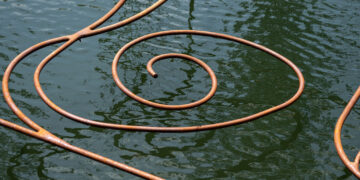
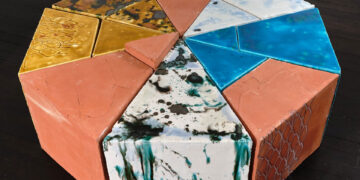
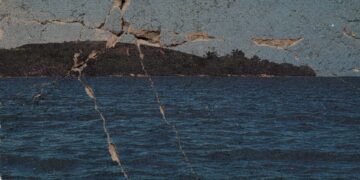
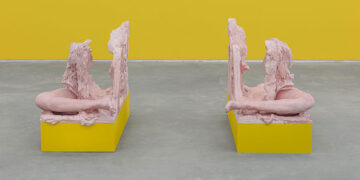
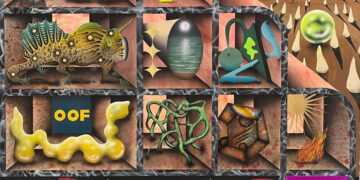
PK: Our inaugural exhibition, Soft Screens, was especially meaningful in establishing the curatorial language and critical conversations we want MESH_ARTS to hold.The exhibition was looking at our hyper-mediated digital lives, but interestingly, sculpture and materiality became central to how we curated it. We were thinking a lot about what happens when something we usually experience through a screen, through algorithms, data, interfaces, is translated into something physical. Suddenly it has weight and texture. You have to move around it. Your body has a relationship to it. That physical encounter gives form to systems that are often invisible or difficult to locate. There was this material tension running through the show. We had clay and salt, these ancient, elemental materials, sitting alongside works dealing with new technologies. I loved that contrast. It brought up this question of physical depth versus digital depth, the actual dimensionality of an object compared to the illusion of depth that we experience through a screen. Alexandra Lerman’s Swipe, Swipe, Swipe is a great example. She made these beautiful ceramic objects roughly the size of an Iphone. There’s no technology in the piece, but the language of technology is completely present. The gesture of swiping is embedded into the clay, so this movement we perform almost unconsciously every day suddenly becomes physical and a little strange. Alexandra’s research was around the idea of copyrighting gestures, and I think the sculpture really brings that question back to the body, who owns a gesture, and what happens when our physical behaviors become so deeply choreographed by the technologies we use?
II: The work stayed with people. So many of my friends still bring it up, it’s one of those pieces that people immediately remember. Another collaboration that was important was with Mari Nagem. She created this beautiful installation that played with the illusion of depth we experience through screens, how something completely flat can convince us that we’re looking into another space. And again, she explored that without relying heavily on technology. The physical installation itself became a way of thinking through the digital. We’re actually bringing Mari back for Climate Week in September, which we’re really excited about. There were so many great artists in Soft Screens. Anna Frants also brought this incredible material and technological sensibility to the exhibition. I think collectively the works showed that you don’t necessarily need to use technology to speak critically about it, sometimes sculpture, material, gesture, and physical space can make our relationship to the digital even more visible.
PK: Anna Frants’ Peck of Salt really captures this convergence between sculpture and the digital, between two dimensions, the virtual and the physical. A TV screen plays nothing but static, and each speck of digital noise is measured and translated into a stream of salt falling onto the floor. Over time, something immaterial accumulates into a physical form. The work gives weight to digital noise, making the constant, often invisible flow of information in our lives suddenly tangible.
II: I was so happy to show Nouf Aljowaysir’s new piece conceived specifically for that exhibition, but also a less recent work called Where am I from?. It is available now on the New York Times platform.
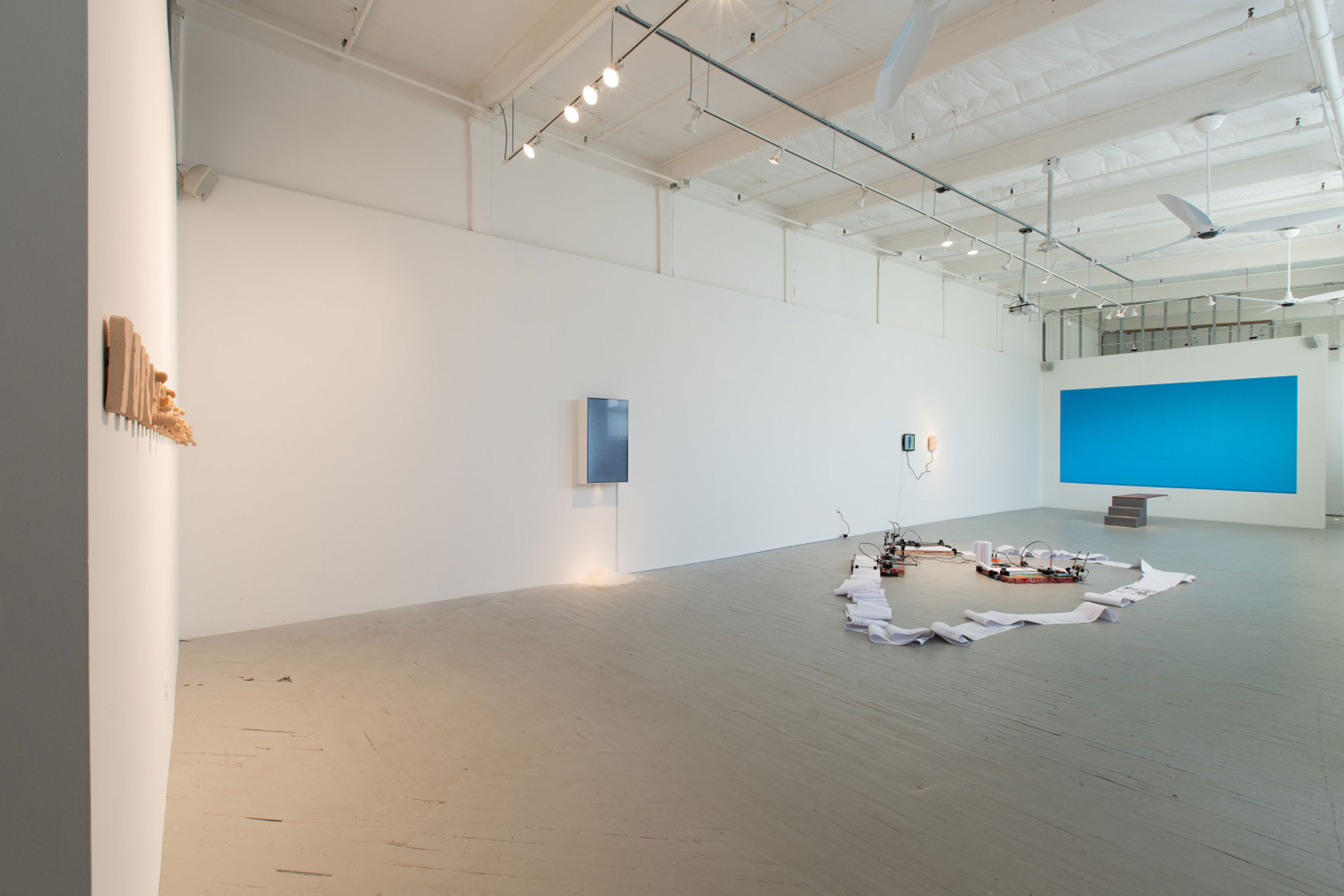
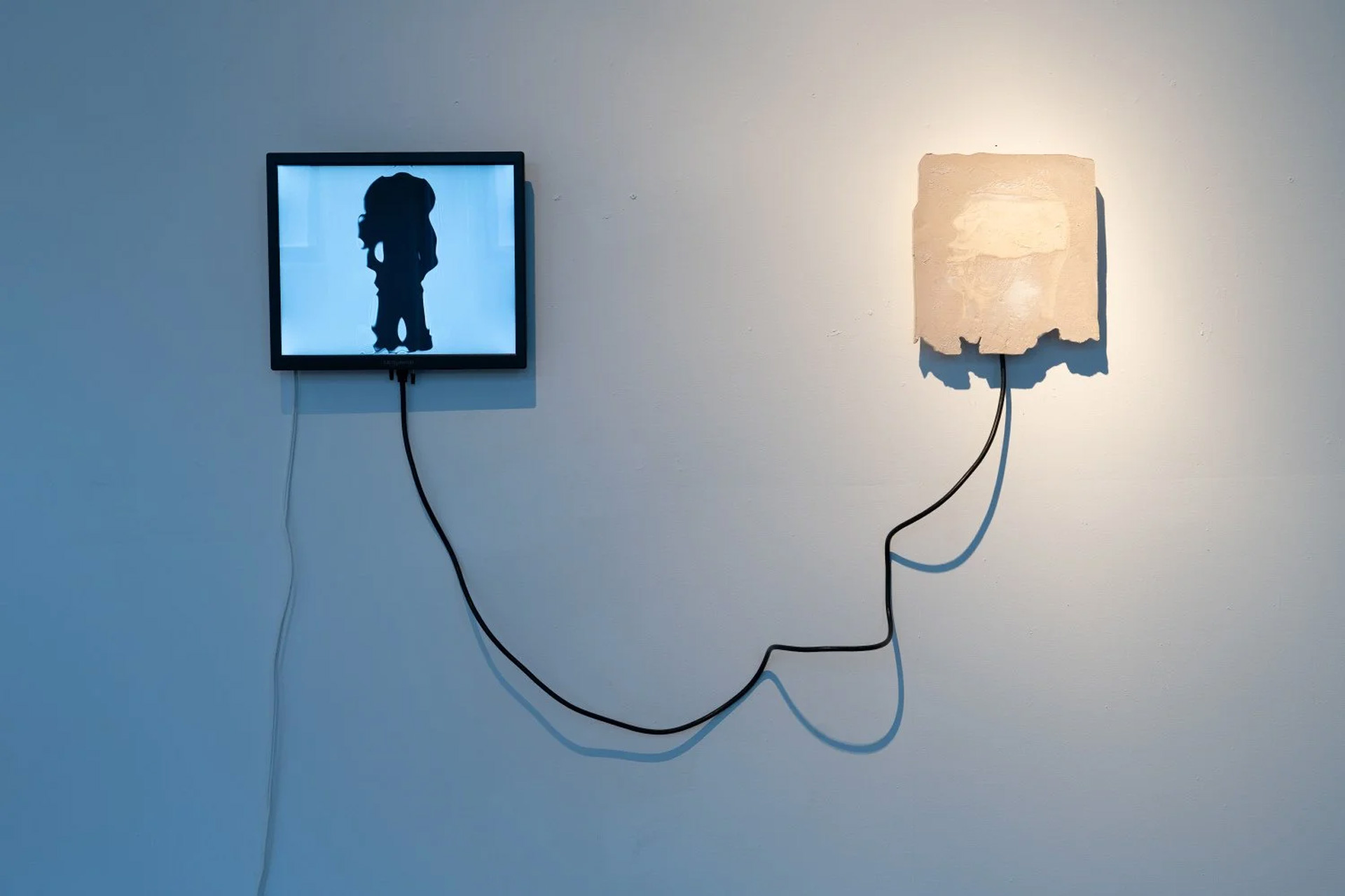
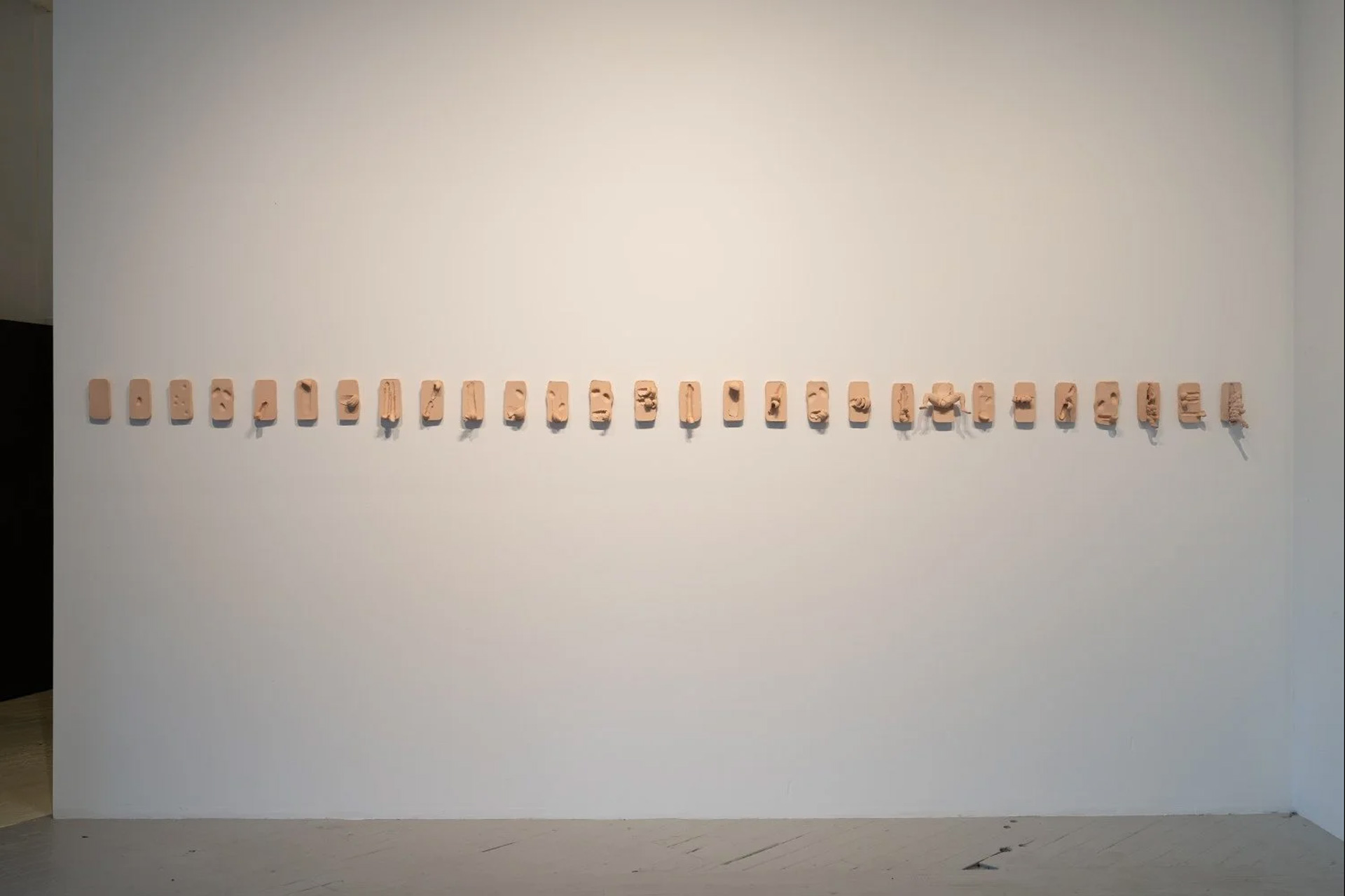
Group show Soft Screens, 2026. featured the artists: Nouf Aljowaysir, Anna Frants,
Alexandra Lerman, & Mari Nagem. Curated by: Isabella Indolfi & Paige King. Courtesy of MESH.
PK: That was really special for me. I worked at ThoughtWorks Arts residency and in 2020 Nouf was a resident and started to develop this work. It’s so rewarding to have MESH and be able to bring in artists that you’ve had relationships with for an extensive period of time, seeing their work evolve, and to provide a space for other people slash the public to experience these important and critical works, like Nouf’s. Her work shows the dominating western lens/bias embedded in AI and datasets and archives, and the dangerous implications of that.
II: The show came up really well and in such a fluid way. We had the same vision in our minds before we even put things together and it was impressive how we agreed on every little detail.
PK: Siiiiiiii, we work really well together. It emerged somewhat seamlessly.
II: I think that show was a statement for MESH, showing the type of works we want to engage with and the vision that will drive the curation.
PK: It’s been a really special incubation period for us. And now, as we start to move out of that phase, we’re thinking about how to expand the network, inviting organizations and collaborators to become recurring members, bring their research into the space, or develop a curatorial concept here. It’s exciting to finally be in a position where we can open the doors and invite others in. And we don’t see that network as being limited to New York. We want MESH to extend internationally as well. I’ve worked with CYLAND MediaArtLab for years, and through that work there’s this incredible network of institutions and organizations that are interested in having a presence in New York, sharing their work here, and creating new exchanges. That’s really what we hope MESH_ARTS can facilitate, connections between people, practices, organizations, and geographies that might not otherwise come together. Any concluding thoughts? [laughs]
II: It’s also worth mentioning that we’re bringing in an exhibition and performances centered around sound. We will be partnering with New Ear, a New York based festival directed by Daniel Neumann, who has been affiliated with Fridman Gallery for many years. We’re really excited to give this kind of sonic research a space at MESH and to see how the artists engage with and activate the space through sound and performance.
PK: Yes! And then we have two sound artists from CYLAND MediaArtLab, Sergei Komarov, who runs CYLAND’s sound art and audio department and archive, and Lidia Griaznova, who is both a curator and sound artist. They’re collaborating on a project that will be very much in conversation with Daniel Neumann’s work. Daniel will also be leading a workshop series on spatial sound, which we’re really excited about. So, there’s a lot going on, maybe more than we anticipated when we started this! [laughs] Readers can visit our website to see everything coming up. But this has been such a lovely opportunity to sit down together and actually hash out our origin story, how MESH started, what we imagined it might be, and how that vision is already shifting and growing as other people become part of it. We’re still so early in the process that it feels a little funny to even call it an origin story. I think it’ll be really special, and probably very amusing, to come back to this conversation ten years from now and see where all these mesh threads ended up.
II: Oh wow, I love that: a little time capsule. It’ll be wild to see how it all unfolded ten years from now! Okay, my dear, ciao!
PK: Ciao, bella!

To learn more about Isabelli Indolfi: isabellaindolfi.it
To know more about Paige King: paige-king.com
To learn more about MESH: meshartcenter.org