Over the last summer, I wove a landscape—one that began in my studio in New York and eventually traveled with me in a carry-on across the Pacific Ocean to Hawaiʻi. The work grew out of a desire to understand what happens to a landscape when it is carried through memory, distance, and migration. Since leaving Tehran, I have often experienced landscape as a form of connection to home. The sky, mountains, rivers, and changing light around me can suddenly return me to Tehran and the Alborz Mountains. At the same time, living in New York at sea level has given me entirely different landscapes to inhabit. My work develops in the space between these places, where one landscape overlaps with another.
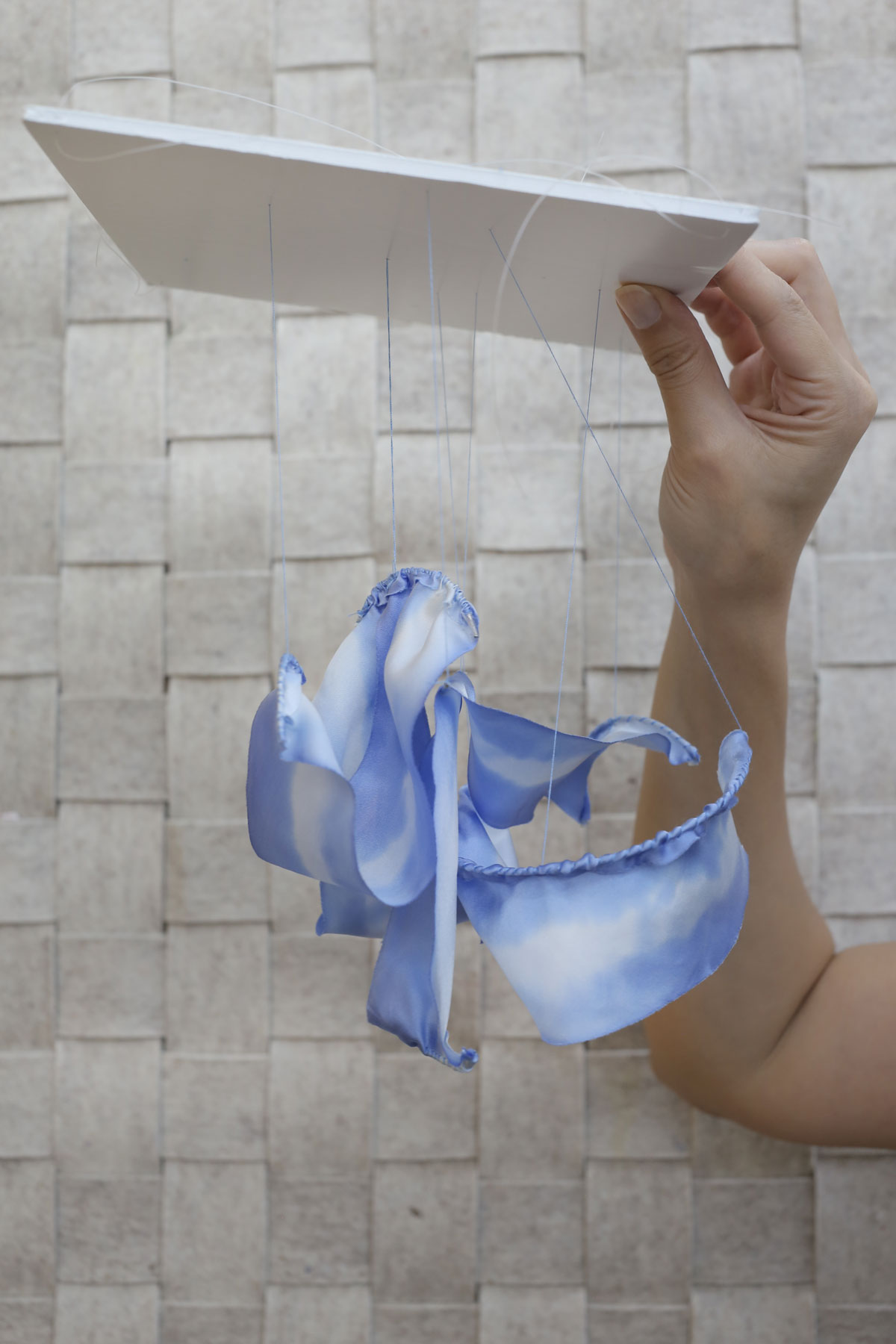
I began incorporating fabric into my fine art practice in 2016, but I had been immersed in textiles my entire life. My mother was, and remains, the most important influence on this relationship. Our home was always filled with fabrics: curtains, sheets, and my mother’s many chador namazes (prayer veils). As children, my brother and I would build a large tent in our bedroom using some of her chadors, creating a space that almost filled the entire room. I loved the world that emerged among the folds of the fabric. Lying on the carpets and looking up at the floral-patterned ceiling, I felt as though I had entered another reality. There was something surreal and deeply joyful about inhabiting that temporary space.
Another formative memory is of my mother soaking white curtains that had turned light yellow from sunny days in Tehran in indigo dye; I watched the fabric transform, and the yellowness turned into clear shades of light blue, closer to white, before I hung them on the rooftop to dry in the wind. These memories shaped my understanding of fabric not simply as a material, but as something that can transform a space, carry knowledge, and hold personal and cultural histories, as well as sustainability.
It feels natural, then, that my first installation grew out of this relationship. With my mother’s help, I up cycled old sheets and curtains; she taught me to dye, sew, and mend textiles. I want to acknowledge her knowledge and skill, and the countless forms of labor she mastered as a traditional homemaker. Like so many women, she learned from her mother and carried out this work without formal recognition or financial compensation. Her influence is woven into my practice, not only through the techniques she passed on to me, but also through the memories, gestures, and forms of care that first taught me to see fabric as a space of possibility.
In my recent work, I have been exploring how painting can move beyond a flat surface and occupy space. Birds in Search of Blue Expanses, my installation at Shangri La Museum, grew from this question. I wanted to bring together my background in painting and my long-standing relationship with textiles, letting the material itself transform the image.
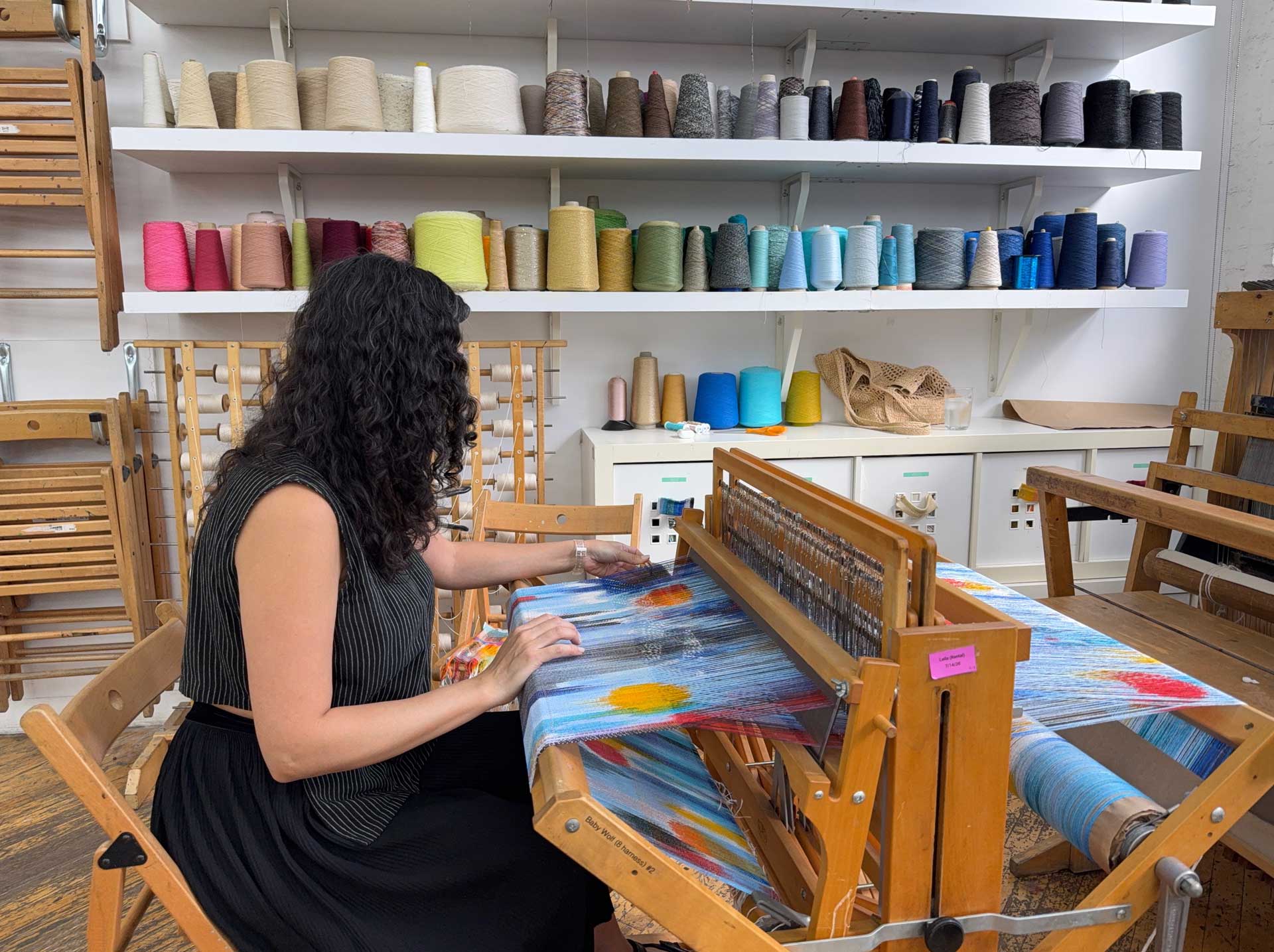
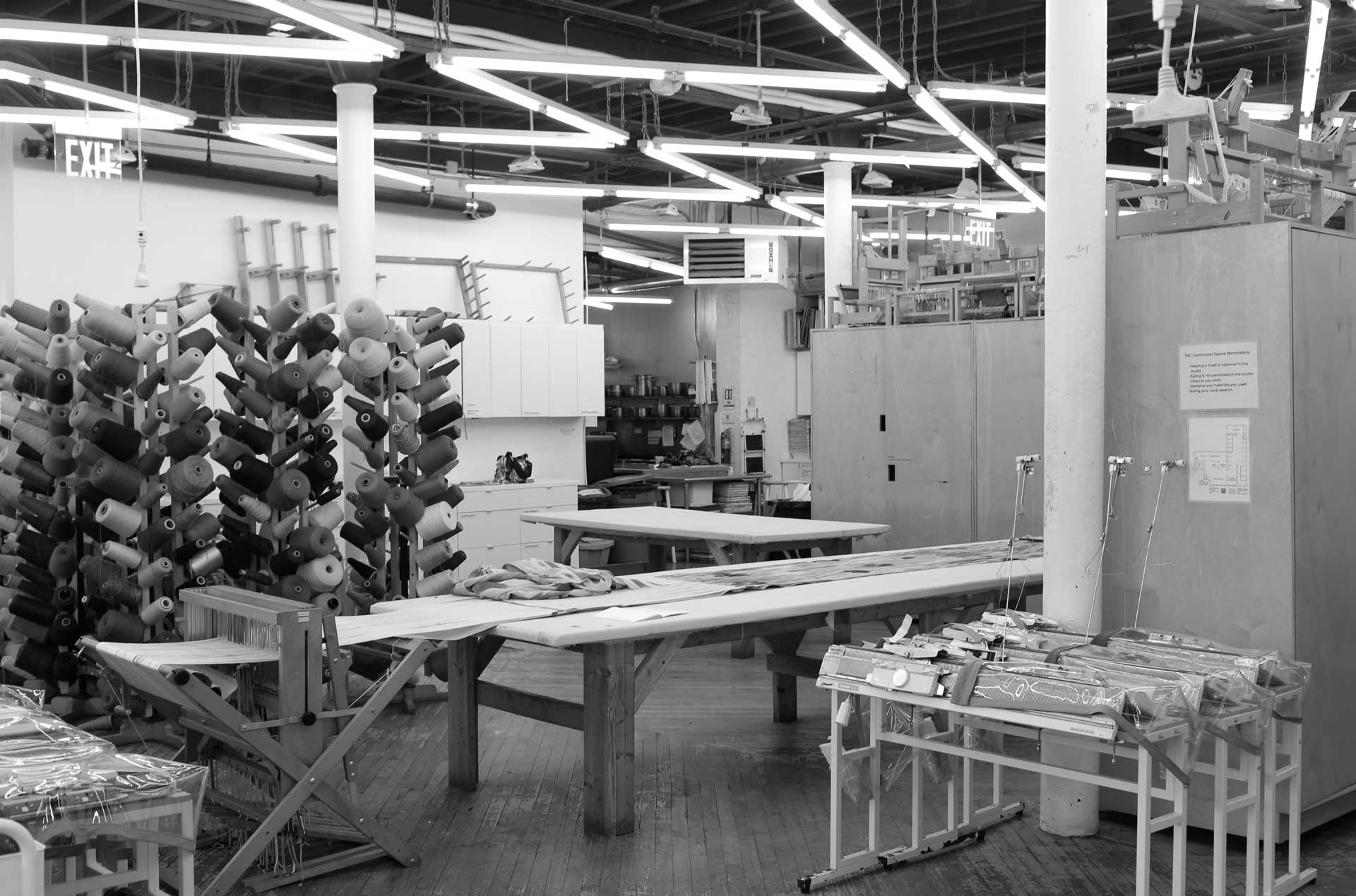
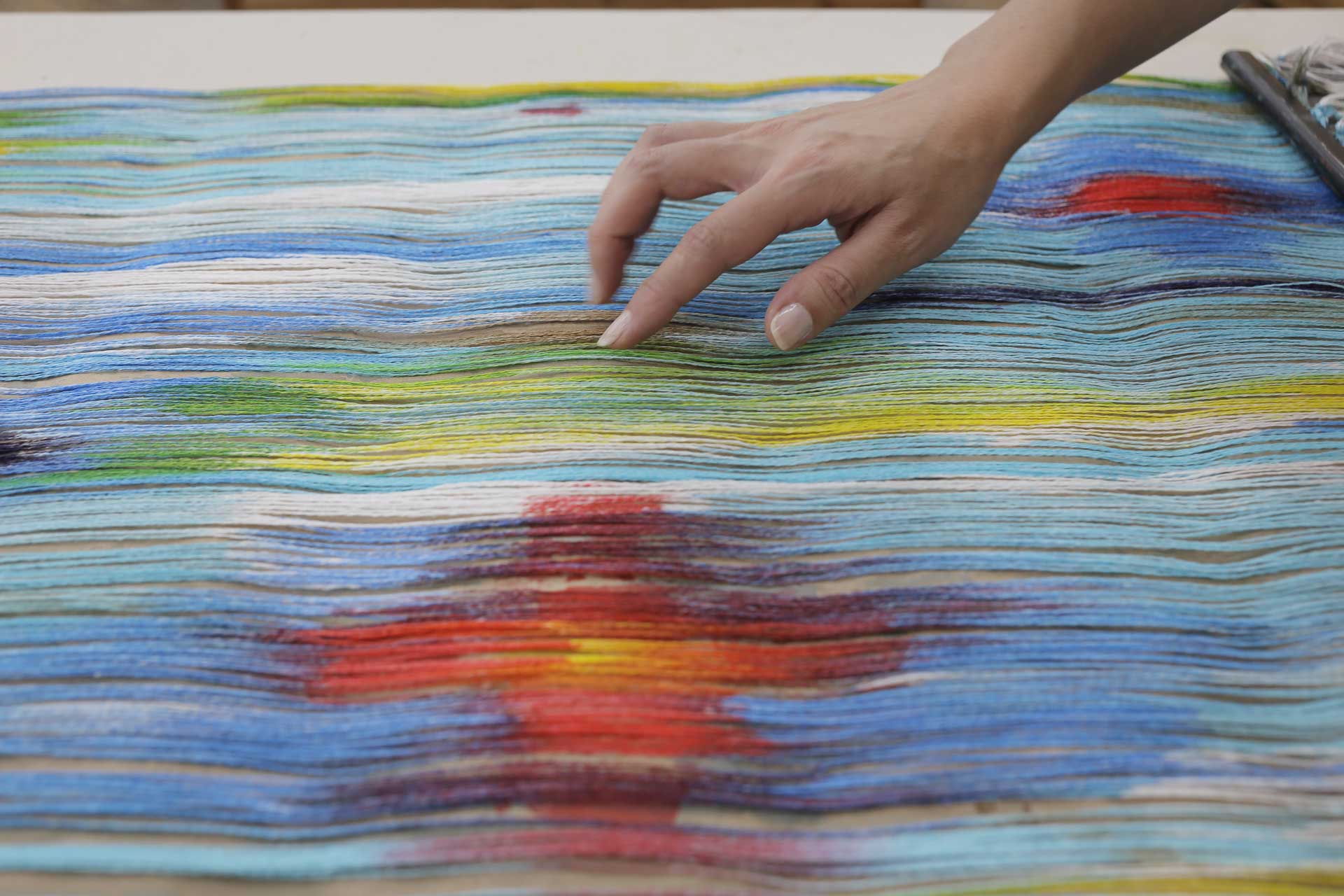
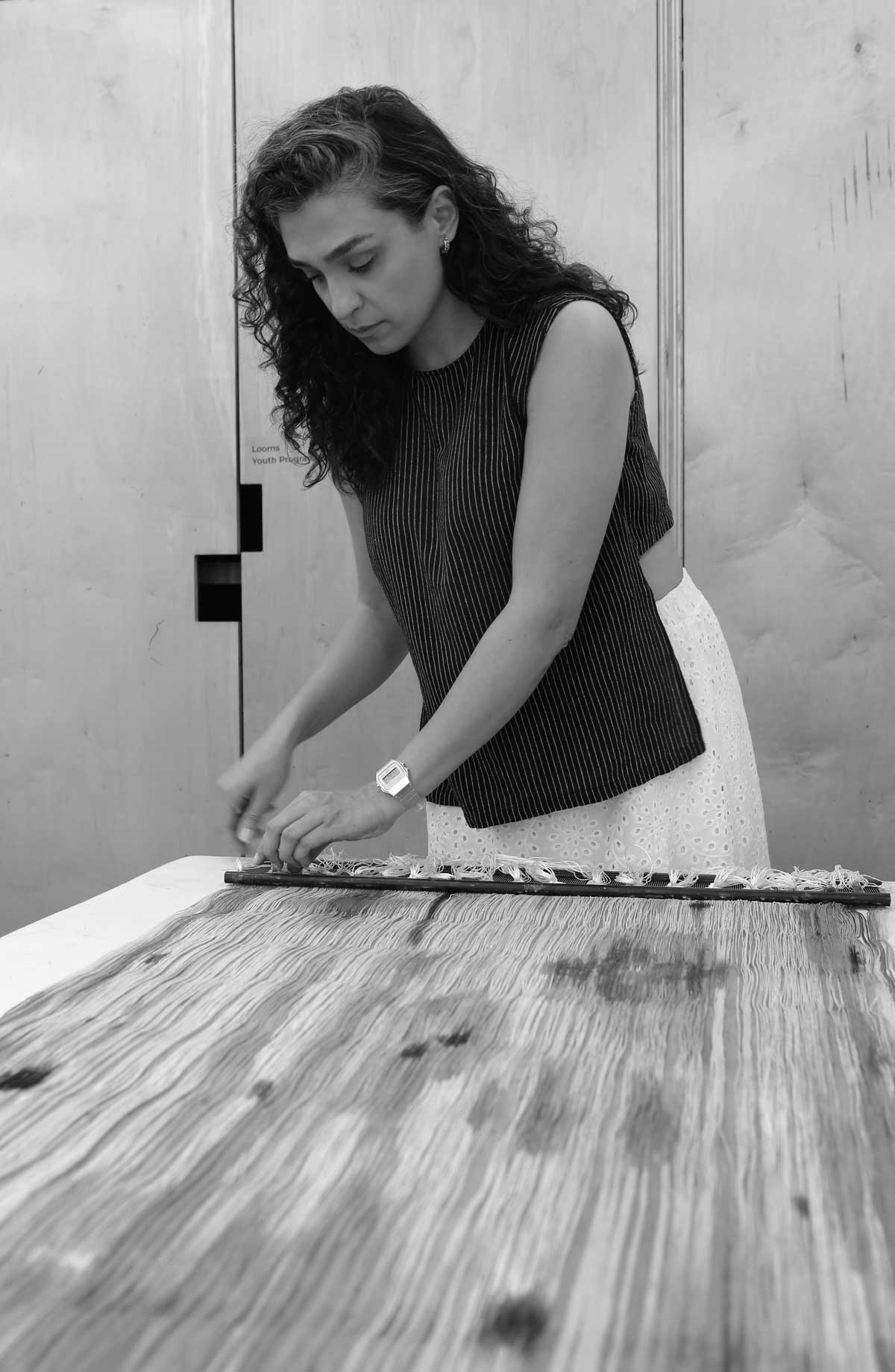
I shaped the work over the summer in my studio at the Textile Arts Center in New York. I worked with thirteen yards of linen yarn to create three woven paintings, each 26 inches wide and measuring 6.5, 3.5, and 3 yards in length. After dressing the loom, I had to pull the yarns out of it before I could paint on them. Instead of painting on a continuous surface, I worked directly on the individual yarns outside the loom.
I drew inspiration from the flower patterns in the collection tiles and the ocean’s blue. Once the painting had dried, I carefully returned the yarns to the loom and began weaving. Painting let me establish an image across separate threads, while weaving brought them together, interrupted the painted forms, and gradually transformed them into something new. I had to imagine how marks distributed across individual yarns might eventually come together through the structure of the weave. As the threads crossed, the image shifted. Lines and colors were interrupted, and forms emerged differently than I had initially imagined.
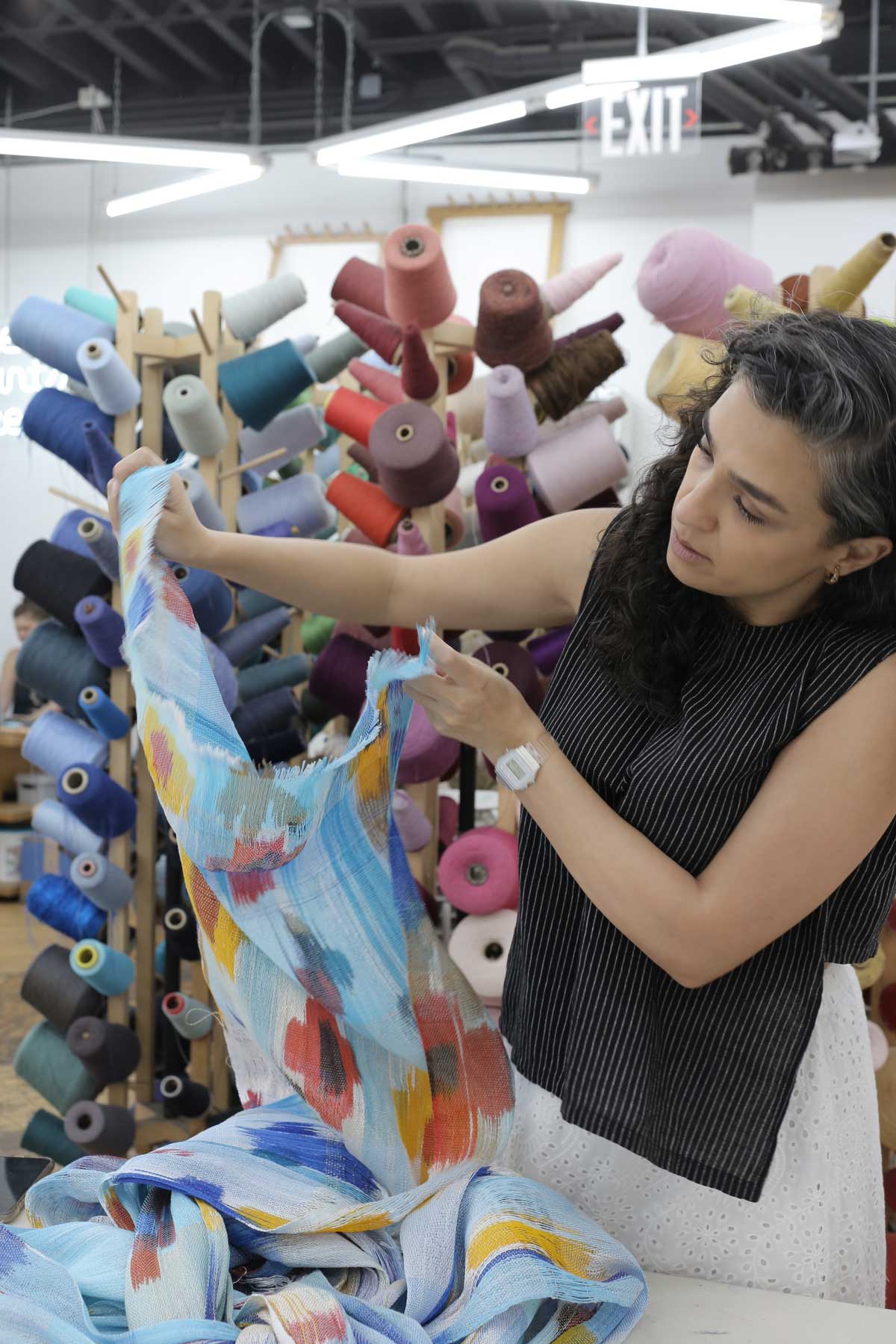
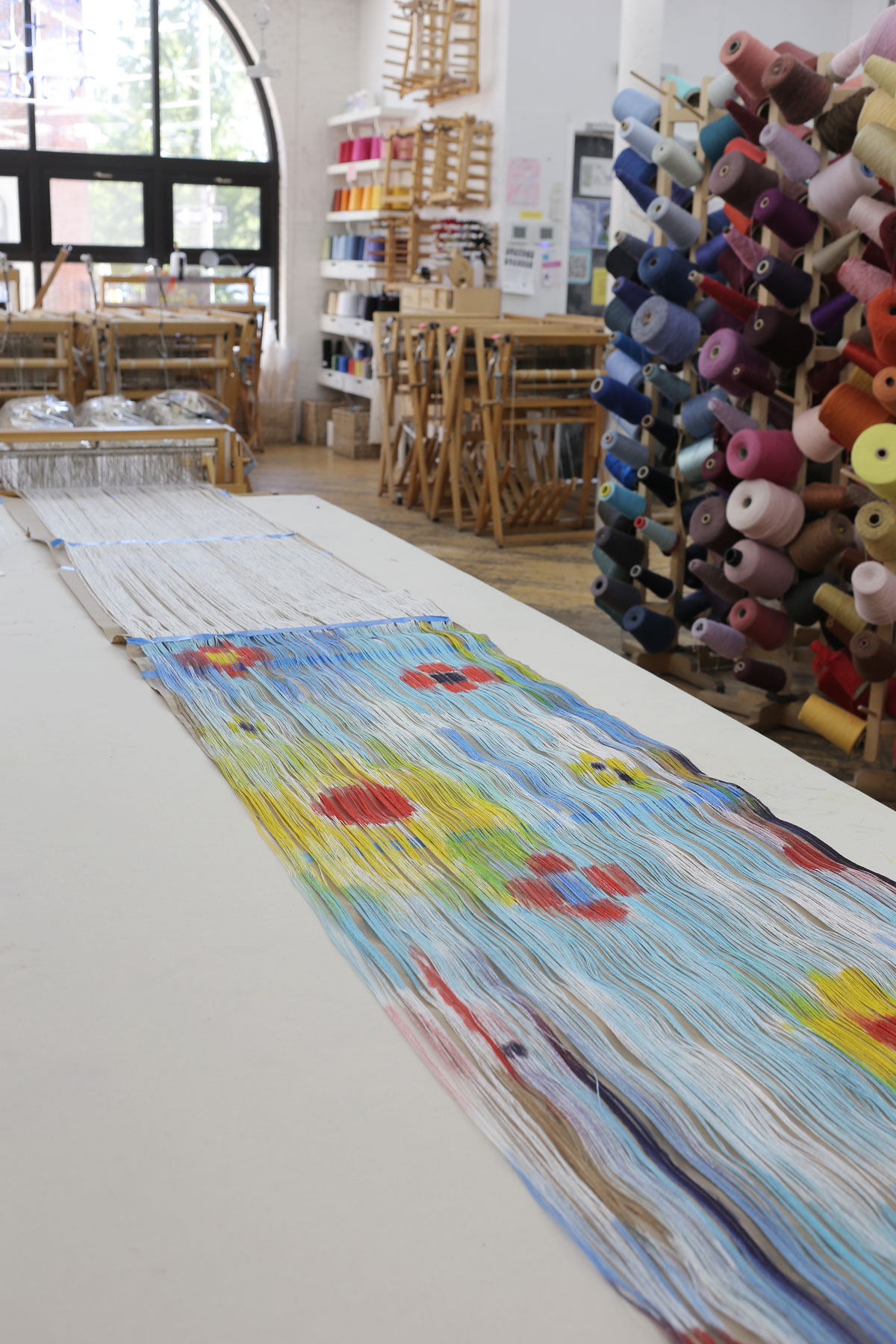
I became interested in the interval between taking the yarns apart and bringing them together again. The image had to be dismantled before it could become a woven painting. This physical separation and reconstruction resonated with my experience of migration and memory. What I remember of a place is never a complete, unchanging image. I assemble it from fragments, sensations, and present encounters. Something familiar can become unfamiliar, and something that seems lost can suddenly return in an altered form. Similarly, the landscape in these works could not exist in its final form until the individual threads were brought back together.
My research often begins with close attention to images, materials, and places that have stayed with me. I return to Persian miniature painting, or Negārgari, particularly its use of flattened space and multiple viewpoints. Unlike the single-point perspective associated with Western painting, Negārgari can show different elements from different orientations at the same time. Vertical elements are presented frontally, while horizontal surfaces are seen from above. Rather than organizing everything around one fixed viewpoint, a composition allows several perspectives to coexist.
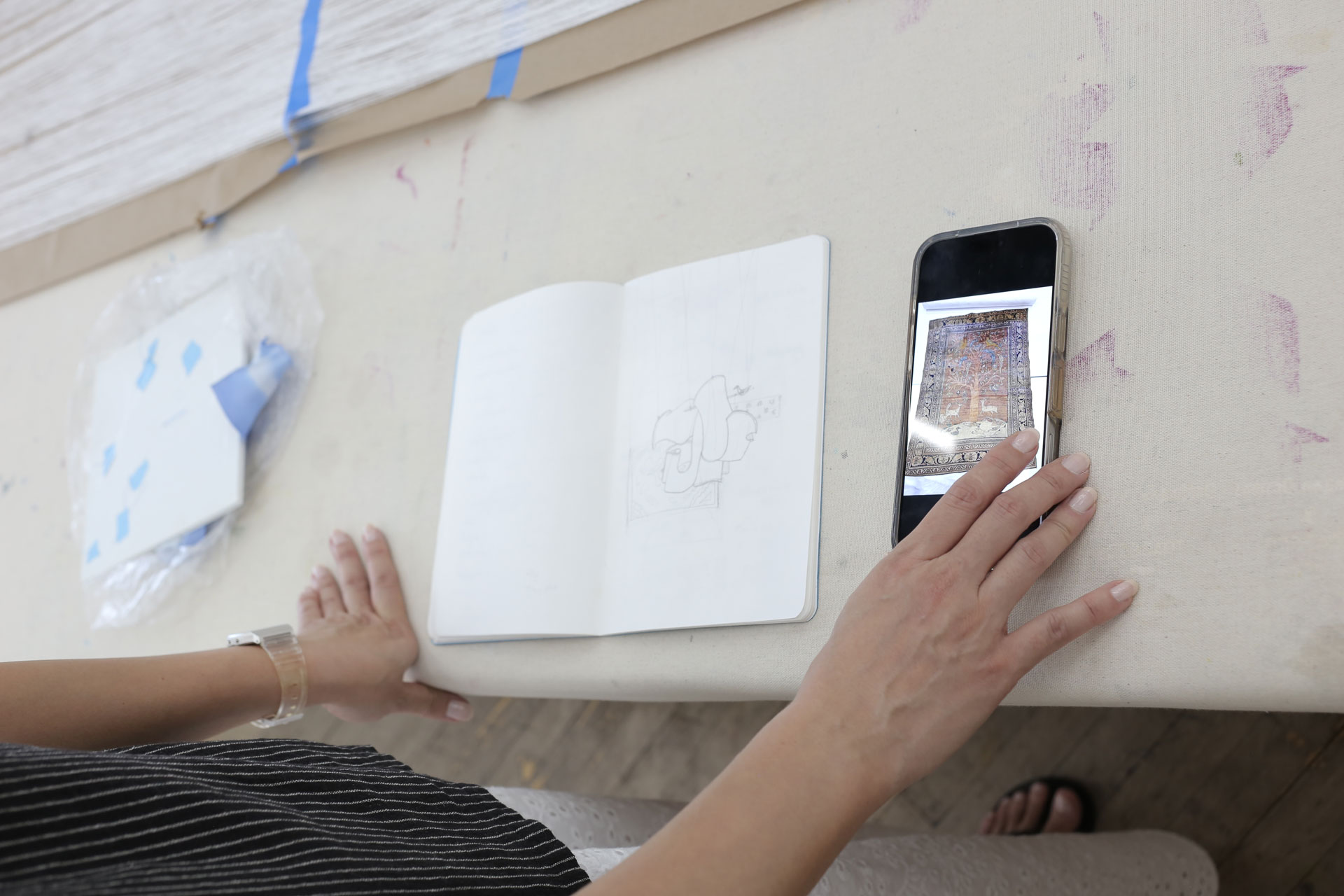
This spatial logic offers a way to think about inhabiting more than one place at once. After leaving Tehran, I became increasingly attentive to the sky and the open horizon. The Alborz Mountains and sky I remembered from home began to coexist with the East River, the North Atlantic Ocean, and the expansive horizons I encountered in New York. I became interested in how moving between places changes not only what we see, but also how we see it.
For this installation, I extended Negārgari spatial logic beyond woven surfaces. The suspended woven paintings stand vertically, while Persian carpets from the museum’s collection hang on the wall, presented as flowering plains viewed from above. The carpets become more than textiles or familiar domestic objects; they function as landscapes; horizontal planes translated into a vertical orientation. The installation asks viewers to move between these different ways of seeing rather than remain in front of a single fixed image.
Making the installation in Hawaiʻi brought another dimension to this process. Persian architecture, the Pacific Ocean, mountains, tropical vegetation, and the museum collection entered into conversation with the landscapes I carry from Iran. I was not trying to reproduce either place. Instead, I wanted them to coexist within the work: the landscape I physically encountered in Hawaiʻi alongside the landscapes that continue to shape my sense of home. As viewers move through the installation, their relationship to the work changes. There is no single position from which the entire landscape can be seen. Fragments of blue birds in Safavid tilework, with yellow backgrounds, from Vank Cathedral in Isfahan and the Shangri La collection became part of this dialogue. I brought these birds into conversation with a white-tailed bird made of silk, titled Koa‘e Kea. The bird became another figure of movement and transition, connecting Hawaiʻi’s landscape with an installation shaped by memories of Iran. Its presence allowed me to think about migration beyond the human experience, through birds flying across landscapes and their relationship to the sky and ocean. The birds exist between different places and visual histories, much as the woven paintings bring separated fragments together.
The title, Birds in Search of Blue Expanses, comes from a poem by the Iranian poet Forough Farrokhzad, in which birds depart in search of the blue. For me, this search speaks to the desire to find belonging while carrying memories of another place. A bird leaves one landscape and flies toward another, but the place it came from does not simply disappear. It remains part of its movement. The blue expanses suggest an openness that can be approached but never entirely possessed—a horizon toward which one continues to move.
When the woven paintings were finally suspended in the gallery, the process I had experienced in the studio became architectural. The work left the loom and entered space. Painting became textile; textile became sculpture; and the image became a landscape you could walk through. What began as individual painted yarns became an environment in which relationships among objects, architecture, and viewers continually changed.
Ultimately, Birds in Search of Blue Expanses is about the search itself. The landscape is not something I arrive at. I continually construct, dismantle, remember, and see it again from another position. Through weaving, I have found a way to make that experience visible. The work holds together fragments that might otherwise remain separate, allowing them to form a landscape without losing the traces.
You can find out more about Larissa at @azuolarissa // www.simoesdeassis.com/artistas/larissa-de-souza
Photos: Anita Goes