The painting serves as a hinge for analyzing Silva’s rural and urban depictions, bringing together formal strategies developed in her harvest scenes and her attention to urban life, its social dynamics and forms of coexistence.
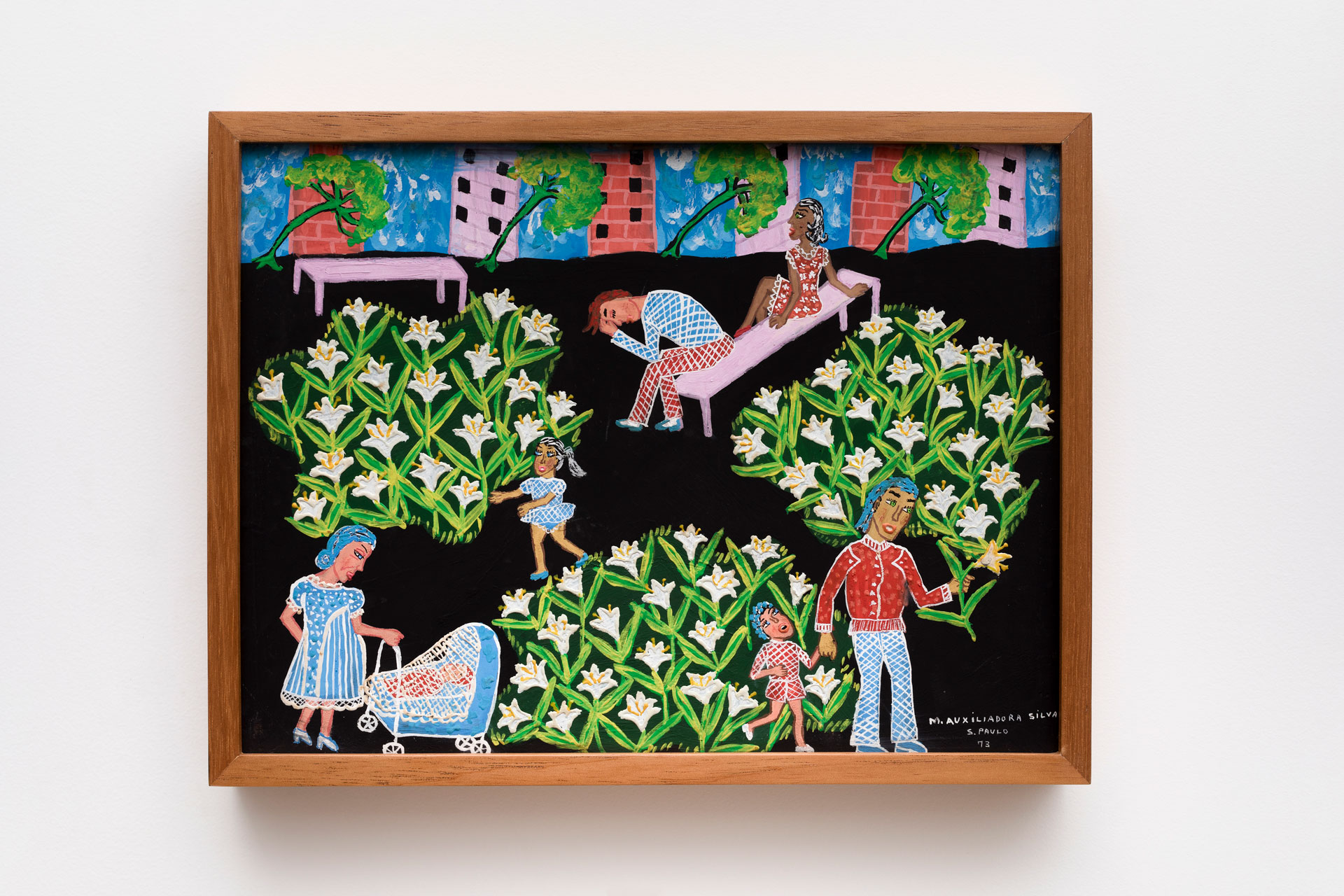
Maria Auxiliadora Silva, At the Park, 1973. Gouache on cardboard glued to canvas, 25 × 33 cm. Courtesy of the artist’s family and Mendes Wood DM.
Last April, the exhibition I curated, Maria Auxiliadora Silva: Imprinted in My Mind, opened at the Hessel Museum, gathering paintings and archival material and, with them, questions about how her work has been seen and classified.
Maria Auxiliadora Silva was born in 1935 in rural Campo Belo, Minas Gerais, to Maria Almeida da Silva and José Cândido da Silva. At the age of three, she moved with her family to the bustling city of São Paulo, where she grew up in a large family of artists. From an early age, she experimented with embroidery, drawing, and painting.
Coming from a working-class background, Silva balanced artistic production with other occupations for many years before dedicating herself fully to art from 1968 on. In the late 1960s, she became part of the Embu das Artes artistic community, led by Solano Trindade, a poet, playwright, and cultural activist who was a key figure in the Black Brazilian cultural movement. During Brazil’s military dictatorship, artists gathered in the city of Embu das Artes to discuss, exhibit, and circulate their work, creating spaces of resistance and affirmation. Silva died in 1974, leaving a prolific and cohesive body of work grounded in lived experience, collective memory, and material experimentation.
During her lifetime, Silva’s work was framed as naïve or primitive. After her death, it faded from institutional art circuits, returning only in the past decade through surveys and group exhibitions (1). Yet, reductive labels such as self-taught or outsider art are still commonly applied to the artist and her oeuvre. These categories, shaped by race, gender, and class, measure her distance from art institutions and leave little room for close analysis of her stylistic decisions or the social and material concerns that informed her practice. Working with an archive marked by these absences, I took the paintings as primary sources and entry points, following their cues. In Listening to Images, the cultural theorist Tina Campt proposes a method “that reckons with the gaps, fissures, and interstices that emerge when we refuse to accept the ‘truth’ of images and archives.” (2) Bringing that attentiveness to painting meant resisting the urge to classify and staying with what the works register beyond what is immediately seen. The exhibition design gave each painting room to create its own environment, allowing the works to be seen up close and on their own terms.
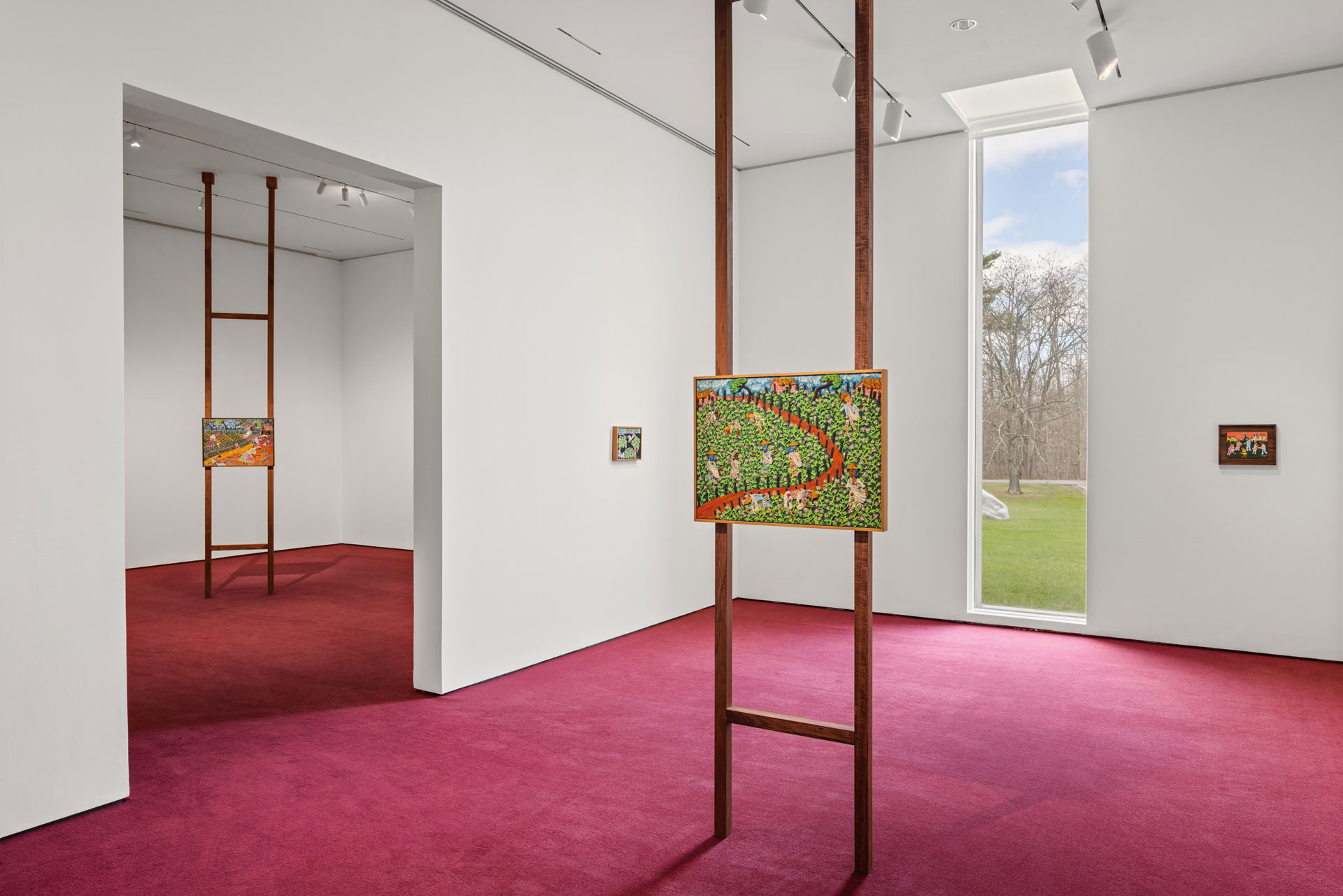
Annandale-on-Hudson, NY, April 4 – May 24, 2026. Master’s thesis exhibition curated by Bruna Grinsztejn. Photo: Alon Koppel 2026.
Silva is still often referred to simply as Maria Auxiliadora, by her first name alone or, more rarely, with the full name Maria Auxiliadora da Silva. Yet she signed her works M. Auxiliadora Silva, with the M abbreviated and without the da particle. The choice was deliberate, as the archive confirms (3). Her signature is a form of self-authorship, reflecting ownership over how she would be named as an artist.
The late 1960s and early 1970s were also marked by intense experimentation. From 1968 onward, chance became an active component of her process: strands of hair embedded in paint were not treated as accidents but as generative forms, producing volume and movement within the pictorial surface. At the time, she was exhibiting and selling her work at Praça da República (4). She recalled that people recoiled from paintings containing hair, but she wanted to preserve their three-dimensionality (5). She therefore incorporated house-repair materials to build sculptural relief, further collapsing distinctions between painting and objecthood. As she put it, “I begin to make the relief as if it were a sculpture.” (6) Such choices demand to be read as deliberate formal operations rather than indications of naïveté.
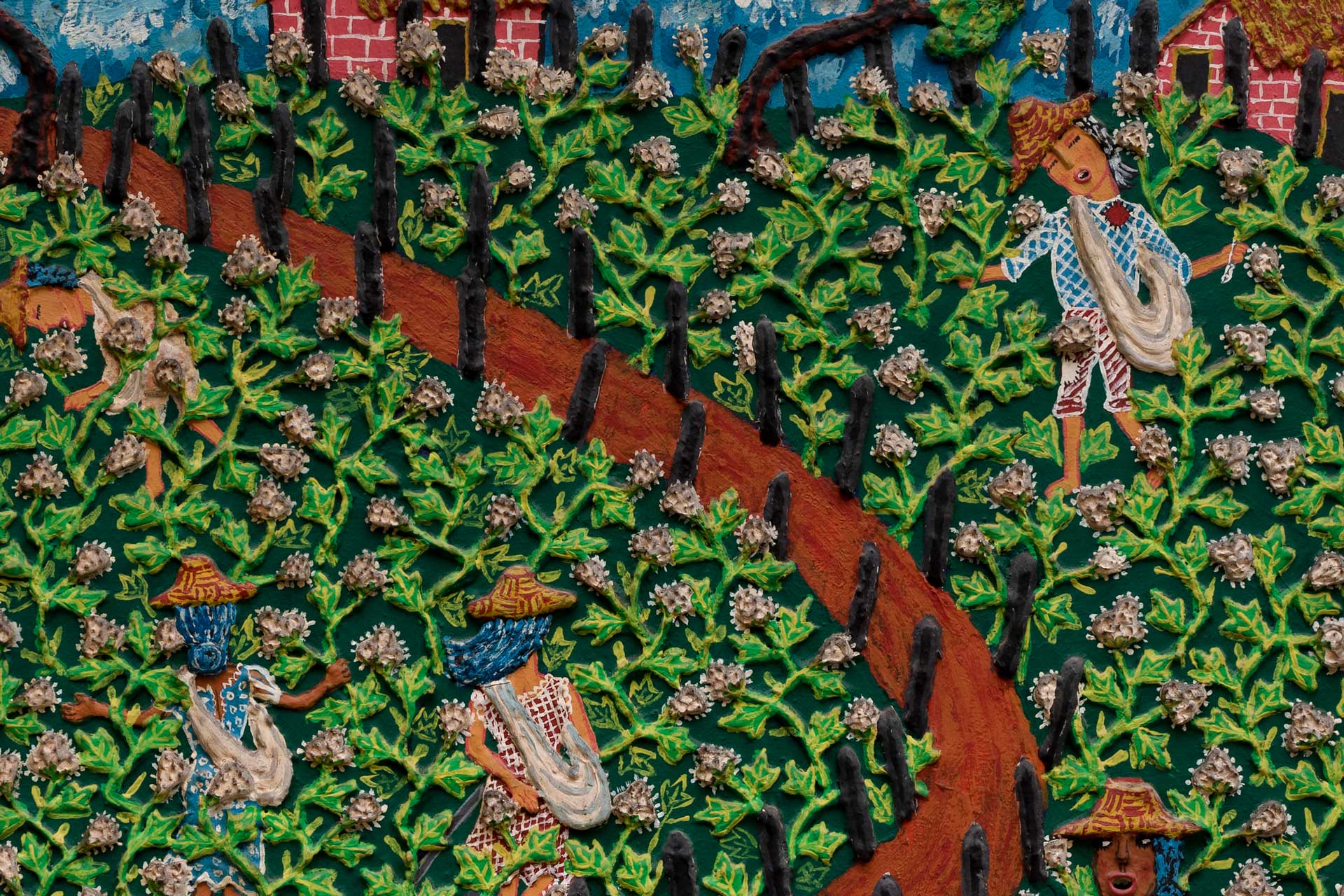
Maria Auxiliadora Silva, Cotton Harvest (detail), 1973. House-repair paste and oil on canvas, 53 × 73 cm. Courtesy of the artist’s family and Mendes Wood DM. The work’s original title was identified by the author in Pietro Maria Bardi and Crisalido Morais, eds., Festa das Cores (São Paulo: Museu de Arte de São Paulo, 1975), [19].
Silva’s mother, Maria Almeida da Silva—a sculptor, embroiderer, and poet—transmitted technical artistic knowledge alongside a deep attachment to artistic practice. Silva and her mother embroidered together, “covering all the surfaces of their home” (7) with stitched textile works, a sustained practice that left clear traces in Silva’s paintings. In many works, she forgoes contour lines, producing spatial recession through differentiated textures and repeated motifs: a translation of embroidered surface into painted field, where depth arises not through perspectival illusion but through patterned variation and tactile accumulation. That this transmission passed through her mother’s hands—through embroidery, domestic practice, and shared making—rather than through an institution is precisely what classifications such as “self-taught” fail to account for.
Silva recalled that her mother was also central to the oral recollections of their past in Campo Belo (8). Her rural scenes are frequently misread as literal depictions of her surroundings. In reality, Silva, who spent most of her life in urban São Paulo, drew on childhood memories “imprinted in her mind” (9) and narratives transmitted by her mother. Her rural imagery operates as a space of reverie, where landscape is built from recollection and transmission and carried by what Campt calls the power to imagine “beyond current fact.” (10)
These imagined fields were also precisely named. Archival documentation shows that Silva titled the harvests by what was grown: Roses, Blue Roses, Daisies, Blue Rhapsodies, Cineraria, White Daisies, Periwinkles, Grapes, Carnations, Gladiolus, Tomatoes, Orange Trees, Papaya Trees, Palm Trees, Coffee, Cotton, and Corn (11). Many of these titles have since been lost, and the paintings are now registered as “Untitled” or simply as “Harvest,” effacing the detail and care of her originals. Read together, the documented titles restore to each painting its particular abundance within a larger world of plenty.
Populated by roses, carnations, and lilies, these fields are hardly places of rest and contemplation. Work organizes them: bodies bend over crops, backs curve, and gestures repeat as figures cultivate and harvest. Labor appears as part of daily existence, neither abstract nor romanticized. Within this order, though, some figures drift away from the rhythm of work toward intimacy, play, or distraction. These small deviations make it difficult to read the scenes as simply productive or as mere tableaux of toil. Desire and idleness coexist with duty, in subtle refusals or suspensions of productivity that disrupt the totalizing logic of labor without leaving it behind.
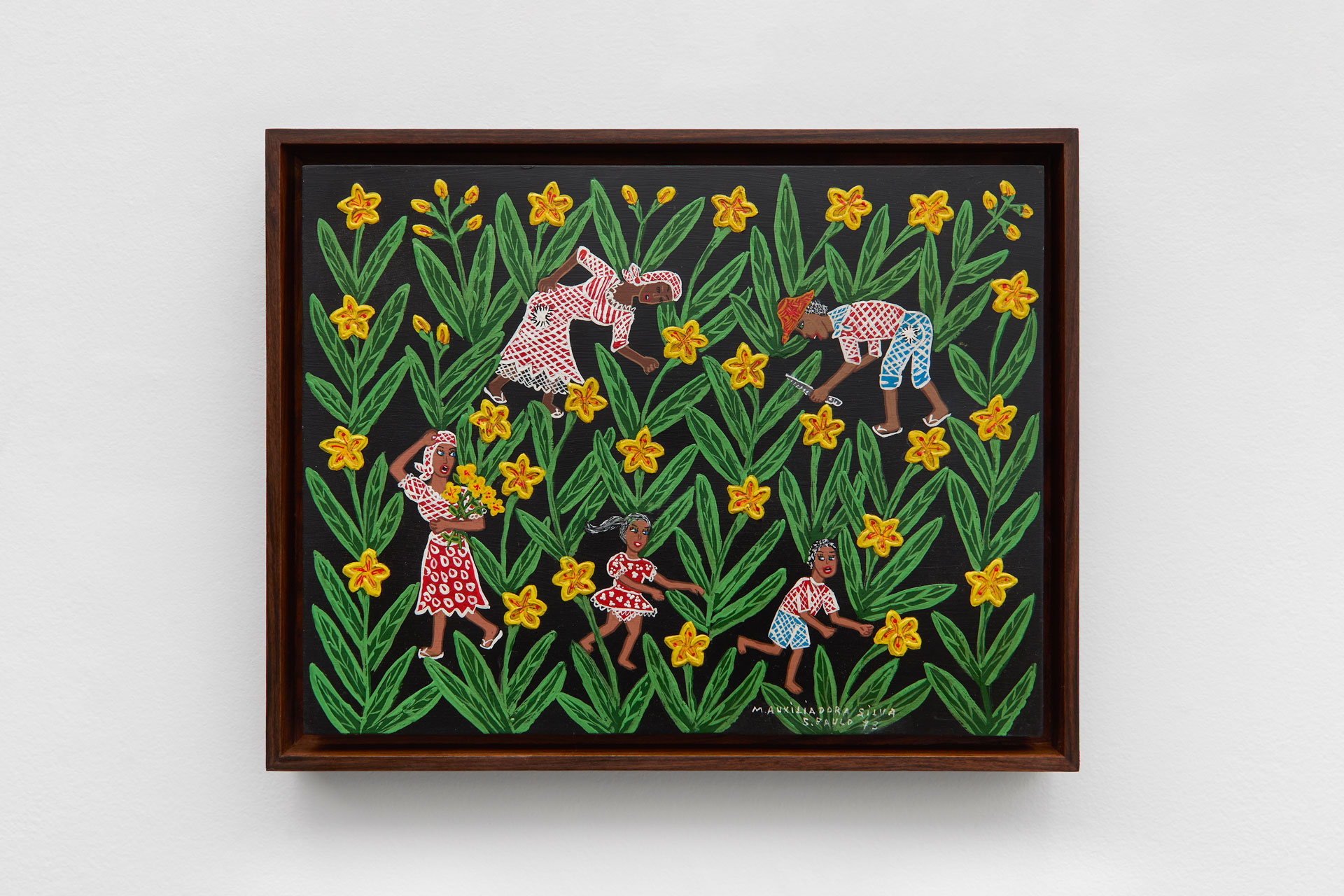
Maria Auxiliadora Silva, Harvest, 1973. Oil and gouache on hardboard, 27 × 35 cm. Courtesy of the artist’s family and Mendes Wood DM.
The rural in these paintings is charged with excess and proliferation. Figures move between labor and diversion, discipline and desire, while the scenes spill beyond the moral and productive frameworks that might otherwise hold them. A force runs through the paintings that insists on flourishing through expansion, persistence, and transformation—and it carries an erotic charge present in the abundance of crops, in the contact between figures, in flowers that seem to multiply across the surface. Tina Campt suggests that images can be approached through the affective frequencies they register as much as through what they show (12). Seen this way, the dense floral fields work as affective atmospheres, saturated with intensities felt before they are recognized. Here, beauty arises from the exuberance the paintings radiate.
Desire in Silva’s work also has a collective dimension, one that the museologist Lélia Coelho Frota identified in the Embu group’s artistic production: an Afro-Brazilian theme with a Dionysian approach, privileging movement (13). Silva’s dance hall paintings portray this vision. Animated by music—represented through sound systems emitting musical clefs or musicians performing for audiences of couples and solitary figures—her compositions stage forms of sociality in which participants appear on relatively equal terms, each rendered with a care that reinforces their individuality. These scenes register a celebration of Black subjectivity: of presence, pleasure, and belonging in spaces where Black people were rarely expected to claim symbolic authority. Painted during the anos de chumbo of the military dictatorship (14), they carry an affirmative life drive: couples dance, flirt, and gather against the normative pressures of the regime.
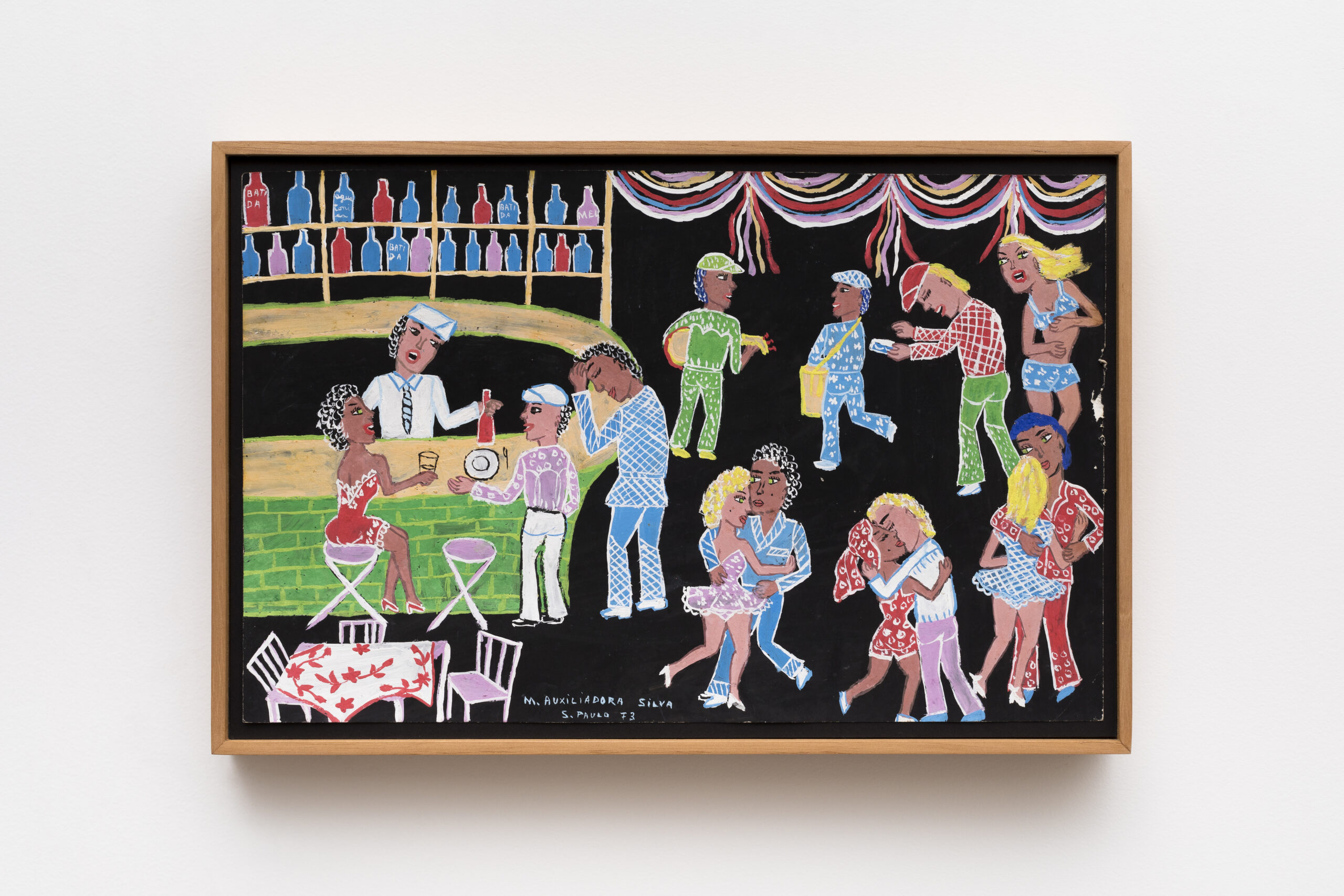
Maria Auxiliadora Silva, Ball, 1973. Oil and gouache on paper on hardboard, 20 × 31.5 cm. Courtesy of the artist’s family and Mendes Wood DM.
Such collective consciousness sits uneasily with the label outsider (15), which presumes isolation from the art world and its conversations. Applied to Silva, it overlooks her deep participation in, and contribution to, the Embu community—a community engaged in dialogue with the institutions of the metropolis even as it functioned as a counter-institution in its own right.
Recent scholarship and exhibitions have sought to rethink artists long classified as outsider, naïve, or primitive. In Outliers, the art historian Lynne Cooke proposes a new term, the outlier, to shed the pathologizing connotations of outsider and treat difference as a relational and productive condition (16). It is a significant advance. Yet renaming, however critically motivated, does not fully escape the logic it seeks to displace.
Etymologically, outlier refers to something that lies outside a boundary or enclosure. Applied to Silva, the term suggests that she produced outstanding work despite her circumstances, when actually her practice took shape precisely through her family of artists, the Embu das Artes community, and the Praça da República art scene.
Had Silva’s work been present in the debates of its time, it might have opened alternative ways of seeing urban and cultural life, foregrounding different rhythms, forms, and subjectivities. One can imagine an early 1970s exhibition placing Silva’s pieces alongside Hélio Oiticica’s Parangolés (1964–80), Heitor dos Prazeres’s paintings, Carlos Vergara’s Cacique de Ramos (1972–76), and the work of other artists engaging with carnival and street-based practices; in dialogue with Wanda Pimentel’s Involvement series (1968–75) and Anna Maria Maiolino’s work around dictatorship, gender, and domestic space; or bringing her iconography of African deities into conversation with that of Agnaldo Manoel dos Santos, whose work was likewise entangled with Brazil’s modernity. Such constellations can be constructed retrospectively and staged today. Yet when these encounters do not take place in their historical moment, they lose their critical momentum—the capacity to generate new relations, contaminations, urgencies, and forms of thought that emerge through contemporaneous friction.
More than fifty years after her death, revisiting Silva’s oeuvre reveals not an exceptional artist who transcended her circumstances, but a practice fully embedded in its epoch: formally deliberate, historically grounded, and engaged with the contradictions and possibilities of its time. This embeddedness is the source of the work’s power—poignant, political, and unapologetically contemporary. The categories through which such work has been framed are far from neutral; they are political, structuring how value, visibility, and authorship are assigned.
Silva’s paintings remain open, resisting closure—a continuation, a yearning, a striving for futurity. They do not settle into interpretive frames but sustain a vital force that defies containment, much like the gesture of the man in At the Park who plucks a lily from the flowerbed, animating the composition in an unexpected way. The paintings overflow.

Top center: Talita Zaragoza in her grandfather’s studio during the pandemic, which now hosts exhibitions and cultural events (Taller Zaragoza). São Paulo, 2021. Lower left and right: Talita Zaragoza, Mini Z’s, 2021. Acrylic, colored pencil, and crayon on paper, 9.8 x 7.5 inches. Courtesy of the artist.
1. See, among others, Maria Auxiliadora: vida cotidiana, pintura e resistência, Museu de Arte de São Paulo Assis Chateaubriand (MASP), 2018; and the 36th Bienal de São Paulo, 2025.
2. Tina M. Campt, Listening to Images (Durham, NC: Duke University Press, 2017), 8.
3. On her 1969 registration form for the São Paulo Biennial, her legal name, Maria Auxiliadora da Silva, appears in the field “artist ‘s full name,” while the name she gave for the catalog is Maria Auxiliadora Silva. Although she submitted her works, Silva did not take part in the 1969 Biennial. The same name appears on the identity card issued to her in 1972 by MOBRAL, the military regime ‘s adult literacy program. Source: Artist registration form of Maria Auxiliadora Silva for the 10th São Paulo Biennial, 1969, Fundo Maria Auxiliadora, Arquivo Histórico Wanda Svevo, Fundação Bienal de São Paulo; Pietro Maria Bardi, Maria Auxiliadora (Turin: Bolaffi, 1977), 21.
4. The Silva family exhibited and sold artworks at the Sunday fair in Praça da República, in central São Paulo, for about forty years.
5. Lélia Coelho Frota, Mitopoética de 9 artistas brasileiros (Rio de Janeiro: Grupo de Planejamento Gráfico Editores, 1978), 77. Silva’s interview with Frota is the only one she gave during her lifetime.
6. Frota, Mitopoética, 69. 7. Frota, Mitopoética, 70. 8. Frota, Mitopoética, 70.
9. Ibid.
10. Campt, Listening to Images, 17.
11. Registration form, 1969 (see note 3); checklist of the exhibition Maria Auxiliadora, Museu de Arte de São Paulo Assis Chateaubriand (MASP), 1981, Dossiê Maria Auxiliadora, Centro de Pesquisa, MASP. Titles translated by the author.
12. Campt, Listening to Images, 4.
13. Frota, Mitopoética, 69.
14. Anos de chumbo (“years of lead”) refers to the most repressive phase of Brazil’s military dictatorship, roughly from 1968 to 1974.
15. The term was coined by Roger Cardinal in Outsider Art (London: Studio Vista, 1972) as an English equivalent of Jean Dubuffet’s art brut, designating artists presumed to work outside, and untouched by, the art world and its traditions.
16. Lynne Cooke et al., Outliers and American Vanguard Art (Washington, DC: National Gallery of Art; Chicago: University of Chicago Press, 2018).

Talita Zaragoza, Sleepy Mountain XXXIII. Acrylic, colored crayon, pencil and graphite on linen, 41 x 79 inches. Courtesy of the artist.
Bruna Grinsztejn is a curator and researcher based in New York. Her work focuses on contemporary art, with particular attention to Latin American art in a global context. She has worked with galleries and institutions in the United States, Brazil, and Cuba. She holds an M.A. in Curatorial Studies from the Center for Curatorial Studies, Bard College, and is currently an ISLAA (Institute for Studies on Latin American Art) Fellow. Her recent exhibition Maria Auxiliadora Silva: Imprinted in My Mind (Hessel Museum of Art, 2026) reassessed the artist’s practice through her paintings and archives.
To know more about Bruna: @brunagrinsztejn_ //

Left: Talita Zaragoza, Untitled Memory III, 2024. Acrylic, colored crayon, and graphite on linen, 38 x 31 inches.
Right: Talita Zaragoza in her grandfather’s studio, São Paulo, 2021. Courtesy of the artist.
Talita Zaragoza, born in São Paulo, Brazil, in 1985, is an artist working with painting, drawing, and photography. Her inspiration is rooted in the dynamic between humanity and nature, exploring our urge to shape and control the landscape.
In her paintings and drawings, Zaragoza weaves together landscapes from memory, creating a realm reminiscent of ever-changing maps. These maps adapt to shifts in politics, the environment, and the viewer’s perspective. As observers, we are in constant flux, projecting ourselves into the landscape and, consequently, into her art.
Since 2012, Zaragoza has been based in New York, where she studied at the International Center for Photography (ICP), focusing on Fine Arts photography. She holds a B.A. in Fine Arts (2008) and a Master’s degree in Art History (2010) from Fundação Alvares Penteado (FAAP) in São Paulo, Brazil.
Her work has been exhibited internationally, notably in São Paulo and New York, at venues like Nars Foundation, Galeria Lume, Carmo Johnson Projects, Foley Gallery, Lazy Susan Gallery, Emma Thomas Gallery, and The International Center for Photography. Zaragoza has also completed artist residencies in the United States, including Residency Unlimited, The Hollows in New York, The Marble House in Vermont, and one in Iceland at The Fish Factory.
Zaragoza’s artistry transcends borders, with projects spanning Brazil and the United States. She is represented by Gisela Projects.
SELECTED EXHIBITIONS
“Regra de Três”, June 2024, Galeria Estação with Gisela Projects, São Paulo, BR “Engradados”, April 2023, Taller Zaragoza with Gisela Projects, São Paulo, BR “Futuro Oásis”, April 2023, Galeria Lume with Gisela Projects, São Paulo, BR
“Sounds of Water”, December 2022, Sardine Gallery with Gisela Projects, New York, US “Echoes Are Visible”, August 2022, The Boiler, New York, US
“Poéticas do Habitar”, October 2021, Casa Cunha Lima, São Paulo, BR
“Emotional Landscapes”, July 2021, Taller Zaragoza, São Paulo, BR “Conditions of Exchange”, April 2019, New York, US “Land+Body=Escape”, Nars Foundation, 2018, New York, US “Land+Body=Escape”, 2018, Carrer D’art, Miami, US
“Bird”, 2018, Bird, New York, US
“Árvore, Galhos e Folhas”, Galpões Santo Antonio, 2017, Amparo – BR
“Living Things”, Lazy Susan Gallery 2017, New York – US “Procession”, Folley Gallery, October 2016, New York – US “Rubik’s Cube”, Hollows, October 2016, New York – US
“Vertigo”, at Interventions 3, September 2016, New York – US “Gogó da Ema”, Emma Thomas Gallery, July 2016, New York – US “Transportados”, Casa Samambaia, 2016, São Paulo, BR
“Da Feitura dos Sonhos” – Galeria Ventana, 2014 – São Paulo – BR “P/ARTE” – Galeria de Babel, 2014 – São Paulo – BR
“Elective Affinities”, 2014 – International Center for Photography, New York – US
“Estruturas Imaginárias”, 2014 – MARCO, Museu de Arte Contemporânea de Campo Grande, BR
“P/ARTE” – Galeria de Babel, 2012 – São Paulo – BR “Sem Marchand II”, 2012 – São Paulo – BR
“Ressonâncias”, 2011 – Galeria Concreta, São Paulo – BR “Sem Marchand”, 2011 – São Paulo – BR
“Arquivo Criativo”, 2010 – São Paulo – BR
“Do lado de lá”, 2008 – MAB-FAAP, São Paulo – BR
ART RESIDENCIES
The Hollows, New York, 2014
The Marble House, Vermont, 2015 Fish Factory, Iceland, 2019
Residency Unlimited, New York, 2023
To know more about Talita: @talita.zaragoza