During his travels in Morocco and Italy between 1952 and 1953, Robert Rauschenberg devoted much of his time to carefully observing, collecting, and assembling objects of many kinds that became the basis for the series of works he created during this period. Among these are the North African Collages (1952)— later reprised in facsimile collages as Shirtboards—Morocco/Italy, 1952 (1991) — and the Scatole e Feticci Personali (1952-1953). The later body of work included a series of boxes, cans, and tins, corresponding to the Scatole Personali, and a group of assemblages composed of found animal hair and fur, twigs, twine, bark, bones, rope, and other object remnants, corresponding to the Feticci Personali, on which the following pages will focu.
The Scatole e Feticci Personali were exhibited at the Galleria L’Obelisco in Rome, and in the Galleria d’Arte Contemporanea in Florence, in March 1953 (2). The materials used in these assemblages and boxes, according to Rauschenberg’s artist statement at L’Obelisco Gallery, “were chosen for either of two reasons: the richness of their past: like bone, hair, faded cloth and photos, broken fixtures, feathers, sticks, rocks, string, and rope: or for their vivid abstract reality: like mirrors, bells, watch-parts, bugs, fringe, pearls, glass and shells.” (3)
The constructions of the Scatole e Feticci Personali explored material languages that suggested a ritual character. In the same statement presented at Galleria L’Obelisco, Rauschenberg wrote, “Other stringlike totems hang pretentiously boasting of their fictitious past… You may develop your own ritual about the objects. The order and logic of the arrangements are the direct creation of the viewer assisted by the costumed provocativeness and literal sensuality of the objects.” (4) Here, Rauschenberg alludes to the “fictitious past” of the totemic objects and their ritual potential by evoking a poetic myth in them. The objects achieve a formal reading as individual objects and as works interacting with other natural and manufactured environments, calling to mind possible apotropaic properties through the combination of fragments that once constituted something else.
In many ways, Rauschenberg’s process resembles the figure of the ‘bricoleur’ that Claude Lévi-Strauss describes in The Savage Mind (5). The ‘bricoleur,’ for Lévi-Strauss, is someone who creates with whatever materials are on hand, arriving at a result through their own subjective set of rules, parameters, and tools. To elicit myth, the bricoleur “builds up structured sets, not directly with other structured sets but by using the remains and debris of events [such as] fossilized evidence of the history of an individual or a society.” (6) The lens of the ‘bricoleur’ is useful when thinking about Rauschenberg’s process and material explorations. The particular forms of his assembled fragments are often hard to identify individually, yet together they form a material lexicon that Rauschenberg treated as fundamentally fictitious.
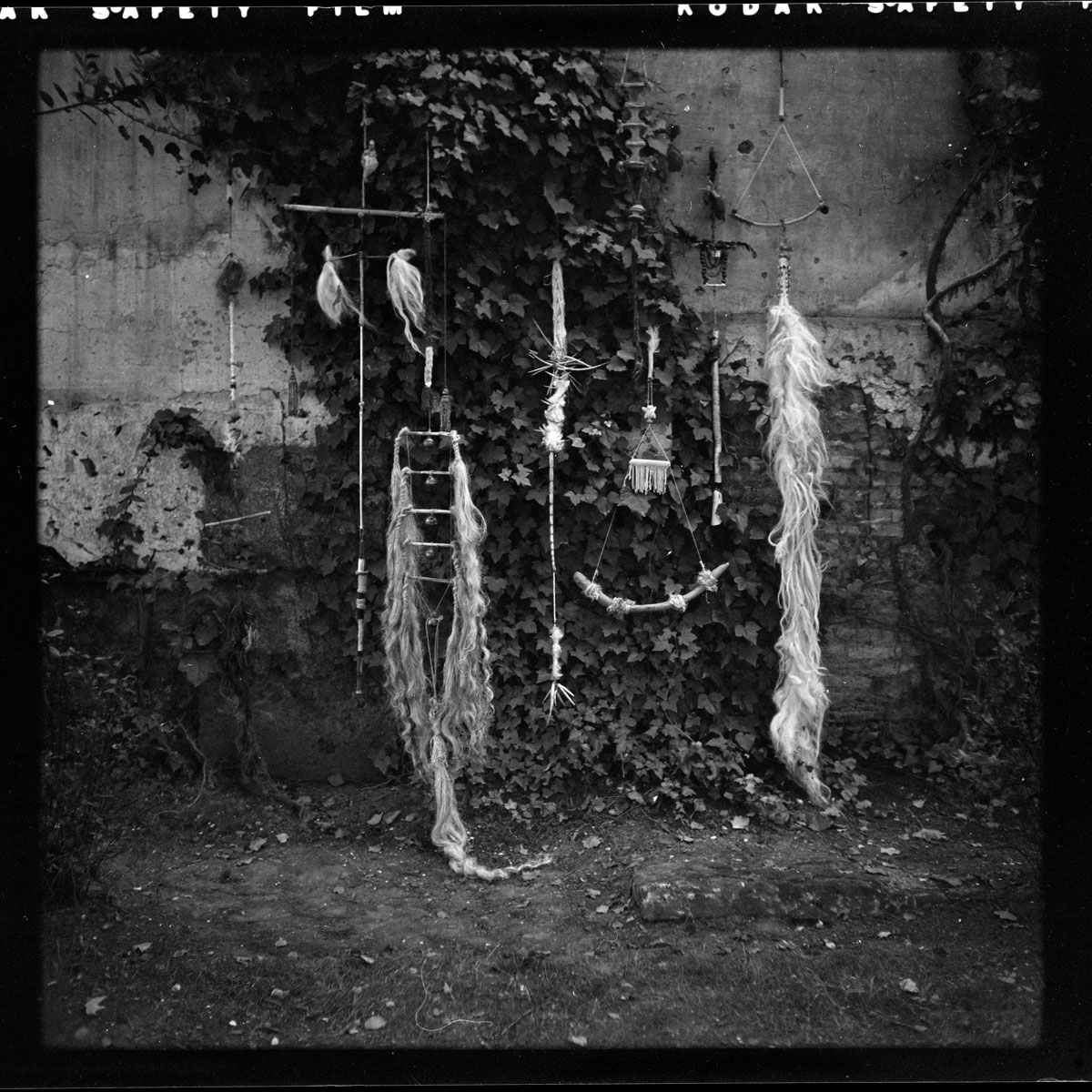
<brWorks from Robert Rauschenberg’s Scatole e Feticci Personali series, Pincio Gardens, Rome, Italy, 1953. Photo: Walter Auerbach.
Digitized from black and white film negative. Courtesy of Robert Rauschenberg Foundation Archives, New York.
As writer Horacio Fernández explains, “Lévi-Strauss characterized the ‘Savage Mind’ by saying that the most important element of its structure is the disposition of a determined order, totally apart from the pursuit or expression of any logical coherence.” (7) In the ‘bricoleur’s’ mind, Fernández notes, “The author knows where everything should be, but not what it is, what it is for, or what it means.” (8) Rather, it follows an intuitive path in which the relations of objects and the rules for their assemblage obey no specific relation, task, or goal. Like Rauschenberg, the objects that a ‘bricoleur’ selects are defined only by their potential use. This approach to objects and creation is also evident in the ways he reused photographs. For In + Out City Limits, Rauschenberg stated that the photographs of this project “make no attempt to totally document, moralize or editorialize the specific locations. They are a collection of selected provocative facts (at least to me) that are the results of my happening to be there.” (9) Whether he was collecting images from magazines or newspapers, objects he found in his walks and travels, or photographs he took in his life, these became the available materials from which he drew, not concerned with issues of repetition and instead, conveying that each new combination “represents a set of actual and possible relations,” (10) while yielding renewed ways of observation towards the object and what surrounds it. The mythopoetic aspects in the Scatole e Feticci Personali are thus built by “fitting together events, or rather the remains of events.” (11)
Rauschenberg’s interest in discarded materials and detritus can also be traced back to Josef Albers’s teachings of matière at Black Mountain College. His interest in materiality involved not only formal aspects of the object (texture, color, form, etc.) but also his matière, which was about the “relationship between the viewer and the material. [For Albers,] how the material is perceived became its most interesting aspect.” (12) Also, in the essence of a ‘bricoleur,’ Albers’s studies of matière “focused on explorations using commonly found materials and the fewest possible tools.” (13) These perspectives influenced Rauschenberg to investigate distinct material conditions related to surface qualities and the multidimensionality of objects and environments.
For the exhibition of these objects in Rome and Florence, Rauschenberg invited audiences to participate in “his reordering of experience,” (14) by creating their own rites, attempting to generate unique perspectives of the object but more so as an invitation to a form of observation that Rauschenberg was discovering and developing at that time. However, besides Hopps’s description of the Scatole e Feticci Personali as “gentle shamanistic hangings,” the general reception of these assemblages disappointed Rauschenberg. He thought the work “was considered a joke by everyone, the gallery owner included.” (15) In Off the Wall, Calvin Tomkins recounts this episode and remarks, “The objects were priced so low that several people bought them for laughs.” (16) After the following exhibition in Florence, local art historian Carlo Volpe dedicated his column to criticizing the work, calling these “psychological messes” and suggesting that “The works of Robert Rauschenberg should be thrown into the Arno [River]”, to which Rauschenberg responded by exactly doing so. (17)
But Rauschenberg didn’t get rid of all of his Scatole e Feticci Personali. According to Tomkins, he brought five of them back to New York City. When passing through customs, Rauschenberg had to open his suitcase for inspection, and an officer asked about the assemblages, to which Rauschenberg replied that these were ceremonial objects made by American Indians and added jokingly that he had been lecturing in Europe on their culture. (18)
Before throwing most of the Scatole e Feticci Personali into the Arno River, the works were photographed by Walter Auerbach in Rauschenberg’s pensione in Rome and at the Pincian Gardens. A particular image in a contact sheet shows Rauschenberg standing in profile, holding one of the assemblages with his left hand against the wall. The construction functions like a two-dimensional object in front of the plain surface. One can notice that Rauschenberg’s gaze is fixed not on the object but on the space’s light source, observing the outside world. Although the order in which the photographs were taken is unclear, perhaps the background’s insistence on flattening the objects led him to explore other forms of interaction.
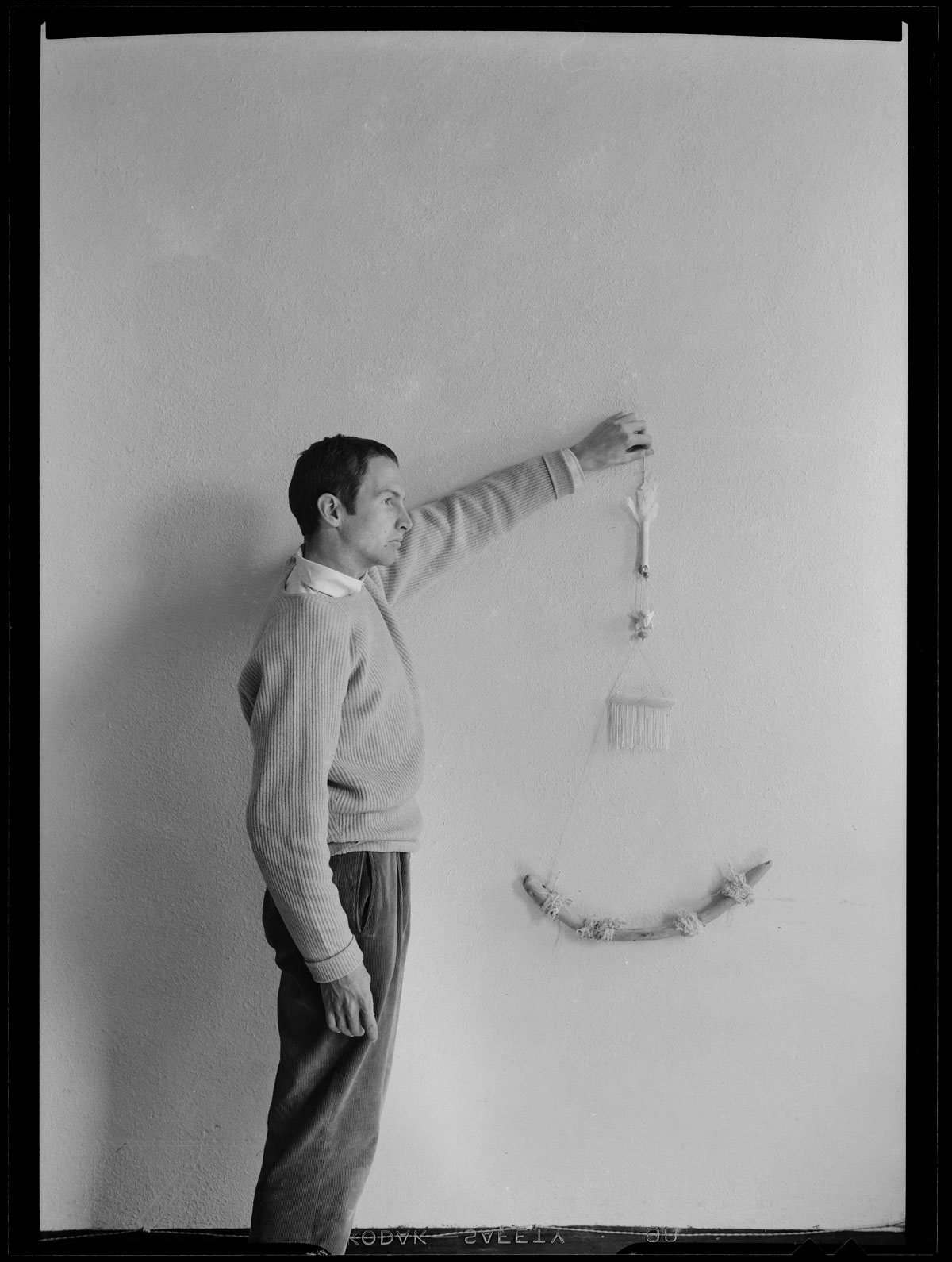
Digitized from black and white film negative. Courtesy of Robert Rauschenberg Foundation Archives, New York.
In other photographs, we see the Scatole e Feticci Personali at the Pincian Gardens in Villa Borghese, where they hung from trees, vine-covered walls, and busts that populate the garden. For instance, one of the negatives, also attributed to Walter Auerbach, shows eight assemblages of different shapes and lengths against a wall with sections of bare brick and crumbling paint and a thick section of vine (fig.1). Unlike the bare wall at Rauschenberg’s pensione, these provided a sense of dialogue and contrast with the natural world. Rauschenberg’s exploration of dimensionality through photography renders a third plane through juxtapositions, producing contrasts, shadows, and texture. A third negative portrays one of Rauschenberg’s assemblages hanging on the marble bust of Roman lyrical poet Horace (65 – 8 BC, Italy). Through this combination of objects, Rauschenberg playfully suggests the inherent tensions between conceptions of the “primitive” and the “classic”– two concepts Twombly and Rauschenberg constantly explored as they made their way through Italy and Morocco. In the photograph, the artwork and the marble bust resist each other, and in this tension, the image becomes both indecipherable and open to multiple readings. The act of suspending this construction from the marble bust speaks of Rauschenberg’s interest in understanding relations between objects. Brian O’Doherty has pointed out how, in Rauschenberg’s work, “The fundamental emphasis is process.” (19) He observes Rauschenberg’s tendency to approach his practice of the time as a form of diary where he’s mainly using and collaging personal material (in this case, the souvenirs and objects collected in his travels) and refers to these as ordinary objects and their inevitability of remaining open, “refusing to close the psychological gestalt. It is this lack of closure that indicates process.” (20)
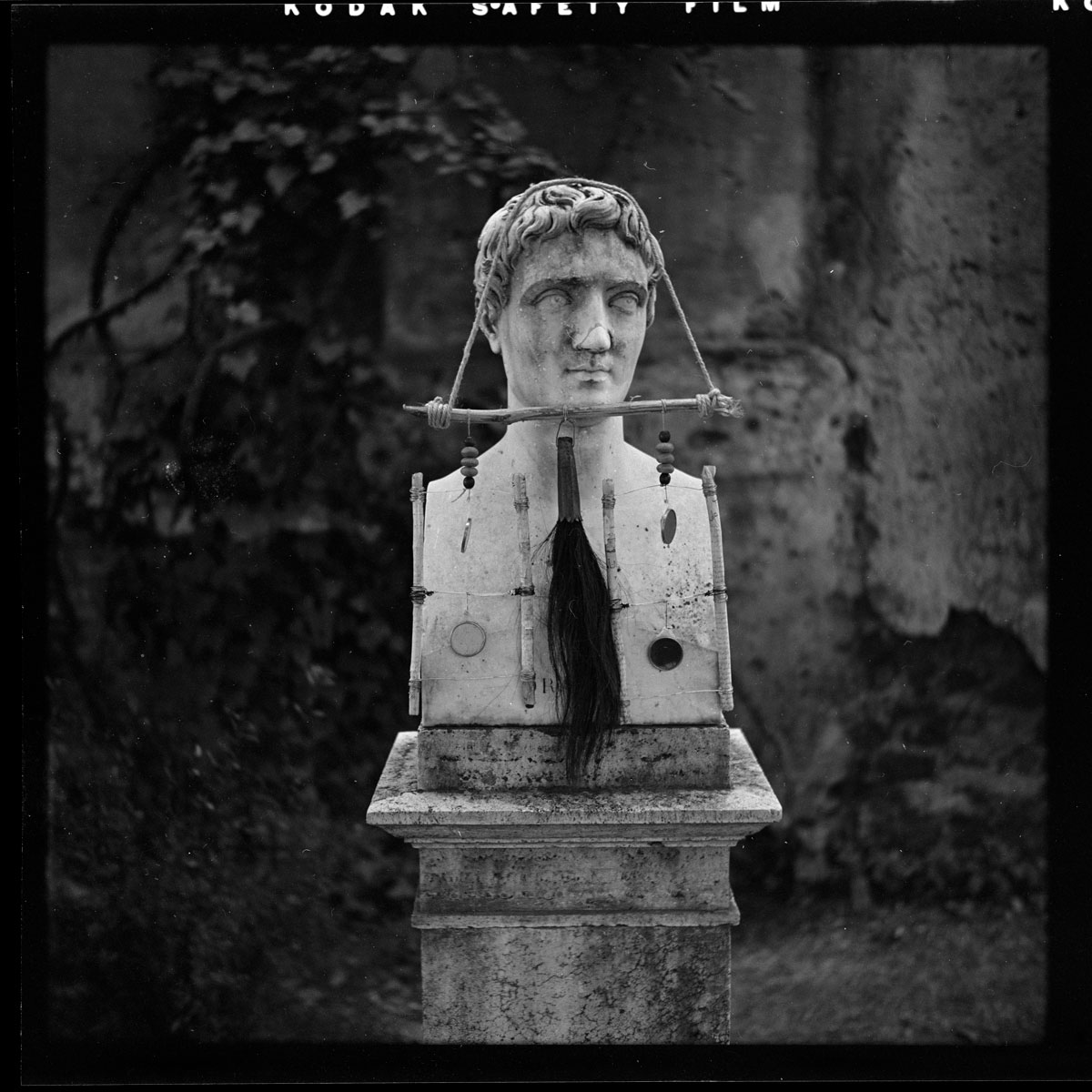
Digitized from black and white film negative. Courtesy of Robert Rauschenberg Foundation Archives, New York.
Another negative in the archives shows the assemblages hanging from trees, where the contrast of the objects in the gardens prompted a tacit dialogue about impermanence and the passage of time (fig. 4). Through these forms of display, not only did Rauschenberg allow the object’s movement and dynamism, but he also challenged notions of flatness versus dimensionality and explored figure-ground relationships, echoing, once again, Josef Albers’s teachings on matière at Black Mountain College. However small or even ephemeral these constructions were, these were Rauschenberg’s first-ever suspended objects, and as Barbara Rose notes, “These informal conjunctions of industrial and natural scraps…anticipated arte povera by nearly two decades.” (21)
Cy Twombly’s own interest in the primitive and fetishistic character of materials was equally influential. In 1952, Twombly wrote in his application for the Out-of-State Fellowship: “I’m drawn to the primitive, the ritual and fetish elements, to the symmetrical plastic order (peculiarly basic to both primitive and classic concepts, so relating the two).” (22) During their travels, Twombly kept a series of sketchbooks in which he jotted down lists of materials he was considering in his work. His list included fur, velvet, feathers, and rope, evidencing the common interests in materials and their multiple uses. Rauschenberg’s interest in the re-discovery of objects or images as places for new meanings and relations depended on the object/images’ ability to remain unanswered questions. It appears that Rauschenberg’s intention to elude any possible readings and connotations from his objects was among his main goals. Moreover, as Rose wrote in 2008, Rauschenberg “was an empirical experimenter who rejected calculation for the far riskier process of trial and error, in which success is predicated not on the repetition of formulas but on prior failures.” (23)
Upon returning to New York in spring 1953, Rauschenberg began the Elemental Sculptures (ca. 1953-1958), a new series of constructions made from found materials from the neighborhood surrounding his Fulton Street studio, which he presented for the first time at Stable Gallery in September 1953; later, in 1954, he made his first Combine (1954-1964). Whether Rauschenberg considered the Scatole e Feticci Personali a success or a failure, this series marks a decisive stage in his material experimentation. As the bricoleur working from remains at hand, Rauschenberg carried this same logic of assemblage forward. The Scatole e Feticci Personali are a testament to his early assembling habits and his fascination with the possibility of re-ordering experience.
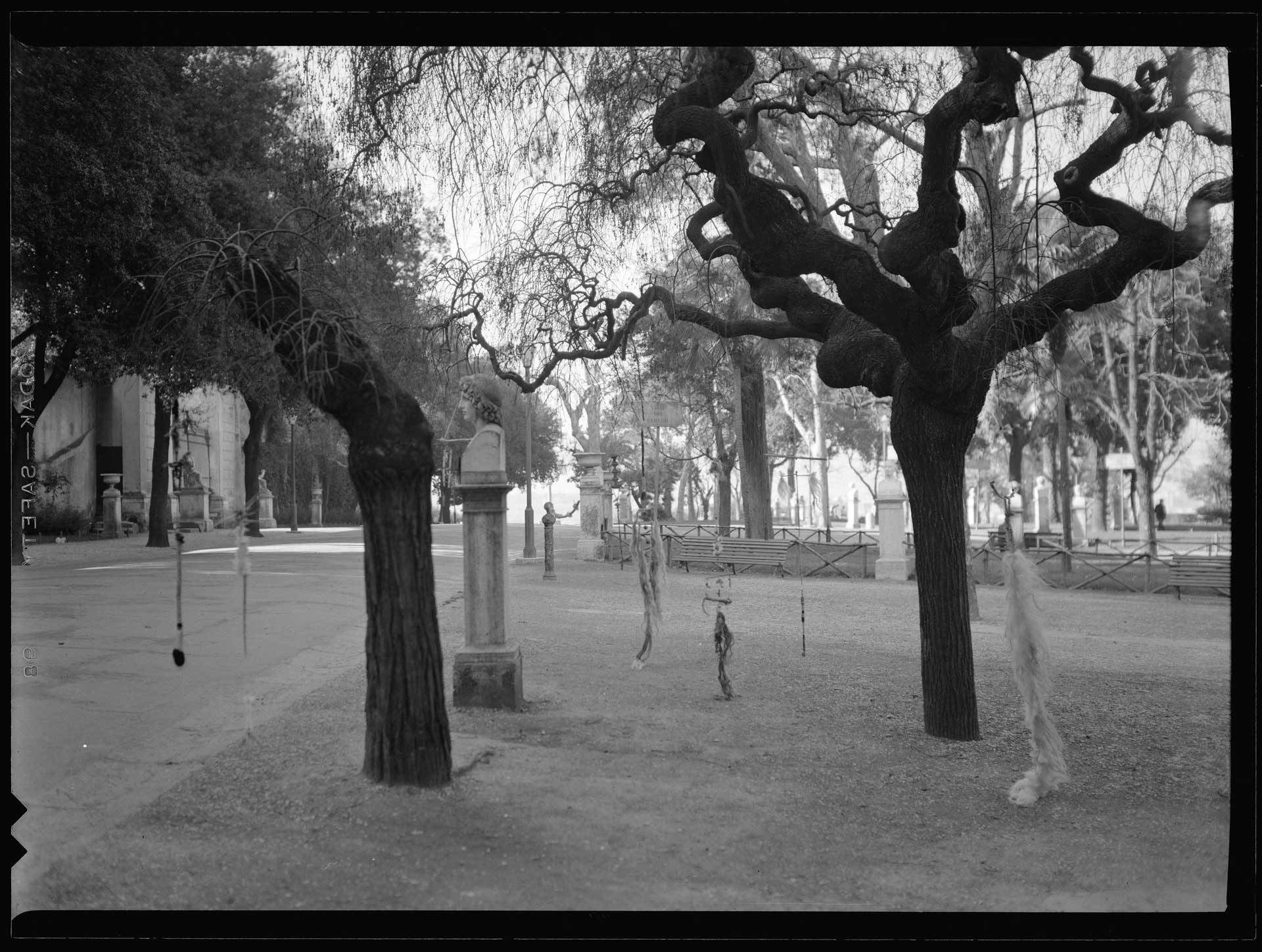
Digitized from black and white film negative. Courtesy of Robert Rauschenberg Foundation Archives, New York.
1. When describing the process of assembling an artwork, Rauschenberg described how, “Sometimes you see a piece of metal…of a certain shape and color, and you know just the place it’s going to go in the picture, but then it doesn’t go there after all; it’s too big, or too heavy…so you put it where it will go and everything else in the picture has to be adjusted to that. Sometimes, of course, objects just insist on being themselves.” On Calvin Tomkins, Off the wall: Robert Rauschenberg and the Art World of Our Time (Penguin Books, 1980), 88.
2. The show travels as Scatole e Costruzioni Contemplative di Bob Rauschenberg to Galleria d’Arte Contemporanea, Florence. (Rauschenberg Foundation Chronology)
3. Transcript of exhibition statement at Galleria L’Obelisco, Rome, 1953. Walter Hopps, Robert Rauschenberg: The Early 1950s (Houston: The Menil Collection and Houston Fine Art Press, 1991), 232.
4. Transcript of exhibition statement at Galleria L’Obelisco, Rome, 1953. Walter Hopps, Robert Rauschenberg: The Early 1950s (Houston: The Menil Collection and Houston Fine Art Press, 1991), 232.
5. Levi-Strauss, Claude. The Savage Mind (University of Chicago Press, 1966).
6. Levi-Strauss, The Savage Mind, 14-15.
7. Fernandez, Horacio. Photems/Fotografias (Madrid: galleria Cobo y Alexander, 1993) 15-16. Fernandez’s article was originally written in Spanish, and its English translation used “Savage Thought”, although the official translation of Levi-Strauss’s oeuvre is titled “Savage Mind” which I will use for consistency.
8. Fernandez, Photems, 15-16.
9. Robert Rauschenberg, statement in Rauschenberg, Photos In + Out City Limits: Boston (West Islip, New York.:Universal Limited Art Editions,1981), n.p.
10. Levi-Strauss, The Savage Mind, 12.
11. Levi-Strauss, 14.
12. Horstman, Fritz. “The Preliminary Course and the Matière”, (theartsection.An Online Journal of Art and Cultural Commentary, 2017). Accessed on 05/8/2024. https://www.theartsection.com/albers—the-matire
13. Diaz, Eva. The Ethics of Perception: Josef Albers in the United States. The Art Bulletin, Jun 2008, Vol. 90 No. 2 (Jun, 2008). pp. 260-285. 263. The quote is from a telegram response to a request by Alfred H. Barr Jr. (November 26, 1938, Yale Papers).
14. Hopps, Walter, Introduction: Rauschenberg’s Art of Fusion, Robert Rauschenberg: A Retrospective, pp. 20-29 esp.p.22. Quoted on Cullinan, Nicholas. To Exist in Passing Time, in Robert Rauschenberg: Photographs, 1949–1962, ed. Susan Davidson and David White (New York: D.A.P., Inc., 2011), pp.13-37. 36.
15. Tomkins, Calvin. Off the wall: Robert Rauschenberg and the Art World of Our Time (Penguin Books, 1980), 81
16. Tomkins, Off the wall, 81.
17. Tomkins, Off the Wall, 82.
18. Tomkins, 82
19. O’Doherty, Brian. Rauschenberg and the Vernacular Glance. Art in America 61, No. 5. (Sept – Oct 1973): 82-87. 85.
20. O’Doherty, Vernacular Glance, 85.
Bibliography
Beggs, Michael. The Flattest Kind of Picture: Texture and Matière in Photography at Black Mountain College. Begin to see: the photographers of Black Mountain College (Ashville: Black Mountain College Museum, 2017), pp.79-80
Chang, Christina. Painting in New Media, University of Michigan, 2010
Cullinan, Nicholas. American-Type Painting, in Cy Twombly. Cycles and Seasons, Nicholas Serota, ed., (Tate: 2008), pp.55-59
Cullinan, Nicholas. Double Exposure: Robert Rauschenberg’s and Cy Twombly’s Roman Holiday. The Burlington Magazine 150, no. 1264 (July 2008): 460-470.
Cullinan, Nicholas. To Exist in Passing Time, in Robert Rauschenberg: Photographs, 1949–1962, ed. Susan Davidson and David White (New York: D.A.P., Inc., 2011), pp.13-37.
Diaz, Eva. The Ethics of Perception: Josef Albers in the United States. The Art Bulletin, Jun 2008, Vol. 90 No. 2 (Jun, 2008). pp. 260-285
Fernández, Horacio. Photems/Fotografias (Madrid: Galleria Cobo y Alexander, 1993)
Hopps, Walter. Robert Rauschenberg: The Early 1950s (Houston: The Menil Collection and Houston Fine Art Press, 1991).
Horstman, Fritz. The Preliminary Course and the Matière. The art section: An Online Journal of Art and Cultural Commentary, 2017. Accessed on 05/19/2024. https://www.theartsection.com/albers—the-matire
Joseph, Branden. The Gap and the Frame, October 117 (Summer 2006): 44-70
Levi-Strauss, Claude. The savage mind. University of Chicago Press, 1966.
Nesin, Kate. Miniature Monument. Travel and Work in Italy and North Africa, in Robert Rauschenberg (The Museum of Modern Art and Tate Publishing, 2016), pp.61-69
Rose, Barbara. Barbara Rose on Artforum, September 2008. Accessed May 19, 2024. https://www.artforum.com/features/barbara-rose-217294/
Schiaffini, Ilaria. It’s a Roman Holiday for Artists: The American Artists of L’Obelisco after World War II. Methodologies of Exchange: MoMA’s “Twentieth-Century Italian Art” (1949), Issue 3, January 2020. Accessed on May 19, 2024. https://www.italianmodernart.org/journal/articles/its-a-roman-holiday-for-artists-the-american-artists-of-lobelisco-after-world-war-ii/
Tomkins, Calvin. Off the wall: Robert Rauschenberg and the Art World of Our Time. Penguin Books, 1980.
Transcript of exhibition at L’Obelisco Gallery, Rome, 1953 (Hopps, p.232)
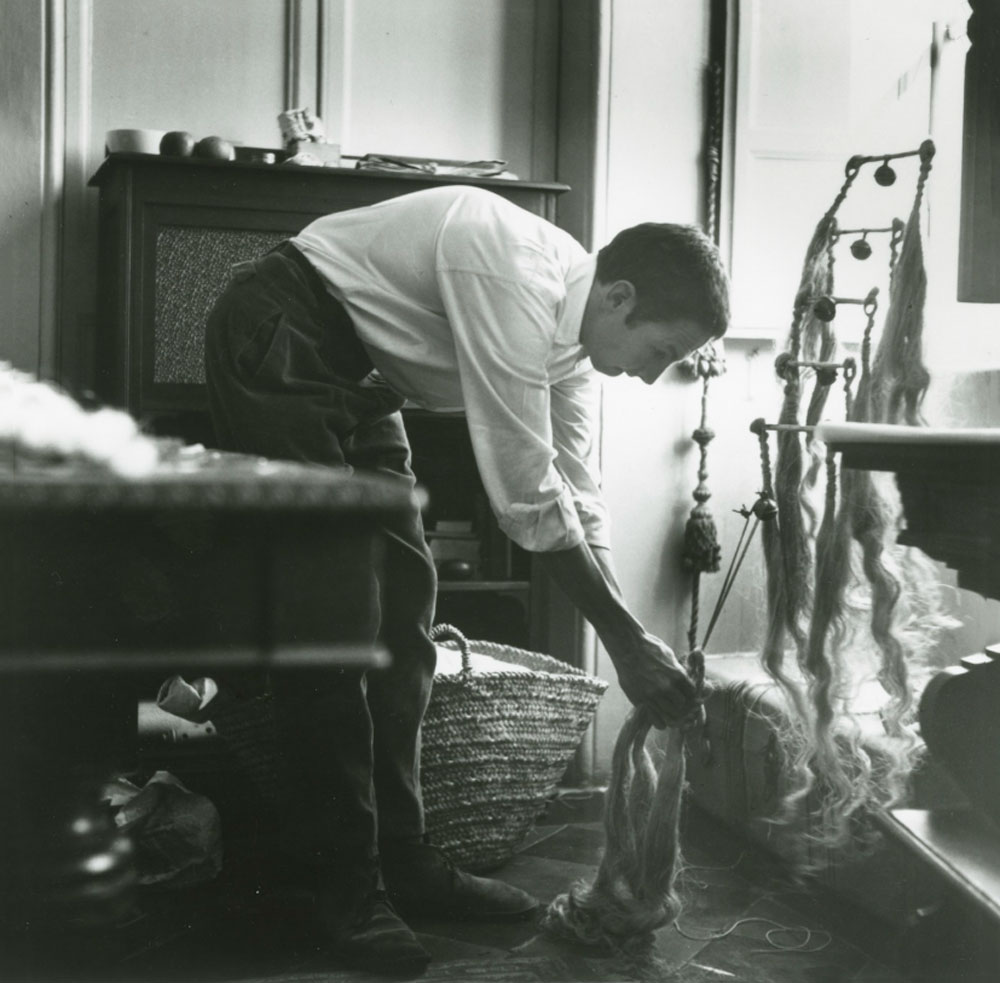
Robert Rauschenberg working on the “Feticci Personali” series (1952–53), Rome, Italy, 1953. Photo: Attributed to Cy Twombly.
Courtesy of Photograph Collection. Robert Rauschenberg Foundation Archives, New York
Elisa Gutiérrez Eriksen is a New York–based Mexican curator and arts producer specializing in contemporary art. Her work centers interdisciplinary approaches that interweave ecology, territory, and identity through collaborative, site-responsive, and research-driven curatorial practice across exhibition-making, research, and public programming.
She is Network Co-Director of Tiger Strikes Asteroid, a nonprofit network of independently programmed, artist-run exhibition spaces with locations in Philadelphia, New York, Los Angeles, Chicago, and Greenville, SC, and has been a member of the New York site since 2025. She is also the founder of Common Frequencies, a multidisciplinary platform bringing together artistic practices that engage sonic, environmental, and interspecies relations.
Elisa previously served as Programs Manager and Curator at the New York Art Residency and Studios (NARS) Foundation, Cultural Specialist for the UNESCO Field Office in Mexico, and Head of Exhibitions for the nationwide Alas y Raíces program at the Mexican Ministry of Culture. As an independent curator, she has organized exhibitions and public programming at institutions and artist-run spaces, including Museo Universitario de Ciencias y Arte (MUCA), BioBAT Art Space, Lydian Stater, Home Gallery, op.cit., Salón Silicón, and 601 Artspace.
She holds an MA in Art History and an Advanced Certificate in Curatorial Studies from Hunter College.
Hero image: Portrait of Robert Rauschenberg, 1998. Photo: Sidney B. Felsen. Courtesy of Photograph Collection. Robert Rauschenberg Foundation Archives, New York