Mia Weiner: Thanks for doing this with me.
Tuna Bora: My pleasure!
MW: I was wondering if our voices are different enough and if they’ll know who each person is [the conversations are transcribed from recordings].
TB: I feel you have a very distinct speaking voice.
MW: It’s particular.
TB: It’s very soothing.
MW: Not everybody likes it though. Sometimes old men pretend they can’t hear me. They say the pitch is too high. It’s not like I’m an animal that only communicates at ultrasonic frequencies [laughs].
TB: They’re just not used to seeing women as human beings – that’s a different thing. But there’s no cure for that, I’m afraid. You have to dig yourself out of that one on your own [laughs].
MW: That happens less and less [laughs]. Voices are so special though. It’s so nice that everyone has their own. But, anyway, I am so excited to do this with you because we talk so much [laughs].
TB: Should I take that as a compliment or not [laughs]?
MW: We go on a lot of walks and talk about our practices in a really nice way. A lot of my friends are artists, but we don’t talk about our art like the two of us do. Our work is very different but we think very similarly about how we do work, which I find exciting. We often talk about breaks from the studio versus feeling productive and the moments in between.
TB: Agreed. I really love conversations about art that don’t turn it into sort of an exotic object where, you know, you’re trying to create a pretense of how magical this object is. And I think that becomes a barrier for people who are interested in your work. Not that I think an artist can or should aim to be understood by everybody, but I like a person who wants to come halfway and then you can meet them somewhere. When you look at a really famous painting, for example, its value is built on hundreds of thousands of minds and each person’s own meaning and interpretation of that object.
MW: Right. And there are so many paintings that are very obvious in that way. I feel incredibly moved when I go to a museum and see one of these works. Such iconic paintings that one has studied and seen images of everywhere, on books and t-shirts, and yet you still feel something when you stand in front of them. You’re moved. Some artworks really hold that energy in a special way. But with others it’s almost as if I have become blind in front of them.
TB: Yes. And this perception changes over time, right? There are some paintings you don’t appreciate when you’re young. Well, painting is maybe too restrictive when we’re speaking about going to a museum… Take your work, for example, they’re both image and object and I always think of the space they hold as a container. No pun intended, they weave a conversation in and out of other people’s lives and that’s how they begin to contain that value and space in culture. I think, essentially, this is always more valuable than the object itself. The object almost becomes a signifier of those conversations.
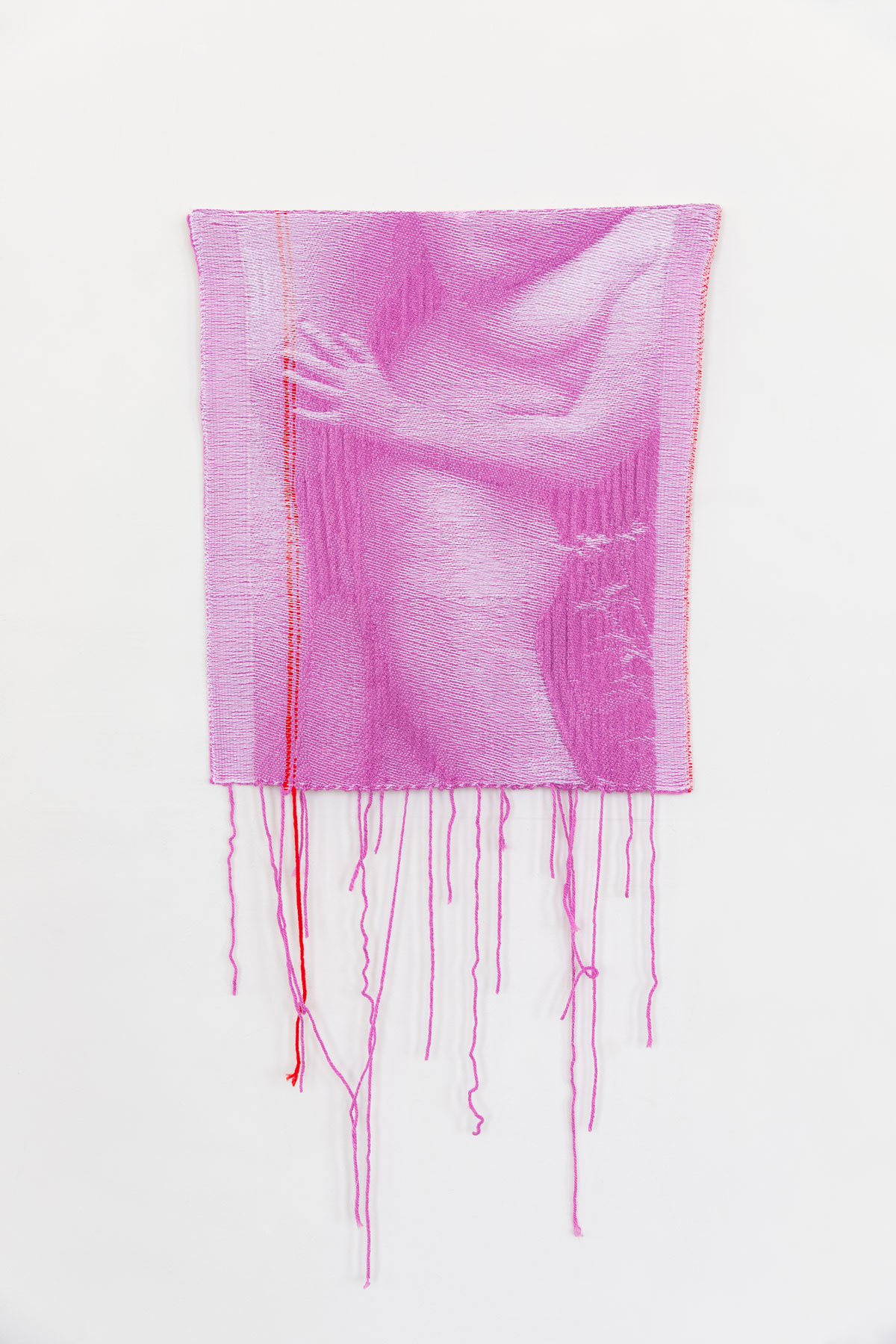
MW: Oh, that’s so nice to hear. When I approach making an image, I think about what it means to transform the digital back into an object and an image into a soft object. But all the works come from a feeling in the body, somatic memories or experiences. So, in some ways, I think I’m more interested in what the person is feeling or how they enter the work and their bodies perceive the work than what they’re physically looking at. I’m interested in aesthetics, of course, but what I want people to take away from it is a feeling.
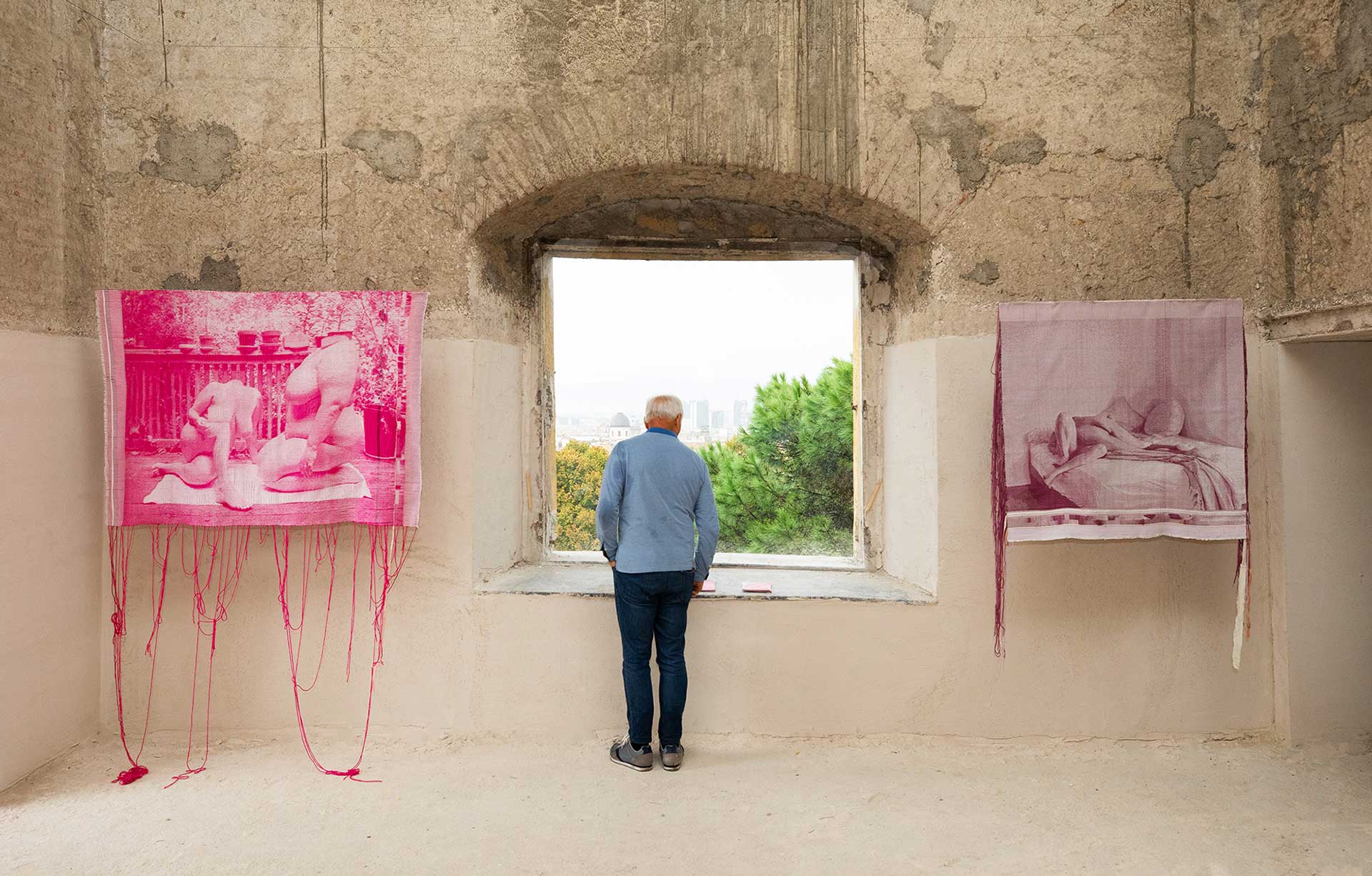
Mia Weiner, Installation image from Tender Dreams with T293 Gallery in Naples, Italy, 2024. Courtesy of the artist and T293, Rome, Italy.
TB: Exactly. I like the idea of something that occupies a room and changes it. It’s like a presence you can’t quite ignore. And even ignoring it is another way of interacting with it, right? It becomes a relationship between these two things.
MW: Even within the work, there are always two bodies. And when you think about the material, there’s something about the proliferation of the digital image and how we think about image now and what it means to make it soft again, through labor, care, the hand. There’s something really special about having an image be physically soft, quite literally soft. There’s so much power in softness. It’s a form of resistance. I think there are lots of reasons why I’ve worked with textiles for years. It’s a really interesting medium to talk about, in terms of gender, labor and intimacy. Very specific topics. I’ve been thinking about the power of softness a lot lately and also about the shifts that happen in material. Now I’ve been dyeing, adding crystals and beads and other found objects to the works. I am so in awe of practices like yours that span so many mediums, because you get to work with so many different materials. I’m so curious about how you move forward with each one.
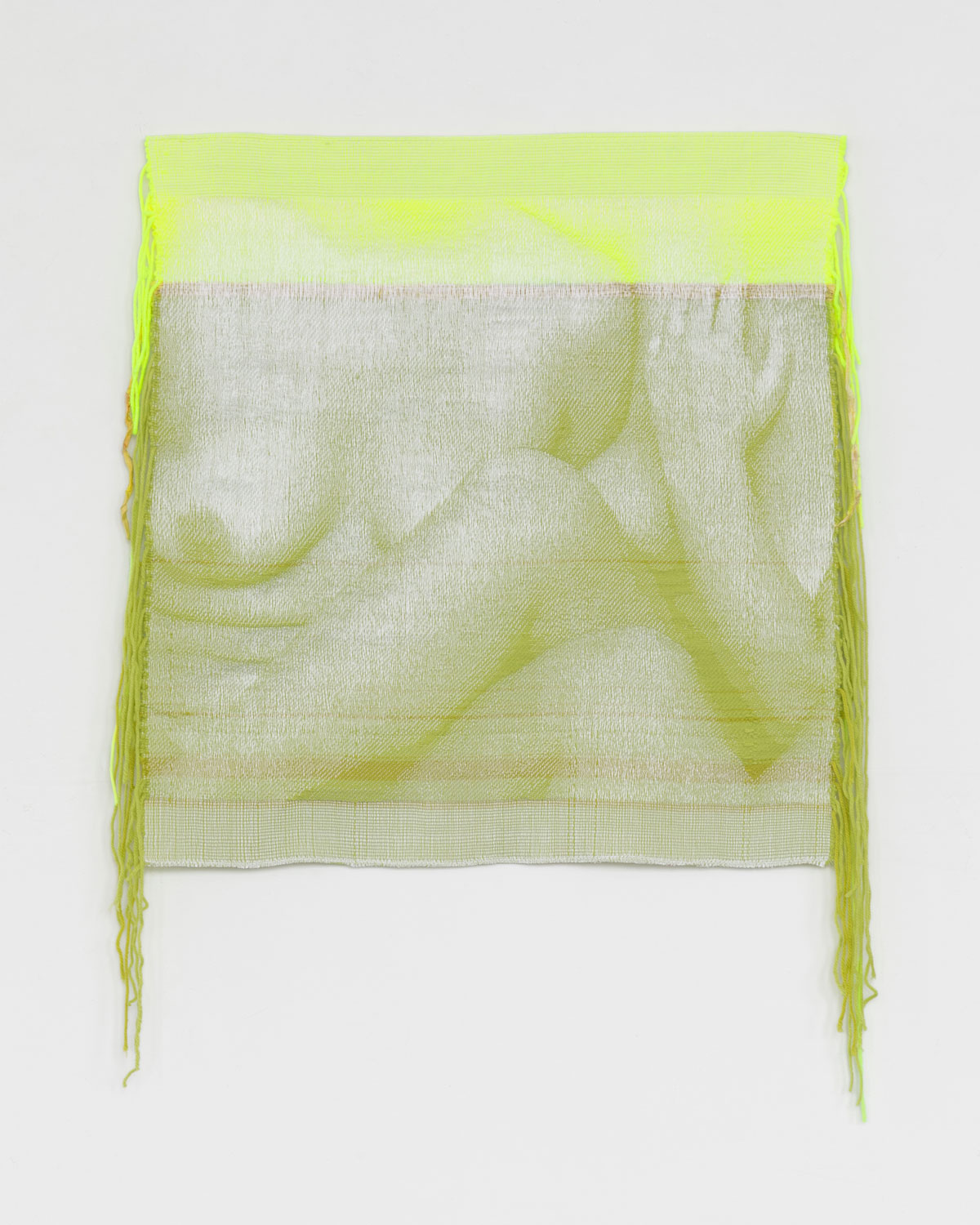
Mia Weiner, to kiss starlight, 2025. Handwoven cotton, acrylic and silk, 26 1/4 x 25 inches (37 x 26 inches with fringe). Courtesy of the artist.
TB: I think knowing when is the right time to do something or move on from something is the hardest thing of art. Like, knowing when something is done. I also have a deep relationship with digital images. I love the idea of taking something abstract that affects us, something that is sort of its own hyper object, and then putting it in a space where it becomes an object again, which I think you do as well. I used to be a production designer in animation and I think maybe that is the reason why I move between things, because [in animation] you create a world from scratch in a visual and aesthetic language that has to have an interaction with the story. Whether you mimic the story or you contrast the story, you’re actually saying something specific because it is inherently a very different way of world building. You don’t find a nice location and shoot, like, the desert is just the desert and everybody understands that. You almost have to reimagine the desert: how could you represent a world where everybody understands what they’re looking at while it is not at all the real thing? And I love that conversation of what’s real and what isn’t. So I think certain ideas want to be certain things and you only find that if you’re willing to put them in different containers and see what works for them. It’s a little bit like that with our photo streams. The age of printing photos has passed. When you get a printed photo, it has a very strange feeling. It feels like it’s older than it is. And I love the weaved images you create, because it feels like it should be an older thing, but it isn’t, right?
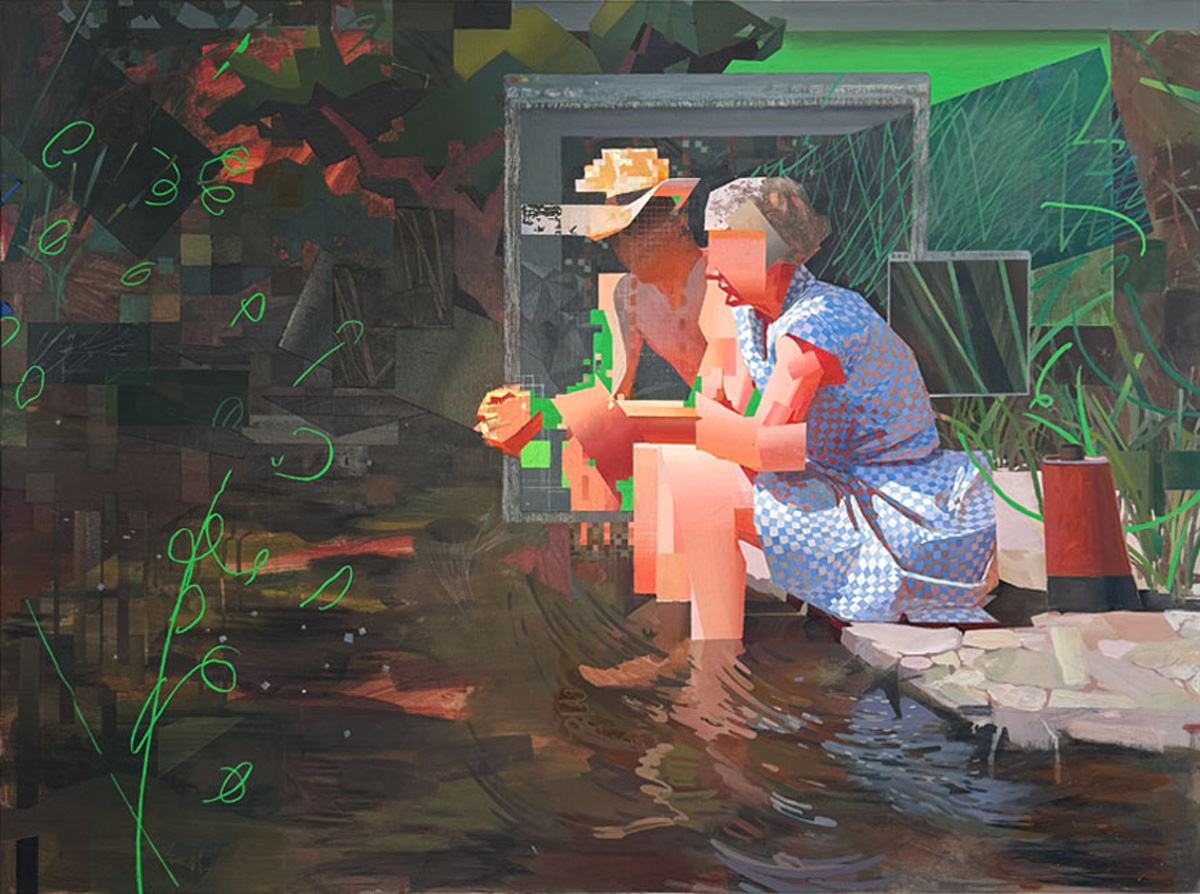
Tuna Bora, Your IG Remains, 2025. Acrylic and pastel on canvas, 30 x 40 inches. Courtesy of the artist.
MW: For sure. I’m so interested in historical textiles. My works generally go on the wall and hang like a painting in a kind of flat, formal way. And people are so surprised it’s not a functional object like a rug or a bedspread. Yet, historically, we’ve had tapestry on the wall for so long.
TB: Yeah, it was almost instructional back then, right? You would look to see a narrative about Jesus… as a unicorn [laughs].
MW: Yes, the stories were on the walls for practical reasons like insulation or sound, for example. And they were mostly religious stories or moral tales about what our beliefs were supposed to be. But they held a lot of sacred spirituality too.
TB: It’s something so interesting about paintings from that era. If we’re thinking of European tapestry from the 16th century. Obviously tapestries go way long before that, but there really is something about them that is utilitarian. It’s telling you how to think. And I like that you’re doing that from a different place.
MW: I think about how to touch [laughs].
TB: Good!
MW: I try to strip out as much of the narrative as possible. That’s why there’s no faces in a lot of the work. Some of the bodies are turned and you can’t see their faces and some of the figures are just headless.
TB: I love that.
MW: But I have a couple in there with faces and they do bring in a narrative. I want to know who they are and what they’re doing. I know there are lots of people who do figures with faces and you still connect in a different way, but that’s not the language I have figured out how to use. I think about the body as an alphabet for me to talk about feelings. I don’t know if you believe this or not, but I truly believe that everything we make has energy, whether we’re thinking about it or not. So I’ve become more and more conscious of the energy embedded in the work that I’m making, separate from what it looks like visually. But then, of course, I also think about the images themselves… Sorry, I sort of lost my train of thought. This was going somewhere… Where did it go [laughs]?
TB: ‘I had the meaning of life figured out, but now it’s gone’ [laughs]! I love that touch and softness is part of your focus. There’s something very misleading about softness and how we engage with that concept in the world. Supposedly, you’re soft when you’re a kid and you don’t know anything and then your experiences harden you. But I think that, both psychologically and emotionally, people who have softness have often been through something really difficult. So it wasn’t the lack of difficulty and hardness or ache that has created softness, but it is almost a really conscientious choice to remain soft when things are difficult, which feels like something so beautiful and relevant to this moment we’re living in. But also to weaving, because the act of weaving is a very hard thing on the body. It is very straining. I don’t know exactly which tools you’re using at the moment, but weaving usually entails some very sharp things. Needles, threads… They’re not soft on their own. The process of making things with your hands like that is not soft.
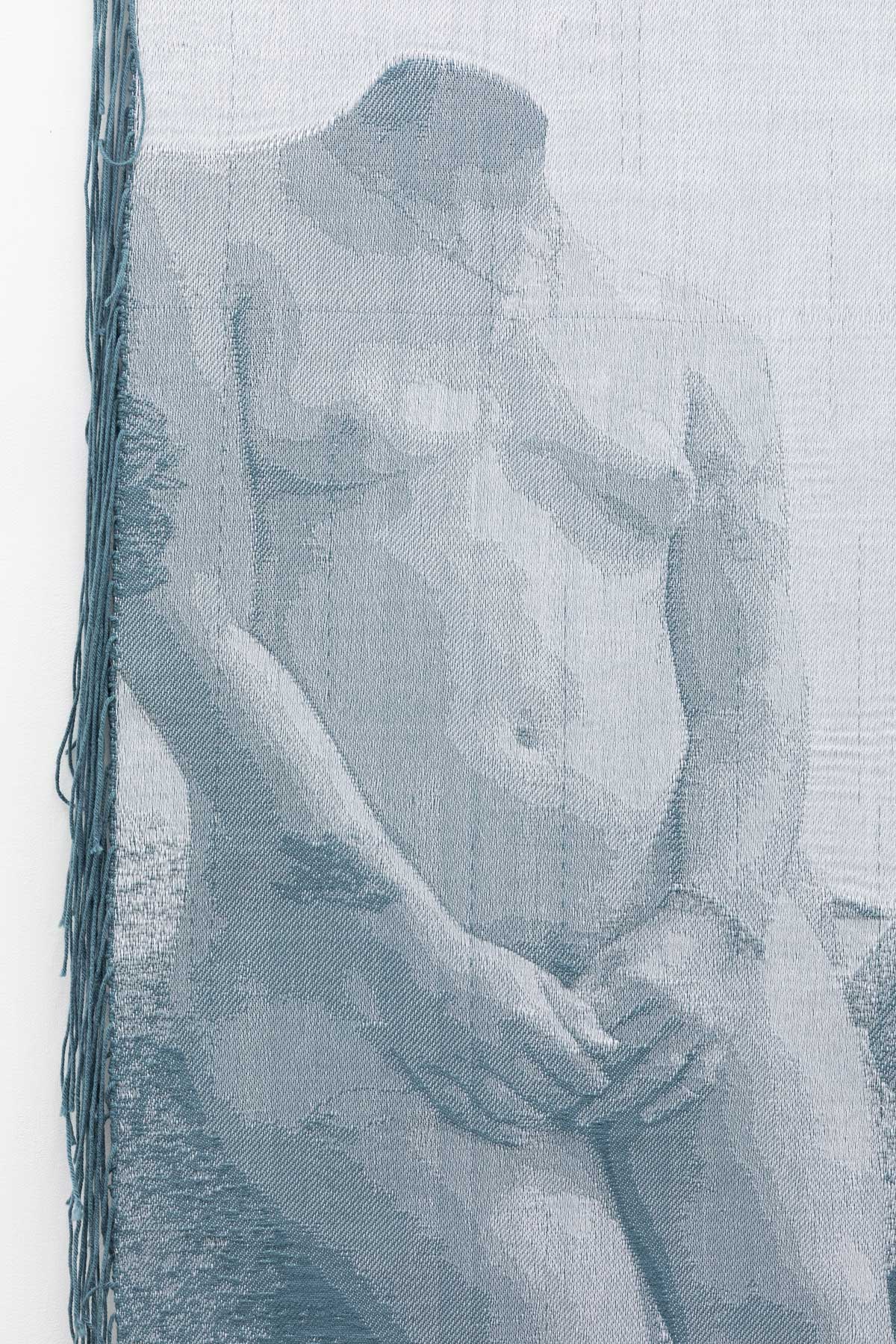
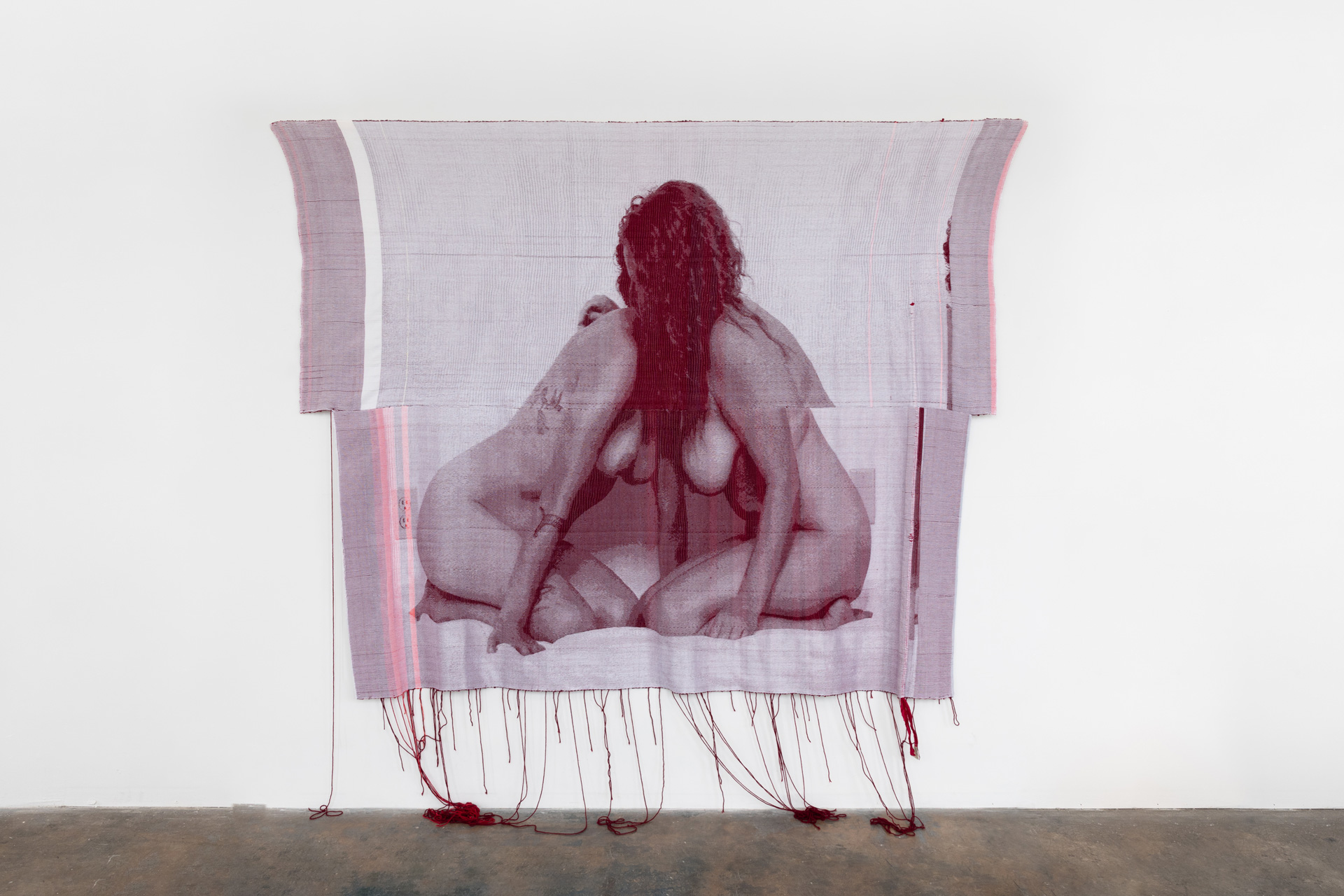
Mia Weiner, together, in one breath, 2025. Handwoven cotton, acrylic, and silk, 86 inches x 120 inches (103 x 120 inches with fringe). Courtesy of the artist.
MW: Yeah, it’s labor. And there’s a lot of labor. I’m hunched all day throwing this, bobbing back and forth. People are always like: ‘oh, it sounds so meditative’. No!
TB: This makes me think of the type of person who looks at someone poor and says: ‘oh, your life is so authentic. Even though I’m rich, I’m not like that. I wish I had your life’. And the person who actually has to work says: ‘yeah, let’s switch lives then’.
MW: But, to be fair, even though I hurt my hips, I hurt my shoulder, and there are all sorts of weird things that happen when you’re in these positions, I did learn to meditate while I was working. So while it’s not a meditative practice, through a lot of work, it has become that for me. It wasn’t a natural thing. But that’s also about the fantasy of making, isn’t it? There are all these steps before the actual weaving: I take photographs, I edit them. Things can shift a lot. But once I get to the loom and work from my map and start weaving this image in one go, I can’t go back.
TB: You can’t [laughs]?
MW: It would be real hard! I have all these fantasies about being a painter and being able to just change the whole color of the background and then move it back.
TB: Depending on what you’re working with, sometimes that is very difficult too. You don’t get to do these things in watercolor, for instance.
MW: It really is a fantasy. I also fantasize about what it feels like to build with clay all day and be in touch with the earth. And then I try to build with clay and I understand it’s not that intuitive for me [laughs].
TB: I love that. Listen, I almost have a very personal take. What I discovered by simply trying to become a healthier human being is that a lot of creative things are very much associated with the fantasy of making something good out of a difficult thing in a therapeutic way. But I think it’s a little bit like writing or running, where having done or having created something feels great, but the making of that thing isn’t just meditative and fun.
MW: No, it’s work.
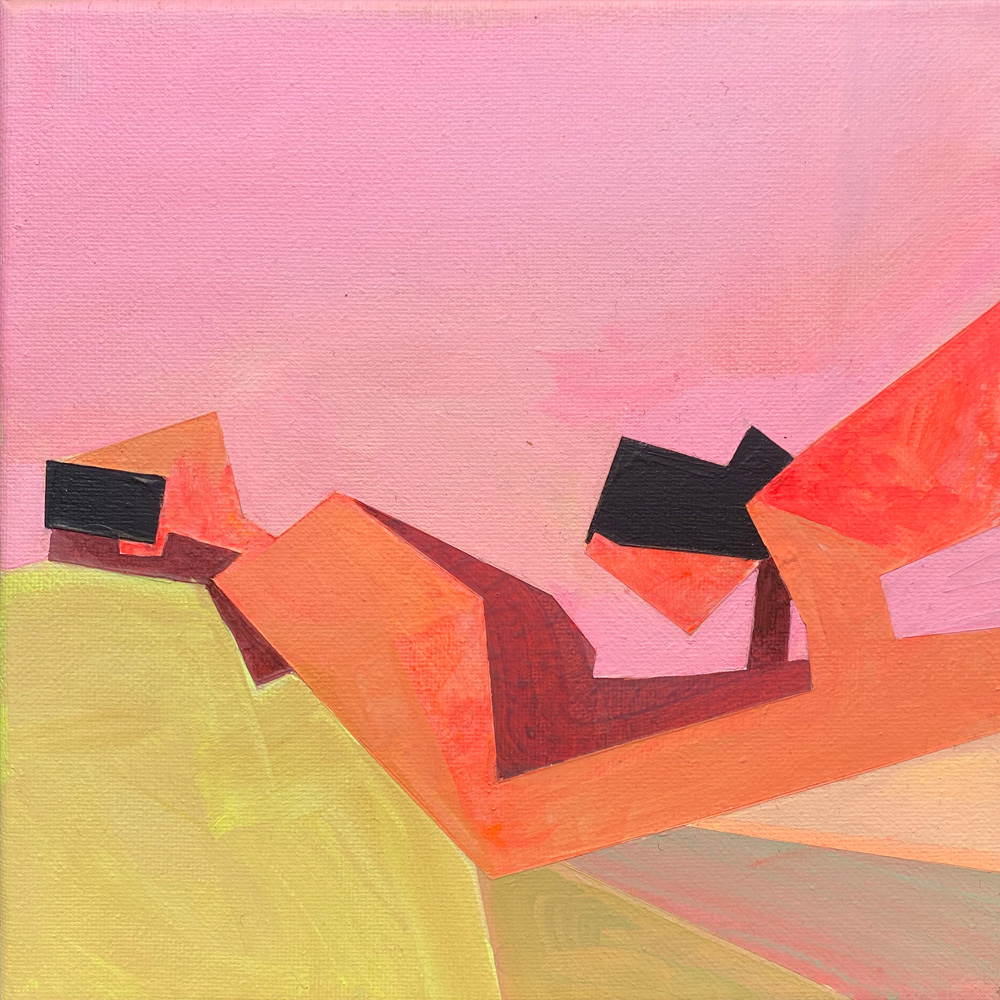
Tuna Bora, Stretch In The Sun, 2022. Acrylic on canvas, 8 x 8 inches. Collection of Maneli Keykavoussi.
TB: It’s work! It sounds like you have to actually sit down and figure out all the details about what you’re going to weave, just because of the unforgiving nature of weaving. You’re almost in the rendering part where all the planning, the concepts, they’re all figured out, right? You do have to just be patient and kind of get lost in the work, but that can only happen because you have front loaded that work on yourself earlier.
MW: I sure did. It’s true. There’s a lot of that sort of dreamland moving around spaces.
TB: And you’re very spiritual. I know that you’ve done plenty of meditation for real. And when you’re at a retreat, it is not exactly an easy, peaceful thing. It is not meant to be. Meditation is not just relaxation, right? And your body hurts when you’ve been praying for 20 hours a day for 10 days and you have all these restrictions. So I think in that way it’s similar to meditating [laughs].
MW: I haven’t thought about it in that way. Very similar strain on the body.
TB: Because your spine hurts, your ass hurts. You’re in a seated position for a long time, no?
MW: Well, when I weave, I stand.
TB: You do?
MW: Yeah. I’m too short for my loom [laughs]. Most people stand to weave on the type of loom that I work with because of the width. So I’m standing and basically doing a grapevine all day because you don’t want to press the pedal with the same foot over and over again. It’s too repetitive. You have to switch foot every now and then, otherwise your body would really hurt.
TB: You’d have one really muscular leg and the other one would be flimsy [laughs].
MW: Only one wild calf [laughs]! So it’s kind of a dance I do all day. It’s the back that hurts. I’m also just tall enough that I have to lean down the whole time to move the thread back and forth and to see what I’m doing while I’m weaving. It’s not a vertical loom and it’s not at eye level. So I get that rounded back [laughs].
TB: Do you have a good back stretch?
MW: Oh yeah. I also had to figure out what physical practices would strengthen my weaving practice. I didn’t use to do that and it would just hurt all the time. And then it turns out there is a reason why everyone loves Pilates! It is really great for your body and it actually really helped me. Because I weave for a long time. I’m not someone who does half a day. I usually do eight hours on a normal day, sixteen hours if I’m really in it or if I’m on a deadline. I kind of do it in chunks. I don’t know if you work that way. I know some people have a schedule and like to split up the different parts of their practice. Do you do that or go all in and then just switch every so often?
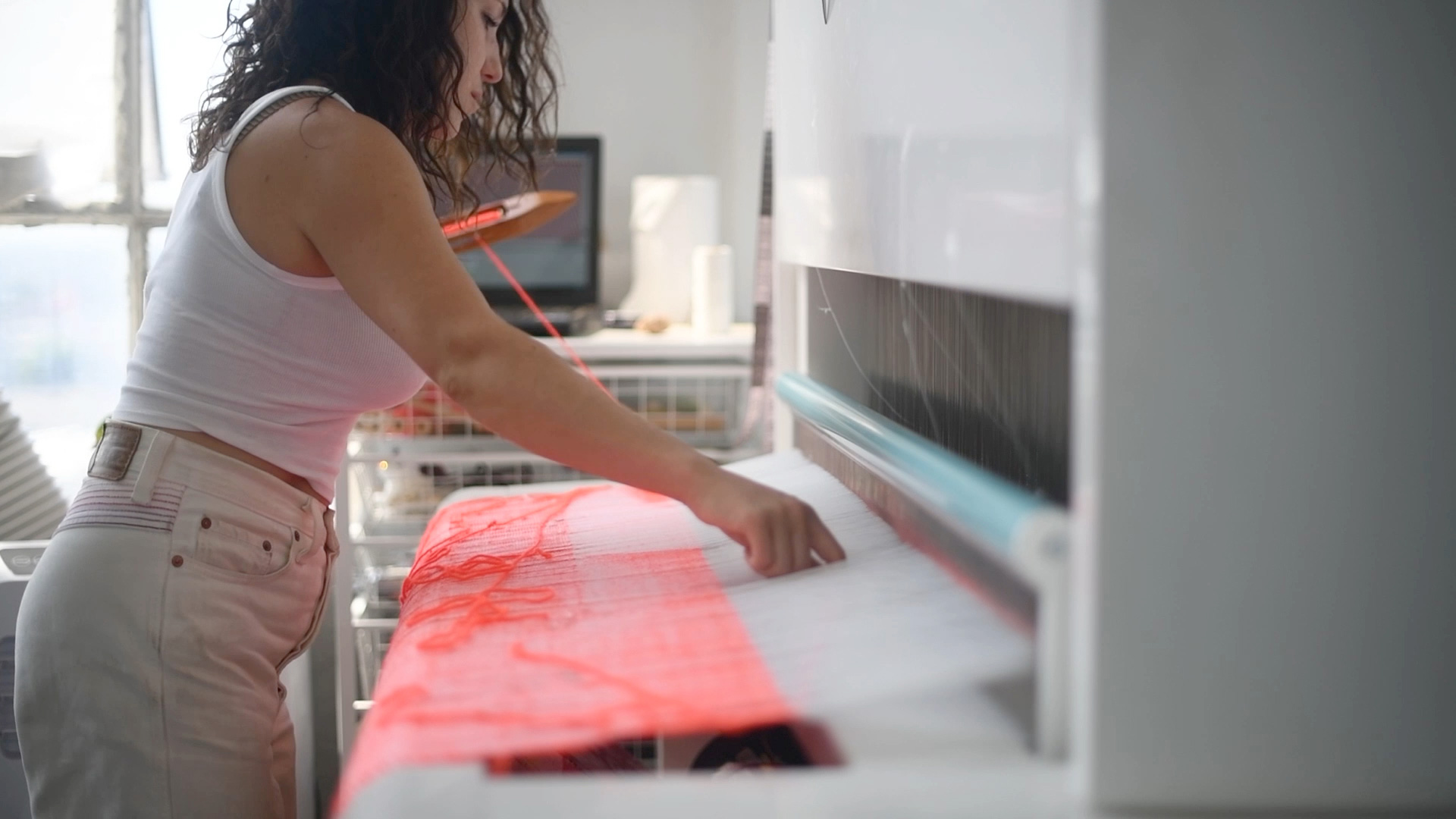
Mia Weiner at her studio, Los Angeles. Courtesy of the artist.
TB: I move through phases. It’s almost like you have the months and then you have the seasons, you know. For instance, when it comes to writing, my mind is clearer in the morning. But I also think there are times where you just have that energy from the night before and you’re ready. You know exactly what you’re going to do when you first get in, because you left in the middle of a thread you’ve been following and you haven’t reached the end yet. There’s no better feeling than coming in ready to go. Like, you just have this momentum within you. And there are moments where you are going hard, you’re very motivated, and then you hit a wall all of a sudden, either because a thread you follow didn’t lead you where you wanted it to go, and now you have to reel back and reassess everything, or because you get tired. Something happens, life happens. It’s funny how work can be a distraction from life. A lot of people use it as escapism. Even though, in some ways, it is a healthier escapism than sex, drugs and rock and roll, it can still be very much a state of disassociation. I think what we call sometimes: ‘oh, I lost track of time’ is just disassociation. But then there’s work where you’re present all the time. And I always want to be really careful not equating those two things. When you have pre-planned everything and you’re executing, it’s very easy for those two concepts to come close together.
MW: Sometimes!
TB: Sometimes, yeah. If you’re actively working on the canvas and you have to be 100% improvising and engaged, I don’t think you can fall into the easygoing, dissociative kind of thing.
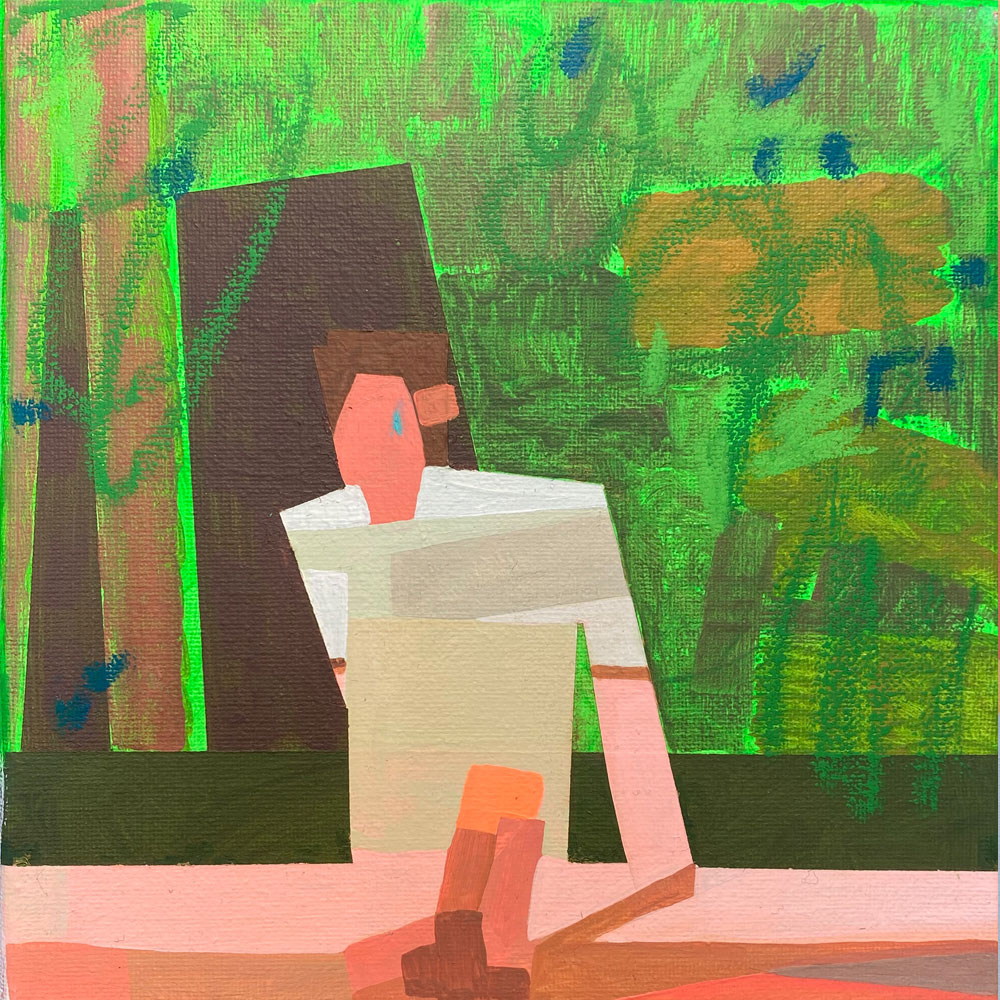
Tuna Bora, Good Morning Starshine, 2022. Acrylic and pastel on canvas, 8 x 8 inches. Private Collection.
MW: Sure. On paper, it should be that. But, for me, there are days when I weave more than I thought I could in a day and it feels so joyful and there are days I have a deadline and I’m stuck on an inch the whole day and I’m losing my mind. But it’s funny that you were talking about disassociation. Sometimes I feel I’m not necessarily dissociative, but I’m kind of surfing.
TB: Sure. I mean, it is a beautiful thing to practice any version of creativity where it gives a new path to your day, both mentally and physically. There are also the choices you make to remain in the things that are happening to you or around you in the world throughout the time you have to work. Because sometimes you have a deadline and you just have to keep going. When you finish a body of work under a big deadline… It’s funny, I didn’t really know about this until I started painting, but there’s a conversation among painters and probably all artists that when you finish a series and it goes to hang, you have this sort of month-long depression.
MW: Postpartum!
TB: Yes, postpartum from the work you’ve done. And it almost feels like some of the things you’re describing, being very joyful… you keep going because you’re in the middle of something and you can’t just leave it. Sometimes, if I’m using an airbrush, it’s particularly painful because I know even if I stop painting now, there’s going to be 30 minutes of cleanup, so I can’t just leave anyway.
MW: And you just keep going.
TB: Exactly. But in some ways, that’s also borrowing from the upcoming month of postpartum and tiredness and just feeling truly empty. Because it’s almost like you were in a kitchen with all your friends, when all your paintings or your weavings are around you and they’re all talking to each other and you’re talking to them. And then all of a sudden you’re alone in a studio.
MW: Well, so much energy is being pointed at one place. I think it even happens to kids when they’re getting ready for finals. But for art, it is very particular because there’s also such joy in releasing the work into the world.
TB: I feel the same way.
MW: Some people are happy keeping it in their studio with no one ever seeing it. And that’s amazing if it’s what they want. But in my case, the work is not just for me. So when it’s in the world and people can experience it, it’s the most meaningful moment for me. But, yeah, the postpartum is so hard and so real. And I always wonder if it would feel less hard if I worked less intensely or had a more balanced schedule. When I’m working on a really big piece, it’s crazy how messy the house gets in one week. I come home from the studio and I’m so tired I just throw the laundry in the corner and leave the loading of the dishes for tomorrow and then it becomes this giant… mess! And I feel so much shame around it. I was brought up to care for everything around me and then I see things kind of falling apart, and it’s gross. I would never want someone to come over and see my house when I’m in one of those states. I remember when we were at Eightfold, which is this coffee shop in between our houses, and you were like: “of course, this is what artists do! We put all our energy into this thing because we’re birthing it. You’re making something that needs all your energy”. It was so nice to hear that!
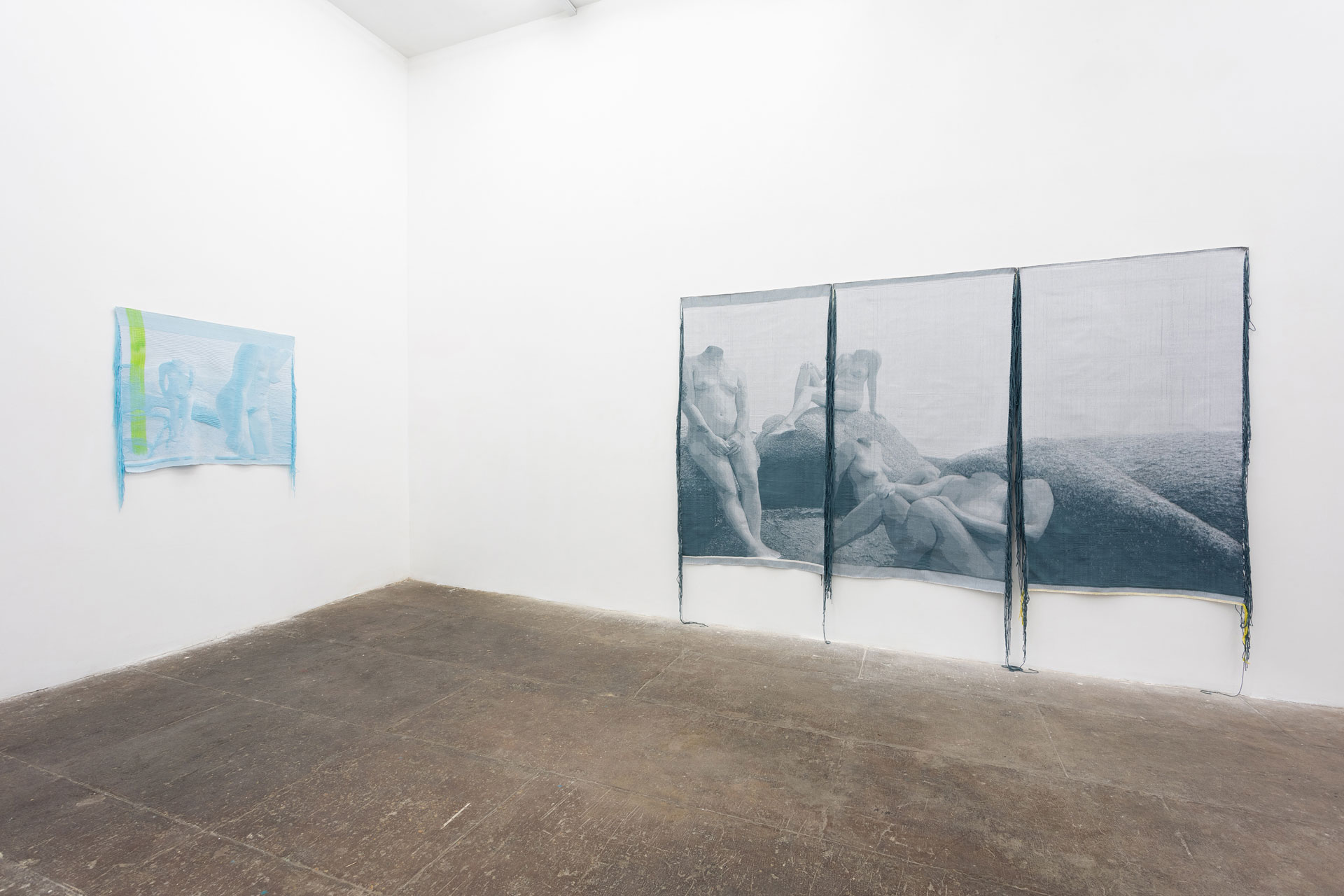
Mia Weiner, installation image from Sirens at T293, Rome, Italy, 2023. Courtesy of the artist and T293.
TB: Well, I think we overlook that a lot of capital A artists in art history had people doing all of their human labor. Yes, some artists were penniless and they did their own thing, but they also lived a bohemian lifestyle. And, not to bring gender into it unnecessarily, I don’t know if a male identifying artist would feel that level of shame. I think, historically, men have felt that pressure more about being great than keeping a clean house and not being presentable.
But I think the things that happen when I’m not in the studio inform the practice, in some ways. A lot of the growth happens in other places. For instance, as you’re building the work, this feeling of shame that comes up with letting certain things go in the house… Shame only makes it harder to deal with it. It doesn’t actually clean the apartment, so that’s why I feel the condition that arises in your home gives you a chance to really examine how forceful and hard you’re being on yourself, which is also happening in your art practice, you know? Learning to soften it in one area always helps you move emotionally more fluidly with your work.
MW: That is very fair. But if we take away the shame and just think about that within my practice and life, I really like to accumulate things. I get really intense and I nest and nest and nest until I find myself surrounded by materials around me.
TB: It just bursts.
MW: And I can’t focus. There’s too much stuff and it makes me crazy! I get anxious and it takes me another week or two to clean out the studio, put all the yarn away, take the weavings off the wall. And then it’s like a blank slate. A fresh thing to start a new idea. So I go through these phases of cleanliness to mound and back, as opposed to some people who like their space to always seem the same. I like this sort of cycle.
TB: I like it too. And I think everything we see as discipline or planning is really an offshoot of the Industrial Revolution – people being taught that there are certain hours to sleep, certain hours to work, there’s a very specific lunch break. I don’t think work really works that way.
MW: I do believe that we have been taught a lot of these things through capitalism in a really fucked up way. People are really different.
TB: Yeah, that’s what I’m saying.
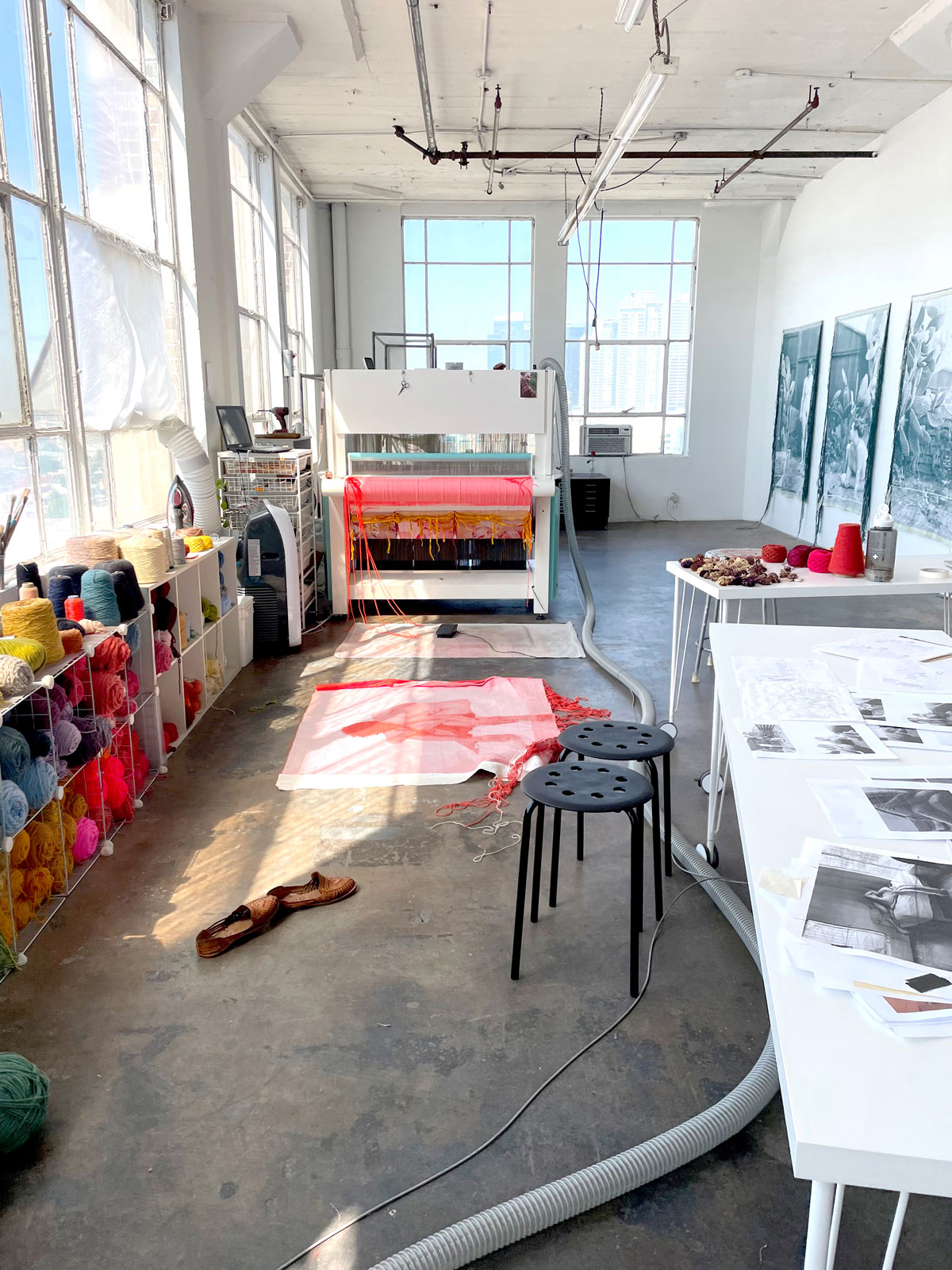
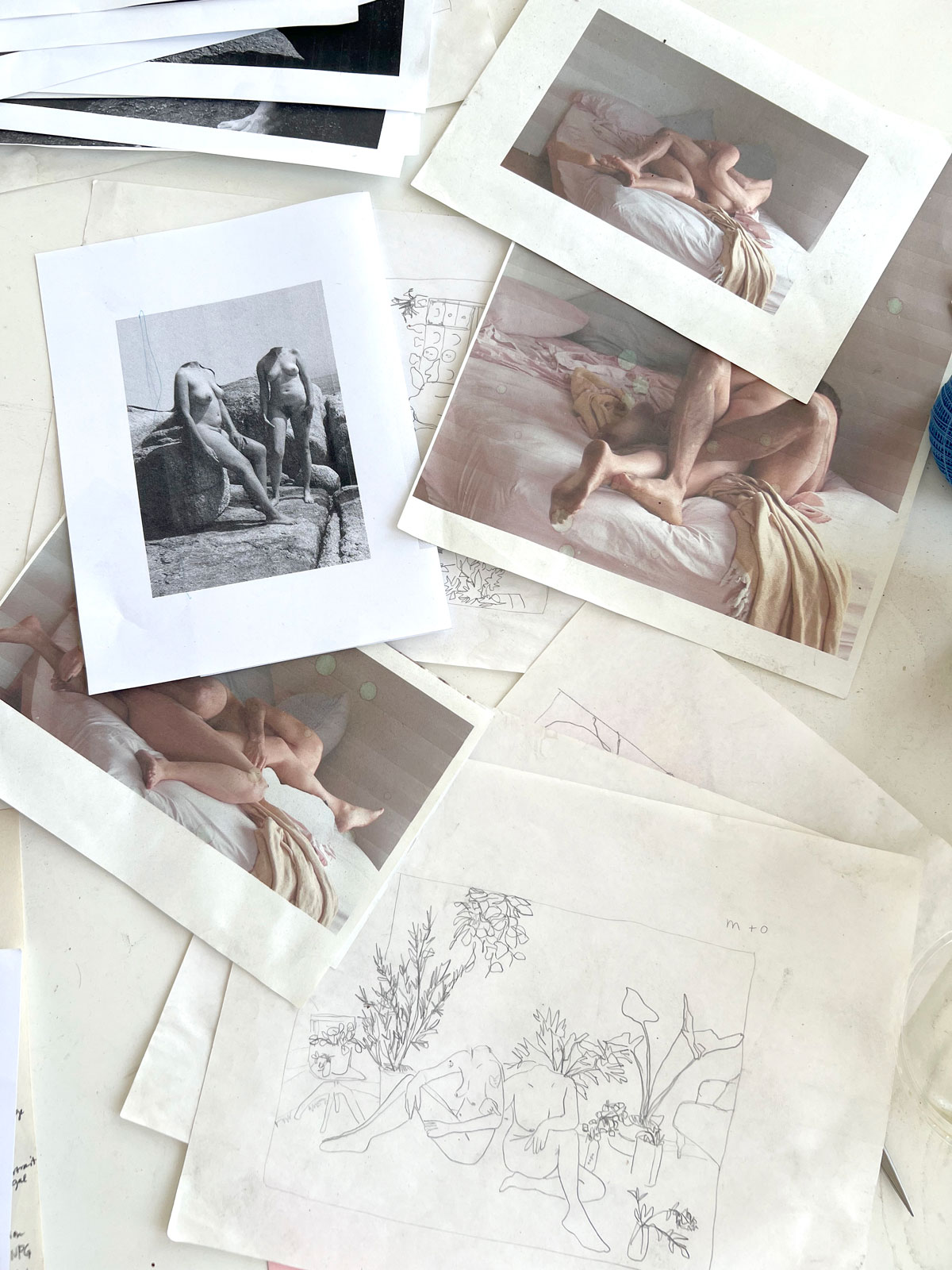
Mia Weiner’s studio, Los Angeles. Courtesy of the artist.
MW: I’m an Aquarius. I’m all over the place, right? I know some people who are the most productive between specific hours. Mostly Virgos.
TB: Look at you. Deep cuts [laughs]!
MW: Let’s go! I do love a Virgo. And I have some friends who, no matter what, will write or draw at this time or that time, and it really works for them. I envy it, but when I do that, it just doesn’t work for me. So I just let myself go through my cycles instead.
TB: I hear what you’re saying, but that is still about productivity.
MW: Yes. Maybe a better way to put it is that I don’t feel connected to working that way. Some people feel connected to materials when they’re working in that way, for example. I don’t necessarily mean productivity because half the time when they’re writing in the morning, they can throw away all those pages, right? It doesn’t matter. But it’s a work rhythm they have and enjoy that has these start and end points.
TB: I understand.
MW: You can still disagree [laughs].
TB: It’s not a disagreement. I’m just elaborating on what I mean. To get good and to truly be fluid with things, you do have to be okay with making things you will throw away and you have to regularly make yourself do the work even when you don’t feel like it. There’s a lot of space between these completely bohemian and completely structured ways of being. However, there are certain temperaments, that unless they produce a number of pages – some to throw away or not, they get anxious about not working. So I think there are different solutions for different people. Meeting yourself where you are emotionally and mentally is important.
MW: Yeah, that makes sense.
TB: And I can’t help but feel that is a product of having always conditioned yourself a little bit too much. People do better when they’re not too hard on themselves, when they can see their inner turmoil and choose to step in it or not accordingly. And that’s where you get this fluidity of motion and movement.
MW: If it’s too hard, it can’t blossom.
TB: There’s a bit of that, for sure. And, maybe it’s a little bit too poetic, but the way I think about it is sort of like the sun and the moon – and I don’t mean the hours, but the fact that both these things are always in the sky. They will always overlap to some degree. But what’s really difficult with the demands of the art world is that a show rarely gives you enough time to put yourself into a concept and make a meaningful amount of work.
MW: But even if I have a year and a half to work on a show – which is amazing, most of my work gets done in the last four months.
TB: I like that you’re saying four months as if we’re not all waiting far more closer to the deadline than that. [laughs]
MW: Well, I physically can’t. It probably would be shorter if it was physically possible. But in the last couple of months, no one sees me and I’m nuts. But I do love getting nuts in the studio. Actually, the building where my loom is has set opening hours, so I have to leave at midnight. And it opens back up at 6 a.m. This broke my bad habit of working all night, for which I’m kind of thankful. But when I lock myself in, I pretend I’m not there. I hope my landlord isn’t listening. And then when they leave, there’s such joy in continuing working.
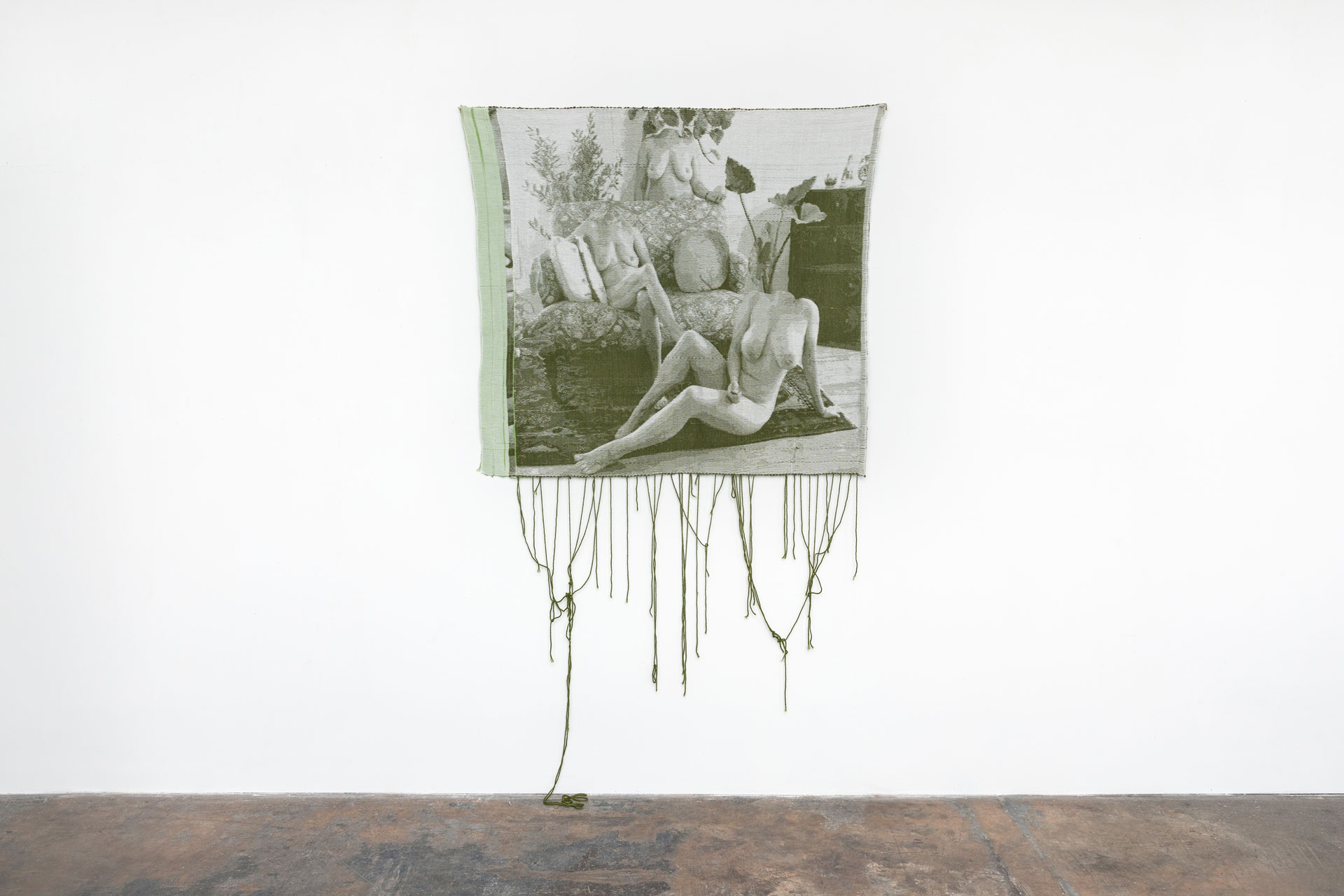
Mia Weiner, untitled, 2022. Handwoven cotton and acrylic yarn, 44 x 54 inches (82 x 54 inches with fringe). Courtesy of the artist.
TB: I actually really love working through the night and I refuse to feel bad about it. What I really like is when the entire world is sleeping – which is not true because half the world is awake. But my family lives about 11 hours off my timeline, in Turkey. So maybe I get to be in a liminal mental space that I quite like. And those are the times where I feel the loosest. I feel good playing music and dancing and loudly singing while I’m working. I think this is how people feel when they’re drunk and dancing.
MW: I feel strongly about that too. I had stopped drinking mostly and slowed down on all these things and the studio felt a little different. It makes me think of people like Jackson Pollock. Everyone says his paintings were terrible when he was sober and that he needed to be drinking to make good work. I don’t know if that’s true, but this is the narrative we hear. When I started playing with my sleep, I found out that being really tired allows me to release. I was too tired and I didn’t have enough time, so I wouldn’t suffer so much about making decisions and it took away some barriers for me. A decision just had to be made and I had to trust it in a different way. But it’s really interesting hearing you talk about this liminal space.
TB: There are a few people I can be on the phone with having meaningful conversations for three, four hours, and it’s actually beautiful to have that while I’m in the process of making things. That’s a different speed than when I’m singing and dancing and whatever. But I think all of that belongs in the work. You can see it in the layers that some moments are really energetic and some are more reflective. It’s funny you brought up Jackson Pollock. There are these myths around artists… this idea that if you don’t suffer, it’s not real. And that’s definitely putting difficulty on a pedestal. So much of it is self punishment spirituality built into the Western world. There’s a lot of guilt and shame in not working hard enough or not suffering enough for the thing you love. Self-sacrifice.
MW: Do you think this is also a way to keep artists down?
TB: I think it eventually turns into that. And that’s true of other works too, like not just art.
MW: One of the most memorable things that happened to me in grad school – and for which I’m thankful for, was hearing Jeffrey Gibson say you don’t have to suffer as an artist [laughs]. At the time, that blew my mind and it shouldn’t have been that surprising. He was talking about how he was in a better relationship and how his life got better and then his work got better.
TB: These are important things. I mean, truthfully, you only live once, right? So you have to decide how much living you’re going to do and what quality it should be.
MW: We’re all going to go through things. It’s the human experience. I don’t mean I’m happy all the time. But a lot of people are scared of how dangerous open creative voices are. I think being taught we need to suffer to make good work as artists is really just to keep artists controllable. That’s my conspiracy theory [laughs].
TB: That’s an interesting theory. But I don’t think anyone else but me can truly keep me down when it comes to whether I should suffer or not, right? The productivity mindset is very Abrahamic, particularly Catholic or Protestant. Unless you’re working, you’re not pure of mind and you should be productive. It’s the capital creating spirituality. But what I like about eastern spirituality is the idea of inaction as action. You have to let things settle. In the Islamic understanding of things, there is sin and the opposite of sin, which according to a friend who was brought up in the States, it’s self-sacrifice.
MW: Like martyrdom?
TB: Almost. It’s about sacrificing yourself for the betterment of other people. I’m atheistic, and I am not very spiritually focused. But, there’s the sort of social fallout of having grown up in an Islamic culture. There’s Sebab, which is when you do a good thing that will be beneficial for the world and other people and also yourself probably. Like helping someone out. It’s not something you go and brag about.
MW: I learned a lot about it when I was in other places like Indonesia, India. I was raised sort of Jewish and Hindu, but on the very spiritual end of it, not in a very traditional “religious” way. I grew up really disliking religion because of the power dynamics within them. It took me many years to start seeing how beautiful all these different practices and beliefs were.
TB: People who have used religion for power have turned all these institutions and beliefs into something that carries darkness into other people’s lives. But I also do see the kindness in people.
MW: Yeah, it’s just different culturally. But, changing the gear a bit, besides the self-sacrificial thing, I also think artists have been taught to be the wallflower in the corner. But I think we are and should be the greatest advocates for our work. You have to build a spine to be able to take criticism or to position yourself when working with a gallery.
TB: Very true. I do think we like control and it’s hard for us to give it up sometimes, especially in the areas we don’t feel comfortable in. Regardless of the practice, I think part of why we like being artists is because we get to be in control of what we’re making, to a certain extent, even if the process includes something more organic that is out of control and improvised. And life isn’t really like that, right? We’re more connected than that.
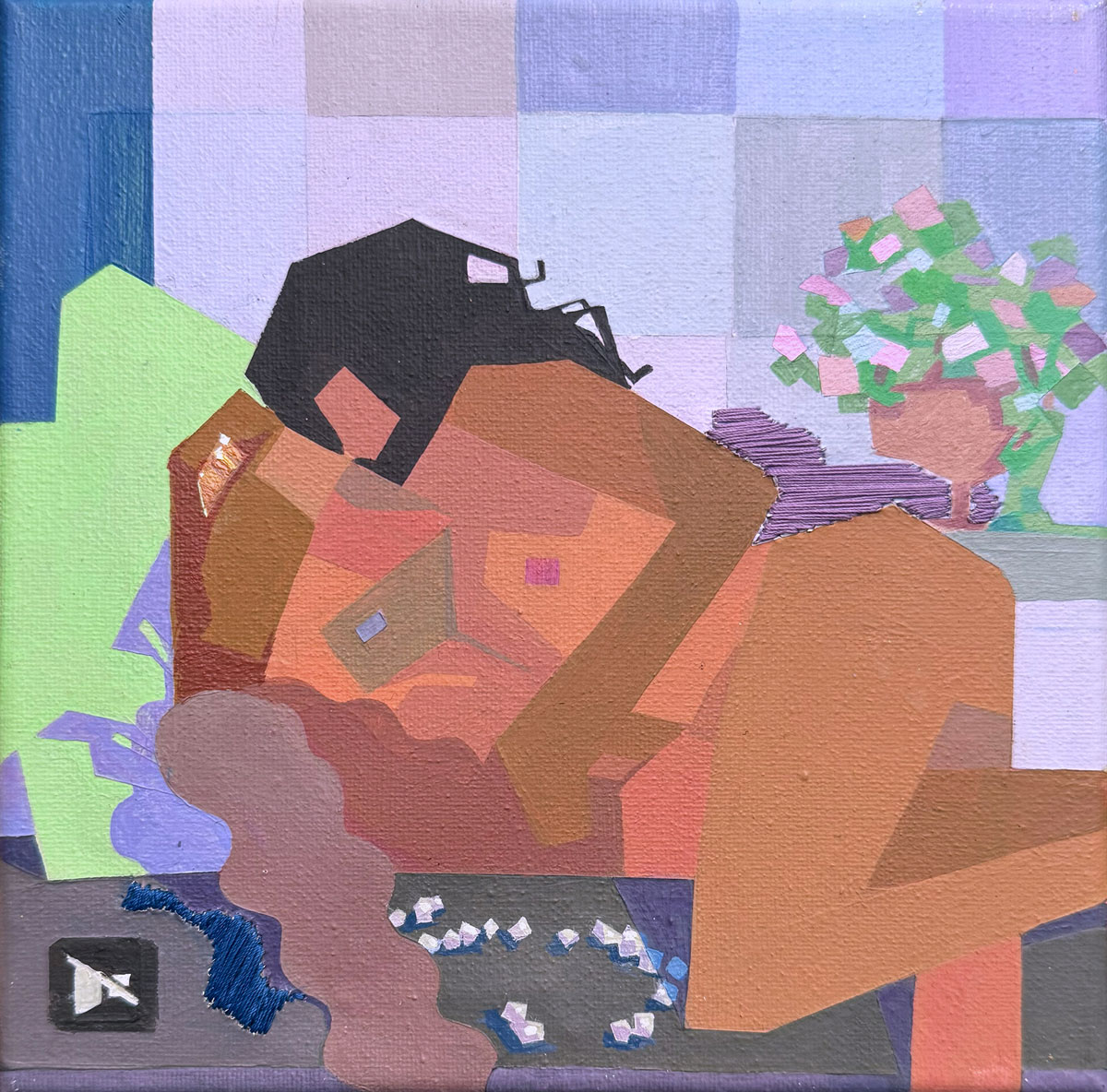
Tuna Bora, Roommates, 2022. Acrylic, pastel, and hand-stitched polyester on canvas, 8 x 8 inches. Courtesy of the artist.
MW: Yes, my whole practice is a push between control and release. As it is our whole lives.
TB: Because, truthfully, you have so much control. Yet, you can be the perfect artist, do all the perfect things, work with the perfect people, and there could be a flood that is way out of your control.
MW: You never know what’s happening, and since we’re talking about control, I wanted to ask you about your experience moving from film, where you work with a big team to create something, to working solo in the studio. Does that feel natural to you?
TB: There’s something so intimate about creating with other people and I do miss it. I haven’t stopped animation and I love that process. And there are many things you do on your own in that process too. You will always work in groups. And maybe this is just my take, it’s not necessarily echoed in everybody, but people get into it because they want to make films themselves and they’re giving chunks of their life to serve your vision, whether it’s because of the money or because they want to work with you. And I think that deserves a lot of grace. You don’t take it for granted – you help them connect and support them in their own journey towards the things they want. So there’s such a beautiful network and I think it’s a little friendlier and a lot kinder than what I have experienced in the art world in general. But there are pockets in the art world where it feels a bit like that too.
MW: This is one of the things I love about Los Angeles. It’s one of the places with the most open and generous art community I’ve ever been a part of.
TB: I have been hearing this a lot.
MW: Not that there’s anything wrong with Chicago or New York, but it just feels really different. And I think that’s partially why the LA art scene has been expanding. There’s such a beautiful community between artists – conversations grow, connections grow.
TB: It’s surreal in that way. A lot of people in LA are creative, either from here or from other places. I do think it gives the city a very specific persona. I will say that the film community in New York is quite like that though and I have always loved that. In film, there is that feeling of the little kid who was shooting their own Super 8.
MW: That is cute. All these people are in this one space together and are putting their energy to create something and to do it together. I guess I use other people in my work, and I’m always in awe of that generosity. But I was thinking about how exciting it is that you have a practice where you get to toggle between working with a team of people and also have your own sort of space or bubble.
TB: It’s a very different thing. And I think it’s just the best thing you can ask. Especially if you have a good relationship with those people. This conversation feels a little bit like that.
MW: Totally. I appreciate our chats too. Thank you. I’m so thankful we’re doing this today.
TB: It’s my pleasure. It is such a pleasure to talk to you!
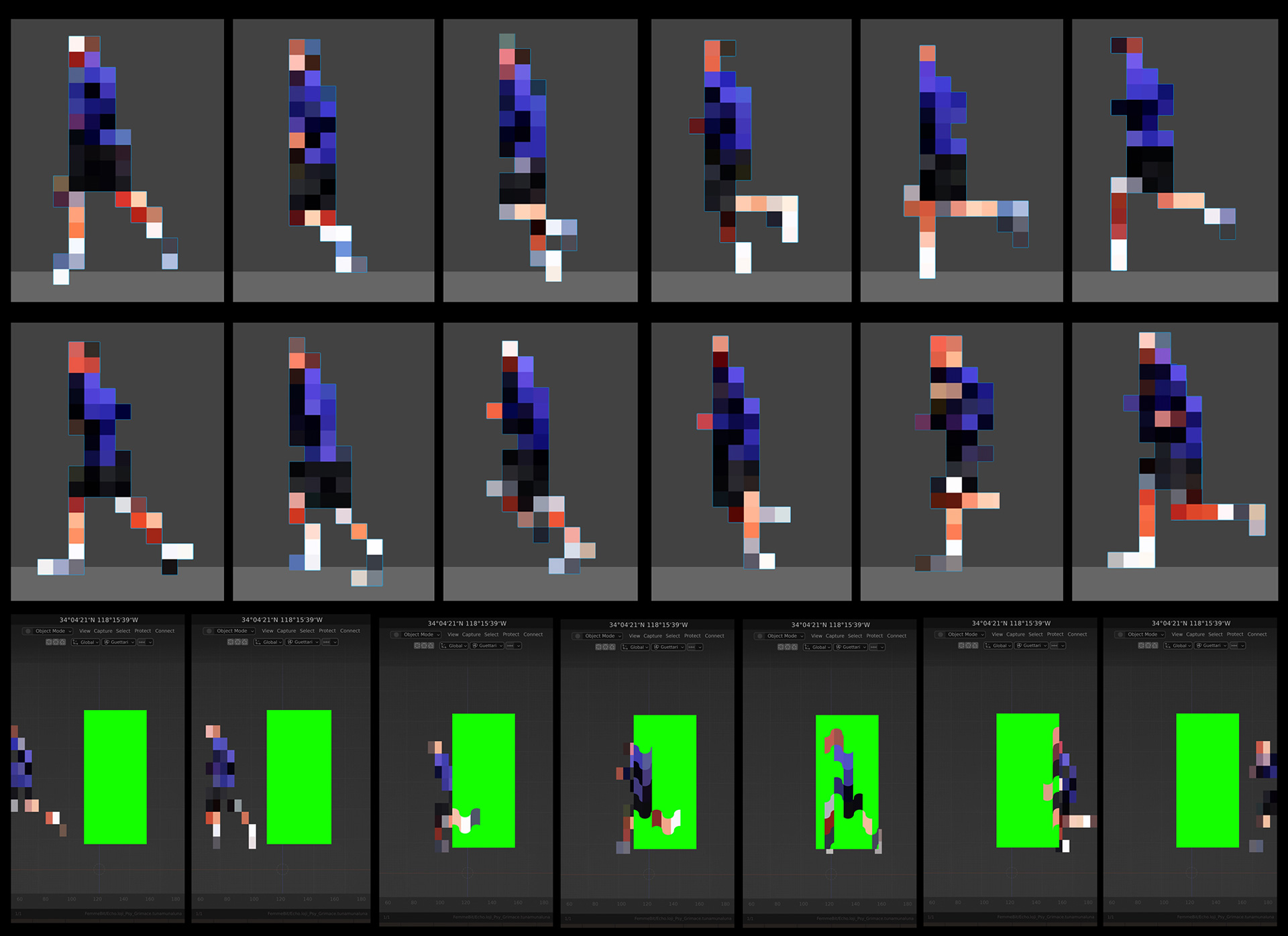
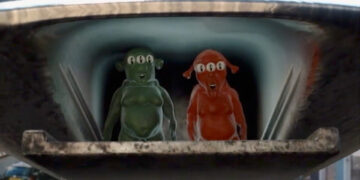
Tuna Bora, Echo.loji_Psy_#003_Grimace, 2024. Video stills. Courtesy of the artist, and Feral File .
To learn more about Mia Weiner’s work: @miaweiner
To know more about Tuna Bora: @tunamunaluna // tunabora.com
Courtesy of the artist and Homecoming Gallery, Amsterdam, Netherlands.