Basting /Using long, temporary stitches to loosely join pieces of fabric, allowing adjustments before final sewing/
“There is always a curiosity to see how certain images will behave.” — Gabriel Pessoto, conversation, January 20, 2026
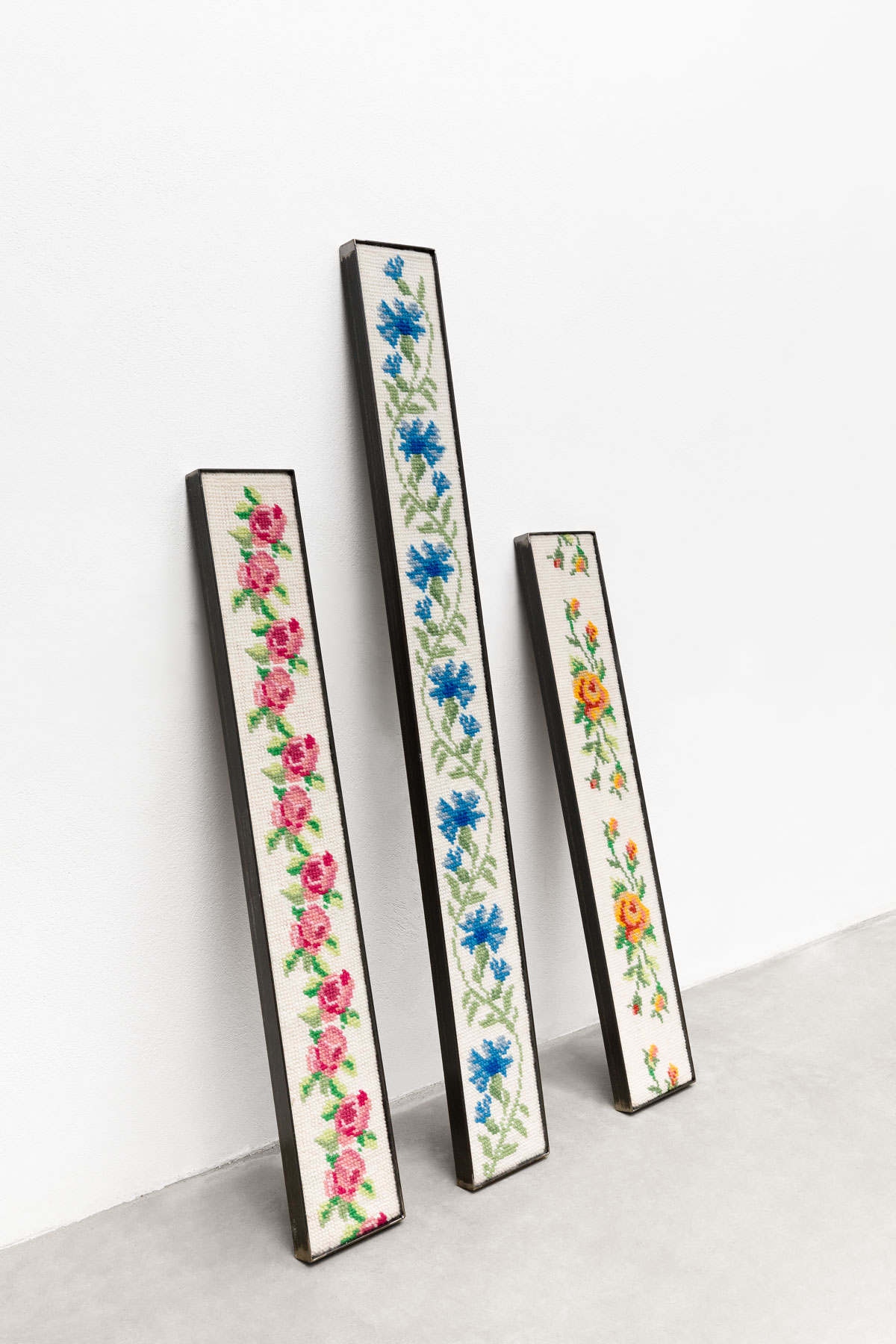
Gabriel Pessoto, jardim, 2024. Natural wool tapestry on a carbon steel structure, 33.1 × 5.5 in, 47.2 × 5.5 in, 35.4 × 5.5 in. Triptych.
Photos: Estúdio em Obra. Courtesy of the artist.
“That contemporary informational and communicational machines should not be content with conveying representational content, but also contribute to the production of new assemblages of enunciation.” — Félix Guattari, On the Production of Subjectivity, 1989 (1)
“Insert the needle from the wrong side, leaving the knot underneath; hold the thread between thumb and forefinger and wrap it around the needle three or four times, according to the desired knot size” — Maude Russell, The Maude Russell System of Garment Cutting, 1914 (2)
I consider the various arts—painting, sculpture, music, poetry, fiction, among others—as components of a vast and often unrecognized technical system essential to the reproduction of human societies, which I will call a technology of enchantment. — Alfred Gell, Art and Agency, 1998 (3)
“There was something about making such a piece; I had to mobilize a series of skills—learn to sew, work on finishes, deal with materials and time to make it; how is the pattern made? What does the unseen part look like? What lies behind it? There is a desire to reach an image, but at the same time there is a silent performance while I am actually sewing a wedding trousseau and wondering what I am learning through the choreography of this practice.” — Gabriel Pessoto
Some time ago, I experienced a moment that intertwined my encounter with Pessoto’s work into a scene. In 2021, I received the publication Ambiente Moderno, which gathers works from his “Enxoval” series. The following year, after a divorce and a move, I hosted my godmother for a meal. As a gift for my new home, she gave me a set of hand towels finished with a hand-knitted hem (by her). Pessoto’s publication, that at the time was sitting on the coffee table, entered the conversation when it was mistaken for an embroidery pattern magazine. We leafed through it together, amused by the votive, desirous phrases printed on its pages: “sleep very well,” “what a beautiful kitchen,” “choose the prettiest,” and so on.
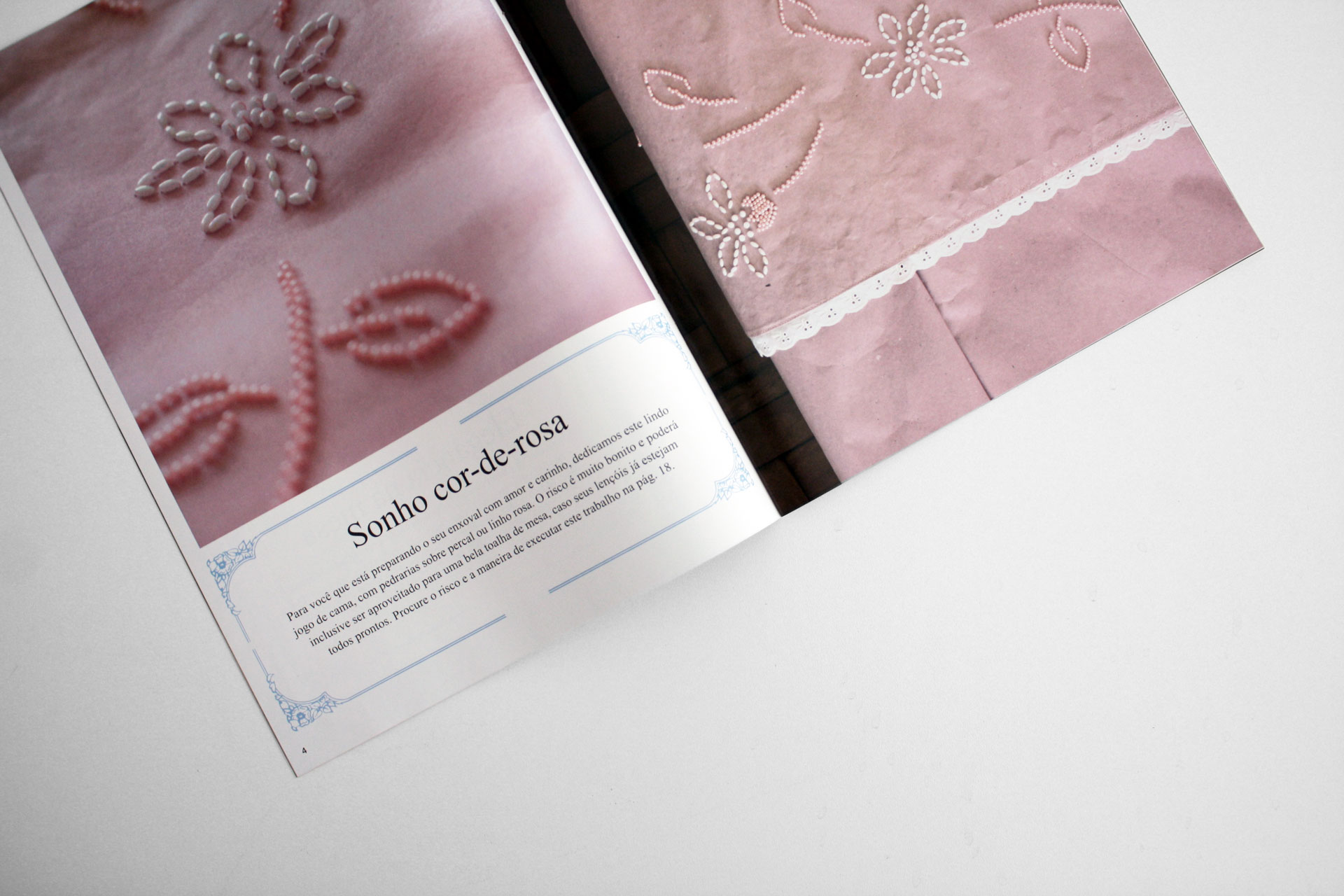
Gabriel Pessoto, Ambiente Moderno, 2022. Artist’s book, 24 pages. 11.4 × 8.3 in. Courtesy of the artist.
Cutting the Pattern/Cutting the shapes that each part will take, defining how they will later come together/
Piece 1: Scene
The personal fragment above defines an important component of this text: the “scene.” The episode reveals how the relationship with works of art is neither isolated nor laboratory-like, but shaped by its surroundings—where spatial, sensory, atmospheric dimensions, among others, participate in the encounter and influence its unfolding. Within this integrative event, scenes emerge between subjects and artworks, from which narratives, meanings, and intuitions about the works are derived.
The “scene” transforms the episode into something more than an image, granting it a gestural, transitive, and emanating character. It thus requires the dimension of the “event” in order to articulate and transmit the assemblages it provokes. As something transitive, it exceeds the regime of code and closed programming, challenging the static, predictable, and rigid nature of reproduction. To speak of “scene” when addressing the image is a strategy to draw attention to its manifesting and enchanted force—one that is often suppressed by the constant focus on the compulsive, reproductive, and massifying aspects of images within the contemporary media landscape. Therefore, invoking the transitive vitality of the image through the notion of scene proposes an active way of engaging with this recurring term in the artist’s poetics—who, it is worth recalling, was initially trained in Cinema.
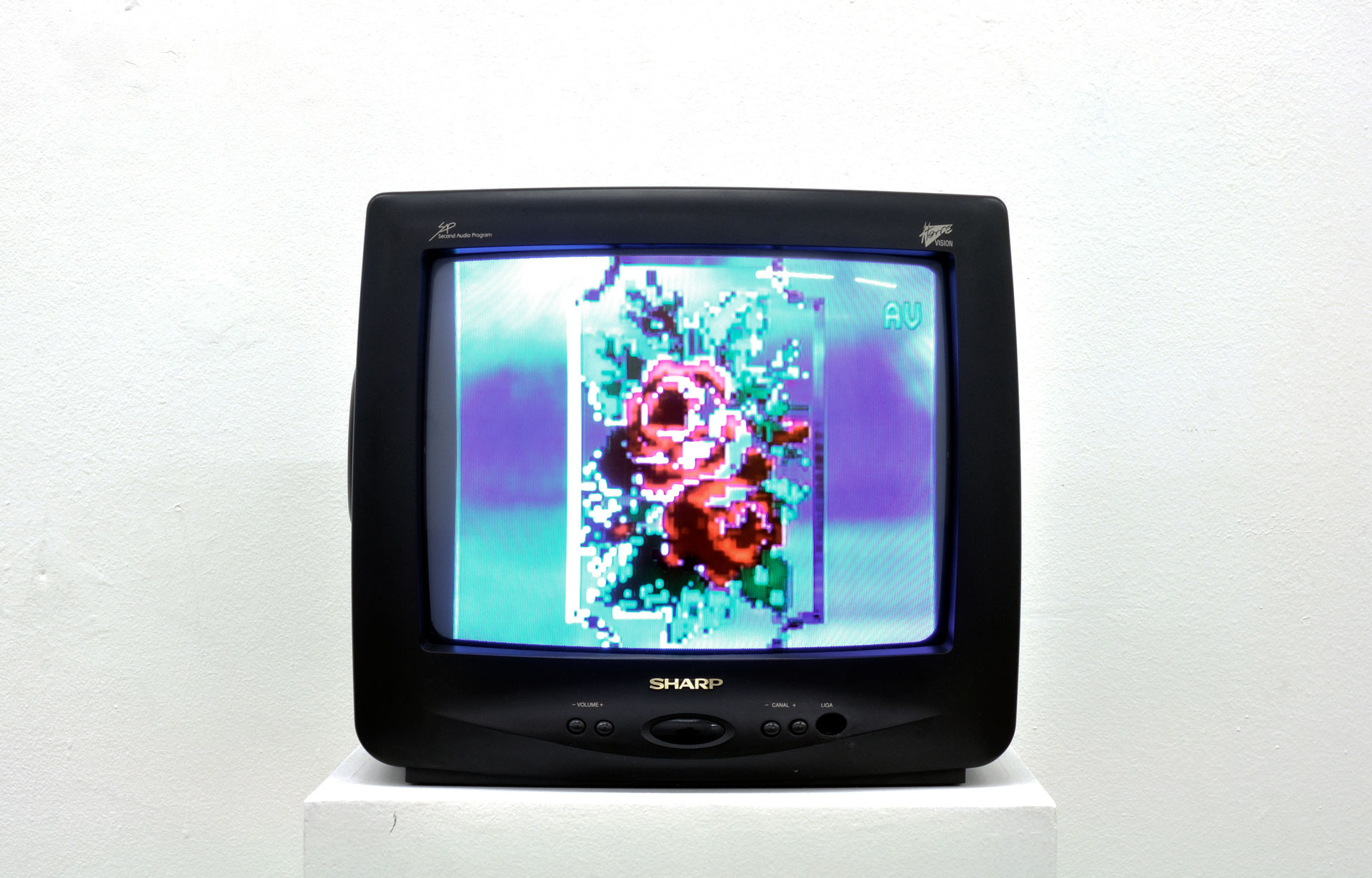
Gabriel Pessoto, flor da pele, 2022. Video, color, silent, 1 min. Photo: Élcio Miazaki. Courtesy of the artist.
Piece 2: Operative Image
The cut above pairs with another component of this text: the one that addresses the operations mobilized by images. This is an inherent quality of images—not only to make something visible, but to manifest and enact an event. Here, we delimit the operative aspect of the image, a concept introduced by thinkers such as the German artist and filmmaker Harun Farocki, to describe images that are not oriented toward a representational purpose, but a functional one. These are images that are not primarily intended for contemplation or for producing a vision of the world, but for executing a task, operating as instruments within technical processes and dispositifs of action. In this sense, they do not aim to make something visible, but to make something happen.
Within their potential to promote, instruct, and mobilize operations—such as spatial navigation commands, the generation of QR codes for passenger boarding, or facial recognition—these images are strongly associated with a technical universe. At the core of their functionality, however, lies the enabling of an act, an action that produces an effect simply by existing. Starting from this non-representational operativity, we can return to images more broadly and ask whether they might also possess an expanded capacity to manifest and produce effects that do not settle within the already given visible and real fabric of representation. Even beyond the technical-operative sphere, might there be images capable of presenting, enacting, and enabling configurations that do not rely on predetermined referents, but instead carry out sensitive instructions—soliciting and mobilizing gestures within the fabric of human subjective production in order to fulfill their purposes?
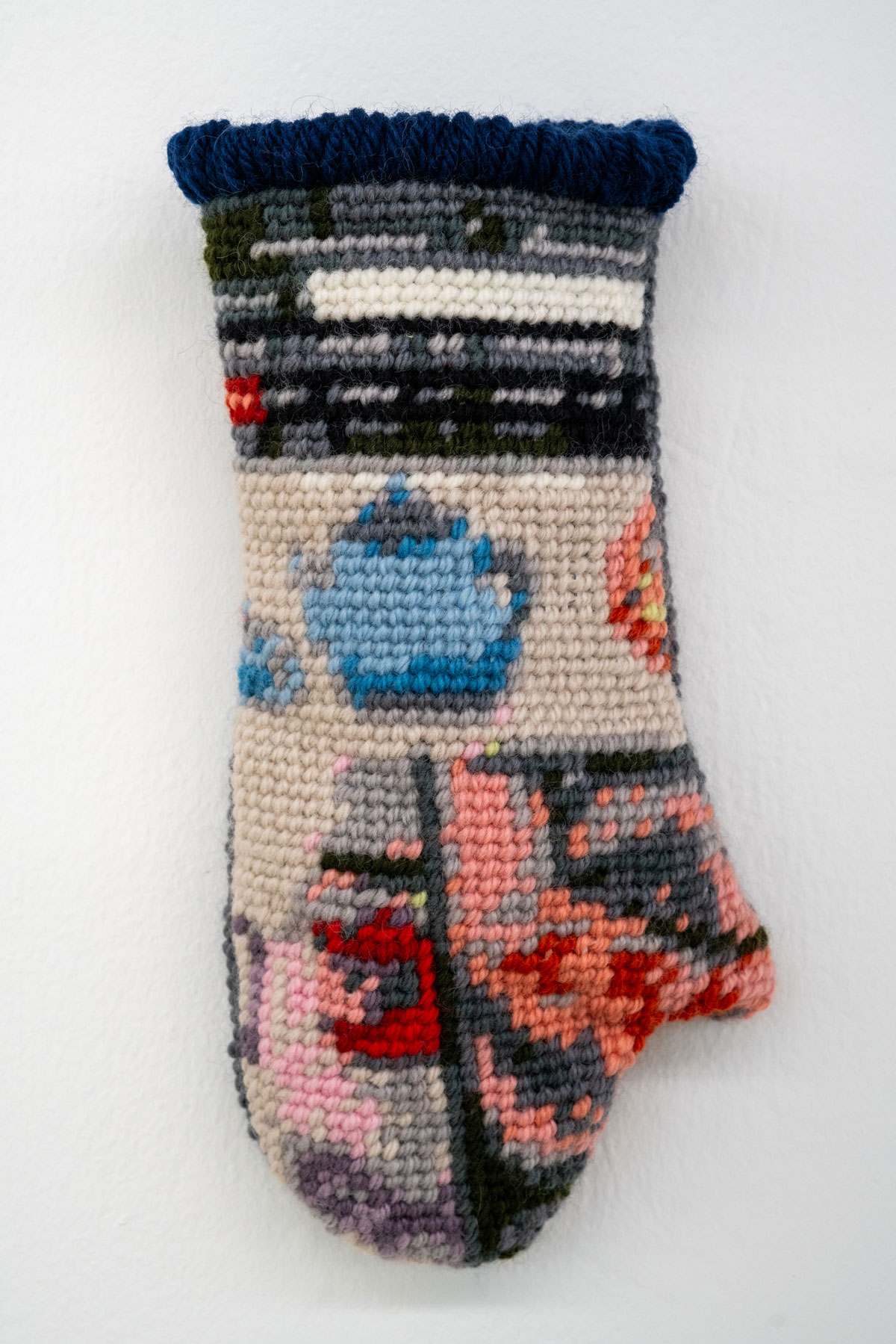
Gabriel Pessoto, acessório 1 / handjob, 2024. Tapestry and sewing on canvas mesh. Approx. 13 × 7.1 × 2.8 in. Photos: Vicente Carcuchinski. Courtesy of the artist.
When considering image-making within contemporary art, we encounter a range of practices that use the image as a tool to resist the reification of hegemonic representations of certain subjects, cultures, affective practices, and even definitions of the past. The stance of “[…] producing images that do not refer to any represented real,” (4) as proposed by thinkers such as Félix Guattari, can be understood as a potentially transformative mobilization within the field of subjectivity production. This is perhaps precisely because it allows us to circumscribe the limiting arrangements that organize our imaginaries, while also calling for ruptures within prevailing representational systems—encouraging the creation of new references and new ways of thinking about and presenting subjects, practices, and histories.
Images that revise and reimagine thus become tools within a broader struggle over narrative—seeking to register and legitimize other ways of seeing, remembering, and framing the worlds around us. In the work cromos educativos (2024), Pessoto presents a sticker album titled Brasil minha Pátria, used as an educational tool during the Brazilian military dictatorship. Across its open pages, we see the completion of a narrative of homage—from stickers depicting the “discovery” caravels to a sequence of early presidents and other canonized male figures from the colonial and republican periods. Do such images merely show us busts and faces? Do they serve only to illustrate or represent a historical narrative? Or do they, through the act of collecting, engender a practice of affiliation with these images?
Certainly, they operate on a sensitive level, shaping dynamics of recognition regarding who may be historicized as a hero, and functioning in multiple sites of conditioning and modulation of subjective production. They contribute to maintaining a particular historical narrative regime within the seemingly innocuous frame of a children’s artifact. But what happens if other stickers begin to compose this album? If we seek to find and produce images worthy of a racially conscious and critically literate reading of Brazilian history, what kind of album would we assemble? And what kinds of society and realities might emerge around such a collection?
Like the use of a seam ripper—a sewing tool used to undo stitches and open new spaces for buttons—Pessoto, in this and other works, appears to open pathways both for registering such questions and for inventing and promoting narratives that challenge those that have become hegemonic.
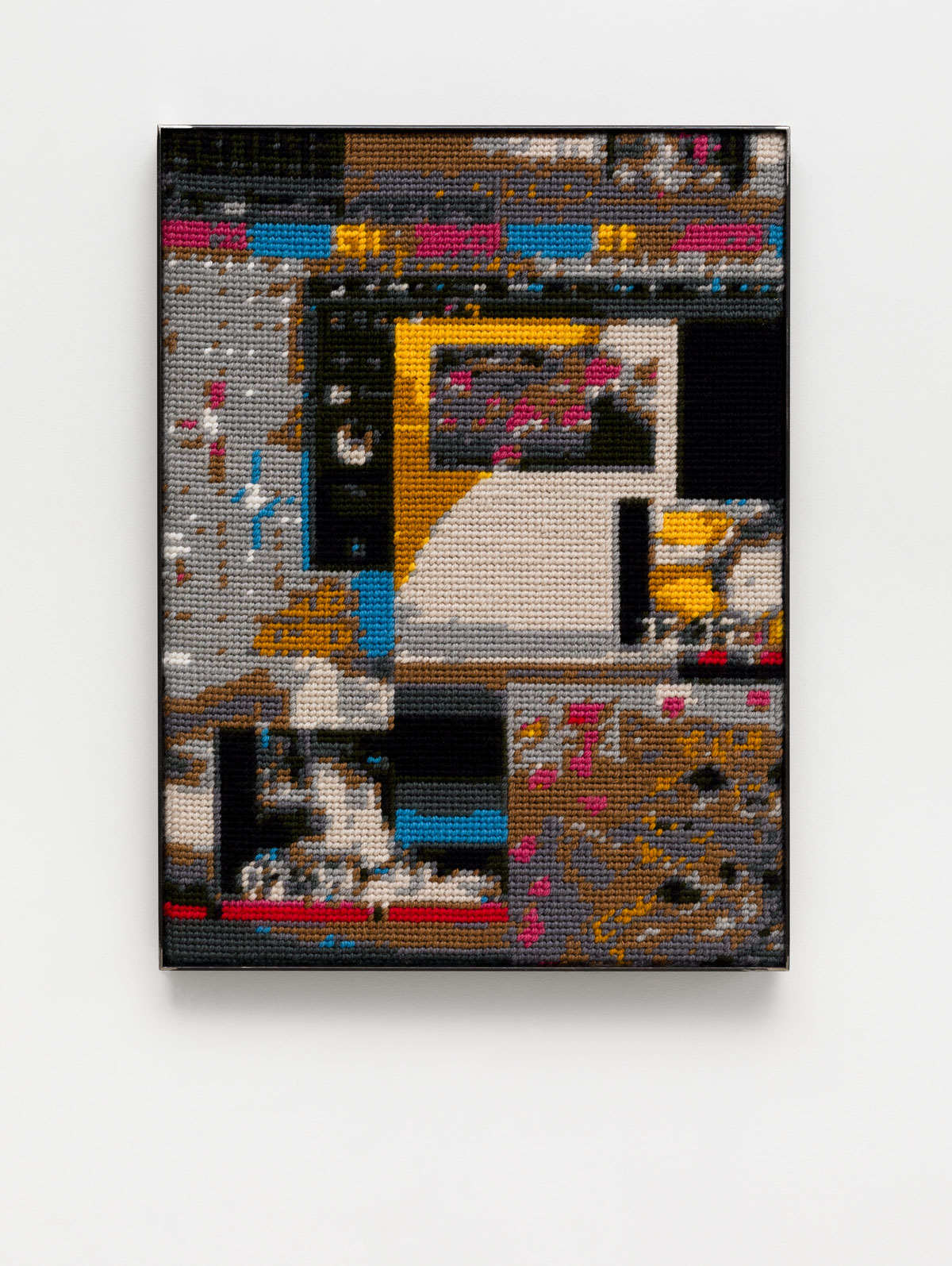
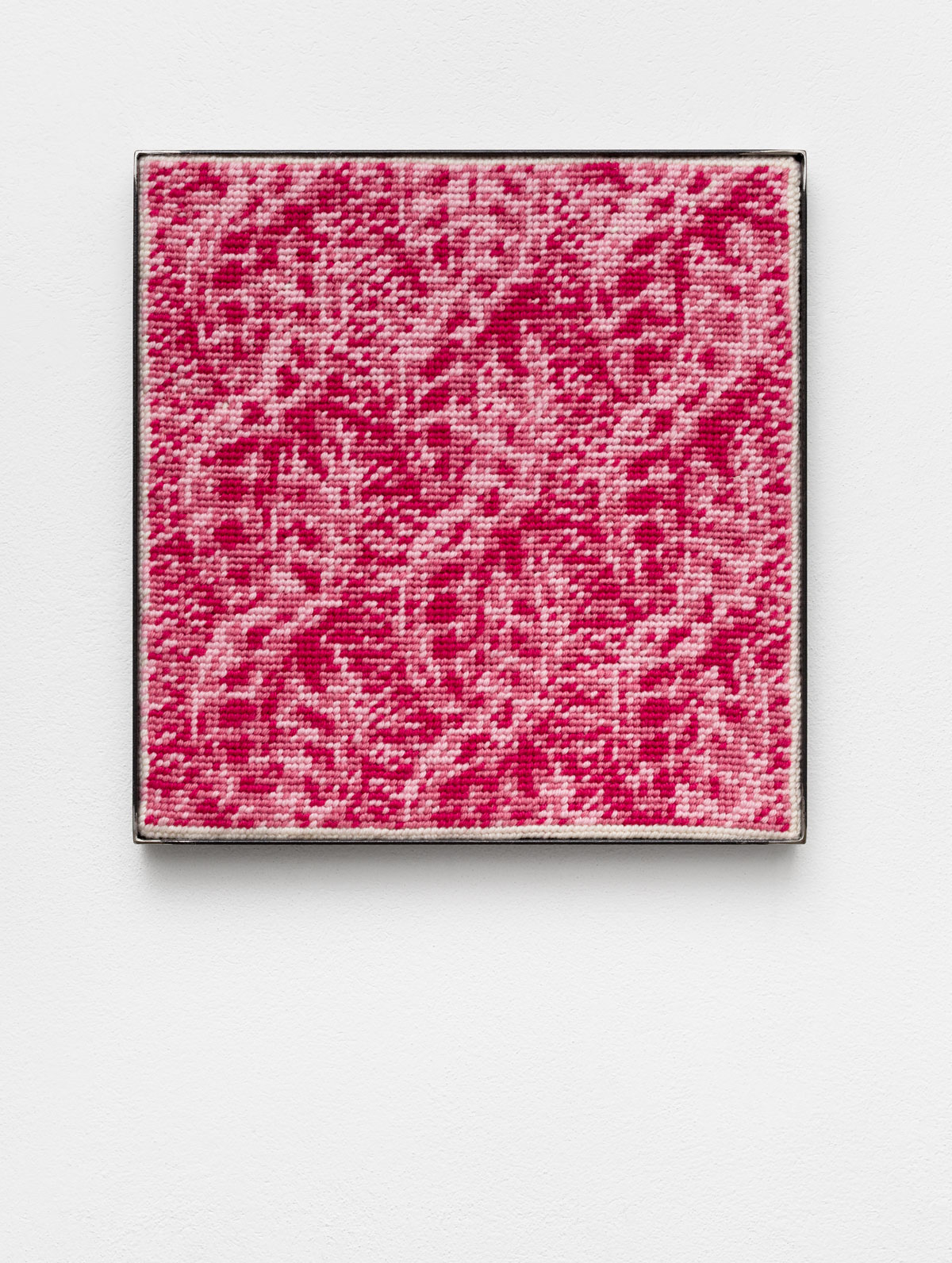
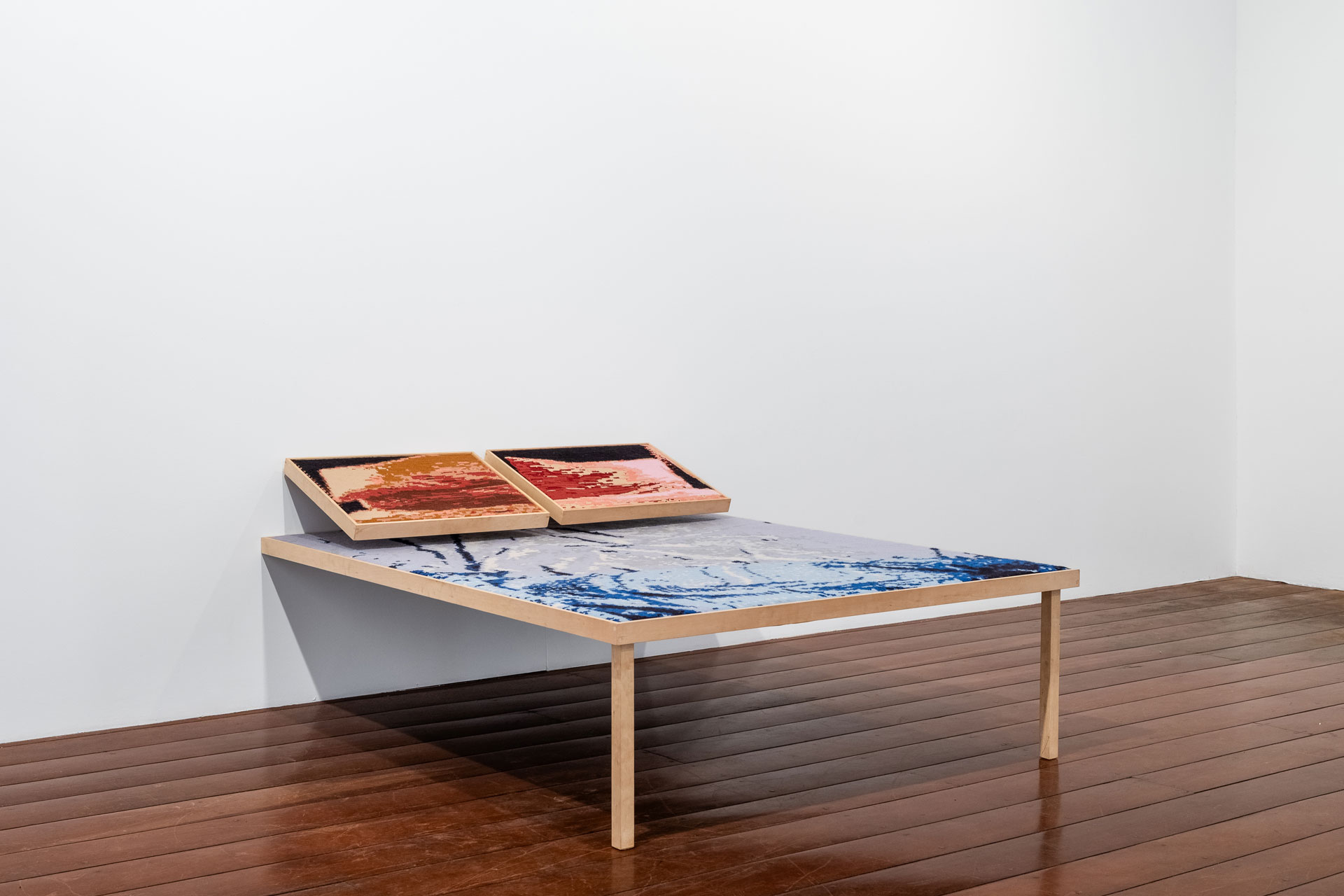
Upper left: Gabriel Pessoto, nova janela, 2024. Natural wool tapestry on a carbon steel structure, 22.6 × 16.9 in. Photo: Estúdio em Obra. Upper right: Gabriel Pessoto, Uma blusa assim fica ainda mais romântica, 2024. Tapestry in carbon steel frame, 17.7 × 17.1 in. Photo: Estúdio em Obra. Lower center: Gabriel Pessoto, A colcha que sempre agrada, 2022. Wool tapestry/embroidery on wooden support, 39.4 × 57.5 × 70.9 in. Photos: Ana Helena Lima. Courtesy of the artist.
Piece 3: Enchantment
If the operative image incites actions and produces effects within technical systems, what name can we give to images that act and mobilize within social and affective networks? For the purposes of this text, we will refer to them as “enchanted images,” drawing both on the magical dimension the word evokes and on the notion of the “enchanting” as it appears in reflections on the ornamental and the decorative—elements central to some of Pessoto’s poetic investigations.
Returning to Ambiente moderno, we can read beneath one image the following phrase: “the charm of this lace bathroom set lies in the cheerful sparkle of its embellishments.” To find oneself “enchanted” by a set of objects—to witness the charm or spell they cast upon us—is to understand that object and subject become entangled, and that something is staged there. I am framed by the object that enchants me, which in turn makes me an object of its sensory intentions. We are briefly seized and held captive by the ornaments, ruffles, charms, and decorations of certain images and objects, and the condition for release is the recognition of a power inherent to them—not only acknowledging it, but allowing oneself to fall under their spell, to be mobilized by them, to let the imaginary be rearranged.
Reflecting on what enchants us, on what may today be considered “decorative,” and on the functions the ornamental performs in our relationship with objects and images helps us understand enchantment within a material, technological grammar—without resorting to the transcendent dimensions the term might suggest. It is worth remembering that the decorative, often dismissed as superfluous, is not merely an aesthetic addition; it operates through the object as a form of visual communication that produces emotions, shapes the atmosphere of a space, and constructs a resonant visual narrative. Here, the “enchanting” reveals itself both within the grammar of decoration and as a potential means of sensorial regulation for those who encounter it.
For the British anthropologist Alfred Gell, “the technology of enchantment is founded on the enchantment of technology.” (5) This statement seems to unpack the way enchanted images are produced. Their quality is not derived from the content they depict or the forms they illustrate, but from a certain enchantment embedded in the techniques of their making. To enchant technique, to rehearse enchanted modes of making, articulating, and mobilizing images—these emerge, for me, as provisional slogans for thinking through Gabriel Pessoto’s practice, from his audiovisual works to his textile processes.
Enabling new assemblages for images and materials—altering their flows and destinies—can already be observed in works from the early stages of his career, such as fora (2016), a video in which the artist edits a message recorded on an answering machine found among discarded objects. By assembling this audio with his own images, he redirects the message toward new recipients and alternative narratives of assimilation. It is useful here to return to Alfred Gell’s notion of enchantment as a form of efficacy inherent to artistic objects—objects capable of acting upon those who encounter them, mobilizing relationships, affects, and interpretations that cannot be reduced to what the image represents.
Gabriel Pessoto, Fora, 2016. Video, color, sound, 9 min 47 sec. Courtesy of the artist.
Expanding the scale of the enchanting’s effects, we observe that aspirations of desire, narrative propositions, and sensorial suggestions emanate from images and artistic objects—elements that incite the formation of scenes, moments in which we are summoned by such images or artifacts, and within which sensorial aspects, narrative inputs, and proposals for thought and action move and circulate. One might ask, for instance, whether a trousseau carries a certain enchanting power that prophesies and manifests a nuptial desire or a wish for conjugal happiness—operating within the logic of the amulet, an object endowed with enchantment that functions as a symbolic technology of efficacy, aiming to make something real, to enable and ensure the existence of something that does not yet exist or has not yet fully taken form. The set of single-person bath linens I received from my godmother, in some way, clothed a reality not yet realized in my life, but one summoned to be constructed after a divorce.
Still within Ambiente Moderno, we encounter another example of the capacity of images to enchant the present reality by anticipating transformations and imaginary rearrangements: the artist presents a men’s bedspread made entirely from pink neckties. The displacement of these elements—traditionally associated with codes of formality and a certain performance of masculinity—into the domain of the domestic trousseau produces a short circuit in the chains of meaning that organize gender, use, and value. By recombining these signs, Pessoto not only reinscribes them in a different context, but also initiates a twist in the logics that stabilize them, opening the possibility for the emergence of other sensorial and symbolic arrangements, and of other subjects formed and recognized around them. In this way, what might otherwise be rejected or repelled within a normative logic of cisgender masculinity becomes, here, a vector of proximity and fabulation—displacing regimes of recognition and reinscribing the sensible within a field of variation.
To further consider language itself as something capable of enchantment, it is useful to recall the distinctions made by the British philosopher J. L. Austin (6) between constative and performative utterances. Certain utterances do not describe the world, but instead bring it into being performatively; one might think that certain images and materialities operate according to a similar logic. The embroidery of a trousseau, the keeping of a four-leaf clover in one’s wallet, or even placing a glass of water in front of a television broadcasting a mass to be blessed, do not function merely as isolated symbolic gestures, but as performative dispositifs that produce concrete social effects—altering understandings, attributing capacities and powers to things.
To conclude this section, I return to the writer and sewing instructor Maude Russell, cited at the beginning of this essay. In 1914, within a territorial context in which sewing was still largely associated with a specific domestic female space, Russell published The Maude Russell System of Garment Cutting, a technical manual aimed at the professionalization of a practice historically mobilized to sustain a domestic repertoire and to restrict certain women from public life. Widely disseminated, the work proved to be not only a technical manual but also a social one, as the book became a device for reconfiguring the female imaginary within its context of circulation. By systematizing sewing practice and translating it into a teachable, replicable language oriented toward income generation, Russell opened a pathway for this activity to move from a frequently invisible domestic sphere into a field of possible professionalization.
In this sense, her practice can be understood as a technology that, by organizing gestures and knowledge, also reconfigured regimes of representation within its field of dissemination, reshaping sensibilities and expectations around gender. The book, as an object, thus operated as an agent of social transformation, enabling a reality that it both articulated and anticipated within its own propositions.
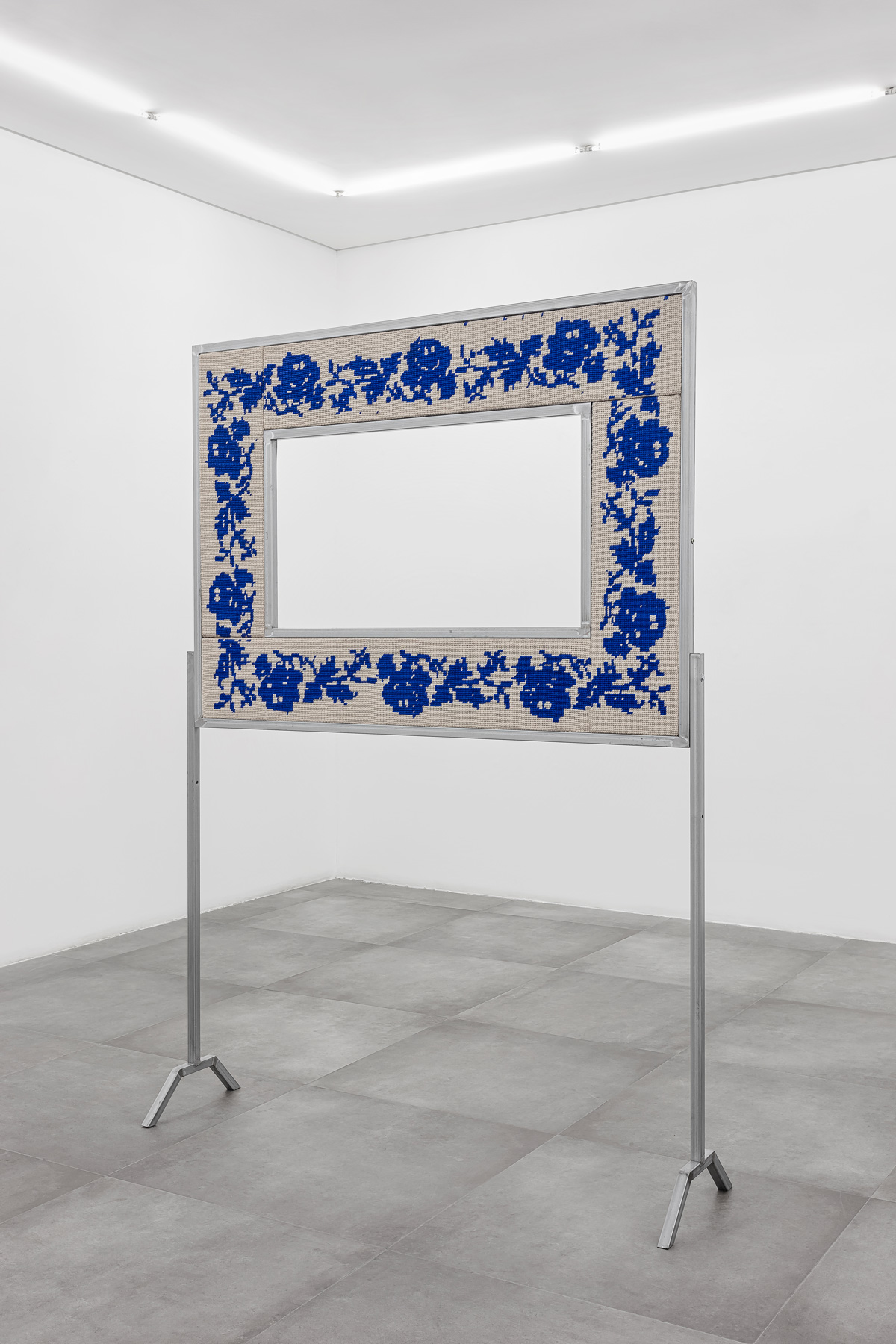
Gabriel Pessoto, Enquadramento, 2024. Tapestry on metal display, 81.1 × 57.7 × 15.4 in. Photos: Filipe Berndt. Courtesy of the artist.
Piece 4: Prompt
Often, Pessoto’s work emerges from following an embroidery code that guides the colors and the placement of each stitch in order to complete a final figure; this code anticipates an invariant image. Works such as Zoom (2022) or Códigos/receitas (2024) reveal these codifications and instructions that sustain the final image. This logic of coded construction reveals a structural affinity between the artist’s textile research and the editing and construction of digital images, since the latter are also structured through a form of coding and, from it, organized into an ordered set of pixels.
Ultimately, this makes clear that, although contemporary and strongly linked to the digital medium, the discussion around coding, programming, and the use of image-formatting languages—and their purposes—can also be analog and manual. The final section we propose to cut for this text attempts to shift from code to prompt, in order to consider another key terminology and functionality tied to the field of image-making today.
Code instructs us, through a standardized arrangement, to formalize an image according to a desired model. In this sense, it functions as a template or base pattern through which an image can be achieved. We can learn a language or become literate in a form of coding in order to manipulate and shape images across different supports. Today, however, with the expanded use of artificial intelligence, another entry point into the field of image creation has emerged—one in which code, and the need to read or understand its language, becomes less central. Automated, it can be readily instrumentalized through a prompt, which allows us, regardless of knowledge of the code itself, to generate images through questions, commands, and instructions.
To think in terms of the prompt rather than the code is, here, an attempt similar to moving from image to scene—to open up the arrangement and structure of the final image in order to locate, at its origin, the force of will and desire that brings it into being, a will communicated through a command: a prompt.
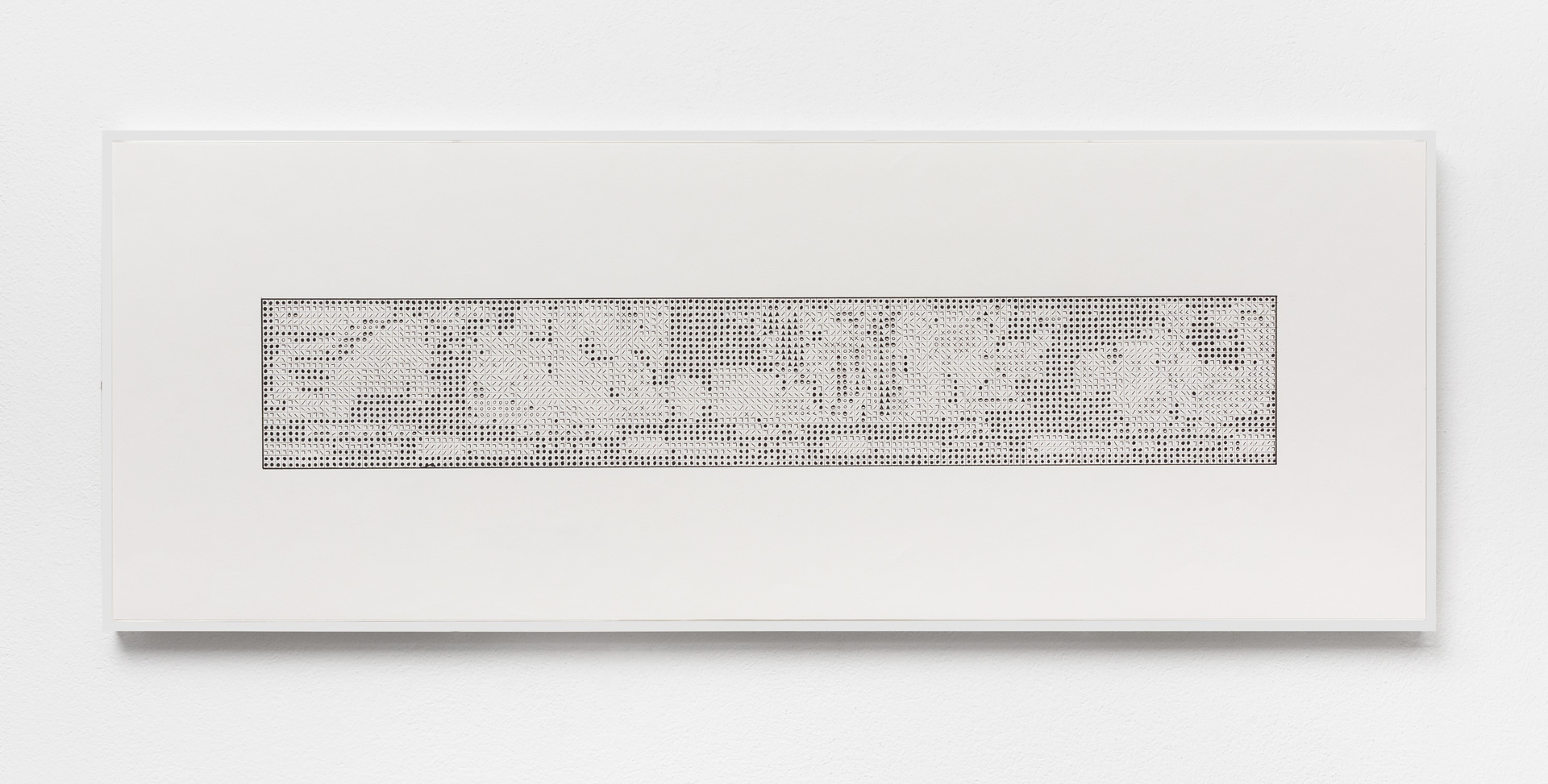
Gabriel Pessoto, Nova Janela Anônima, 2024. Drawing on paper in acrylic frame, 12.8 × 34.3 in. Photos: Estúdio em Obra. Courtesy of the artist.
We return here to the artist’s statement: “There is, indeed, a desire to arrive at an image, but at the same time there is a silent performance while I am sewing.” To arrive at an image may mean completing the sequence prescribed by a code, giving figuration to what was previously an arrangement of points. But it can also lead us to another interpretation—one in which the verb “to reach” carries the sense of “to strike” or “to wound.” This second reading brings the gesture to the core of the work, rather than the final image. How can we make room for a desire that does not settle into preexisting images—a desire that calls for an imagination in revolution, for the rupture of certain sedimented images in order to inscribe others? Perhaps the prompt offers a way to think through this more forceful dimension—charged, affective, invested with intention, and committed to a gesture that seeks to be transmitted and resonate—drawing attention to other aspects of Pessoto’s practice.
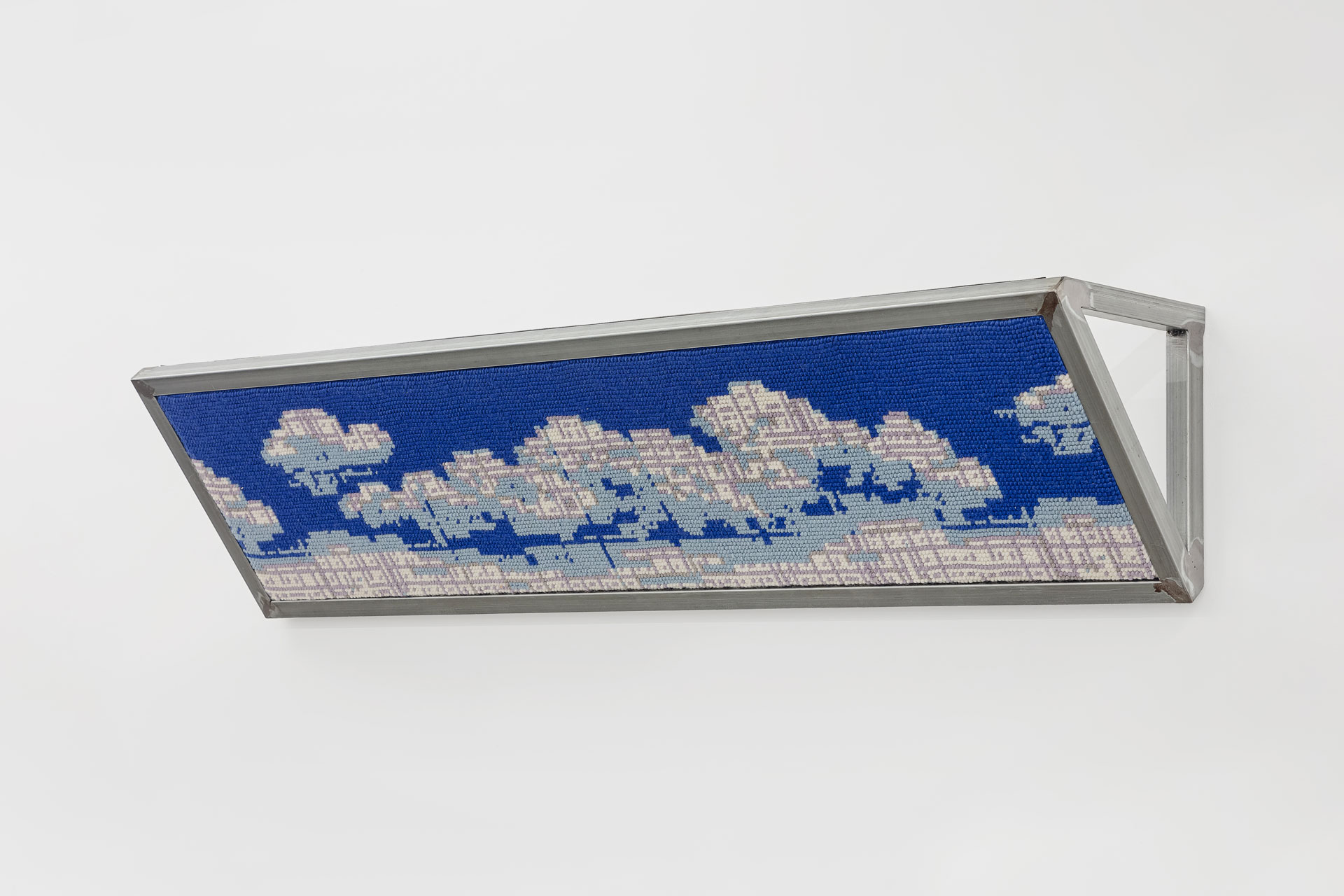
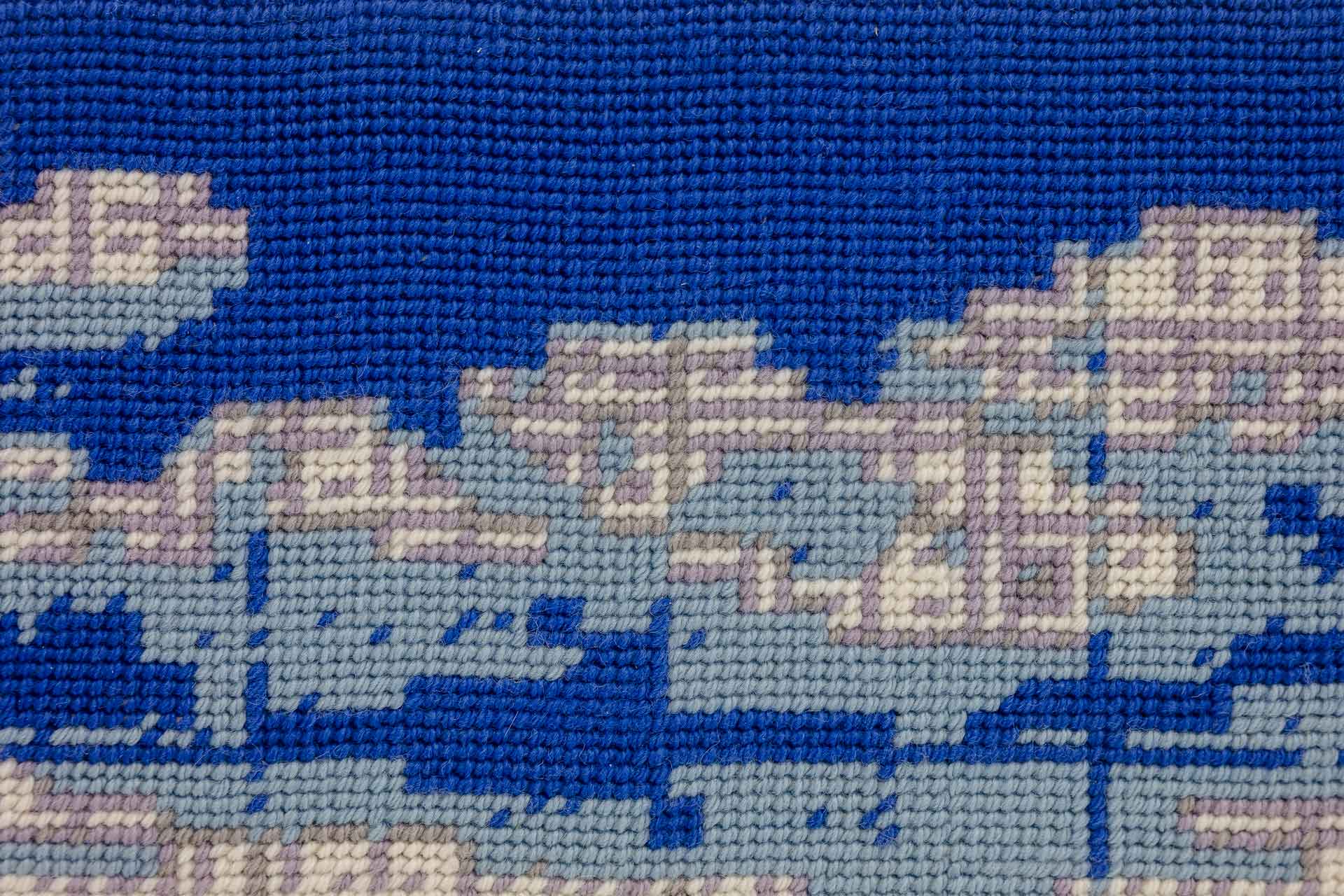
Gabriel Pessoto, Motivo recorrente, 2024. Natural wool tapestry on metal structure, 13.2 × 49.4 × 9.1 in. Photos: Filipe Berndt. Courtesy of the artist.
Stitching/Joining parts through stitches, creating continuity between elements/
How does an image behave?
In this essay, we attempt to follow this thread along which the behavior of the image is choreographed and returns, rehearsing responses across a series of Pessoto’s works. This question echoed throughout conversations with the artist and became a recurring point of return for thinking through the unfolding of his poetics.
Choosing this question to stitch together the sections above establishes a firm line across different planes. To ask about behavior rather than definition is to invoke the dynamic aspect that interests us when we turn to the notions of scene and event. It is not a matter of asking what an image is, but what it can become. Rather than breaking it down stitch by stitch into a revealed code—describing its qualities in order to define it—we ask what lives and moves within it, what kind of demand it makes upon the world, like echoes of a prompt, traces of a desire that do not end within the imagined frame.
It is worth recalling here another issue mobilized in some of Pessoto’s works: the pornographic tonality of certain images. In A flor singela (2020), the artist reconstructs, in video, a cross-stitch floral pattern in which each stitch is filled with fragments of gay pornography. He notes that the work and its investigation seek “to reflect on a popular imaginary of ideals of gender, romance, sexuality, and desire.” He adds: “The video is also a formal investigation, in which I appropriate traditional strategies of image composition from craft practices to construct a new narrative in digital language.”
The capacity of images to compose and shape popular imaginaries—to contribute to the construction of certain processes of subjectivation while inhibiting others, to instruct regimes of sensibility and recognition—does not operate solely at a macromolecular scale of stratification, classification, and fixation of models, segments, and references. It also functions at a micromolecular level, through singular operations and subtle organic flows that they activate within us. The pornographic image can serve as an example here: it alters blood flow, briefly shifts pressure, modifies breathing, anticipates gestures—in short, it instructs the sensible. These are mobilizations enacted by the image that make the scenographic, event-based dimension of certain images undeniable. It is this aspect that becomes central to our relationship with images, rather than the act of recording or contemplating them.
Despite the visual materiality of certain artworks, they do not end at their physical limits. Each work carries a kind of sensorial orchestration and scenographic agency that it sets in motion and transmits—much like the dotted trace of stitches on fabric preserves and reproduces the back-and-forth movement of the hands that sewed them.
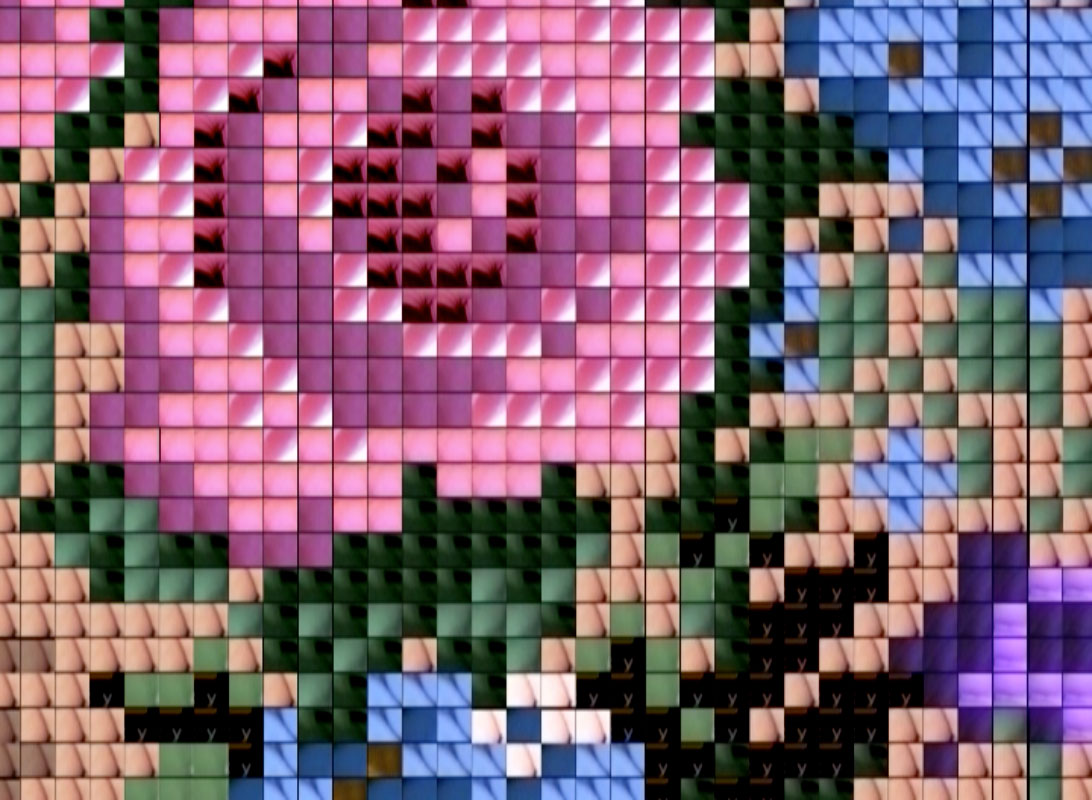
Gabriel Pessoto, A flor singela, 2020. Digital embroidery. Courtesy of the artist.
This orchestration operates not only upon the viewers who encounter the work, but also upon the artist themself. The imperative of the scene beneath the image becomes clear in the statement already invoked here, in which the process of image formation requires a performance—it calls for the production of a body, a temporality, a way of working with the hands, of sitting, of coexisting with the material, of embodying a technique. The work works on us.
The expectation surrounding the efficacy of a work—its potency, or even its appreciation—does not necessarily reside in the immediate reaction of the audience witnessing the results of its presentation and circulation. The prolonged exposure to certain images, the willingness to hold the questions they pose, the ruptures they provoke within existing representational frameworks, and the subsequent assemblages they set in motion all suggest that the manifesting force of the image does not occur where it reveals itself, but where it withdraws—where it resists assimilation, calls for another edge, and delays its unveiling, demanding another world or other scenes in order to take form.
The image may thus claim a future in order to be realized—it can imagine what is not yet there; it can emerge to register a complaint against prevailing imaginaries and propose meaningful transgressions for the future of the visible.
The image lives not in what it shows, but in the gesture it demands in order for us to see it.
Turning Inside Out/Inverting the piece after it has been sewn inside out. Making the internal structure of the work visible/
For this reason, perhaps it is necessary, when faced with an image, to turn it inside out—to look at its reverse, to follow the stitches that sustain it as a path that choreographs our gaze. It is out of focus, in the hollow of the figure, that the power of an image resides: to perform an upcycling of the imaginary, to rearrange the past, to transgress the imaginary agreements that structure representations of the present, to suggest a future, to affiliate and evoke other ways of approaching the world.
In the turning of certain works, I see this hollow—a vacant space that serves to resonate echoes, a machine for transmitting calls. I look, for example, at the work Uma blusa assim fica ainda mais romântica or at Blusão. Here I am drawn to the word “still,” an adverb of time that can name the persistence of a premonition not yet realized but still enduring—this suspended temporality that awaits an event about to echo. In both works, what we see is a tapestry formed from a close-up view of winter sweaters, whose stitching creates circular chains. The entire grammar of color, the temperature of the fabric, the images evoked by the season may suggest comfort, a certain warmth shared between bodies. Yet, beyond what is immediately visible, what insists on appearing to me in this hollow space are chains of genetic structures, like strands of DNA in the process of replication.
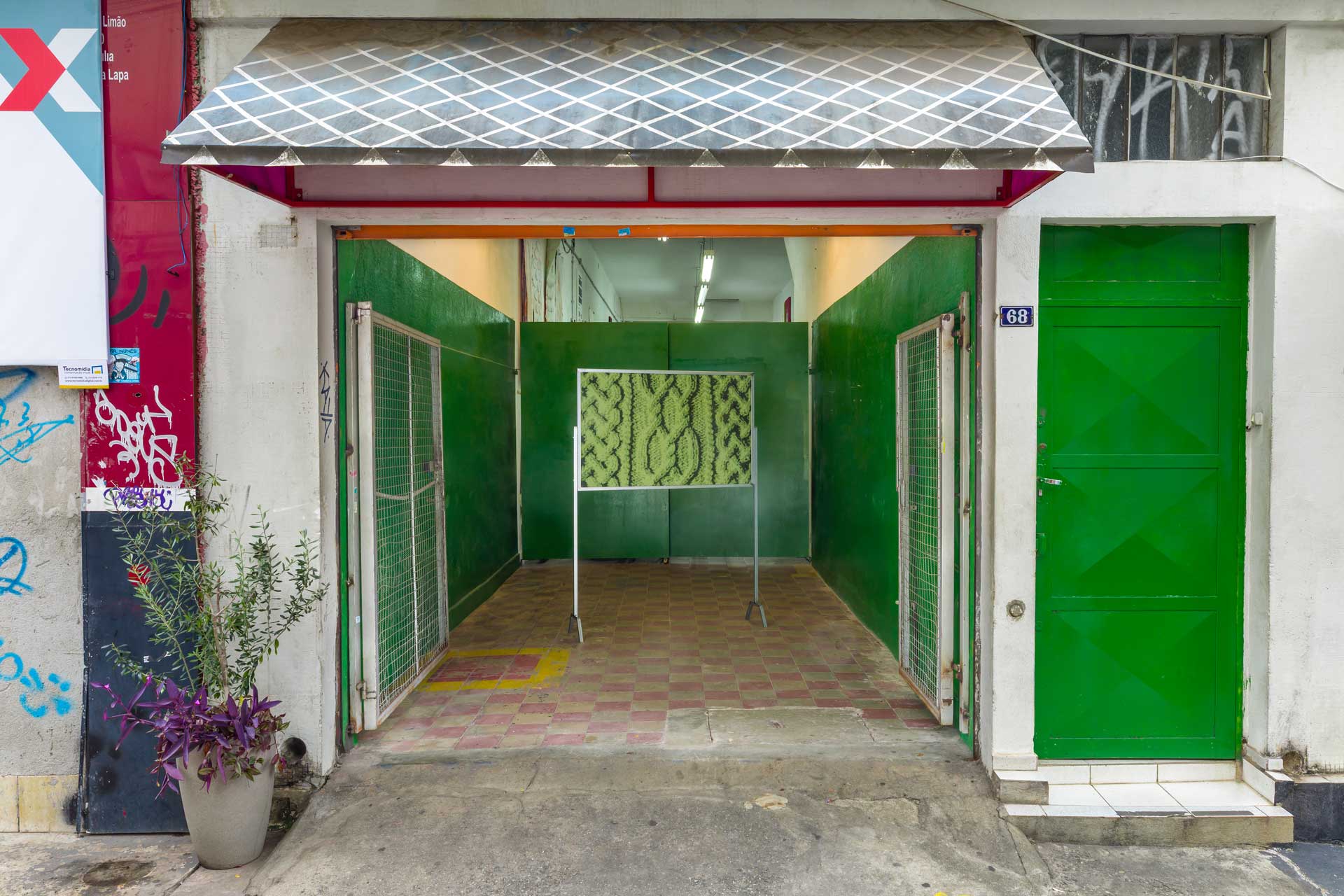
Photos: Estúdio em Obra. Courtesy of the artist.
This association does not arise merely from formal analogy—from the chains of the sweaters resembling genetic strands—but from a deeper affinity: in both cases, we are dealing with systems that carry instructions for the production of future forms. Just as DNA is not life itself but a set of operations that make life possible, these images seem to contain less a stabilized figure than a sensorial program, an operative matrix capable of generating other scenes.
In this sense, Pessoto might be thought of less as someone who represents and encodes images, and more as one who manipulates the conditions of sensorial appearance—a technician or researcher intervening in the orchestrations that organize the visible. His “laboratory” is traversed by deviations, affects, and dense temporalities: a field in which code is constantly tensioned by gesture, and pattern is traversed by desiring variations. Each sequence of stitches is not merely the expected reproduction of a code, but an attempt to actualize a will toward an image that has not yet fully stabilized. As with the prompt, it is about activating a field of possibilities—summoning, in the process of its own execution, an image that still needs to be invented.
Finishing/Through small knots or securing stitches, fastening the thread at the end of the seam, ensuring an essential and discreet finish/
We arrive at the end; the gesture slows, the hands reduce their speed so that the finishing stitches can be made beneath the fabric. In the work Veias (2015), we find ourselves traveling by road with the artist, who points the camera through the window and takes us on a journey along the highway. The images unfold in slow motion, where we can perceive the knot between the major arteries of the city that shapes us and the micro-capillaries that structure our bodies. Slowing the image, making it tactile, rendering it perishable—these are gestures within Pessoto’s practice.
It is like slowing down a video in order to learn a choreography or to modify it. To decelerate repetition is to break from what is expected and introduce a degree of mutability into a pattern otherwise pacified by sameness. If the work leads the artist to inhabit the score of a sewing body, if the tools of its execution return him to scenes, markings, semantics, and repertoires of other times—associated with other genders, lived in spaces and political dimensions no longer in force—then it becomes a kind of temporal editing machine. From it emerge other assemblages, whose outcomes have not yet been announced.
Finally, the verb “to behave” admits a dual perspective: it can refer to “conducting oneself according to a situation,” but also to the attempt to contain within oneself something that exceeds it. An image can serve to regulate behavior and maintain values negotiated within a prevailing system of representation. But it can also interrupt us, making the expected responses falter. An image can hollow us out so that it may move through us. To create, host, and practice such images may be one of the possible paths toward a revolution of the imaginary—so that we might register the future not as a linear projection of a visible present saturated by skeptical and repetitive predictions, but instead form reactive samples of the world, updating the repertoire in order to open the future as an unstable field, where other imaginary trajectories await a fragile reality still in the making.
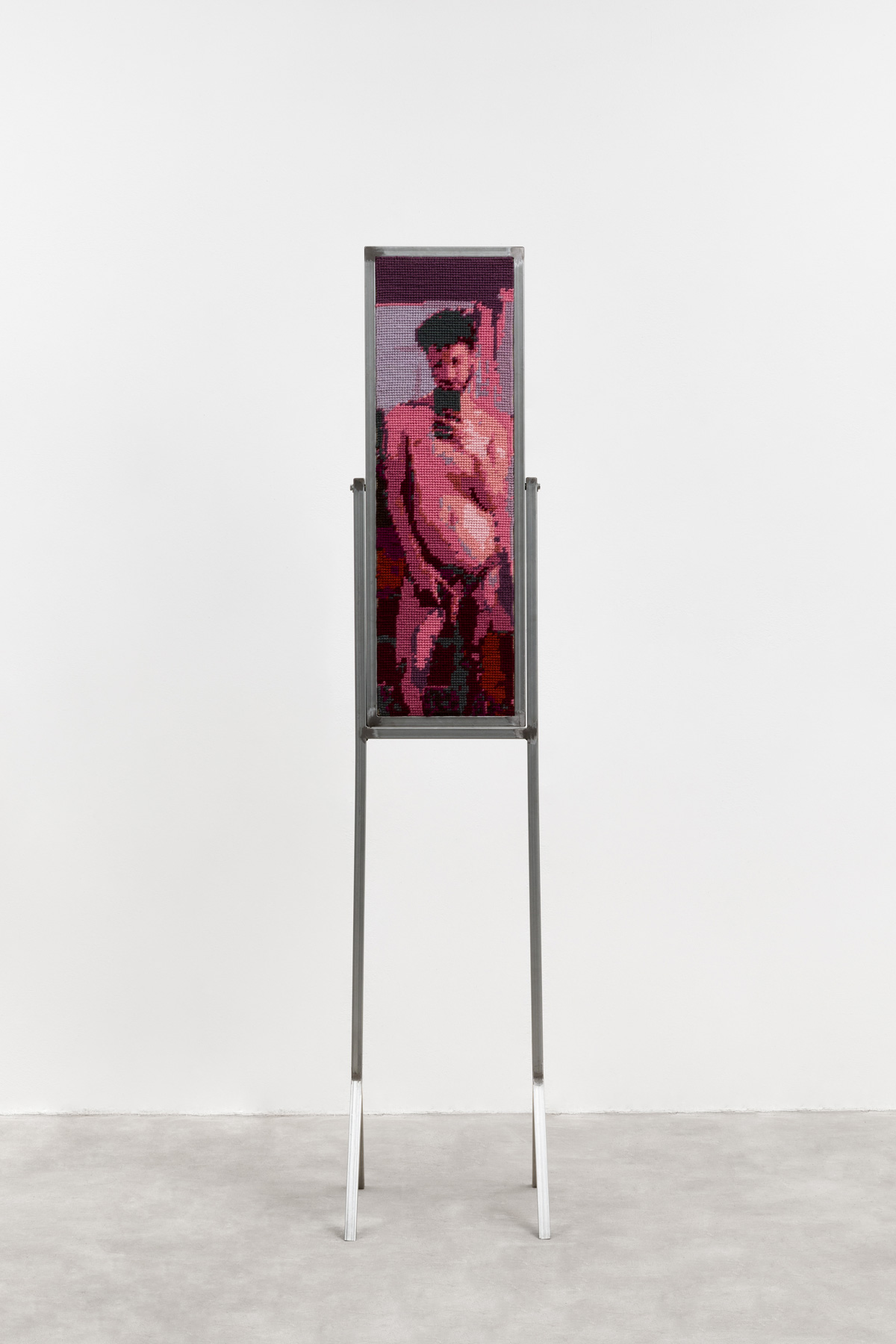
Gabriel Pessoto, permitir repetição, 2023/2024. Tapestry on galvanized steel support, approx. 68.9 × 11.0 × 11.8 in. Photos: Estúdio em Obra. Courtesy of the artist.
1. GUATTARI, Félix. (1989). On the Production of Subjectivity. In: PARENTE, André (ed.). Image-Machine: The Era of Virtual Technologies. Rio de Janeiro: Editora 34, 2011, p. 177.
2. RUSSELL, Maude. The Maude Russell System of Garment Cutting: Specially Adapted for Self-Instruction. London, 1914, p. 88.
3.GELL, Alfred. “The Technology of Enchantment and the Enchantment of Technology.” Concinnitas Journal. Online: PPGARTES-UERJ. Year 6, vol. 1, no. 8, p. 52.
4. GUATTARI, Félix. (1989). On the Production of Subjectivity. In: PARENTE, André (ed.). Image-Machine: The Era of Virtual Technologies. Rio de Janeiro: Editora 34, 2011, p. 177.
5. GELL, Alfred. “The Technology of Enchantment and the Enchantment of Technology.” Concinnitas Journal. Online: PPGARTES-UERJ. Year 6, vol. 1, no. 8, p. 41.
6. AUSTIN, J. L. How to Do Things with Words. Translated by Danilo Marcondes de Souza Filho. Porto Alegre: Artes Médicas, 1990.
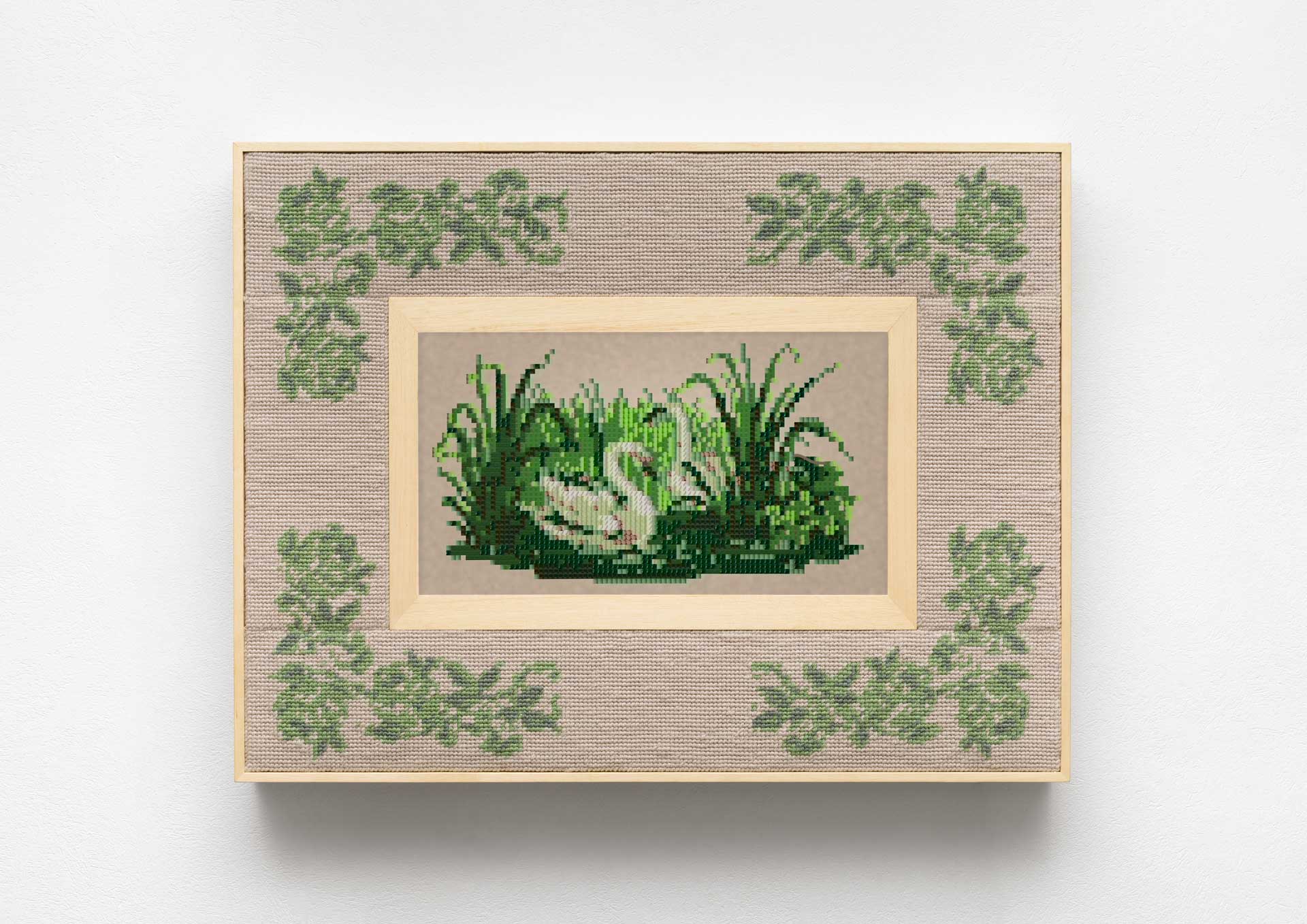
Gabriel Pessoto, bichinhos virtuais, 2023. Tapestry and digital embroidery on LED monitor with wooden structure, 28.0 × 36.6 × 3.9 in.
Photos: Estúdio em Obra. Courtesy of the artist.
Lucas Alberto is a transdisciplinary cultural practitioner. He holds degrees in Arts (UFF) and Psychology (Famath), and is currently pursuing a teaching degree in Philosophy (UFF). He is also a PhD candidate in the Graduate Program in Contemporary Art Studies (PPGCA-UFF), where he researches “critical modes of autobiographical practice” in contemporary Brazilian art within an expanded field that intertwines art, literature, and psychoanalysis. Since 2022, he has been working in research, production, and curating art exhibitions. In 2025, he published the poetry book frígidas certezas with Urutau Press.
To know more about Lucas: @aubertor
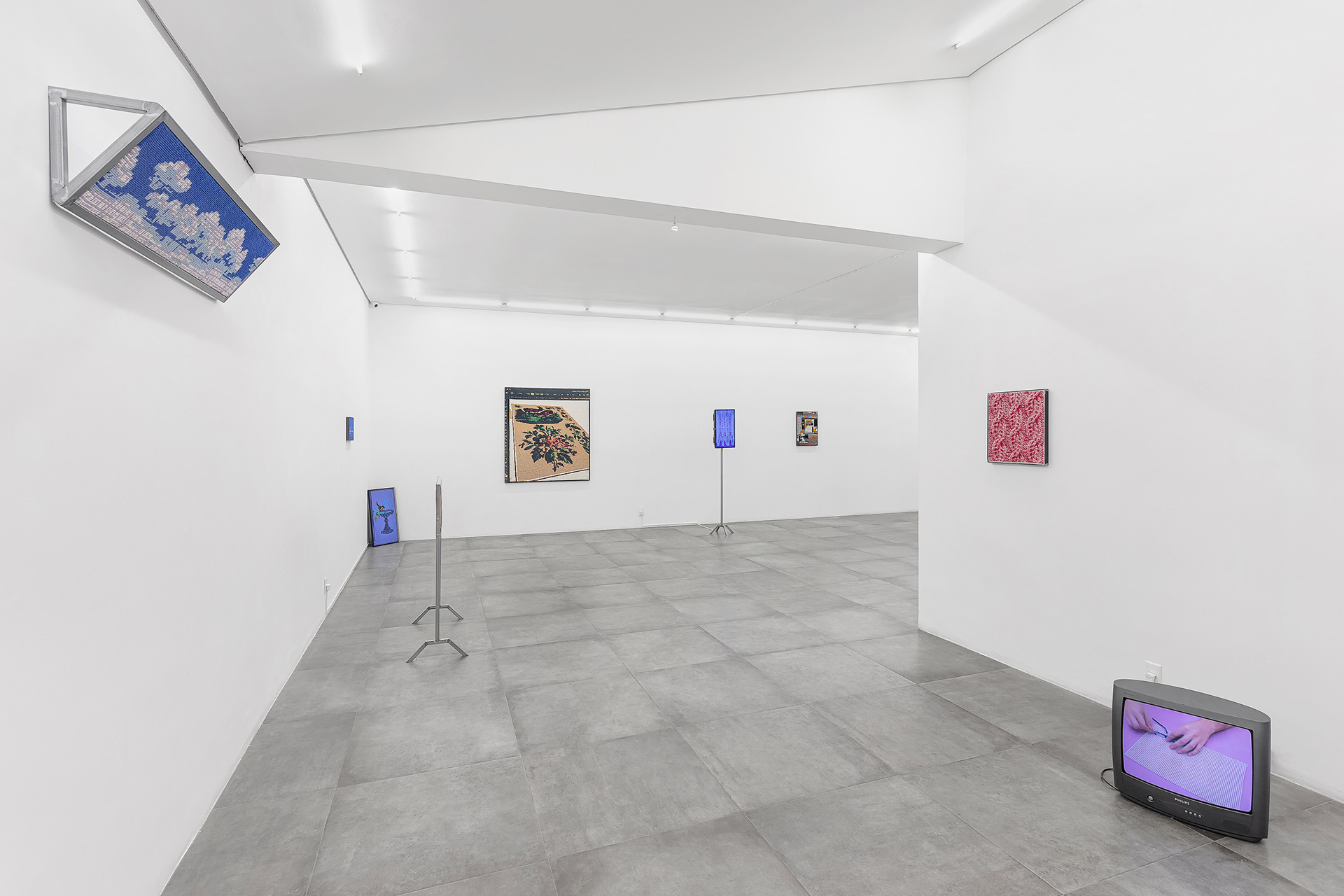
Exhibition views of Descanso de tela (2024) at Galeria Luciana Caravello, São Paulo. Photos: Filipe Berndt. Courtesy of the artist.
In 2020, he received an award from ArtConnect Magazine for the project trocando figurinhas, developed in collaboration with Nicole Kouts. That same year, he participated in the residencies Temos vagas! at Ateliê397 (São Paulo, Brazil) and WebResidência, organized by the espaço OLHÃO. In 2021, he held the solo exhibition Ambiente Moderno, curated by Gabriel Bogossian, at the Fundação Ecarta Gallery (Porto Alegre, Brazil). The following year, he launched the publication of the same name and was selected for the Paço das Artes Project Season with the project Realidade Virtual, which received critical mentoring from Pollyana Quintella.
In 2024, he took part in the exhibition Queer Histories / Histórias LGBTQIA+ at MASP, presented the solo exhibition Descanso de tela (Screen Saver) at Galeria Luciana Caravello (São Paulo, Brazil), accompanied by a critical text by Renato Menezes, and launched the publication Pontos da Moda, published by Ajulejo ArtPress. In 2025, he was selected for the 18th International Triennial of Textile (Łódź, Poland), participated in the group exhibition Unoriginal Genius at Laundromat Art Space (Miami, USA), exhibited the installation Blusão at Massapê Projetos (São Paulo, Brazil), and presented two collaborative exhibitions: Fundo Infinito, in partnership with Lucas Simões, at 25M Sala de Projetos (São Paulo, Brazil), and Dossiê trocando figurinhas, in partnership with Nicole Kouts, at Ateliê397 (São Paulo, Brazil).
To learn more about Gabriel’s work: @gabrielpessoto // gabrielpessoto.com