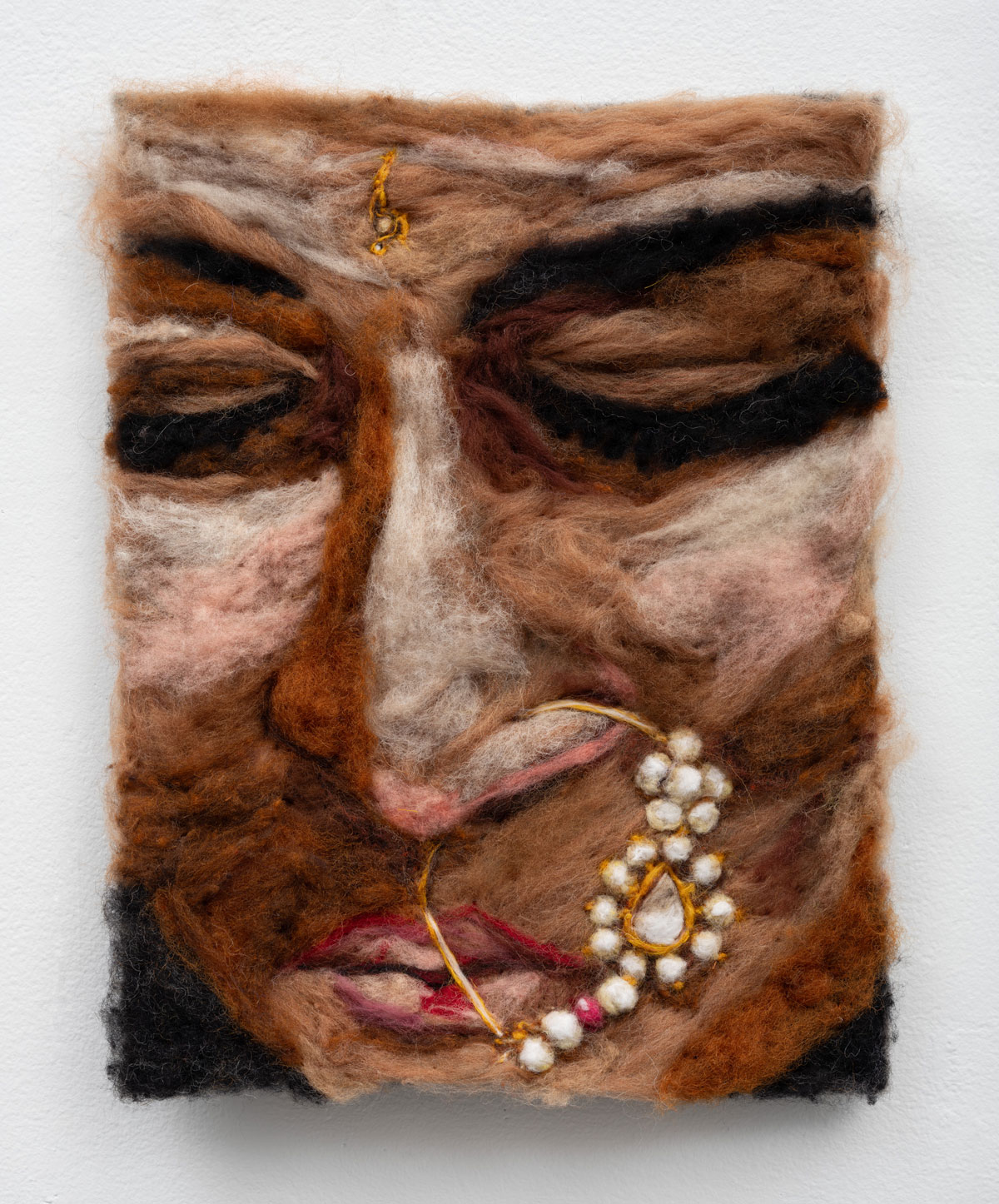
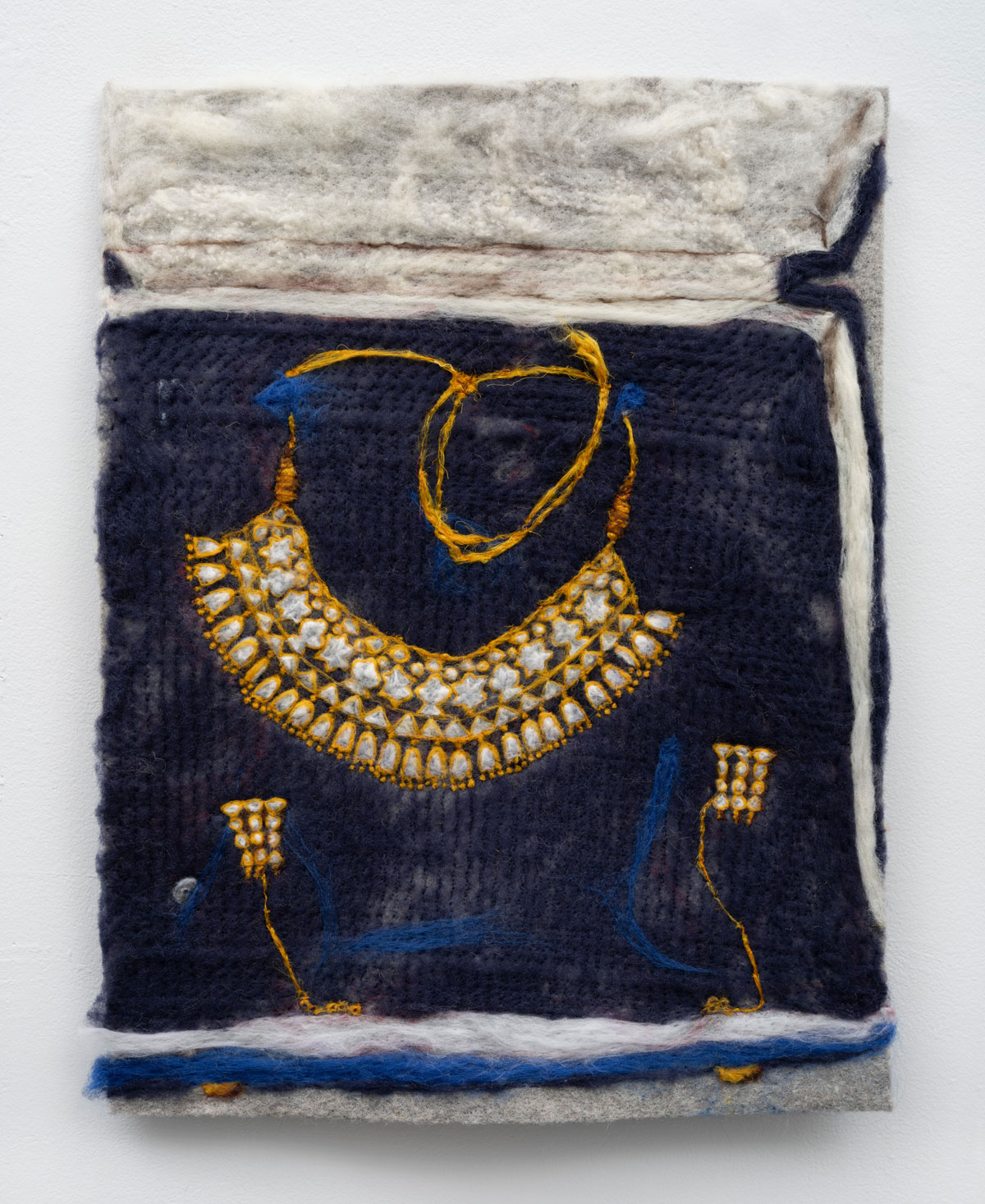
Melissa Joseph, Sheetal’s grandmother’s nose ring, 2025. Needle felted wool on industrial felt, 12 x 9 in. Photo: Daniel Greer. Courtesy of the artist.
Melissa Joseph: Maybe we could start with trying to remember how we first met.
Aruna D’Souza: You know, I was vaguely aware of your work and then the artist and organizer Pyaari Azaadi messaged me saying: “Melissa Joseph wants to be in touch with you”. I think you wanted me to write something but I think I took too long to respond and the moment passed. And when we finally connected it was around a group that coalesced a couple of years ago, centered around the idea of what a South Asian feminist future could look like, which was actually called South Asian Feminist Futures (SAFF). Do you remember?
MJ: I remember I followed you on Instagram and around that time you were asking about Asian affinity groups, so I connected you with the folks from Asianish. So I knew you digitally before I knew you in person, for sure. But it was through SAFF that we actually met in person and became friends. And that group has been very anchoring, a nice lens of the world to have in New York.
AD: One of the things that I wanted to ask you about… With the world the way it is now, how do you come into the studio and do your work? How do you anchor yourself not just in New York, but in this moment?
MJ: Yeah, I think I’ve been struggling to do that this year. But historically being in the studio has been how I work through stuff. And it’s probably similar for you. You can work things out when you’re writing. I guess it is the process of the process that lets things rise to the surface, either ideas or solutions or just context. But this year has been tough and I haven’t been able to really do that. The word that I feel describes this year is unmoored. It’s an uncomfortable place to be.
AD: Unmoored is a good word and I think a lot of us are feeling that now. But one of the things that has come out of the South Asian Feminist Futures group is that we’re all sort of collaborating with people who work beyond our disciplines. I’m thinking especially about your ongoing conversations with the poet Meg Fernandes and how that seems to have played a real role in how you’re thinking about work and how you conceptualize what your work is meant to do.
MJ: Yeah, for sure. Thank you for that. What I love about the group is that there is such a quality of relationships between us. It was ostensibly a professional group – and it still is, but the relationships that have been built there have become personal to the point where you can have conversations like this. And also, like you mentioned, with Meg. Until that project with her, I didn’t really even know that one of the issues I was struggling with in the studio was representational images of my family after my mom died. I just thought, “Oh, I’m just dealing with grief and I don’t feel like working”. But that ended up not necessarily being true. It was just that I didn’t want to be accessing images of my family at a time that I was grieving my mom. So by doing that project with Meg, it was nice to be free of that history and to be able to make work about something with a very different image archive.
AD: Can you briefly describe the project you did with Meg?
MJ: I was working on a show that would take place in Berlin so I was thinking about censorship, which is something you can connect to both Berlin and the US. And I asked Meg if she had a poem with the word ‘correct’ in it. I had been thinking about that word in relation to censorship, because its etymology is about making something straight or fixing it by altering it. She said she would be willing to write one, which I thought would be amazing. I mentioned to her that I was calling the show No Words, so she researched the history of no words and found the first time it was ever used in the English language. And then she also thought about ‘correct’ as meaning ‘to straighten’ and the dissonance between that and Dante’s Inferno and how it was a spiral – so in order to get straight, you actually had to walk in concentric circles. That was the basis for the poem, which she called Discipline. And thanks to that poem, which was really beautiful and powerful, I reread Dante after 20 years! Turns out, it’s still a really good book [laughs]. And then the imagery kind of became the characters who Dante and Virgil met as they went down into the different levels. I happened to be in Berlin, so I was able to source material from there, like medieval sculptures carved in Germany. I really was able to mine a totally different archive, looking at William Blake and other people who had engaged with that text. It was a really nice experiment as far as moving outside of the family story for a bit, which is what I need right now.
AD: It’s interesting that your work has dealt so extensively with your family’s image archive in the past and then you sort of took a break from that. Do you find it seeping back in now in different ways?
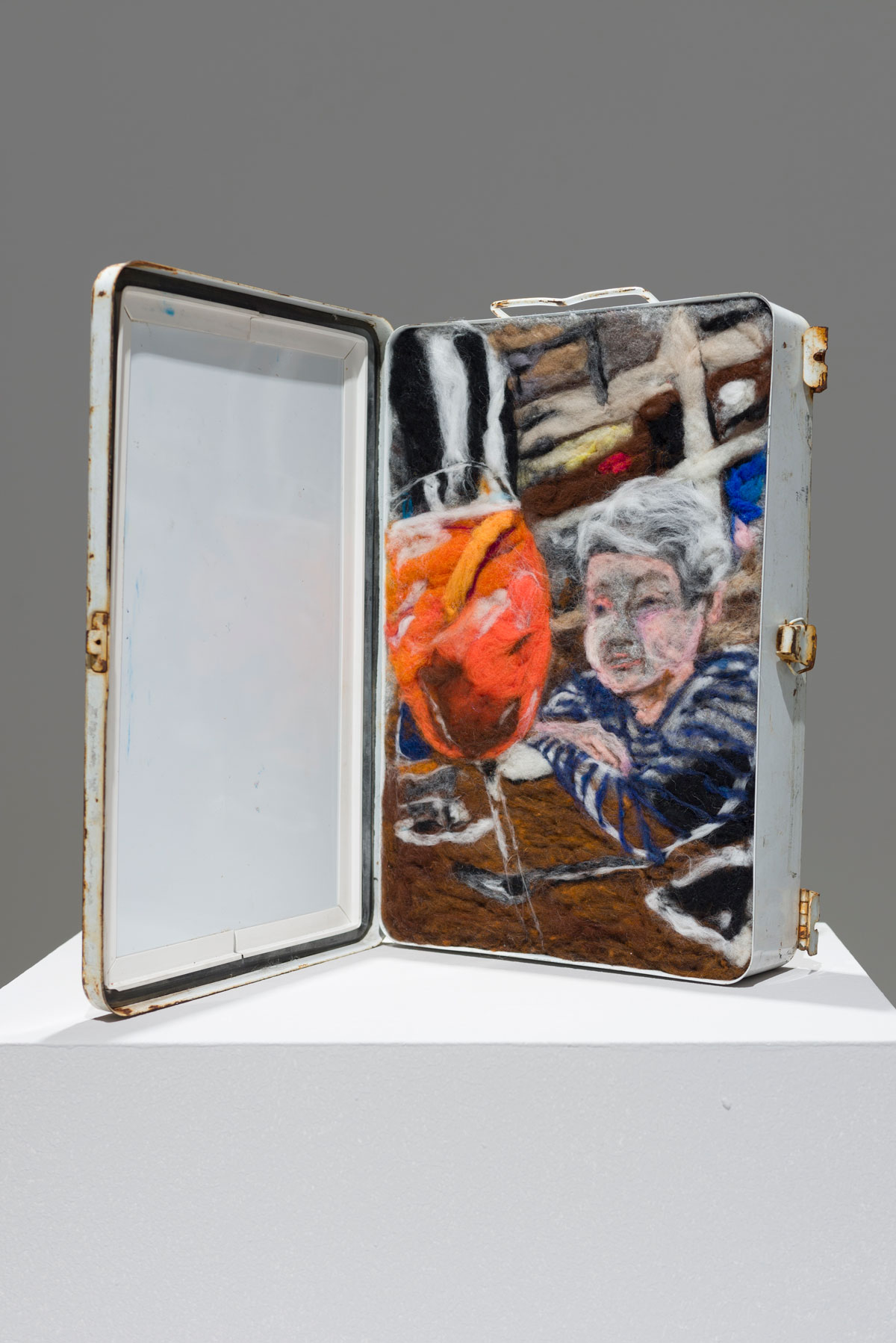
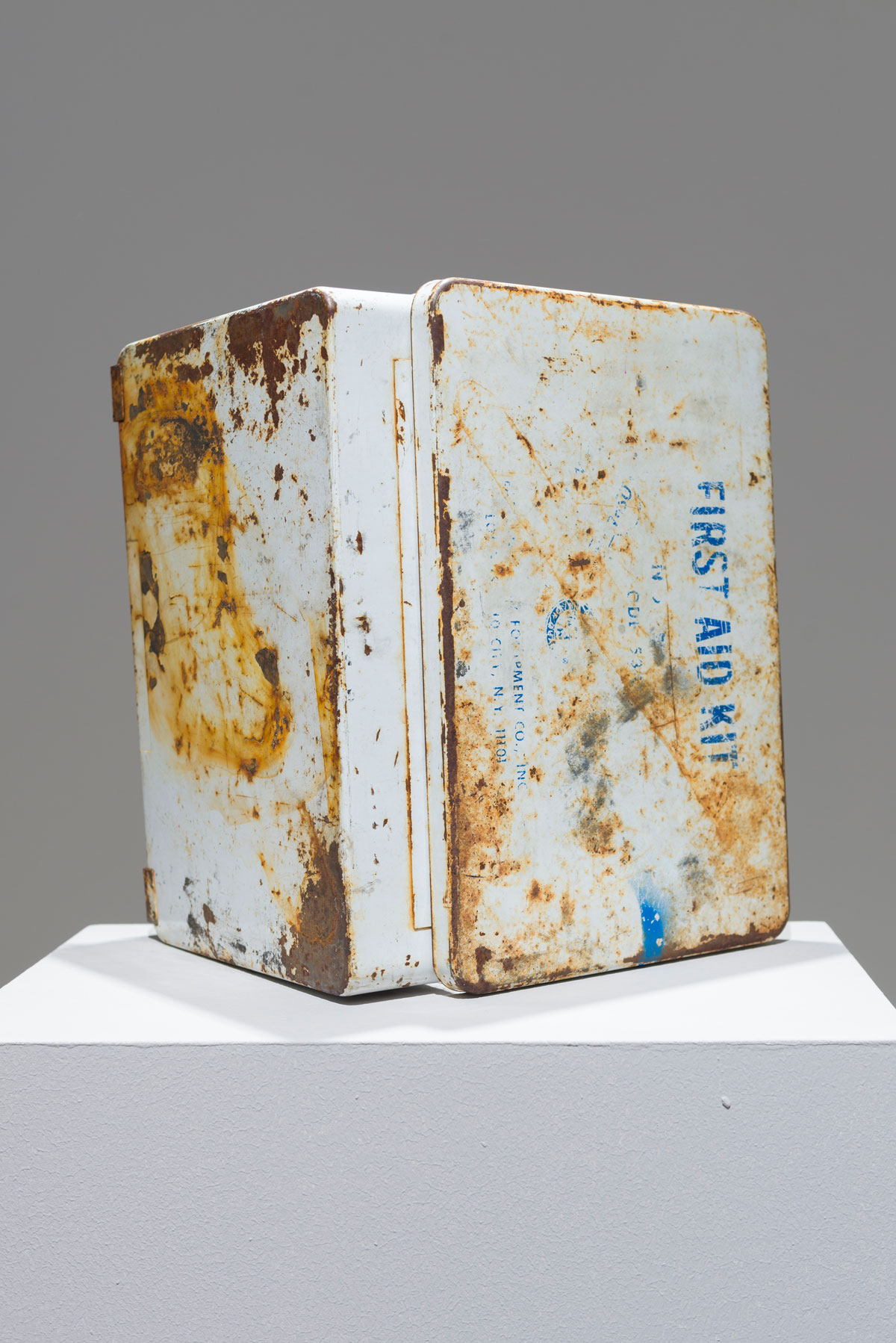
Melissa Joseph, Mom at the Roxy, 2025. Needle felted wool on industrial felt in vintage first aid box, 14 x 9.5 x 3.5 in. Photo: Martin Sánchez. Courtesy of the artist.
MJ: It’s definitely coming back in a little. Unfortunately my work is stuck in Bangalore in customs, but a new show opened in Kochi as a collateral event for the Biennale and my work is about heirloom jewelry. The show is called Like Gold. I did one or two pieces from my own family archive, but I also recruited imagery from friends which I really enjoyed. Because it’s all about storytelling. Sometimes it’s my family’s story, but it’s not exclusively my family’s story. And then for shows that are coming up this year, I’ll be looking more at the vertical process of where wool comes from, since I work as a felter. It will be engaging more with the animals, the land and the people who steward them. And that will be part of the imagery for the show in June, in London. Then, for another exhibition in September in New York, I’ll return partly to my own family history, while also exploring other people’s relationships to Midwestern-ness [laughs].
AD: Midwesternism is another good word! So I mean, obviously, when you’re going into your family history, you’re going into the particularities of your relationships with them, but you’re also going into larger questions of what it means to grow up in what is essentially a mixed-race family and how you experience your maternal family in the Midwest and your paternal one in India. I’m interested in the ways your work speaks to those things simultaneously, not just via the lens of diaspora, but the duality of cultures.
MJ: There are so many mixed and blended identities now, but because I grew up not knowing many people like that, it was harder for me to understand, reconcile, and even articulate what that experience was. There’s a book I often return to, Racial Melancholia, Racial Dissociation by Shinhee Han and David L. Eng, which speaks to the experience of being Asian American in the U.S. I think “racial dissociation” captures so much of what it feels like to exist in between, especially if you don’t present as white. If you do, you’re spared the daily question of “where are you really from?” That tension is a huge part of my work, and it surfaces in the materials I use and how I use them. They come directly from what I was surrounded by growing up in a mixed household—craft traditions alongside Rust Belt America. And that’s exactly what you see in my studio: a mixture of crafting and rough Rust Belt America. Within that, South Asian narratives sit alongside American ones. It shows up in how I combine materials that don’t necessarily belong together, trying to create fusions that feel inevitable. I don’t like the term “code-switching,” because it implies leaving parts of yourself behind, and that’s not what’s happening. Nothing is being edited out.
Melissa Joseph, Jasmine’s polki, father’s side, 2025. Needle felted wool on industrial felt, 17 x 12 in. Photo: Daniel Greer. Courtesy of the artist.
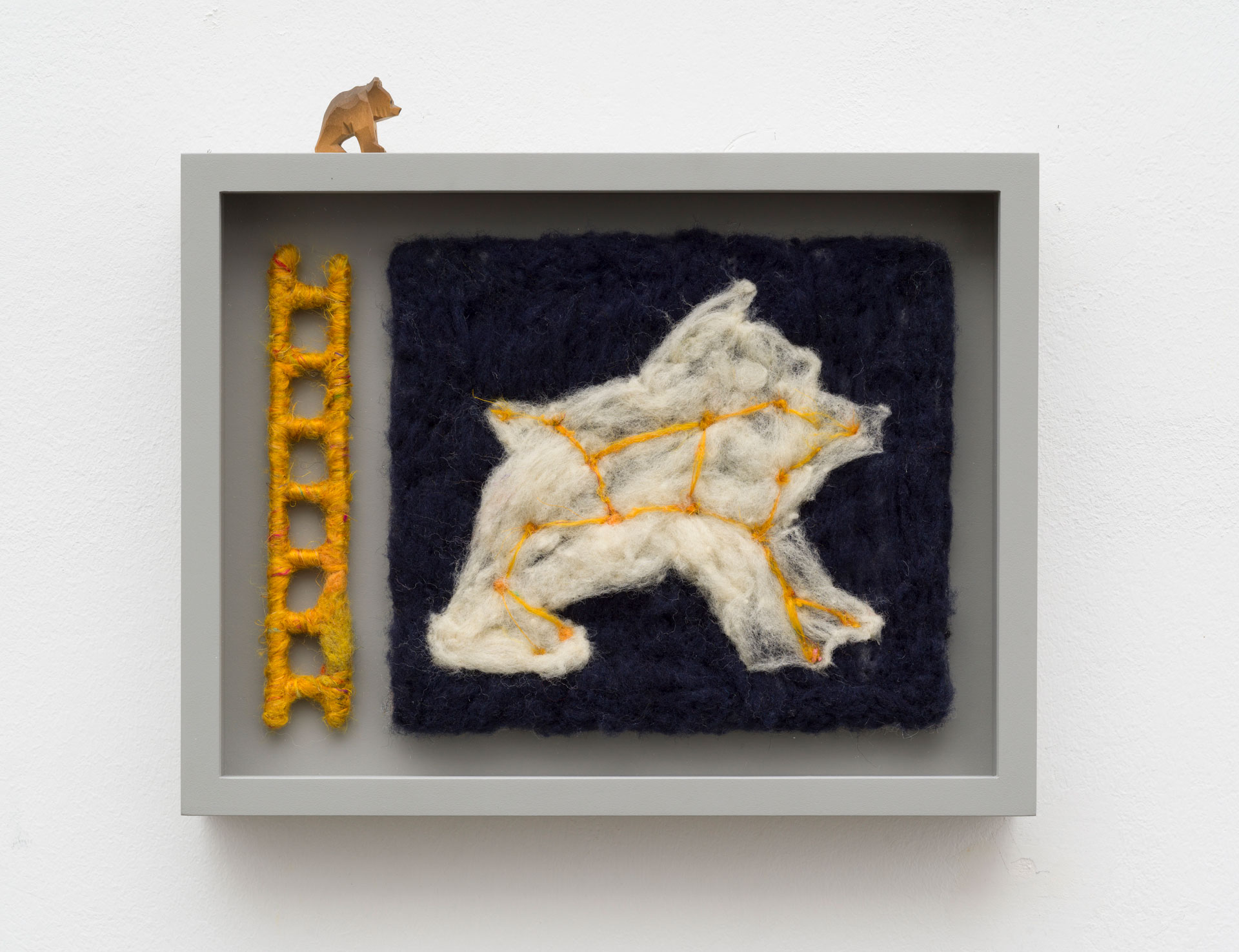
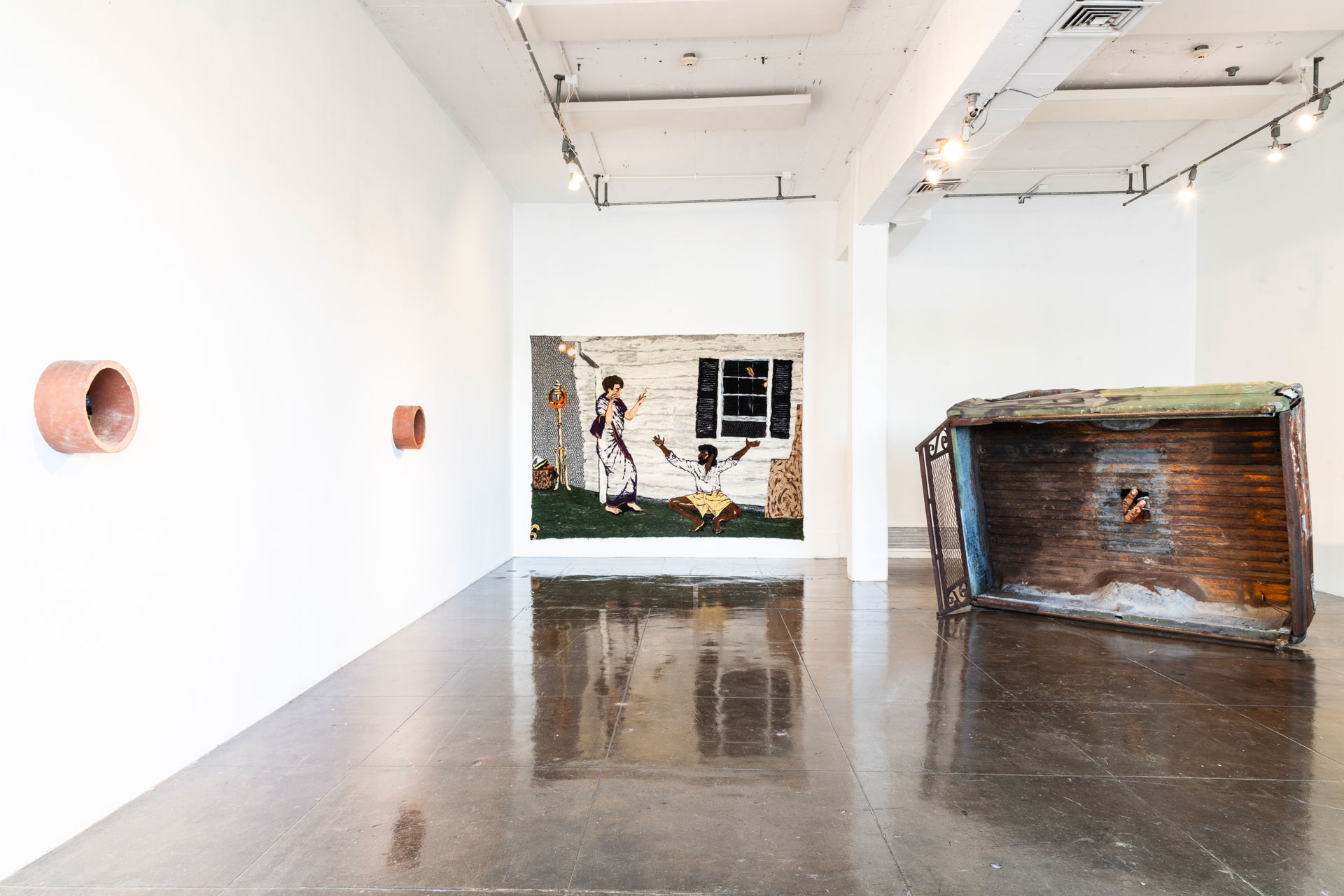
Photo: Roman März. Courtesy of the artist.
AD: Right. It’s not about suppressing or turning away from one side of your identity in order to inhabit another.
MJ: Yes. Reconciling across differences feels like a more accurate way to describe it. If you look through any of these Tupperware boxes filled with photos, you’ll find an Indian image next to one from Pittsburgh, next to a photo from New York—everything is mixed together. That’s another way this experience becomes tangible. Early on, I remember a moment when one gallerist selected only the images that looked European, while another chose only the Indian ones.
AD: Oh wow.
MJ: Until that happened, I didn’t quite understand that it was possible to cherry pick in that way. So I thought about how I could be more intentional about it without fabricating situations that didn’t happen. My Indian family didn’t really come here, so it’s not like everybody was one big happy family. We were the ones shuttled back and forth between the two families.
AD: Correct me if I’m wrong, but you don’t appear in too many of your works, do you?
MJ: Not a ton, but occasionally.
AD: So when you say: “I was shuttled back and forth between the two families”, the connection between those places is in you, your embodied self. It really is like you’re the consciousness holding everything together.
MJ: Exactly. Maybe it’s about giving people access to my point of view. I have to think about that one a little bit. Like me, you grew up in a small town, but in Canada. Did you have a similar experience in terms of identity?
AD: Yes, I was born in Canada and I spent my early years, until I was five years old, in a really small town in northern Manitoba. A pretty remote coal-mining town not far from the Arctic Circle. And that was because my parents were doctors from India, and at the time, many of the immigrant doctors from “Third World” countries were sent to the regional outposts where the white doctors didn’t want to go. So when you are a little kid it doesn’t occur to you that your experiences are so different from the experiences around you. And it was, in my memory at least, a little utopia. There were other brown professionals in that town who were there for the same reasons my parents were. So actually this tiny place was much more multicultural than you would expect.
And then we moved to a place in southern Alberta, with a population of about 70,000 or so, and I think that there I became more and more conscious of how separate we were from everyone else. There were brown people, but very few, and they found all sorts of ways to find each other. About a year after we moved to town the phone rang. The new phone book had just come out and there were some Indian uncles in town who used to comb through each year and call up anyone with an Indian sounding name to invite them for dinner. So that’s how we connected with the 5 or 6 other Indian diasporic families who lived there. They found us. One of the things that I’ve never really been able to connect to is this diaspora story that goes along the lines of “you’re neither here nor there”, like you’re neither fully Indian and you’re not fully North American. I’ve never felt like I was half anywhere, I guess. I’m always my whole self, wherever I am. The way you described it… you were the person who made both of these places make sense, right? Because it was you that were shuttling back and forth in your wholeness. I think I have that sense too.
MJ: Someone asked me recently about diaspora and the idea of being obsessed with this homeland that you’ve never even been to or may not have ever been to. And I don’t actually look at diaspora from that point of view, because I will never feel like India is my home. But I’m really interested in how it integrates once it gets here. What is the culture that is born when it arrives in a new place? Because that’s what I experienced. I was a living petri dish for that, right? After we moved into town, a woman who wasn’t my mom’s friend, but, you know, the town is small, so eventually you know all the neighbors… She told my mom her son came home after delivering the newspaper to us and said, “Mom, the new neighbor is wearing a skirt” about my dad. And I think those kinds of stories, the idea of impact and then blending… What is the new thing that’s born in that space? That’s the conversation about diaspora that I’m interested in. Because we’re never going back to this place that encapsulates the idea of homeland. It’s not even possible because even the person who came from that place could never go back to the same place. There’s a book by Dinaw Mengestu, The Beautiful Things That Heaven Bears, in which these guys talk about when they will go back to Africa and what it’s going to be like, but they both know they are never leaving DC. I think this is why sometimes I like to be in totally removed places. Not an American or an Indian space, but a space that I have no connection to, because then I am just full-on alien.
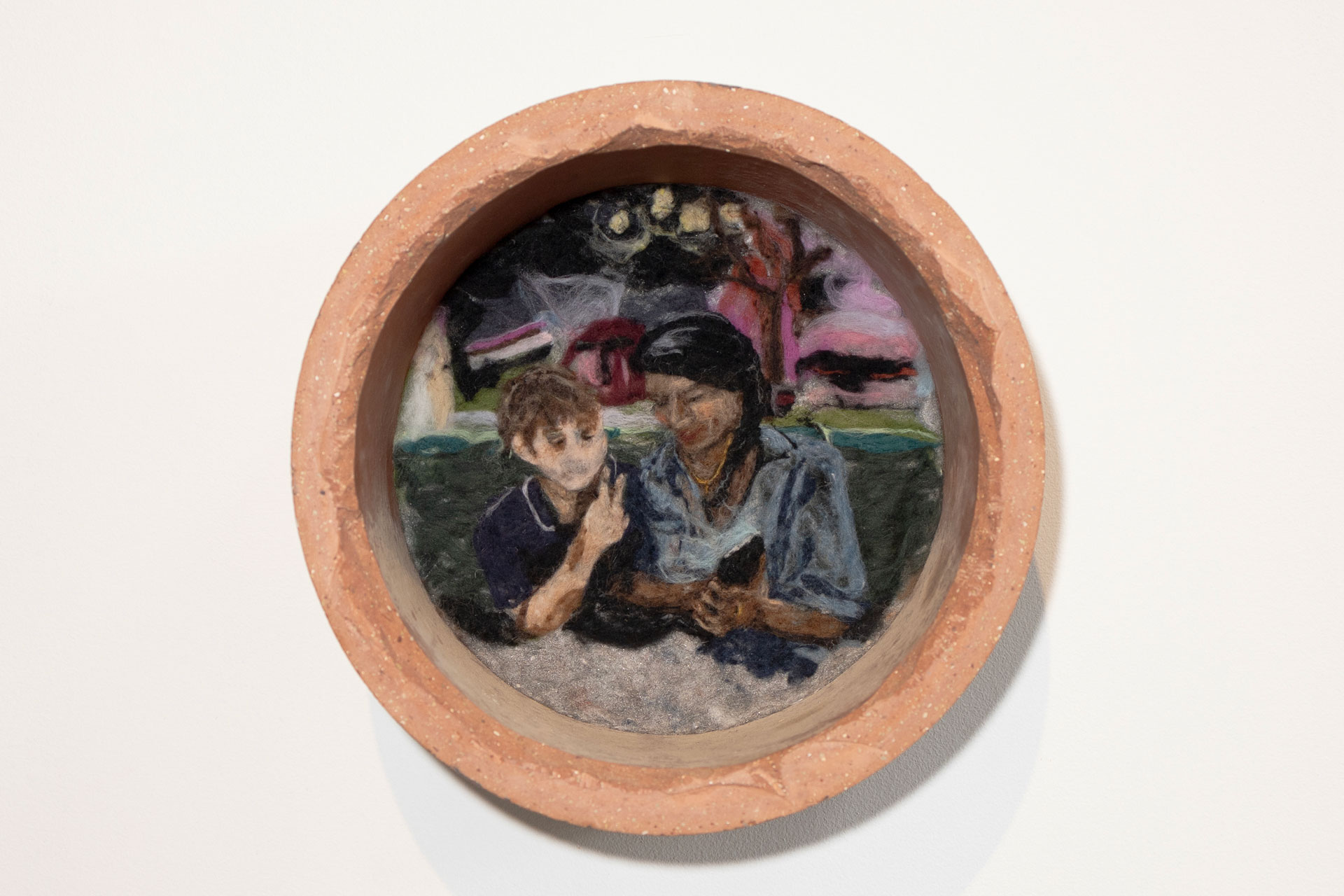
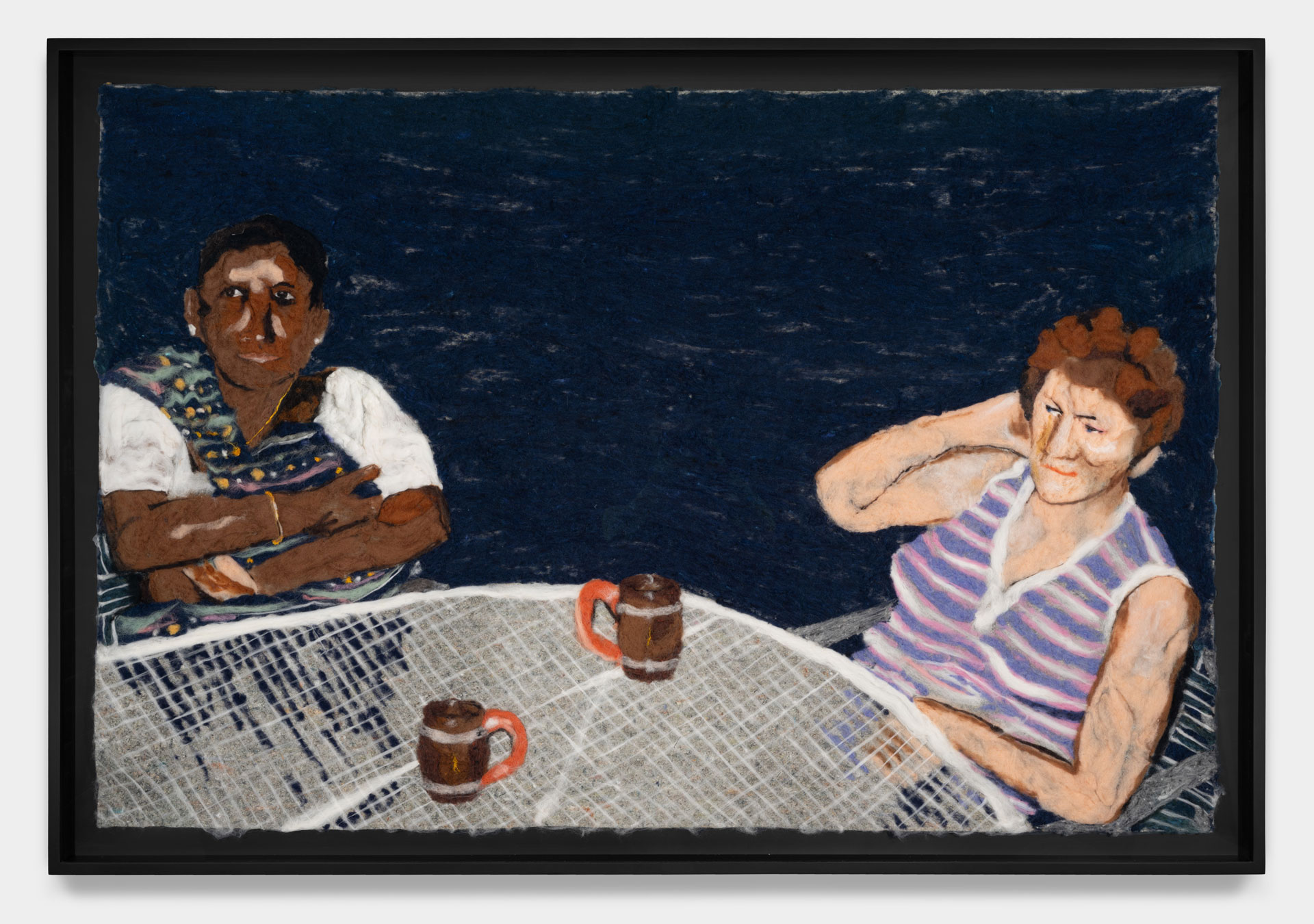
Needle felted wool and sari silk on industrial felt. Photo: Daniel Greer. Courtesy of the artist.
AD: I went to Brazil for the first time last month and I was there for three weeks. And I don’t think that I’ve ever felt so alien in my life. In spite of the fact that everyone would recognize my name, which is D’Souza – and I’d have to tell them all the time that I had no Brazilian roots and my name was just a product of colonialism. My ancestors were colonized in the same way that Indigenous Brazilians were colonized. But I felt so alien because it was one of the few places that I’ve gone to where people really don’t consider the US or North America or Europe the center of their universe. And so, for example, people don’t commonly speak English, to a much greater degree than anywhere else I’ve been in the world. And it’s terribly refreshing, because why should they? Everyone can speak Spanish or other languages. But that experience was so amazing, because, as you know, as a North American, we’re spoiled. We have the world handed to us on a plate, linguistically speaking. So being out of that position of privilege is part of the pleasure of feeling like an alien. It’s a chance to be in the same boat of incomprehension as everyone else.
MJ: Yeah, what happens when you enter into those kinds of spaces is you start to see how much of a construct the affinity groups are in the first place. We’re in this constant tug of war between individuality and wanting to belong, a sense of belonging and finding our tribe. I was actually just talking to a friend on the way over here to meet you about this wave of nationalism that’s happening. And it seems so silly to me that people are leaning into that knowing that it’s absolutely impossible to go back. It’s like entropy, it only goes in one direction. You can’t unblend, you know?
AD: The food blog that I used to write was about immigration and diaspora and trying to reconstitute a sense of home, and the way my parents tried to hold on to certain culinary traditions, even though getting ingredients was not easy back when I was a child. And I titled it You Can’t Unstir a Pot.
MJ: That’s beautiful.
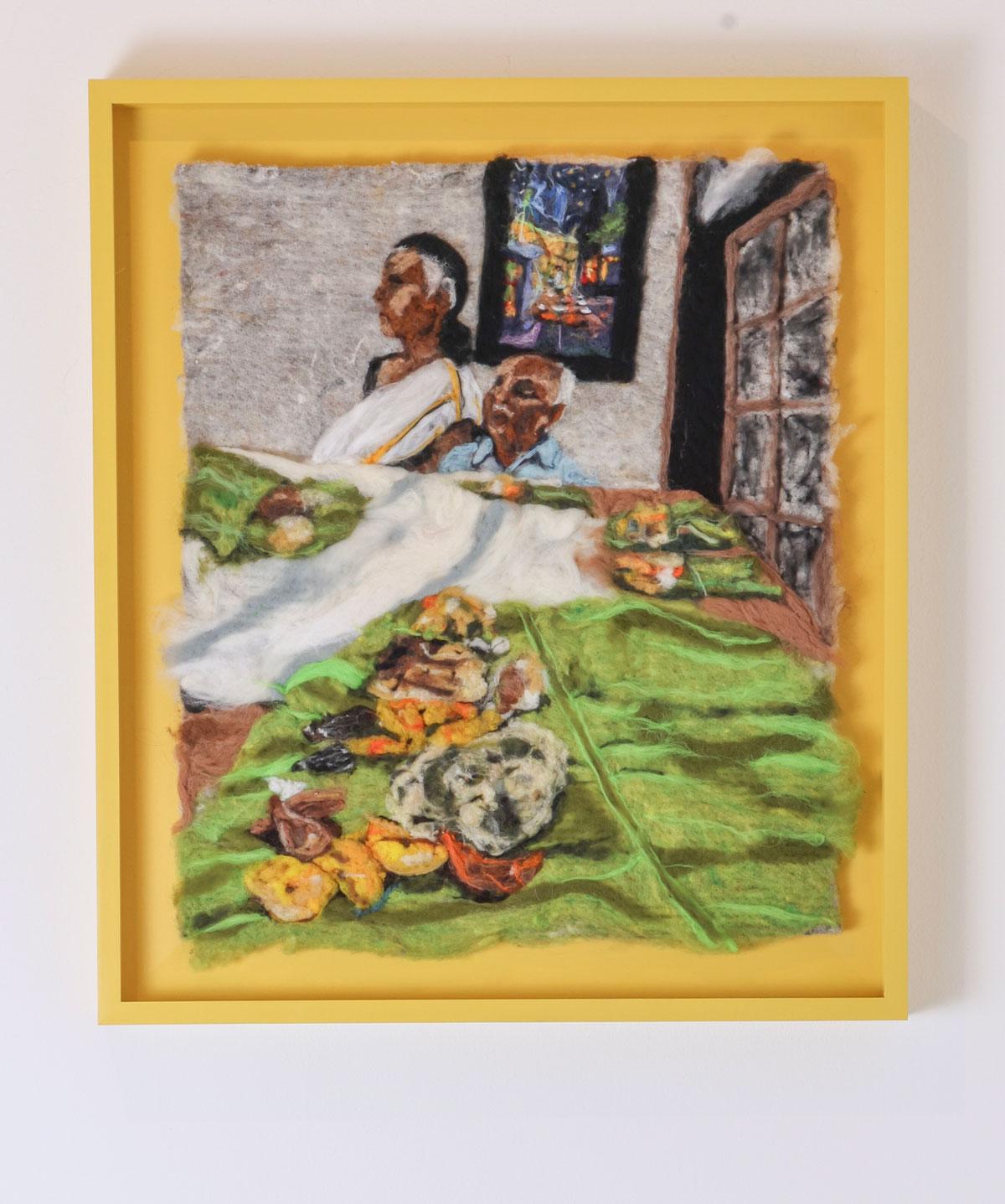
Melissa Joseph, Onam Sadya at night, 2024. Needle felted wool on industrial felt, 21 x 25 in. Photo: Joel Verges. Courtesy of the artist.
AD: That seemed to capture so much of what these kinds of movements of people result in, right? There’s no rolling back time, there’s no regaining of the homeland. Because even if the land is technically still the land, the sense of home is much different. I feel like we’re in this moment where so many people are fetishizing that past and that idea of homeland and committing unimaginable violence in the name of getting it back through ideologies like Zionism. I say this from a certain kind of privilege, because I’ve never been forced to migrate under threat of violence, but I see the movement of people as the defining experience of our lifetime – and lifetimes to come, in a way. That’s what we’re facing. For many, many, many reasons, people will be moving, will be crossing borders, will be spilling over borders. Spilling is a word I like because it evokes something sort of messy and uncontrollable.
MJ: I like that too. And, I mean, especially as the climate continues to change, certain regions will become unlivable and people will be forced to move for that reason too. It’s unavoidable.
AD: It’s unavoidable and, frankly, who wants to go back to those old formations like the nation-state? Making borders porous is the best way to undermine that idea. Not just the nation as in a body of people, but the nation state as a set of mechanisms to keep some people in and other people out.
MJ: Yeah, that’s also true.
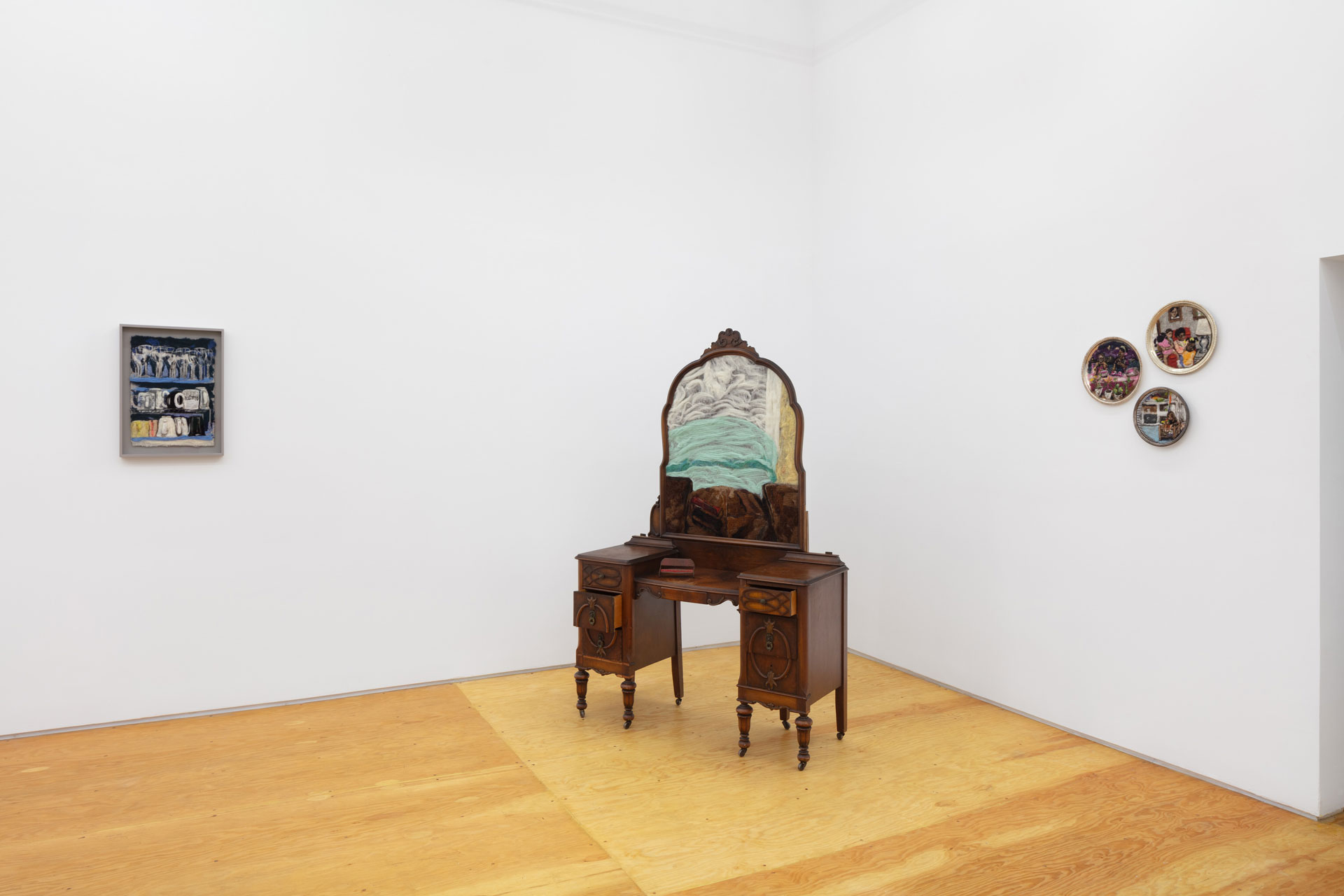
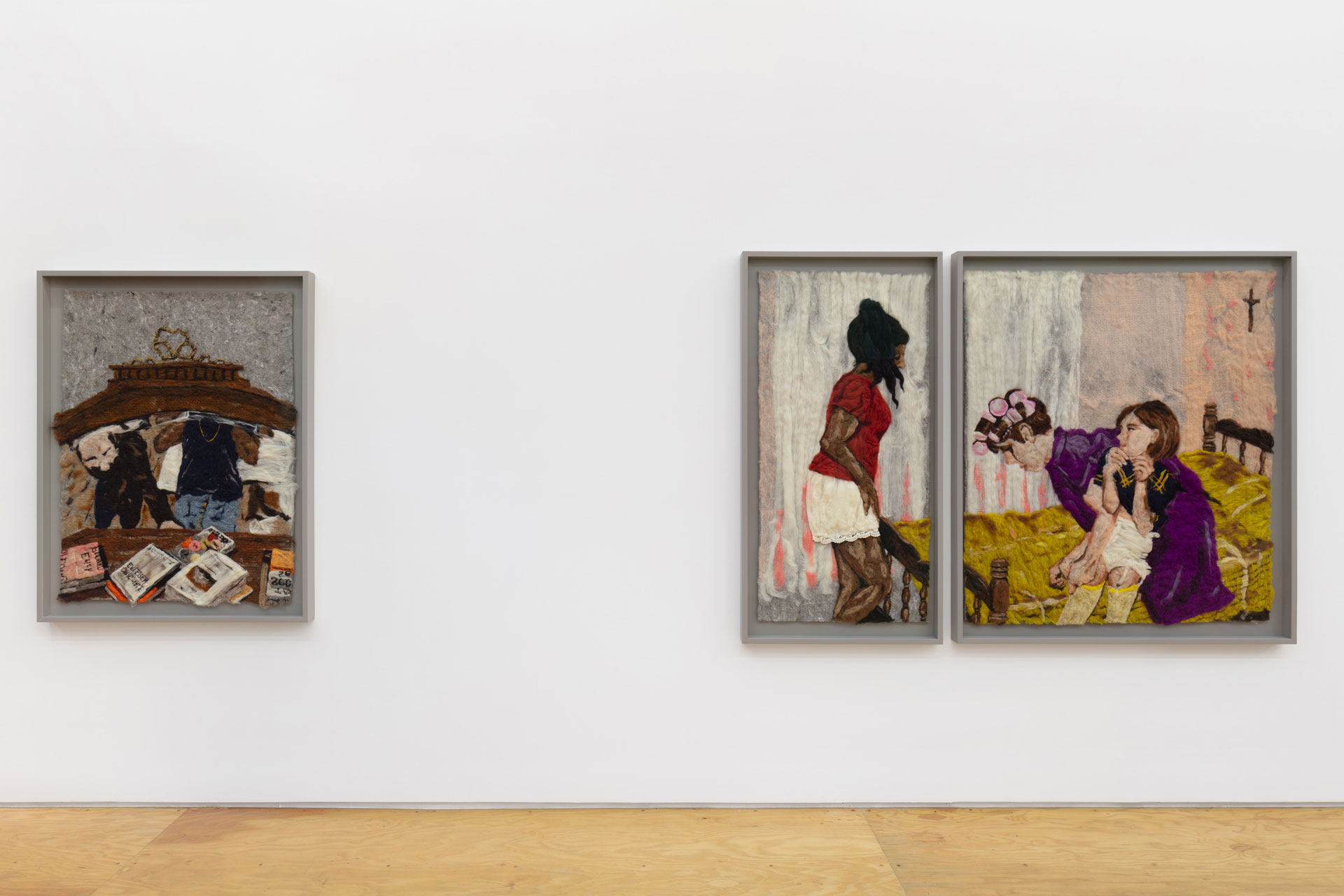
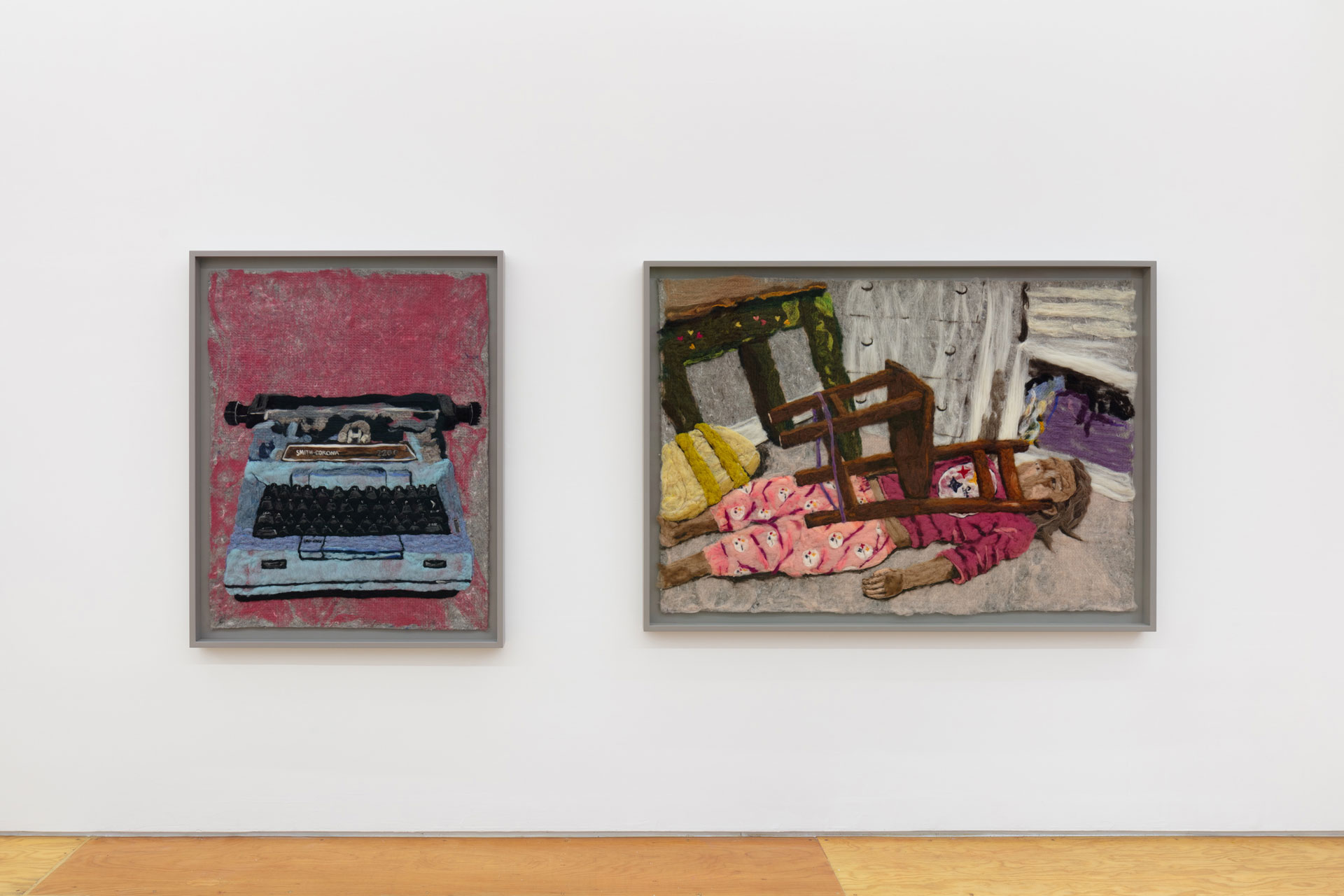
Melissa Joseph, Irish Exit at Margot Samel, New York, 2023. Photo: Pierre Le Hors. Courtesy of the artist.
AD: I’m working on a book with some filmmakers called A Vast Dispersal and we’re thinking about these ideas: how do you move away from just thinking in terms of diaspora, how do you think in terms of other notions of movements New Red Order contributed an essay to the book approaching how to define Indigenous sovereignty outside the terms of the settler colonial state. They end it by saying something along the lines of: up with nations and down with the state. And I thought that was a really interesting way of thinking about it. The nation as a group of people who come together, who have an affinity on some level, whether it’s just proximity, or history, or kinship, or whatever, and then there’s the state, which is the set of mechanisms that control, enforce, keep people out, commit violence which is somehow seen as permissible. It’s a way of thinking that doesn’t fall into the trap of nationalisms or hardened borders.
MJ: I love that. I like the word dispersal. I like privileging the word movement. That’s a beautiful thing. Maybe even porousness. We spend so much time talking about securing borders and it seems to be like a willful indifference to the reality of what globalization is and how far along we are in that process. To think that you can close off a border…
AD: Porousness and the spilling over borders makes me think again of your material process, because one of the things that really defines the way that you use the medium is that you don’t have these clearly defined contours or borders between colors or between depicted objects. What appeals to you about that?
MJ: That connects to another project that I am thinking about but haven’t quite materialized yet that is about Jali screens being selectively permeable. Things can seamlessly blend into each other so that you can’t quite discern where one thing starts and another thing stops. I think that’s what I’m trying to do, through the material, through the imagery, through the objects that I’m using. My dream class to teach is called Content as Medium, where you are addressing a single idea through various mediums and you start to understand the power of different materials to communicate certain octaves or nuances of things. I find myself returning to similar concepts, but always with another material. I keep trying to find as many ways as possible to say the same thing and in doing so eventually they make a hybrid language or a pidgin language of some kind. I don’t know, I don’t have it perfectly articulated. I don’t think I set out to do this, but as you make work, and you look back and reflect on it, you start to identify what it might be trying to do. The objects I use are very humble – I’m not using expensive material. I use found objects, things that have been discarded, clay, wool, which is really pretty inexpensive compared to paint or marble or whatever. So I use these materials that are easily accessible and therefore also common enough for people to have a personal reference to it. That’s something that is important to me. I want people to be able to see some part of it and identify their own memory or their own experience with that material. So what happens is, it also blurs the line between the histories that I’m expressing and the history of the viewer. I just want to blur as many lines as I can in the work, so that it could be a collective history, it can be a personal history. It can be a craft. It can be a fine art. It can be an object or it can be an image. It can be all of the things at the same time, which is like what we are talking about, about how we’re feeling. And of course, like we do get identified or labeled with a nation or a state when we’re born that you know we’re not, we have no control over that. It is the same with gender. But obviously we know that the labels aren’t always accurate and so we spend a lot of our lives trying to sort of navigate the non binary in a binary world. And the work does that too. It just is this little bit quirky, wonky work. It doesn’t quite fit into a single box and doesn’t want to.
AD: Coming back from the São Paulo Bienal just now and also thinking of some of the big global exhibitions I’ve been to in the past few years, it looks like textile work has become a much more central part of the contemporary art idiom. And, then there’s also the craft world. And the craft world is like its own world. Somehow it’s less surprising to me to see all of these textile workers in contemporary art than to think of how the work that you’re making might fit into the contemporary craft world. How do you navigate that?
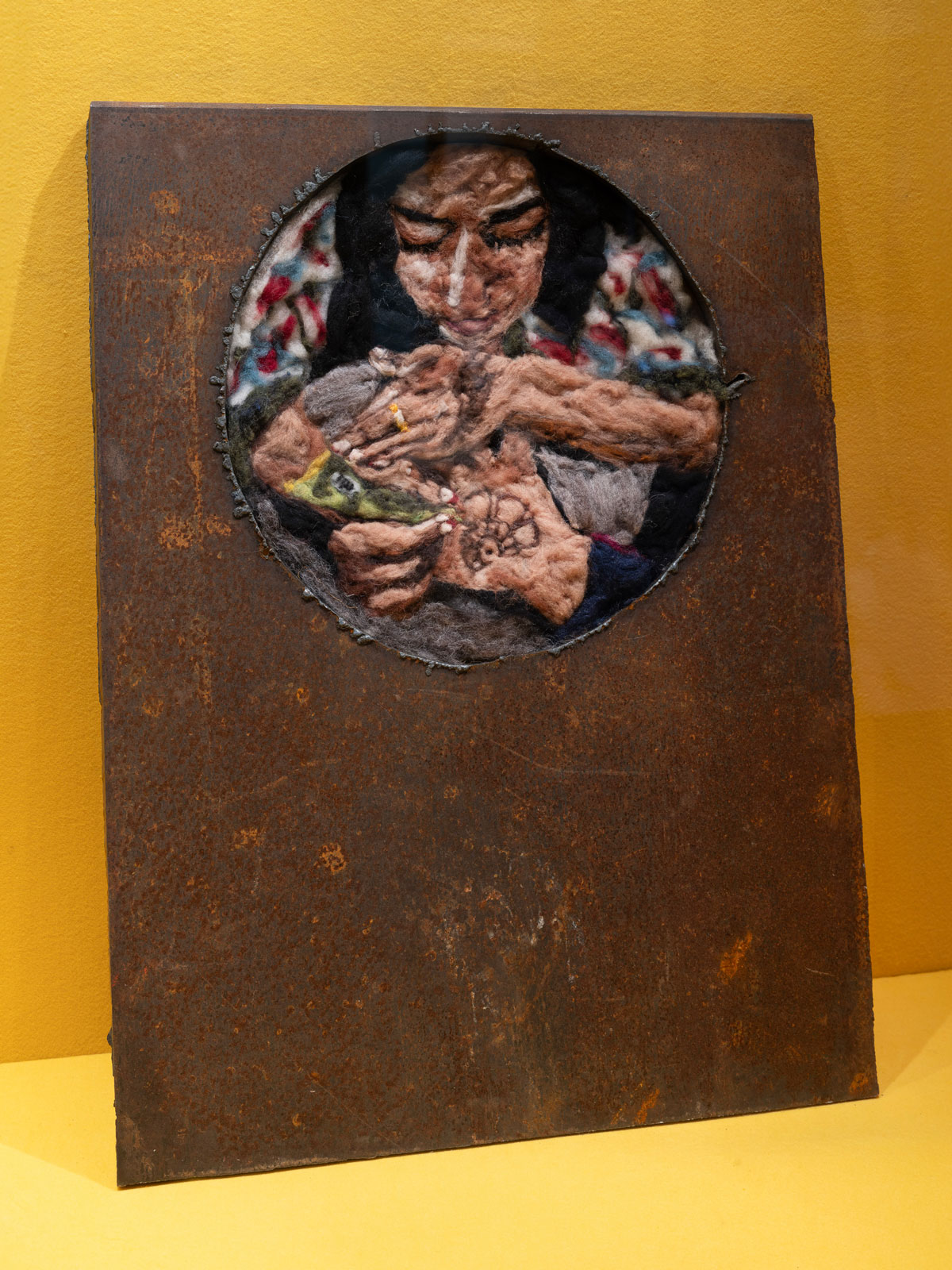
Melissa Joseph, Art Production Fund Art In Focus at the Rockefeller Center, 2024. Photo: Daniel Greer. Courtesy of the artist.
MJ: Yes, I think it’s an unnecessary demarcation, to be honest. I mean, if you just go back to the impulse of humans to create things, it’s pretty simple, but we have constructed all kinds of systems, especially around capital… Having done residencies in craft spaces like Archie Bray, which is a ceramics residency, I started to understand they have their own ecosystem and it’s interesting. I don’t know that all craftspeople want anything to do with the fine art space. Some don’t even want to be called sculptors. They want to be called potters, and some don’t want to be called ceramicists. They want to be called artists. But I think we’re faltering in keeping things too separate. I just wrote an essay for a magazine called Felt Matters – a super craft niche felt magazine, specifically to be in community with some of these felters I have now met. My education was in craft. I’ve since gotten a Fine Art degree, but I came up through craft. My mom, my grandmothers on both sides, my Indian aunts, they all needlepoint and embroider insanely, they knit and quilt. It’s about where and how the artist wants to be contextualized that matters. And I think some people are extremely interested in a very traditional process, less interested in innovating on it. Maybe the difference is that people like me are interested in the history of it, but also are interested in pushing the craft forward.
I’m not trying to make the perfect vessel, or joining, but I am interested in the language of the joint and how I can use that language to write a new story. Especially with needle felting – the type of felting that I do, which is something new. In the 1950s they invented machines and then in the 1980s someone working with the machine decided to isolate a single needle and do some hand needle felting. So I’m working in a method that’s been around for 40, 45 years. And it’s amazing to be working in a handicraft that’s less than 50 years old. Wet felting has been around for thousands of years, but to have this opportunity to be a pioneer of sorts is exciting. I understand the allure of being a frontier woman [laughs]. So, for me, it’s important to honor the history from where it came, and that’s why I want to be in conversation also with the craft people who invented it and who have been doing different things with it. Technically, they’re pushing it all the time. There are these people that are doing craft, needle felting that’s extraordinary, but it’s not necessarily in service of…
AD: Avantgardism?
MJ: Exacly! Avantgardism. But I am interested in that and expanding painting. The expanded field isn’t expanded enough. I don’t think we can just quit and say, “we did that”. It was a conversation that started and that needs to continue ad infinitum.
AD: I was introduced to needle felting because my kid, who, at age 10 or so, decided that they wanted to do it. And then we’re just up in their room for hours and hours and hours a day, poking a needle into a foam block. They would come down and have little bloody fingers from poking themselves. There is something about the accessibility of it as a process that seems pretty interesting.
MJ: That’s something that I also feel. We have all kinds of agendas, but one of mine is access. I want people to have access! I want my niece to have access to see herself in institutional spaces that I never saw in myself or my ancestors. We do have an elitist problem in the fine art world and avant-garde spaces. I’m interested in creating ways for people to feel less alienated or isolated in those spaces. I’m also interested in doing something with a material that other people haven’t done. People have made little animals and stop motion videos and other things with needle felting. But not as many people are doing painterly needle felts. I want to try to push it into a new space and into another conversation. Because it can be something new and also accessible. I can also do workshops and introduce people to it and let them engage with the cathartic aspects of it and the meditative, intuitive, healing qualities of that kind of making. It offers so many different pathways for people to enter into it, which is the goal. What I don’t want is an artwork on the wall that people can’t find a way into. That’s the antithesis of what I want.
AD: So, I saw the movie Hamnet last night, directed by Chloé Zhao, and it’s beautiful. One of the questions that it poses is how grief enters into the creation of art. What was so interesting is it was such a more complex understanding of how that happens than what you usually get in film. It doesn’t try to read biography into a play directly, but suggests that it’s the little bits of memory and little bits of experience and little turns of phrase that filter into the stories we tell that might have nothing on the surface to do with grief, but grief still shapes us. There’s no direct lines, right? You put down the pictures of your family for a while when you were really in that very fresh moment of grief. But now that you have a little bit of a distance, and you’re going back to those family photographs, I wonder if there’s a way that you can articulate how grief or memorializing is coming back into your work or whether your work is a site of working through those ideas?
MJ: What a nice question. I have a lot of thoughts on grief now that I’ve had so much time to think about it and experience it. I used to cringe to hear people say they use their art practice as therapy, because I don’t think that that’s necessarily its best function. But, whatever gets people through, honestly… Grief does come in and you can’t control it. And I’ve learned grieving can start before people are gone. You can grieve things that are still happening. If I look back at the last few years, the grieving was happening before and then it reached a point where it was untenable. I don’t think it will ever leave. It’s a weird combination, I guess, another dichotomy in the work – this weird, whimsical materiality with a somberness or sense of loss. I started my career as an artist after my dad died, so my whole practice is somehow anchored in grief or loss, but also in recovery. I don’t know if I have a good answer for that, Aruna, I’m sorry. But I do think that because the grief will be with me, it will be with the work. And like you said, grief is unpredictable. It’s like a terrorist and it just strikes whenever it wants to. And you can’t prepare for it. But at least I have some record of it. If nothing else, it was part of the experience. I wish I had something more profound to say about it.
AD: I don’t know, that sounds pretty profound. Well, thank you for this conversation.
MJ: Oh thank you. I think we unpacked plenty.
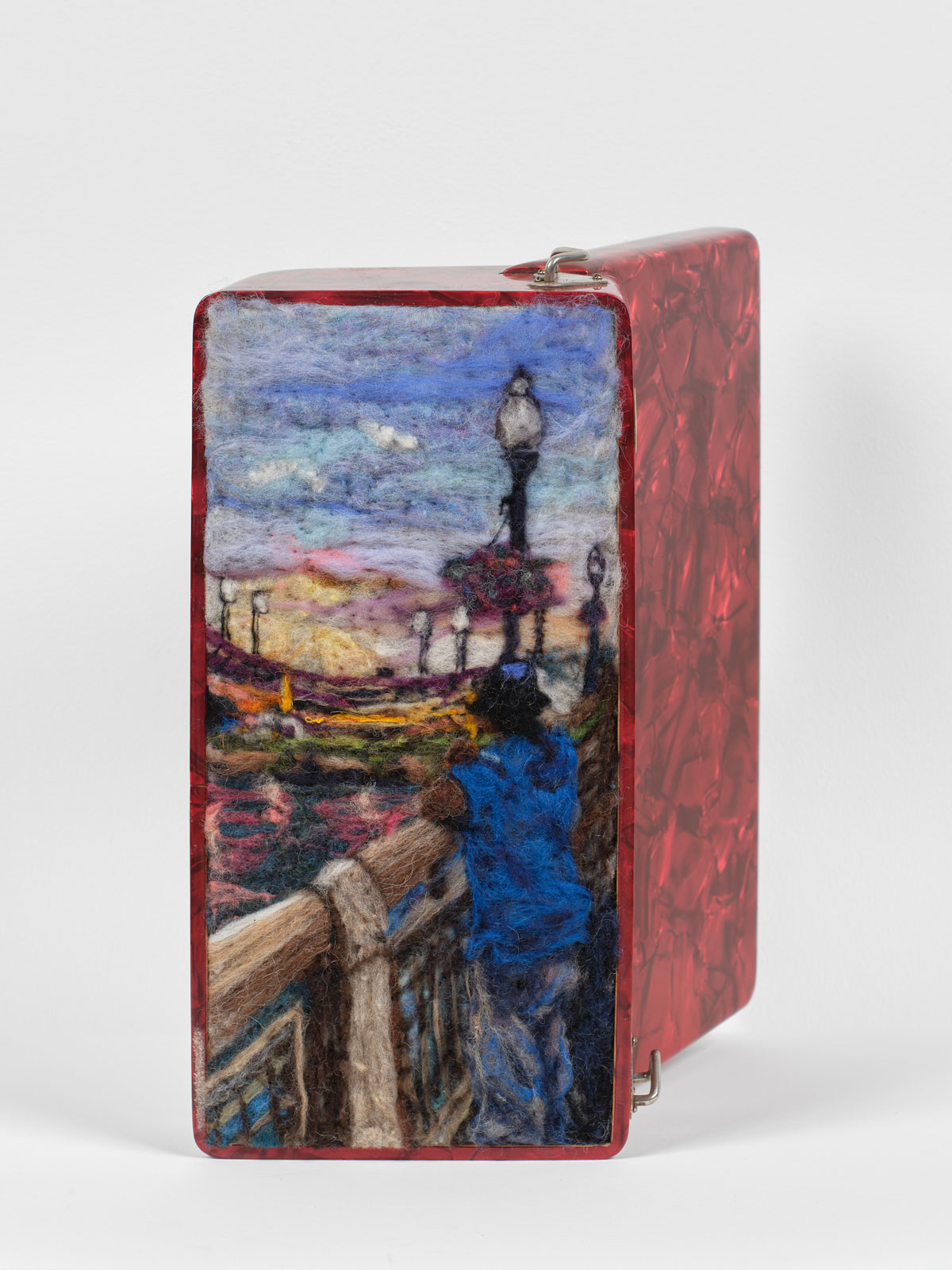
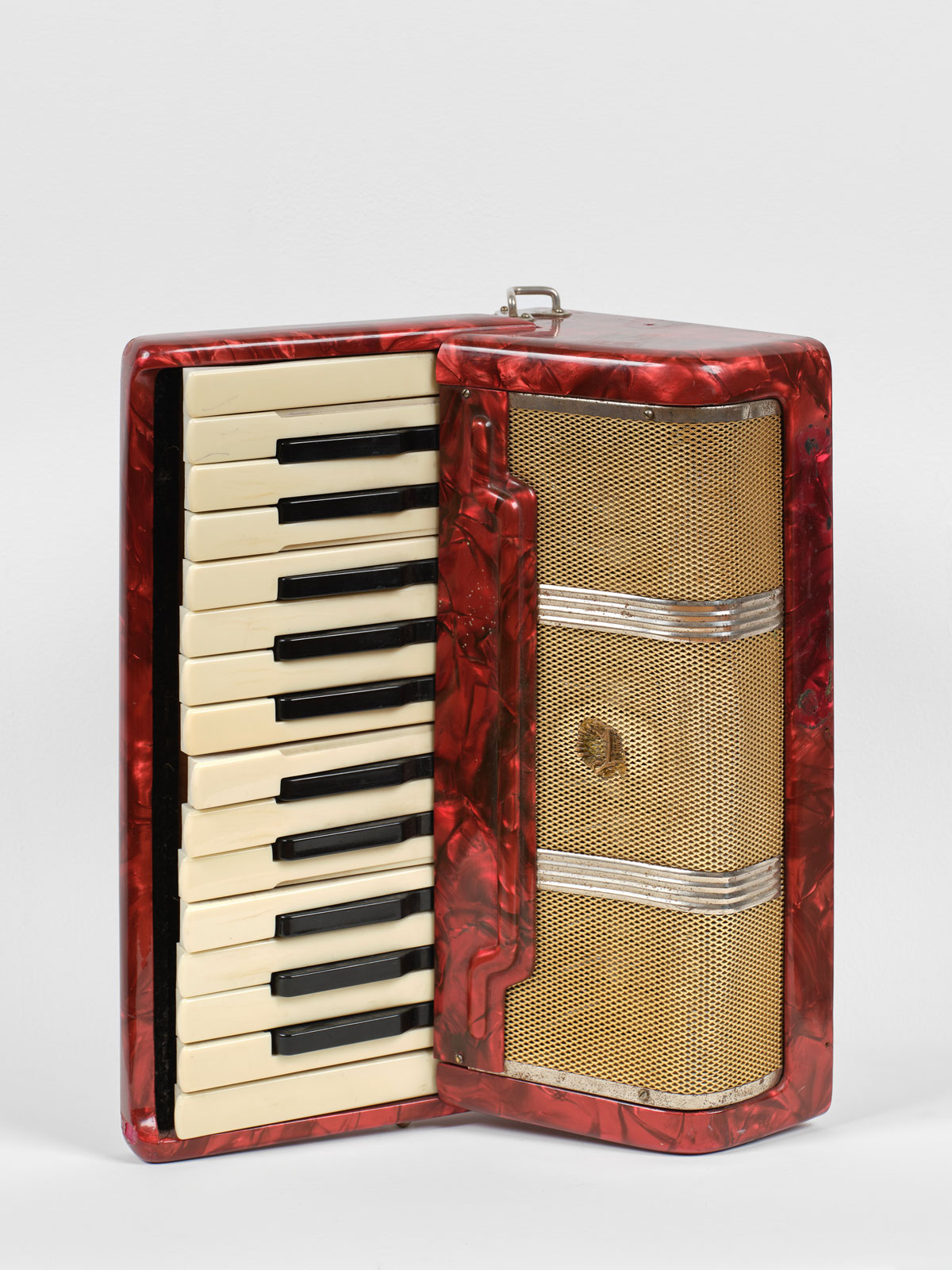
Photo: Matthew Sherman. Courtesy of the artist.
To learn more about Melissa Joseph’s work: @melissajoseph_art
To know more about Aruna D’Souza: @invisible.flaneuse
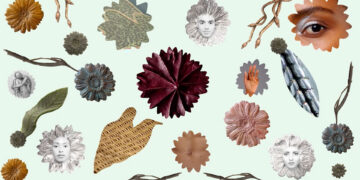
Hero image: Melissa Joseph, Art Production Fund Art In Focus at the Rockefeller Center, 2024. Photo: Daniel Greer. Courtesy of the artist.