Mariane Beline: First of all, I’d like to thank you for this conversation. It’s always a delight to hear you speak about your poetics and your process. This issue of Art Dialogues focuses on textile art, and there’s no one I would rather talk to about this subject than you. Hearing about your story and your processes… How do you see the presence of textiles within art?
André Azevedo: Thank you, Mari. It’s a pleasure to have this conversation with you. Textile work, at first glance, expresses itself through its own materiality. Material concerns are increasingly becoming social concerns, and textiles are fundamentally about material and about constructive process. If we think about clothing, for instance, it is something that separates our body from the world and, in a way, also creates a social identity for the individual. Clothing carries traces of culture, locality, and even the shape of our bodies. The same white T-shirt, for example, will take on different forms when worn by you or by me, simply because it is connected to different bodies. When we begin to examine this materiality—which is so common that it almost becomes invisible—and we notice its constructive and material nuances, we encounter a poetic quality that touches several other languages. It intersects with painting in the organization of color and form on a two-dimensional plane; with sculpture, because fabric projects itself into space and has its own topography; and even with poetry, in the root of poetic language, which is the word—if we think about the sound of textile machines organizing sound in time and space, almost like musical rhythm. Historically, this materiality has been part of human culture for a very long time, so artistically there is an incredibly rich repertoire of information and processes. Textile is a field of research available to all artistic languages. When we think about fashion and the body, what covers us signals many things and has the power of retrospection—of cutting into the past and transforming it into something new.
MB: How do you see the presence of textiles in contemporary art specifically?
AA: In some ways, I think it is still strongly connected to this place of ancestral knowledge. More recently, there has been a reclamation of space by women artists. As a result, practices that were once feminized and confined to domestic environments—or to the realm of craft, dismissed as idle chatter, a term that literally comes from spinning and unspinning thread—were reconsidered. In fact, it’s beautiful to think about the web of words and meanings that emerge from the textile universe. Expressions such as background, something to unravel, or even the word plot. When we tell a story, we talk about a thread or a weave.
MB: That’s true.
AA: Today we find artists researching textiles through ancestral practices of constructing social identity—whether through historical garments or through the geometry and orthogonal production processes associated with textile making. But we also see artists who think of textiles as architectural structures and industrial-scale systems, building entire environments, often on monumental scales—covering buildings, for instance, or constructing large installations within expansive spaces.
Textile is an incredibly generous material. It asserts itself and has its own structural rules, but it is also easy to handle and light. It’s no coincidence that textile serves as the support for painting. There is a direct relationship between painting and textile through the canvas as a structural element. There is immense richness in textile, and increasingly we see artists engaging with these questions.
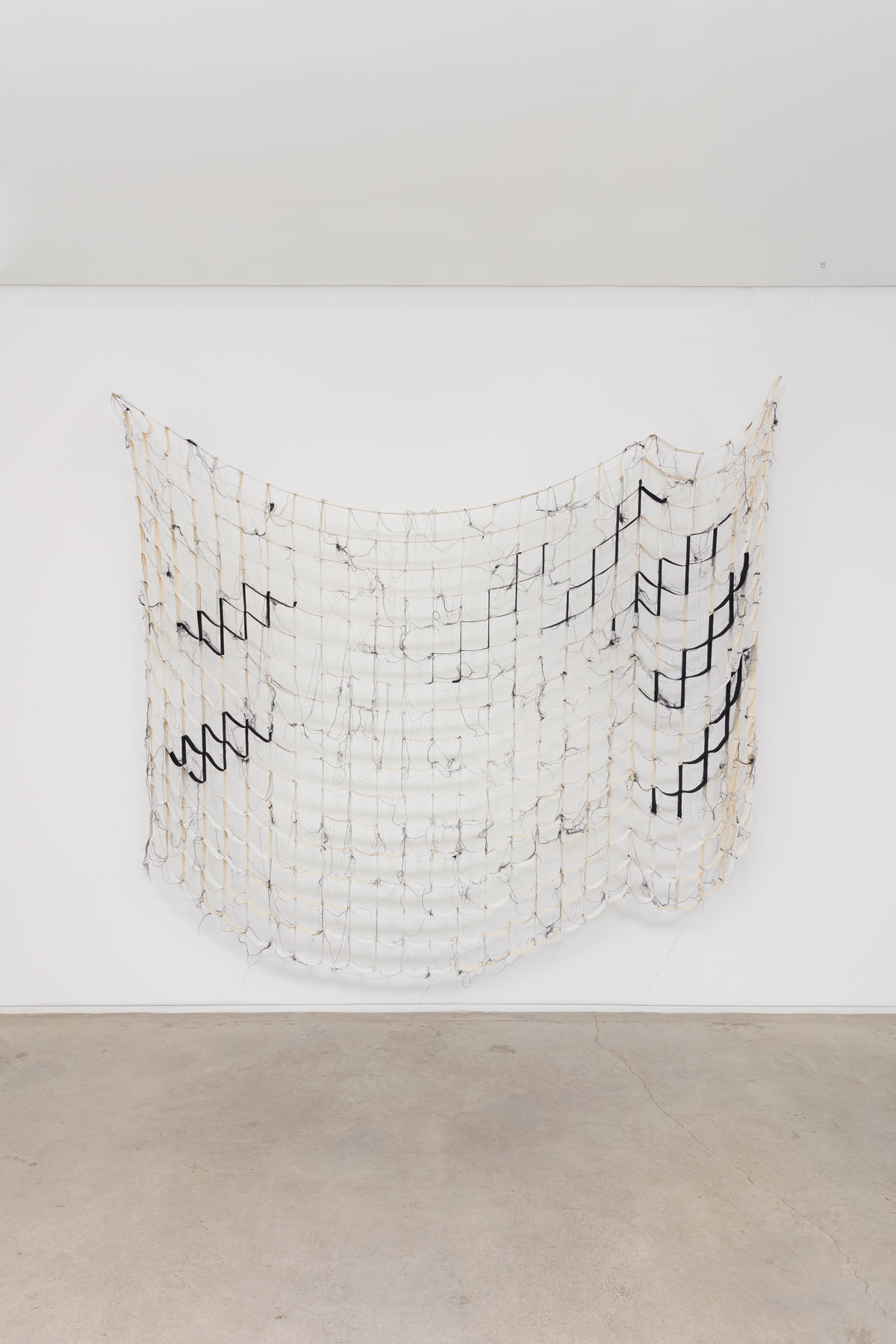
André Azevedo, Macrocélula, 2020. Cut and sewn canvas and tarpaulin, 74 × 79.5 [Variable dimensions]. Courtesy of the artist and Simões de Assis Gallery.
MB: Versatility is something particularly interesting in your work. You often use textile material in sculptural ways that project into space, but in other works your compositions move closer to painting—two-dimensional research, images formed on a surface. When you build a large structure, like a mesh made of typing machine ribbons, you also bring with it the histories associated with sewing machines, typewriters, and even the action of time. All of this appears in your poetics—the act of sewing, writing, the word “image.” With that in mind, I’d like to hear more about the materials you use.
AA: I’m glad you bring that up, Mari. I think everything begins with my desire, as an artist, to recognize a language. In contemporary art, artistic language often dissolves… Some of my works can be seen as painting or sculpture; others as poetry. In some ways, I’m a maker of fabrics.
As a material, textile comes from a craft practice. It begins with gathering fiber—cotton, silk, wool—and goes through a step-by-step process, from the warp frame to the loom. It’s a chain process that can be broken down and even mathematically categorized if we think of stitches almost as binary codes. But textile also has an industrial side. Industrial fabrics carry the most basic qualities of weave and material—cotton or polyester thread. There is an entire industry dedicated to textile technology, with enormous research behind it, because fabric is part of every aspect of our lives. Fabric cools, warms, reflects. It has intrinsic characteristics tied to its construction and to the object itself, and these characteristics can be activated in art.
For example, a knitted artwork may visually evoke texture, but it also activates the sense of touch in our understanding that the material warms the body. Regardless of social class, the contact between body and fabric is familiar to everyone. We all know what the inside of a garment looks like, what a seam does when it joins two pieces together.
When we think about the typewriter, the ribbon itself is an object saturated with ink used to write. It’s a strip—a ribbon that moves back and forth on the spool. That object fascinated me from childhood. There was always that moment of getting ink on your hands when changing the ribbon.
MB: The imprint of a gesture.
AA: Exactly. And it’s fascinating that a machine that has become obsolete still fascinates children. It’s a device full of buttons, levers, and springs, operating through the pressure of fingers on keys—each with a different resistance, producing marks on paper. This is something that has been lost with digital technologies. With smooth touch screens, we also lost a refinement of perception that came from engaging with material.
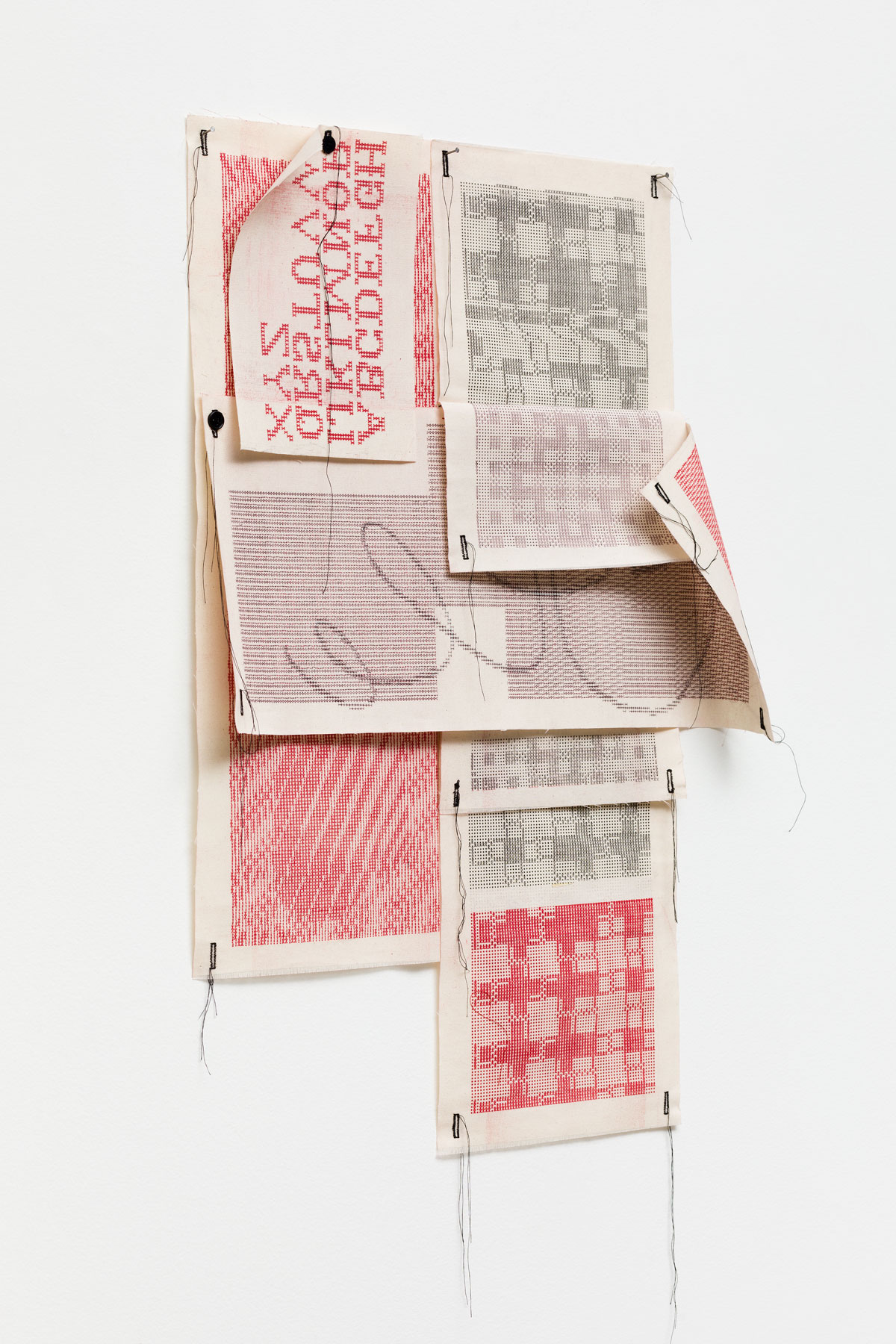
Right image: André Azevedo, Datilográficas, 2022. Typing on raw cotton with stitching and buttons, 31.5 × 29.5 in. Courtesy of the artist and Simões de Assis Gallery.
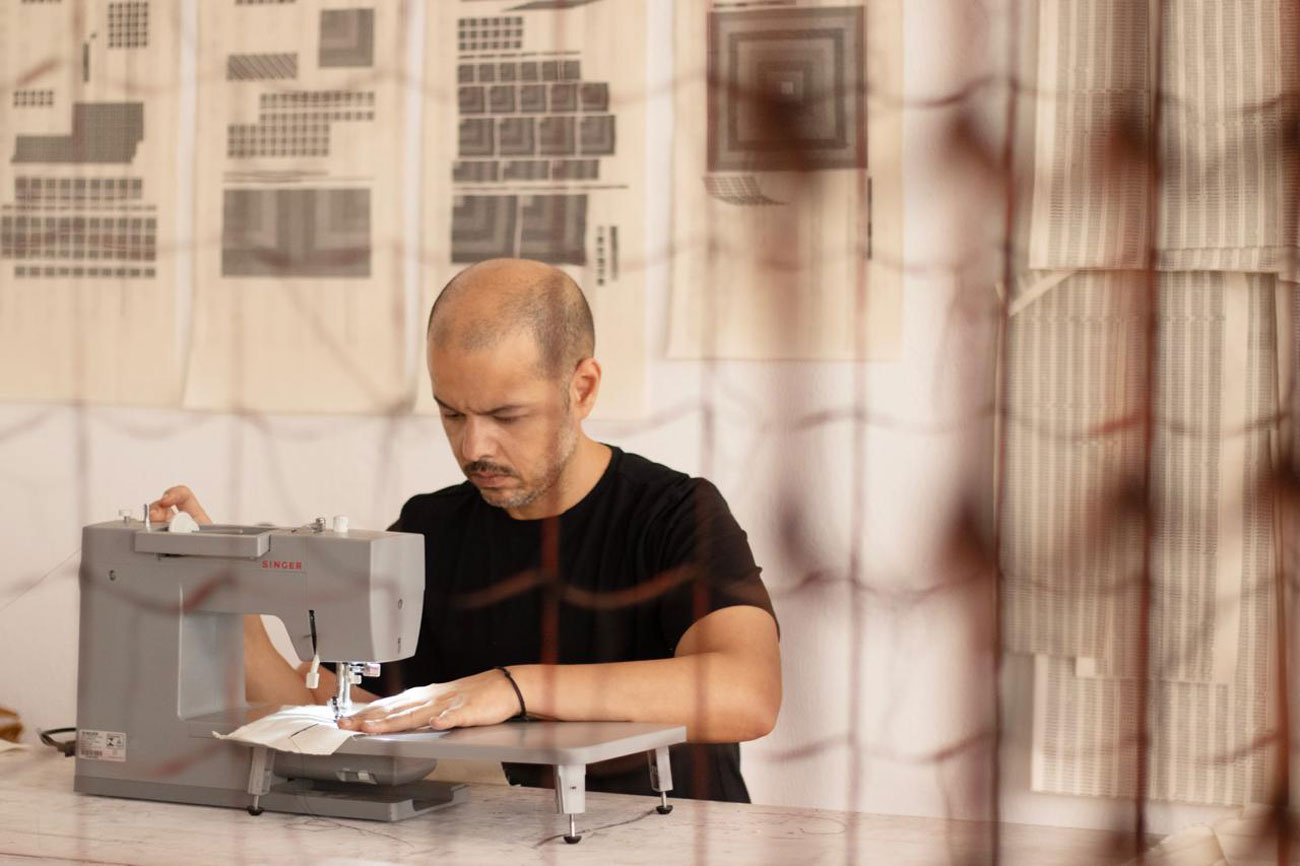
André Azevedo in his studio, 2025. Courtesy of the artist.
MB: Your relationship with the sewing machine also comes from family experience, since childhood, right?
AA: My encounter with both machines happened early. I took a typing course when I was around eleven and received a typewriter as a gift, which I still have today. I still work with that machine and continue learning from it. And I’ve been around sewing machines for as long as I can remember. In my parents’ house there was a sewing room that eventually became something like my mother’s textile studio. Besides the traditional sewing machine, she began to have other domestic machines—like knitting machines, for instance.
Those machines represented my mother’s professional emancipation. She built an entire life from those skills, which until then had been skills women developed “in order to get married.”
MB: Many women achieved emancipation through those abilities.
AA: Yes—and through forms of knowledge that were often transmitted orally and have now been lost. There was a whole generation of women incredibly skilled in needlework, something much rarer today.
MB: How does your process unfold?
AA: Many artists repeatedly return to the same process and refine that technique to the maximum. I’m not like that. I have a continuous interest in developing techniques, but because of the richness of the textile universe itself, I feel there are many possible entry points.
I keep my interests stored in drawers and open them as works emerge. I literally have folders filled with experiments made on the typewriter and knitting machine that remain stored as seminal objects I can return to at some point. Sometimes it’s just a matter of writing a word repeatedly on top of itself until it gains texture and plastic qualities.
I think my work touches on something intrinsic to textile: the archive of memory. We don’t know exactly when humans began weaving, but I believe we have been weaving ever since we became social beings. Many textile artifacts were never preserved because they were organic materials, but textiles hold an image of time passing. Every fabric ages differently. Depending on the fiber, you can reverse the passage of time by subjecting it to processes like freezing, heating, or boiling—and the piece becomes new again.
In art, we materialize something related to the history of our feelings: the overflow of what cannot be spoken or written. It is almost the materialization of sensitivity into a thing. And we can understand that thing. Through artistic objects, we can reflect on the trajectory of human sensibility.
MB: It really is possible to understand a great deal about a time period through its artistic production.
AA: Yes. In that sense, it’s fascinating to see artists using textile logic—structure, interlacing—to create works outside textile art.
Anni Albers, who is a major reference for me, said that textile construction diagrams and manuals could be seen as problem-solving guides for things far beyond textile itself. And perhaps that connects to human life itself—if we think of life as a vast fabric made of threads that follow us over decades. As we move through the world, we leave behind this woven structure.

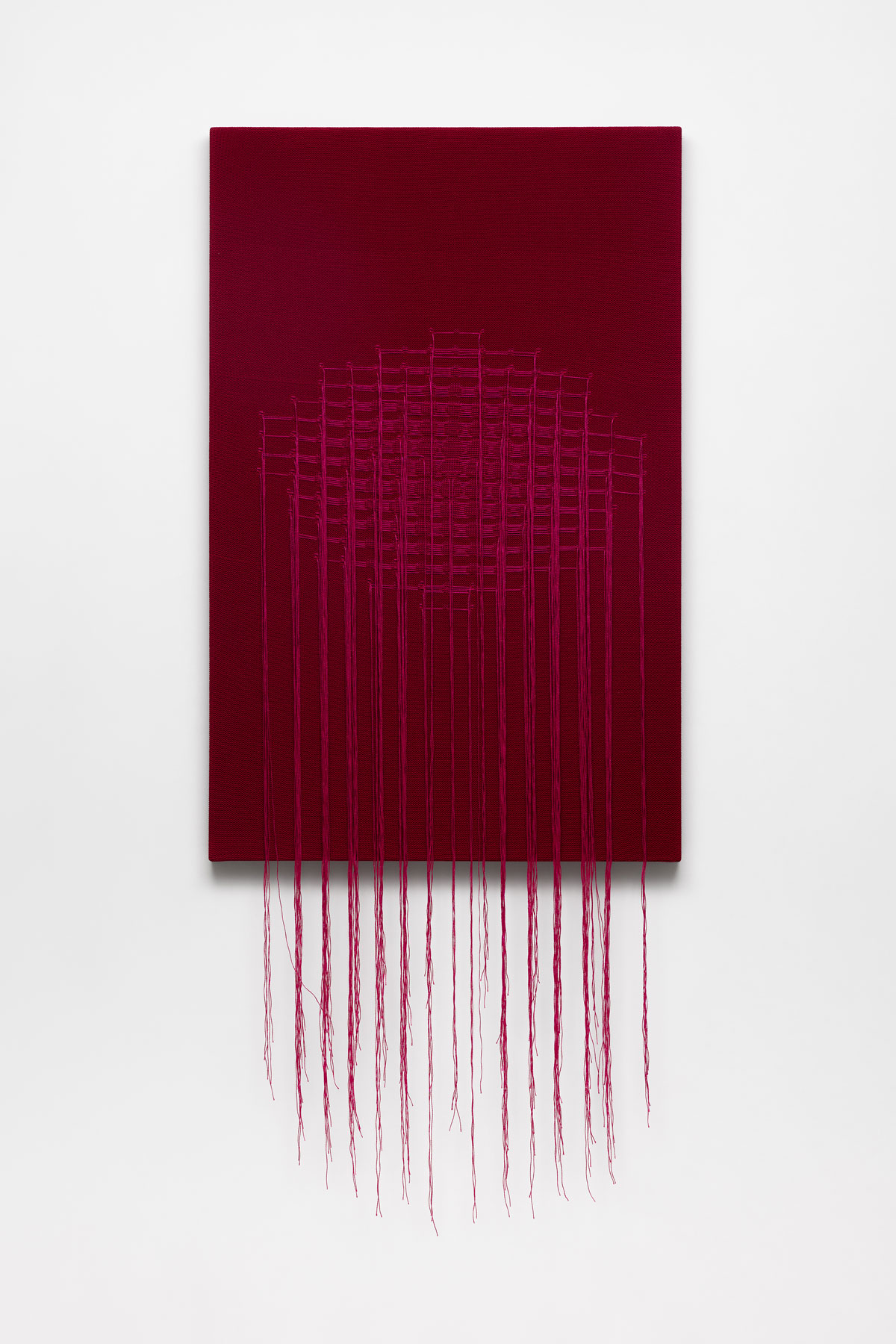
André Azevedo, detail of Enredo 6, 2022. Weave made with typewriter ribbons, collected from different typewriters, stretched over canvas, 39.37 × 31.50 in. Courtesy of the artist and Simões de Assis Gallery.
MB: That’s beautiful. You mentioned Anni Albers, but there are many other references in your work. How do references to fabrics and the materiality of textiles enter into your poetic work? How do you choose cotton, the ribbon?
AA: I realize that many of the things I work with choose me more than I choose them. I have a fixed interest in supports—raw cotton, for example, is something I work with in several weights, both in sculptural structures and in painting, whether cut, torn, or reconfigured through sewing, even in its thinnest weight, which serves me as a sheet of paper to write on. So cotton is constant, and it is a material that fascinates me because it has different tones depending on the region where it is extracted. Cotton from the Northeast is more pinkish, while cotton from the Southeast is more beige or brownish. In any case, it is very interesting to imagine that a gauze fabric, which is extremely light and fluid, and a silk crepe or taffeta, which is shiny and rigid, share the same thread. The only thing that differentiates them is the interlacing of that thread. The textile body is formed more by the arrangement of lines than by the origin of the material. All of this is material constitution, but something that can be manipulated by hand. You cut, join, sew, mend. Fabric has its own very particular vocabulary. And, thinking about terminology, if we consider the verbs to mend and to sew, both suggest joining parts that are not together. But one refers to reconstruction and the other to grouping.
MB: Your work, and textile work as a contemporary poetic practice, enters this new vocabulary in some way. You begin with a thread or a mesh that has the social function of clothing or covering and you reconfigure that perspective. You create your own vocabulary through art itself—re-sewing and bringing together these lines, composing these weaves, meshes, and fabrics in a certain space. Operating with textile material from a very aesthetic perspective. The function of your work is to bring forward this aesthetic dimension.
AA: Aesthetic! Yes. Textile is often misunderstood as an exuberant body with an empty interior. With my work, I have tried to show that this interior is just as exuberant and intricate as the exterior. Thinking about this articulation through art means dealing with a materiality that almost becomes a symbol of capitalism.
During the Renaissance, fabric was more expensive than land, so there was a whole question of displaying possession. In art history, the purchasing power of the depicted figure was often revealed through the fabric they wore—through color and dyeing. And this also meant something for the technology of representation. It is much more difficult to represent the drapery of fabric than a skin tone.
MB: Yes… If you look at Bernini’s drapery, you can see the fabric in the marble—the texture of velvet, the transparency of voile.
AA: Indeed. And if we think about Aby Warburg’s concepts, when he assembled all the images in the Atlas Mnemosyne—a project by the German art historian intended to tell the history of art without words, through more than a thousand images—he used textile as a represented object. He begins with primitive humanity and threads everything together through the representation of fabric. When he brings in Botticelli’s Primavera (1482), he shows that the visualization of the breeze appears through the movement of the fabric depicted there. Textile representation signaled what was happening in those scenes, historically as well. So this emphasizes how rich these structures are in information—even their inner side—and how they serve as important references for research.
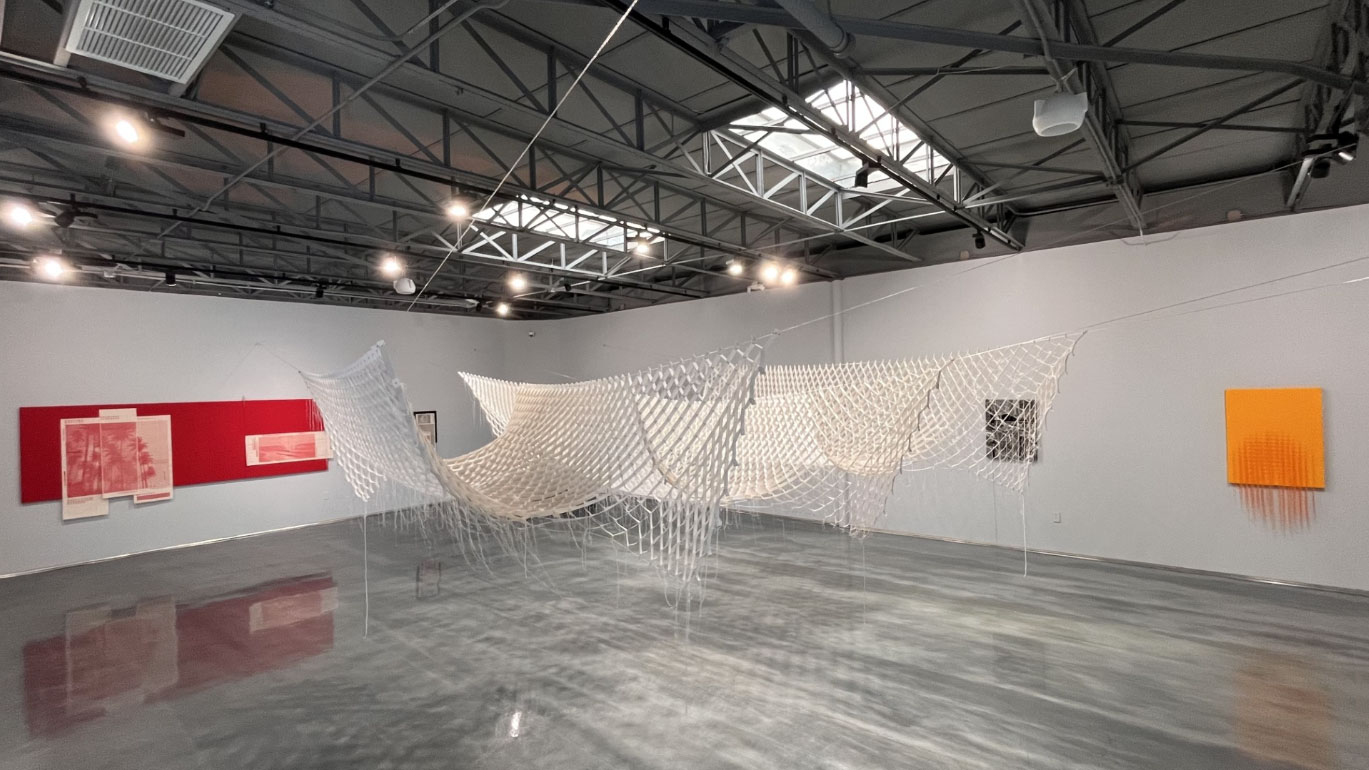
André Azevedo, Text(t), Fundación Pablo Atchugarry, Miami, 2024. Courtesy of the artist and Simões de Assis Gallery.
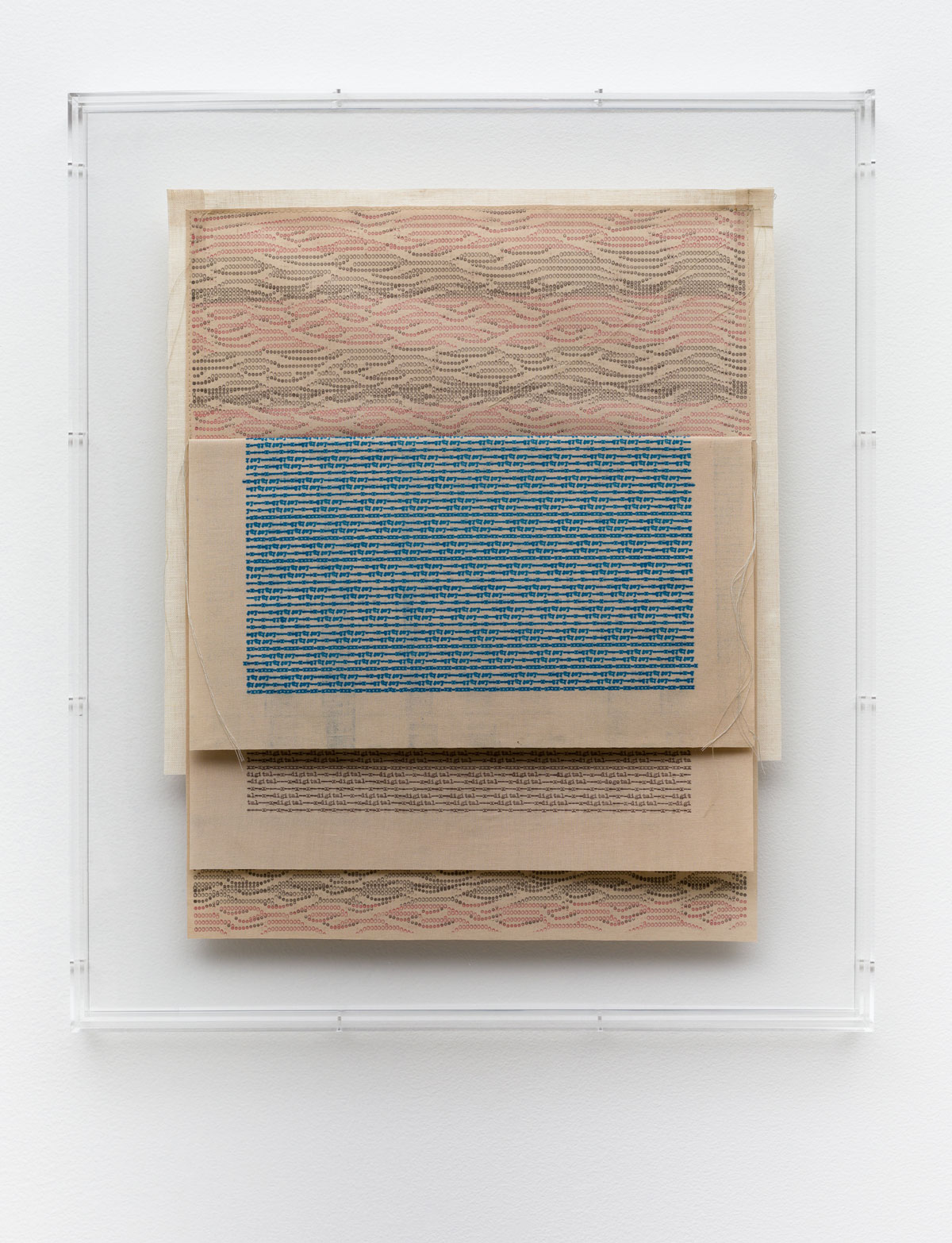
Courtesy of the artist and Simões de Assis Gallery.
MB: How do you organize these references in your work?
AA: I have something very instinctive—I am driven by the will to make. It may happen that after spending three months exercising a geometry on the typewriter, for example, I end up working on figurative abstraction or lyrical figuration. My curiosity picks up information, ideas, references, and at some point I go after them and try to make something with them.
MB: Text is an element that intrigues me, because it is present in absolutely all of your work. What are your references in that sense?
AA: I have always used the technical arsenal of machines so that the work starts from me but, in fact, comes out of them. The machine has always been a barrier between my hand and the final work, and likewise between that work and the world. When I sew, the thread is a body. In the typing works where I start from my own cursive handwriting, I recombine this idea of line or trace so that it can be typed and organized into an orthogonal structure. In cursive writing, the line becomes much looser. It appears in the arrangement of meshes, cells, or networks, for example. When organizing the arrangement of these elements on the wall, there is a search for a kind of dotted line or lines that indicate a mass shifting to one side or another. I believe this reflects an artistic desire to create an image—or to generate a certain anxiety through imagery and then search for that imagery.
MB: I really like how you allow traces or remnants of this material to spill out of the embroidery—whether through leftover threads or in those figurative drawings where we only discover the image when we see the reverse side. This is a very recognizable characteristic of your gesture. It is through the line itself that you place your intention as an artist.
AA: I position myself as a fabric maker because I place myself in the position of the weaver, who produces the object from the back side. If we think of a weaver sitting in front of a loom, they choose to look at the back because that is where the threads are tied—the threads remain on the reverse side. At some point the front side is revealed.
Every now and then I catch myself anxious to see what the front side of my works looks like. Even with the typewriter, because I use carbon paper as the ink trigger more than the ribbon itself—not only because of its plastic quality, since carbon paper has a denser pigment and leaves a stronger mark, but also because when using it you have to make a kind of sandwich with the fabric, placing one sheet of carbon paper in front and another behind, both with the ink facing the fabric. I write behind this paper and only see the result of the writing—the work produced by the machine—after the entire project is completed. This also happens with the knitting machine and with my sewing series. This duality between front and back, reverse and obverse, interests me greatly, as much as working from the inside. Thinking about both sides is intrinsic to the textile process.
MB: You also exhibit the carbon paper used to make the work. It becomes part of the composition. We can see where the ink came from and how the image forms—sometimes figurative, sometimes an image formed through the writing of the word itself, a word-image. And once again, you turn to machines as an extension of your body.
AA: In a way, the machine technologically supplies what the body can no longer sustain alone. The lever, for example, is a tool that allows me to do things I could not do by myself. That interaction makes a certain result possible.
The typewriter is made for the use of hands—just think about the layout of the keyboard letters, about the typographic bars that do not cross between vowels and consonants. It is interesting how every literate person understands the construction of writing. I think my work has the characteristic of showing the path the artist takes to make the work. This is different from the work of a sculptor or painter, who often deals with a materiality that does not necessarily reveal whether it was fired, or how long it took to dry. I can have a very precise idea of how long it takes me to finish all the works in a project, based on my productivity on the machines.
MB: It is remarkable how time collaborates with your work. Time is present in all artistic gestures, of course, but I see it very strongly in yours. You have also used the sounds of these machines in your works, and those sounds function almost like a measurement of time.
AA: The sonic texture generated by the machines is like a companion to my practice. I can hardly work while listening to music because I am always counting in my head—a number, a letter, a word that I repeat. I need to hear the sound of the machine to understand whether it is functioning as expected. Both the typewriter and the sewing machine have subtle sound variations that we recognize just like we do with a car. I am always listening carefully and also connected through touch, noticing where each side of my hand rests, even the little finger.
It is a visual practice, obviously, but also an olfactory one. The materials have very specific smells—both the fabrics and the textile apparatuses, as well as the printing inks used in writing. In that sense it is a very connected process. When I write something repeatedly, sometimes I get lost and start wondering whether I am spelling the word correctly. After writing a simple word like “image” on many pages, when I start reading it again, it feels strange. It is fascinating to observe this repetition, repetition, repetition, repetition.
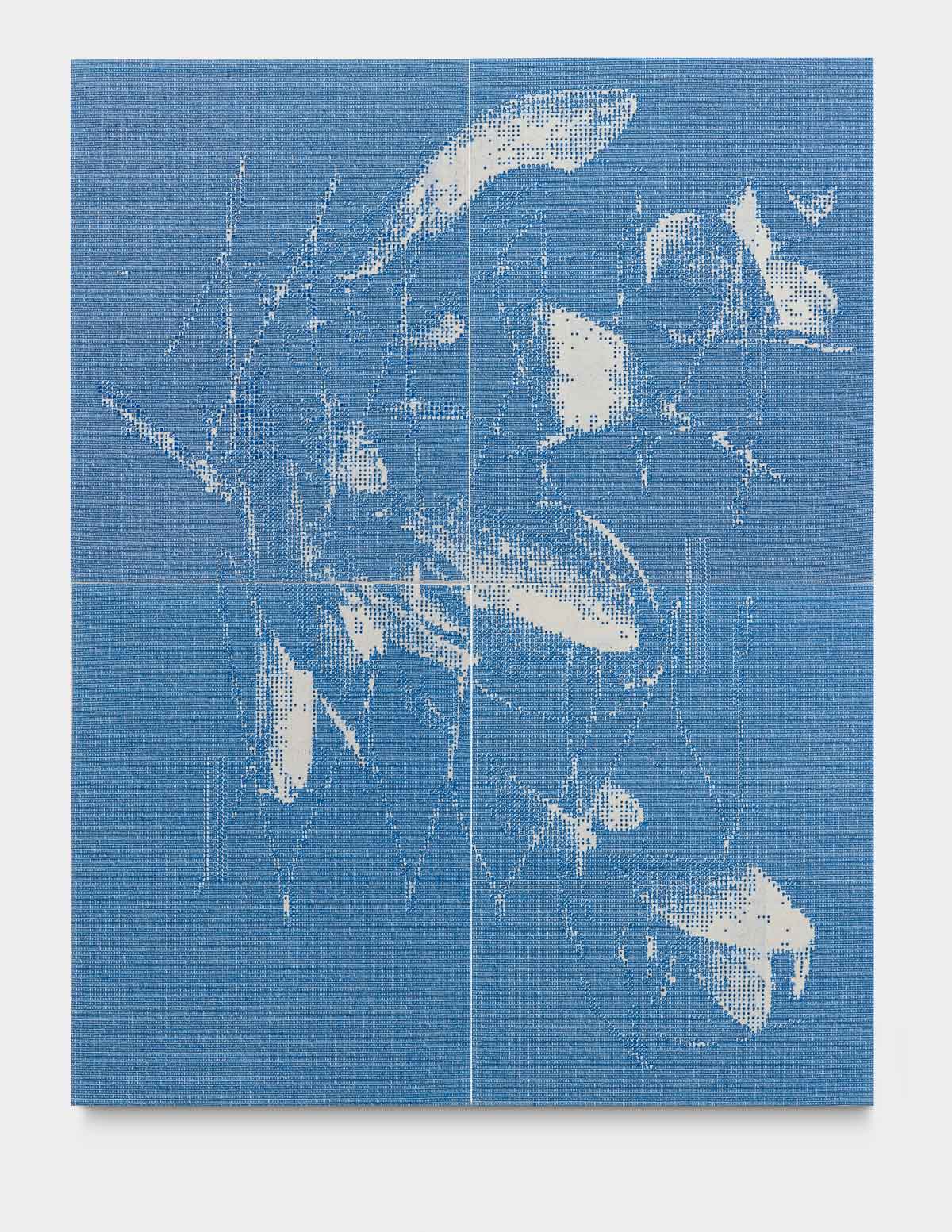
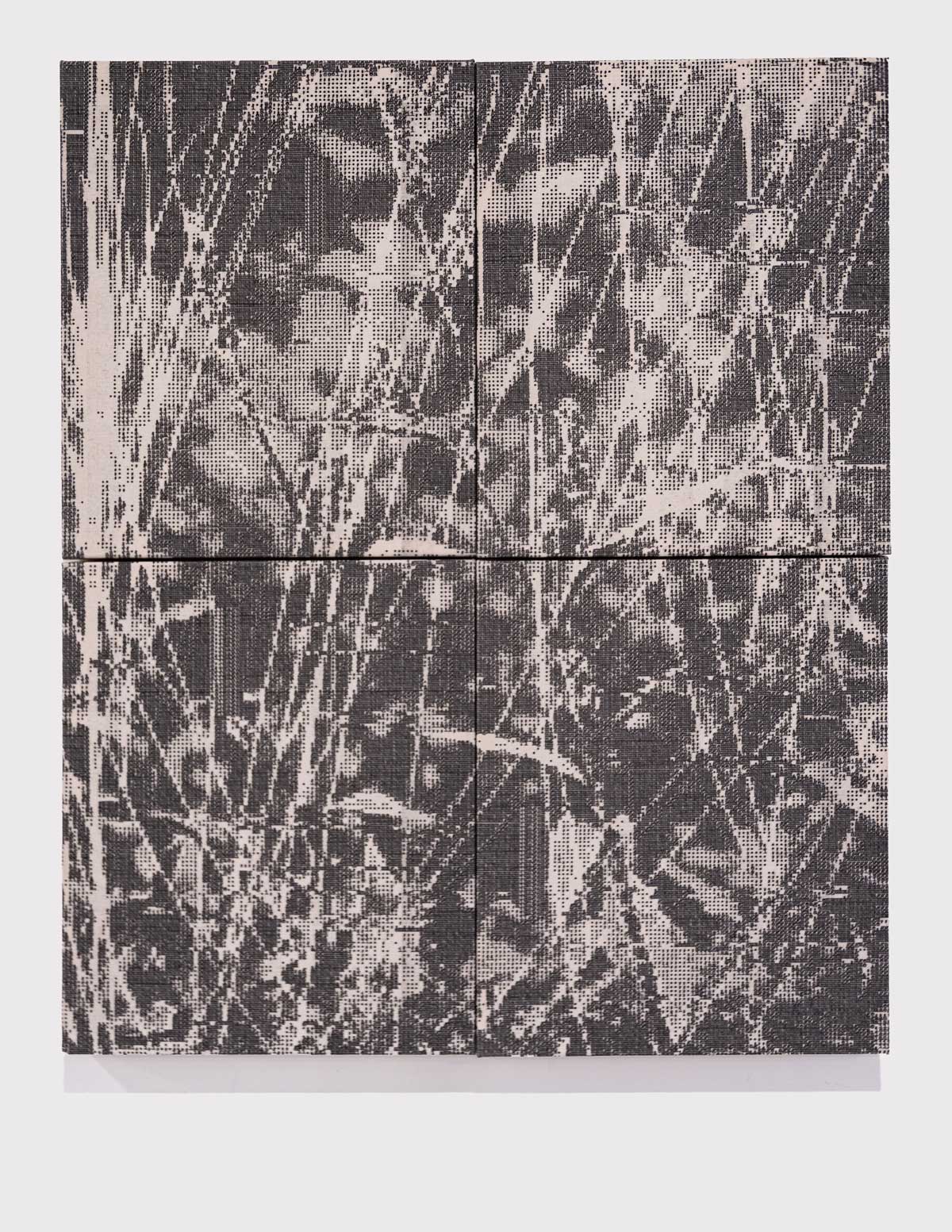
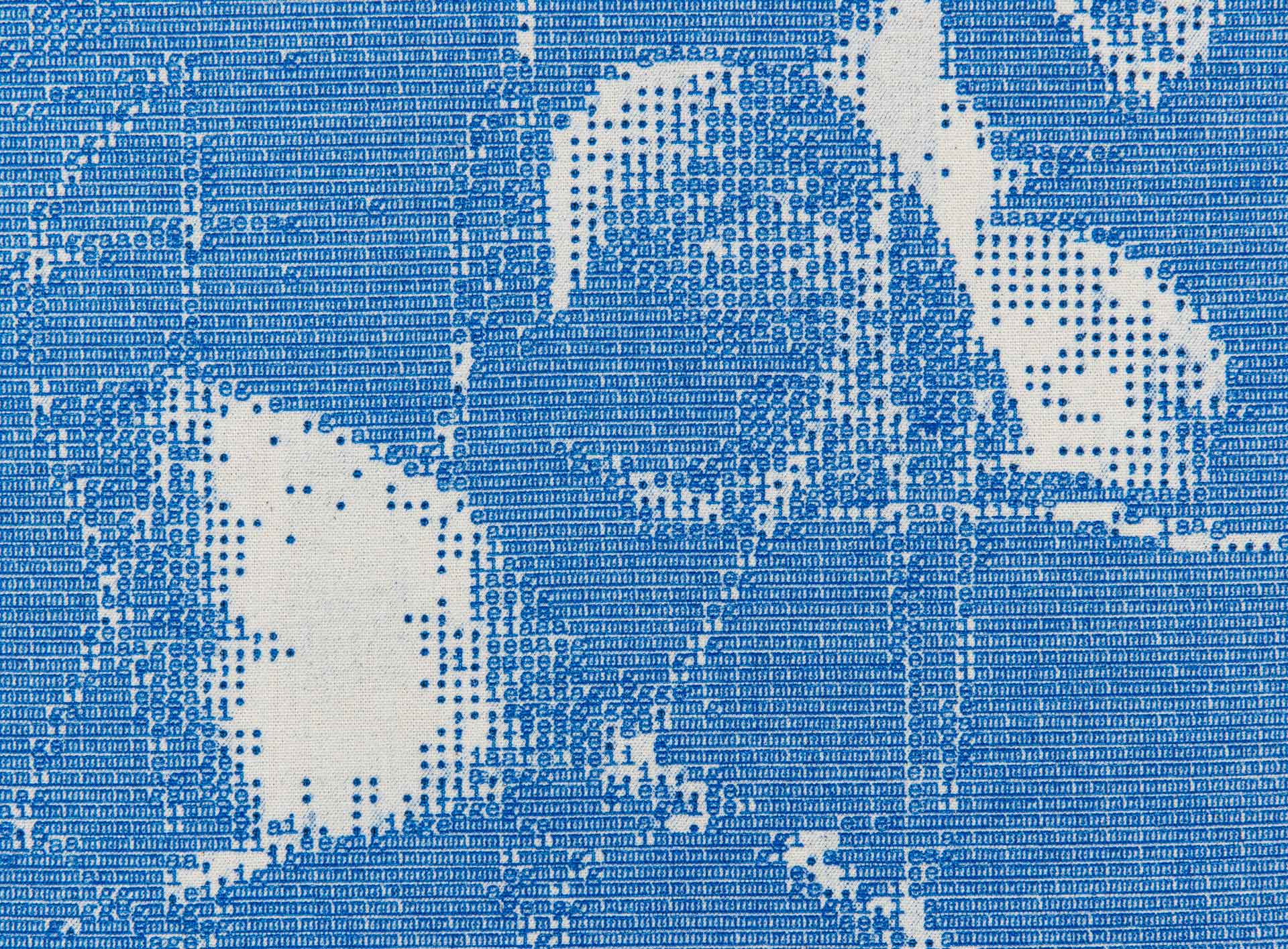

Left image: André Azevedo, Datilográfica 2, Image Series, 2024. Typing on carbon paper and raw cotton, stretched on a wooden frame, 22.4 × 17.3 in.
Right image: André Azevedo, Datilográfica 11, Image Series, 2025. Typing on carbon paper and raw cotton, stretched on a wooden frame, 23.8 × 19.9 in.
Courtesy of the artist and Simões de Assis Gallery.
MB: There is also this idea of embracing chance. Small flaws that shape the handmade process and the gesture—and that become performative acts.
AA: Yes. It is a constructive manual, a step-by-step process with an initial imperative order. But it is also a performative act that I choose, one that organizes my practice. It is very interesting that repetition generates difference. After repeating an action many times, difference appears—almost like a malfunction in the machine, a human malfunction. In industry, error is always destined for disposal. In my work, error is embraced, welcomed, and marked as an expressive act of the process that escaped my control. The works always begin with an almost absurd attempt at control, even of scale, but there is also a desire for these processes to fail because the flaws have plastic qualities.
Sewing has taught me a lot. In clothing construction, finishes are always invisible and very perfect, which was a problem when I was a curious teenager sitting at a sewing machine trying to make clothes for myself. I wanted to make clothes that looked like store-bought garments, but I could never produce anything without a homemade appearance.
Today I recognize that everything I once described as homemade—the crooked seam, the poorly placed button, the visible thread—forms a very evident plastic characteristic of my work. It was truly a discovery. A skill I once tried to control but now allow to happen freely. I have a slightly heavy hand for certain things, especially finishes. When I outsource some processes, certain things are lost, so I end up doing everything myself—except typing, which I sometimes outsource, because if another person does it, mistakes also appear. After all, error reveals the process of repetition.
MB: When we think about fashion, it is also interesting to see that there are not only aesthetic solutions, but also solutions aimed at comfort.
AA: Exactly. There is a whole technology behind seemingly simple things like fasteners. Price is also taken into consideration. Many factors determine whether something will be produced on an industrial scale. I have many friends who are fashion designers, and I have accompanied them in the process of developing collections and prototype garments in the studio. They would travel for research, visiting thrift stores in Brazil and abroad to find an old garment with a certain technique, cut, or drape that could solve something in their own designs.
Fashion has this curiosity of looking, investigating, and absorbing references from its own repertoire. In fact, it is impossible to deal with textiles without touching on the work of many artists because they all exist within the same cauldron of material, structure, savoir-faire, and connections to social life. When the Bauhaus textile workshop was dedicated to women, it was precisely there that most sales and commissions came from—or, more precisely, where the most money entered the school. Those women were making history. There is a vast body of writings from the Bauhaus textile studio that was fully absorbed into the discourse of the modern movement.
Gropius drew from what those women artisans were saying about form and function, about the thresholds between art and design, and about the grid as a constructive element. Fabric is a flexible grid. Much of what modernism proposed came from textile thinking.
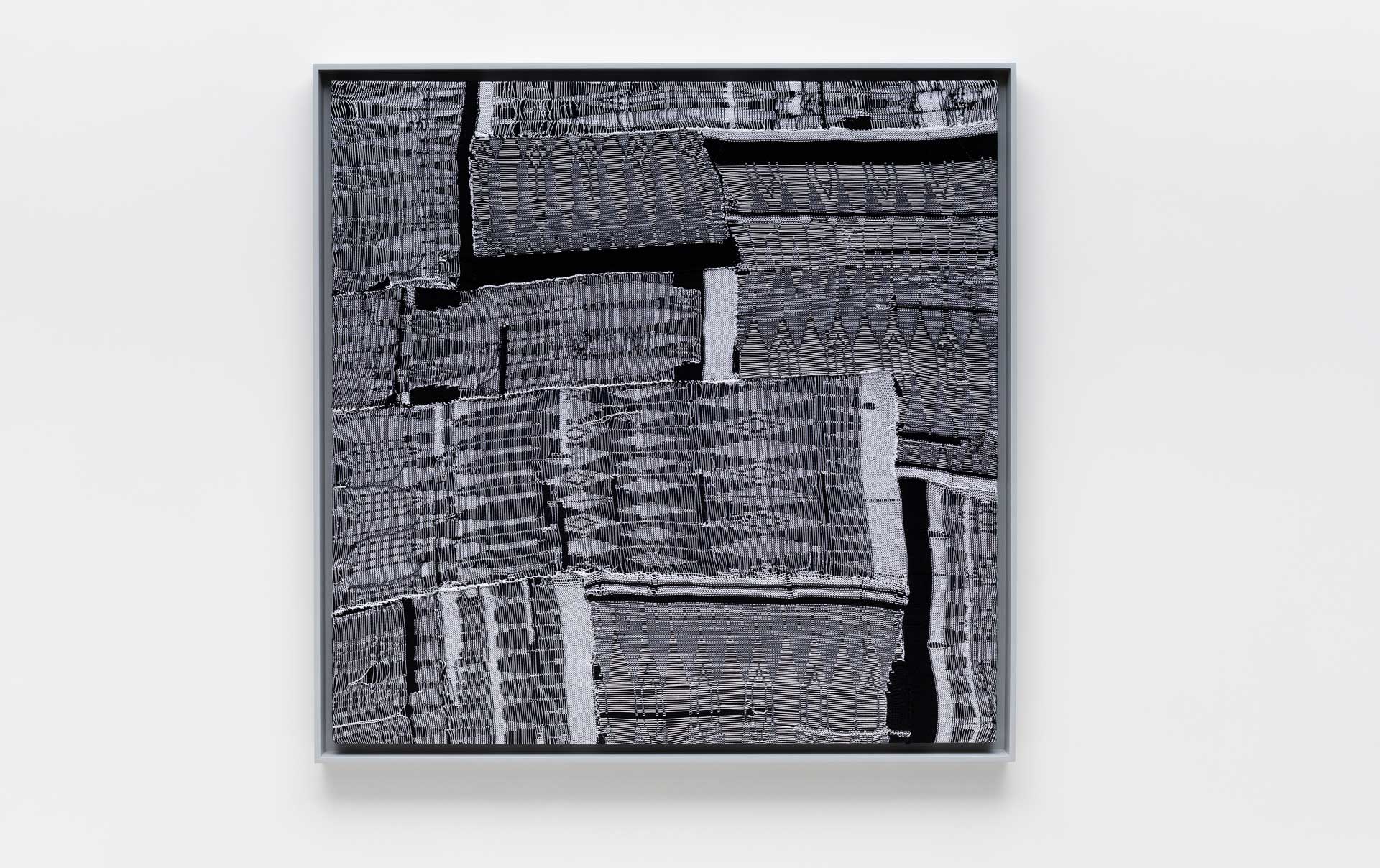
Courtesy of the artist and Simões de Assis Gallery.
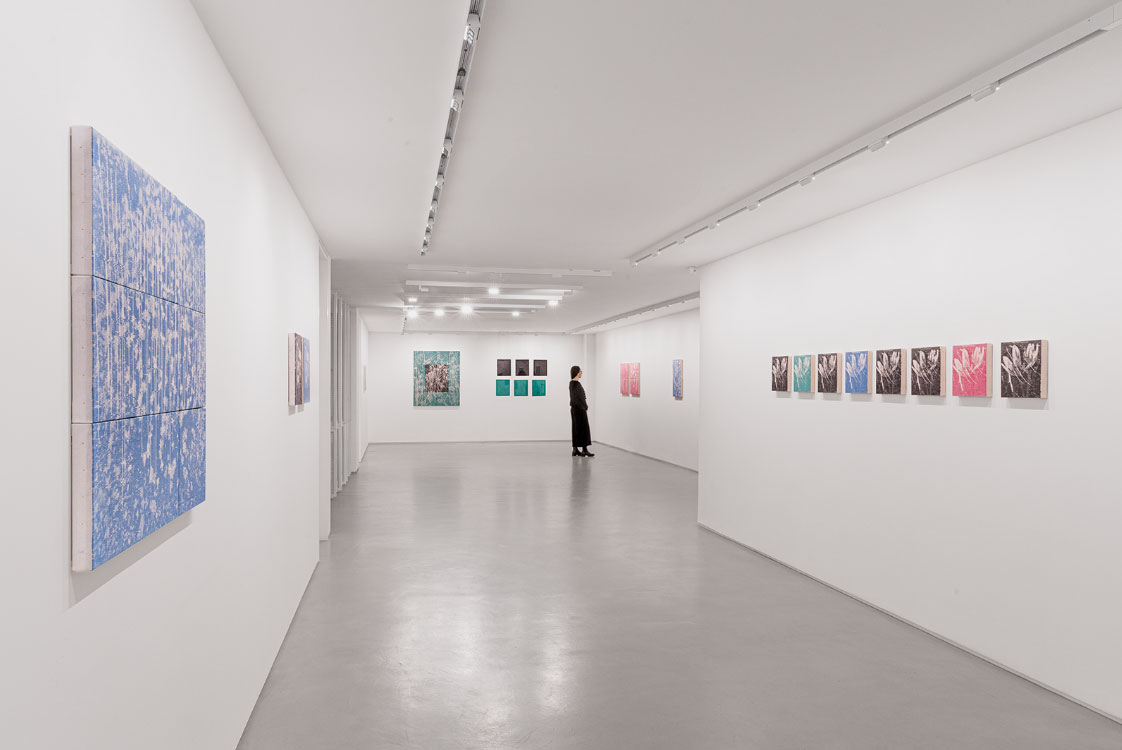
André Azevedo, Escrita-miragem, 2025. Exhibition view at Simões de Assis Gallery, São Paulo. Courtesy of Simões de Assis Gallery.
MB: It would be great to talk a bit about your experiences with residencies. That seems connected to the artist’s constant research—always searching for new reflections, new ways of making, or new ways of looking at one’s own practice.
Here in your studio we can see an infinity of research fields—boxes of materials, books, tests. All of this contributes to your work. It is very significant that you were one of the artists selected for the Albers Foundation residency. What was it like to work in a temporary studio within such an important institution, especially one connected to Anni Albers?
AA: It was very special. I feel that things started connecting outside of me first. I encountered Anni Albers’s work while studying color in the work of Josef Albers, her husband. When I came across her work, it was as if a huge window opened in my perception. She touched on something very central to my perspective as an artist: how the qualitative aspect of textile making often goes unnoticed—the intelligence acquired through the hands, through the process of making.
MB: It was confined to the domestic sphere or erased.
AA: Right. It was confined to an ornamental workspace. Anni said that, just like writing, weaving organizes lines and creates a connection between thought and manual activity. It generates an automation of the hand to the point where the hand itself almost develops knowledge of the process. Beyond the technical brilliance of her work, she also wrote extensively about processes. By reading her texts—and writing a bit about her myself—I began to learn more about the Bauhaus textile department where she worked, and later about Black Mountain College, where she taught after moving to the United States because of Nazism.
The Albers Foundation was established in the late 1990s in Bethany, Connecticut, after Anni’s death, to care for the Albers estate and to offer artist residencies. After I wrote an article about her work in 2020, the foundation invited me to do a three-month residency.
At the end of 2022 I went there, and by a stroke of luck I also connected with the Museum of Arts and Design in New York during that trip. I was commissioned to produce a work for the museum’s collection during the residency. There was a lot of bureaucracy along the way, but in 2024 the work was presented in an exhibition of recent acquisitions.
MB: Incredible.
AA: What struck me most was that the work entered an exhibition whose theme was “Masters and Students,” and it directly dialogued with a work by Anni Albers, accompanied by a curatorial text about my research in relation to her work. Having a work acquired by the museum in direct dialogue with such a fundamental artist in my research made me realize that I was on the right path. Throughout our trajectory we receive certain signs.
MB: What kind of signs?
AA: The first is the feeling you have when you remain faithful to what you believe you are capable of doing—an innate sensitivity that can become something that remains in the world. For example, when I recognized textiles through my family history and realized that this was the language I should develop as an artist. Then other confirmations appear along the way: a work entering an important collection, the first sale—which in my case did not happen through a gallery—a group exhibition, a solo exhibition, the first institutional exhibition.
When I received the invitation to produce a work for a museum collection in direct dialogue with ideas I had written about, it felt as though my work was contained within those ideas while also renewing them. It was truly a milestone in my career and a great source of joy. That residency also closed a cycle of research. When I returned, my production intensified and I began working in a different rhythm.
In 2024, I completed a second residency organized by The55 Project, a nonprofit foundation based in the United States and run by Brazilian directors. They invite a Brazilian artist to undertake a residency and create a bridge with the North American market. The residency took place in Miami at El Espacio 23 and lasted for one month. This became a longer institutional relationship, lasting about a year, and one of the outcomes of the residency was an exhibition later presented at the Pablo Atchugarry Foundation, in Miami. The result was better than I had imagined. I ended up presenting a solo exhibition—my largest to date—with the greatest number of works and the largest audience. After that, I continued collaborating with the project to participate in Untitled Art Fair, an art fair in Miami.
So they were two very different experiences. At the Albers Foundation I deepened my research into my poetics and artistic processes, while at The55Project there was also a learning experience related to the art market. Both were extremely positive.
MB: André, I could listen to you for days [laughs].
AA: We’ve been talking for quite a while already, haven’t we?
MB: We’ve been talking for so many years, and I always leave our conversations feeling nourished by what I learn.
AA: Exchanging ideas with you is always wonderful.
MB: Thank you for the conversation. I also thank you on behalf of Art Dialogues.
AA: I’m the one who thanks you for the opportunity to speak more deeply about my trajectory and work.
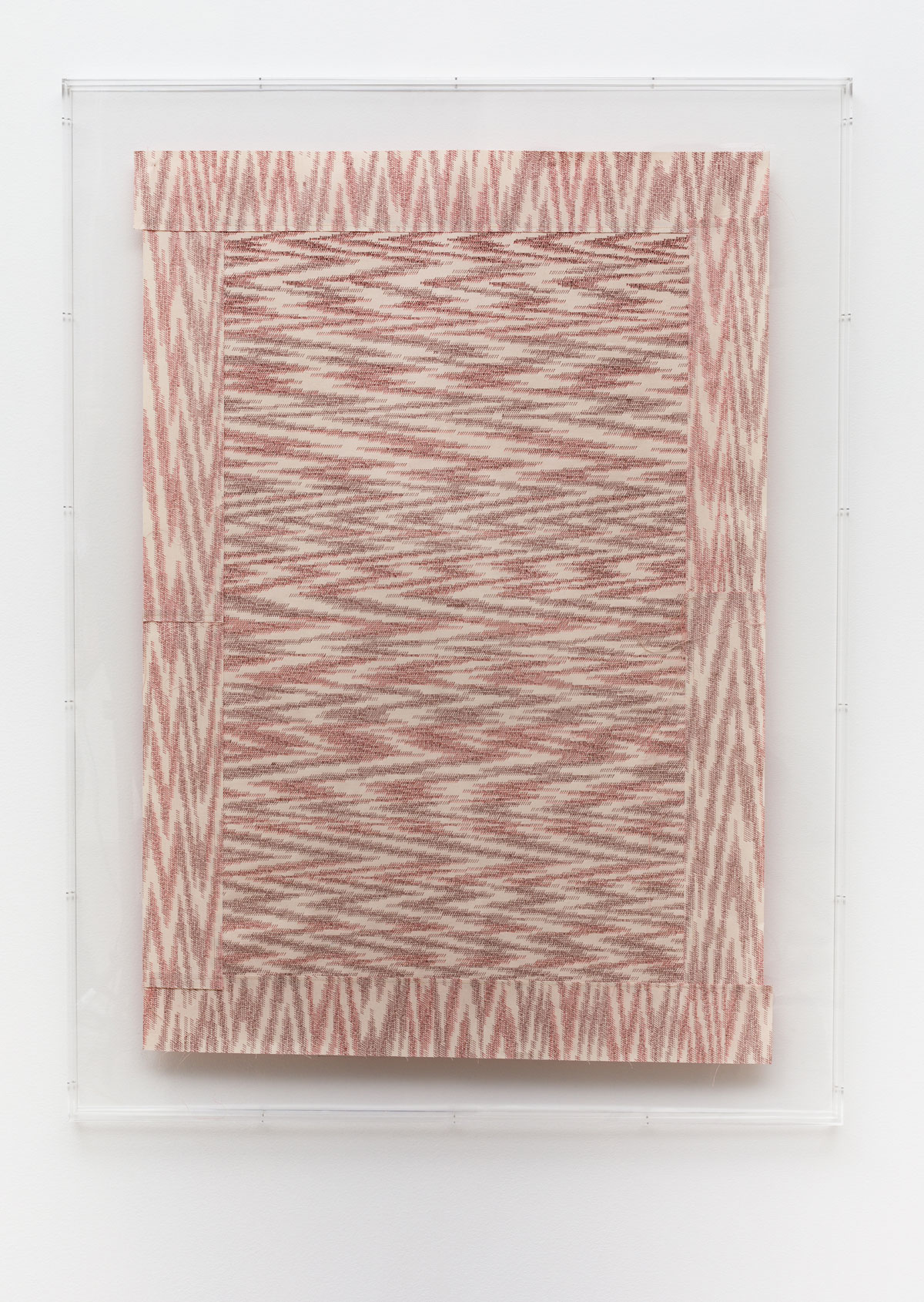
André Azevedo. Datilográfica Password, 2023. Typing, carbon paper marks, and machine stitching on raw cotton, 51.57 × 38.58 × 1.57 in.
Courtesy of the artist and Simões de Assis Gallery.
To learn more about André Azevedo’s work: @andreazevedostudio // simoesdeassis.com/artistas/andre-azevedo
To learn more about Mariane Beline: @marianebeline
Courtesy of the artist and Simões de Assis Gallery.