He collects the leftovers of Rio’s streets and beaches—sunburnt umbrellas, faded towels, fabric from the iconic beach chairs, crumpled plastic bags, Styrofoam beer coolers from samba rodas, and endlessly discarded Havaianas [Brazilian flip-flop brand]. You know these objects, the ones that become emblematic of cities, especially in the Global South? These materials are the lifeblood of Rio’s social and urban fabric, literally embodying its vibrancy, precariousness, and colors. How many broken flip-flops scatter across our paths daily? How many lives have they carried?
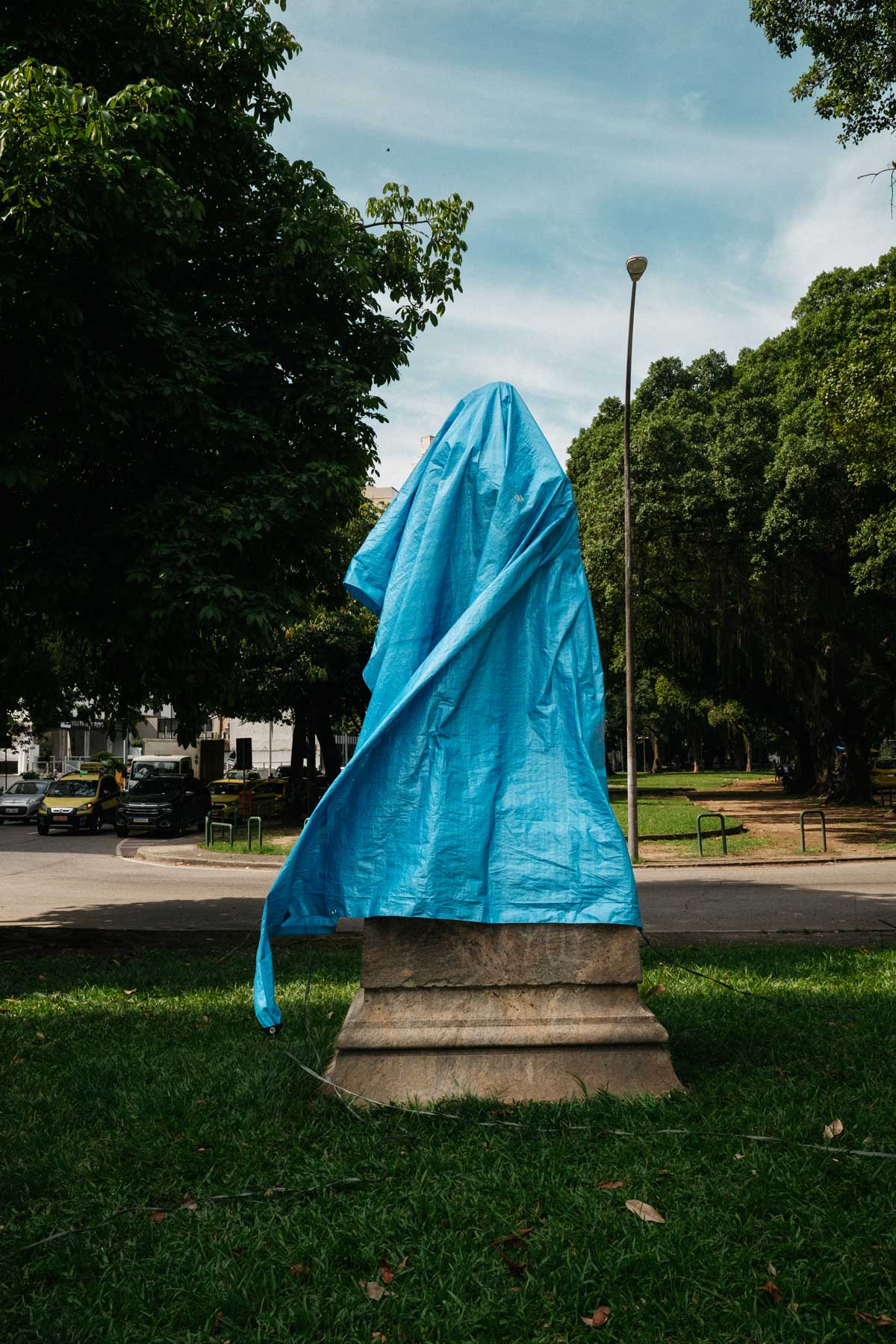
Zé Tepedino, Poetry and Ruins, 2021. Plastic tarp over marble sculpture. various dimensions. Action at Botafogo Beach, Rio de Janeiro, Brazil. Courtesy of the artist.
His practice resonates with me in a way similar to how Dubai-based artist Vikram Divecha’s practice did a decade ago. Both artists engage with the city not only as a material or source of inspiration but as a field for public interventions. Zé and I collaborated on two public art interventions with TAP in Brazil. Both took place in the most beautiful park of Aterro do Flamengo. I was hooked.
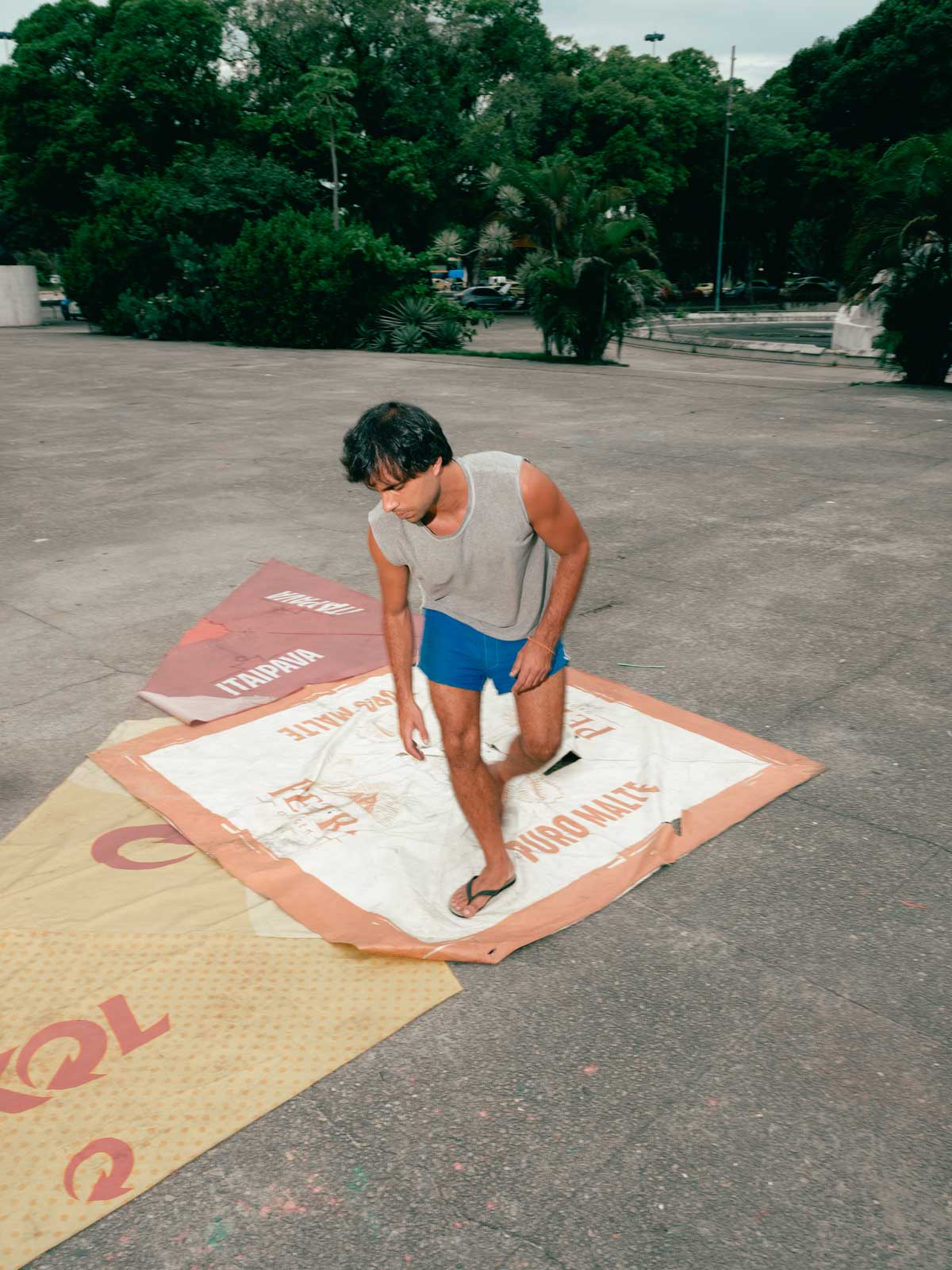
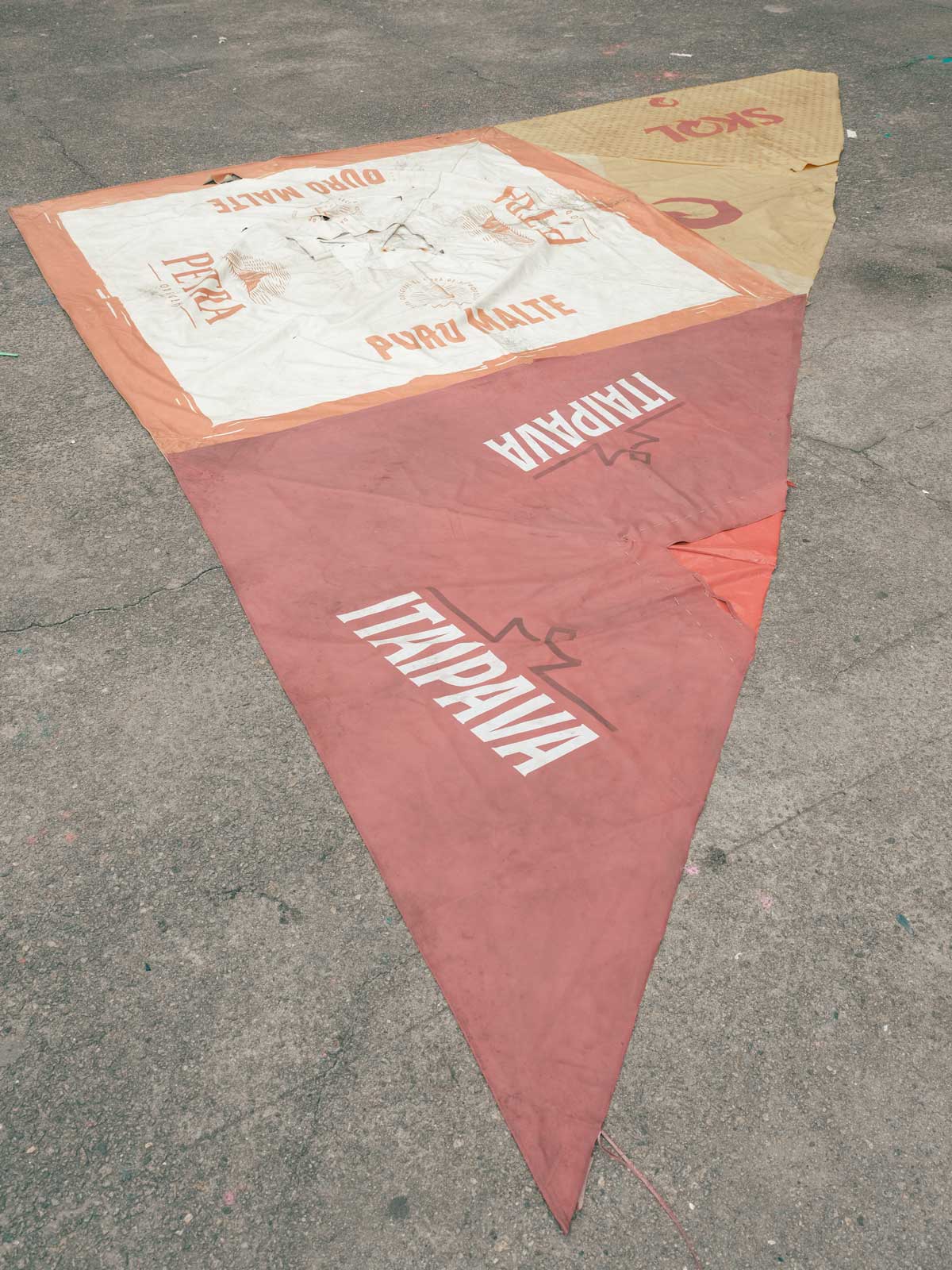
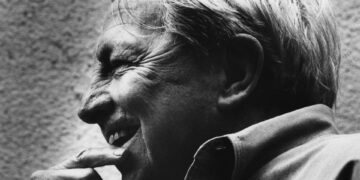
Zé Tepedino. Courtesy of the artist.
Tepedino’s work is steeped in the rich legacy of Brazilian modernism, particularly the Neo-Concrete movement and its iconic figures, Hélio Oiticica and Lygia Clark. Oiticica’s explorations of color, form, and space, along with Clark’s blurring of the boundaries between art and life, resonate deeply in his work. He actually doesn’t just blur this line, he makes us confront it.
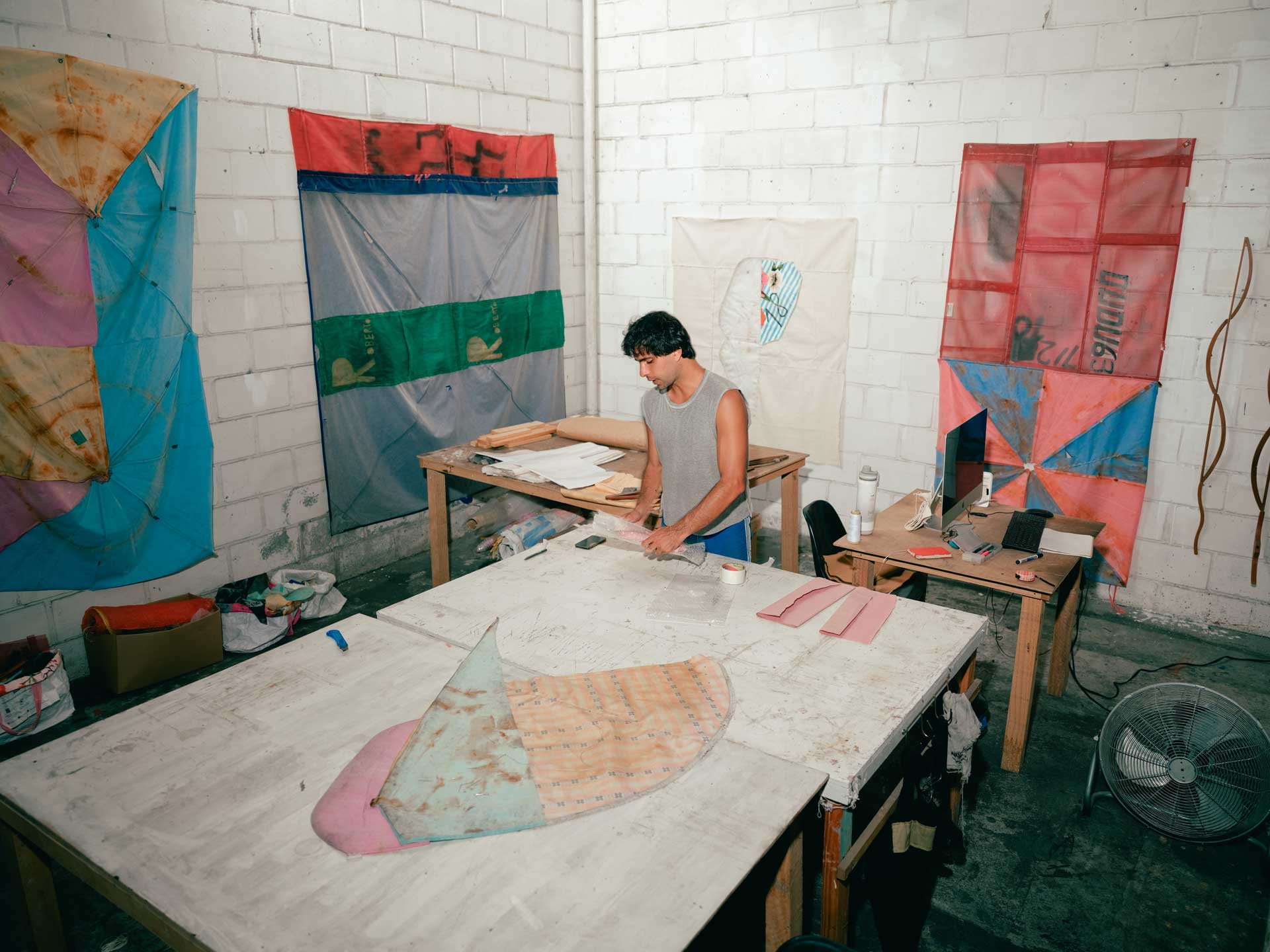
Zé Tepedino’s studio, Rio de Janeiro, Brazil. Courtesy of the artist.
The discourse surrounding art and user value has long been explored, from Tania Bruguera’s Arte Útil to Stephen Wright’s theories of the counterreadymade. These ideas have deeply influenced the social practice curating I cherish most, where art dissolves the boundaries between life and people. Zé Tepedino’s public art interventions walk a fine line between usership value and poetic resonance, embodying a dual ontology that weaves together utility and imagination, function and transcendence.
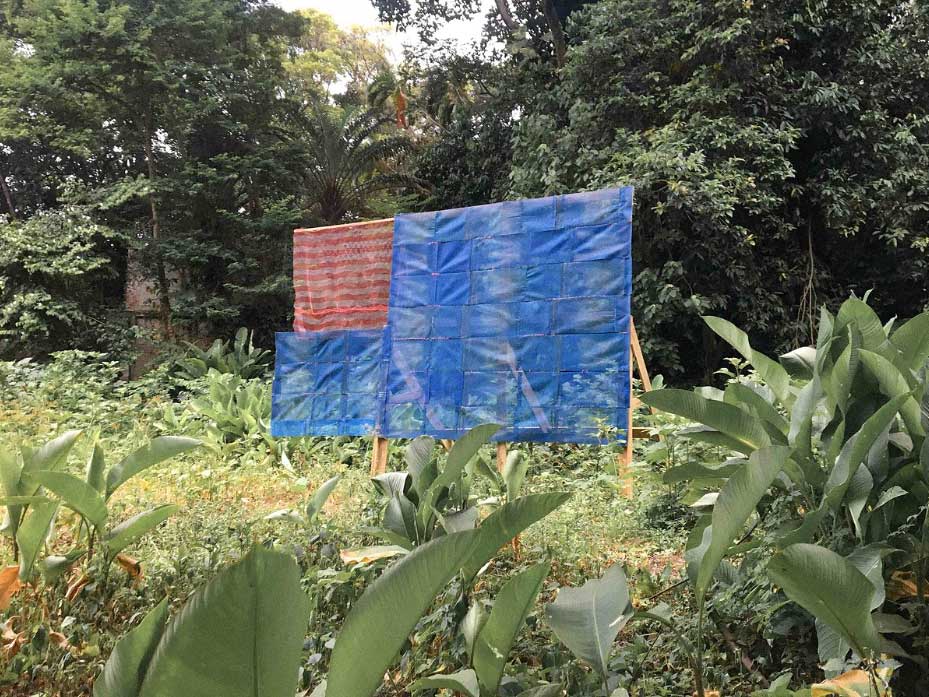
Zé Tepedino, Vende-se. Beach chair fabric, construction mesh, and wood. 16.4 × 11.5 × 6.6 feet . Courtesy of the artist.
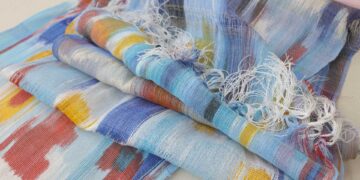
In one of our many conversations, Zé described himself as a co-author of all his works. His recognition of the traces people leave on the materials they interact with—through the city, through life—is deeply moving. His process of weaving, assembling, and composing with these traces brings together worlds, elements, and people. In Araruama, ice bags and plastic table covers shed their identities, transforming into something else. They become repositories of memory—tangible reminders of lives lived in the margins. These textures, shaped by time and human experience, become custodians of memory. They remind me of Gabriel Orozco’s Asterisms, where discarded materials are transformed into abstract yet profoundly emotional works. Similarly, Zé’s landscape series, crafted from Havaianas debris and tape reads like visual poetry, an ode to Rio de Janeiro’s layered beauty and precariousness. Here, beauty is not in the form but in the act of making it visible.
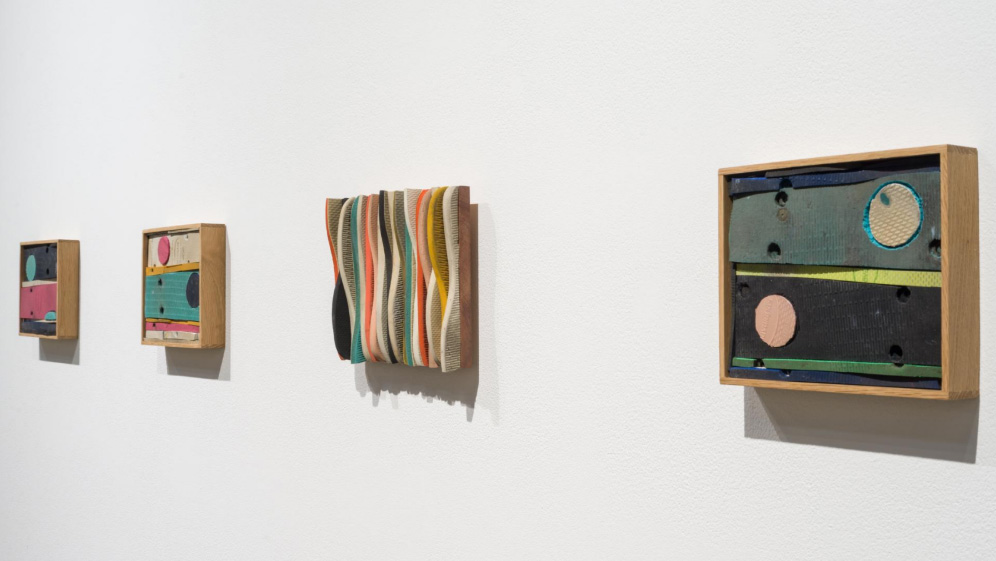
Zé Tepedino, Marina’s exhibition at Isabelle Gallery, Dubai, 2024-25. Curated by Amanda Abi Khalil. Courtesy of the artist.
Even the names Zé gives his works hold meaning. They are laced with humor and urban references, adding textual depth to the visual compositions. They feel like secret notes tucked into a city’s crevices, waiting to be discovered.
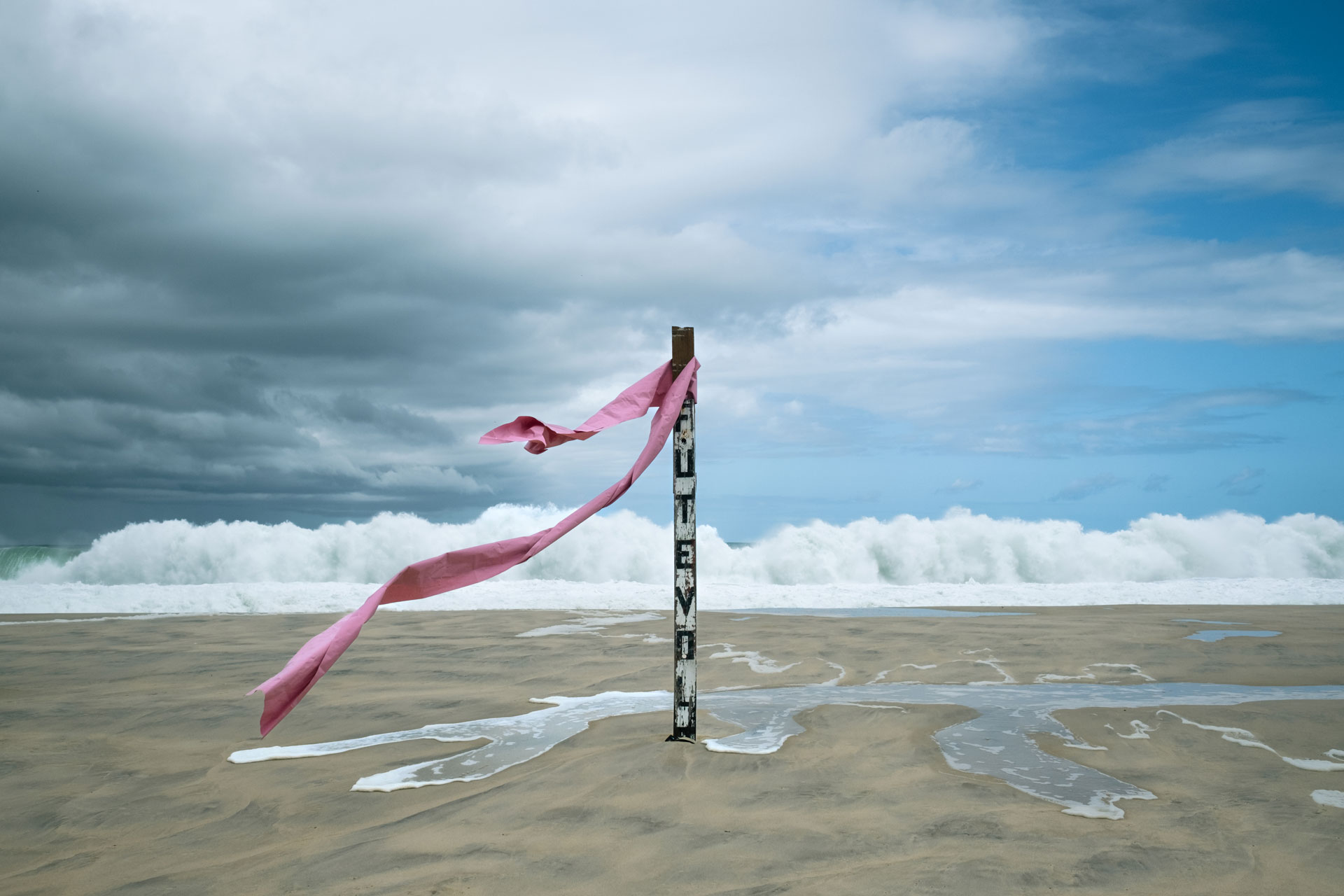
Zé Tepedino, public intervention at beach, Rio de Janeiro, Brazil. Courtesy of the artist.
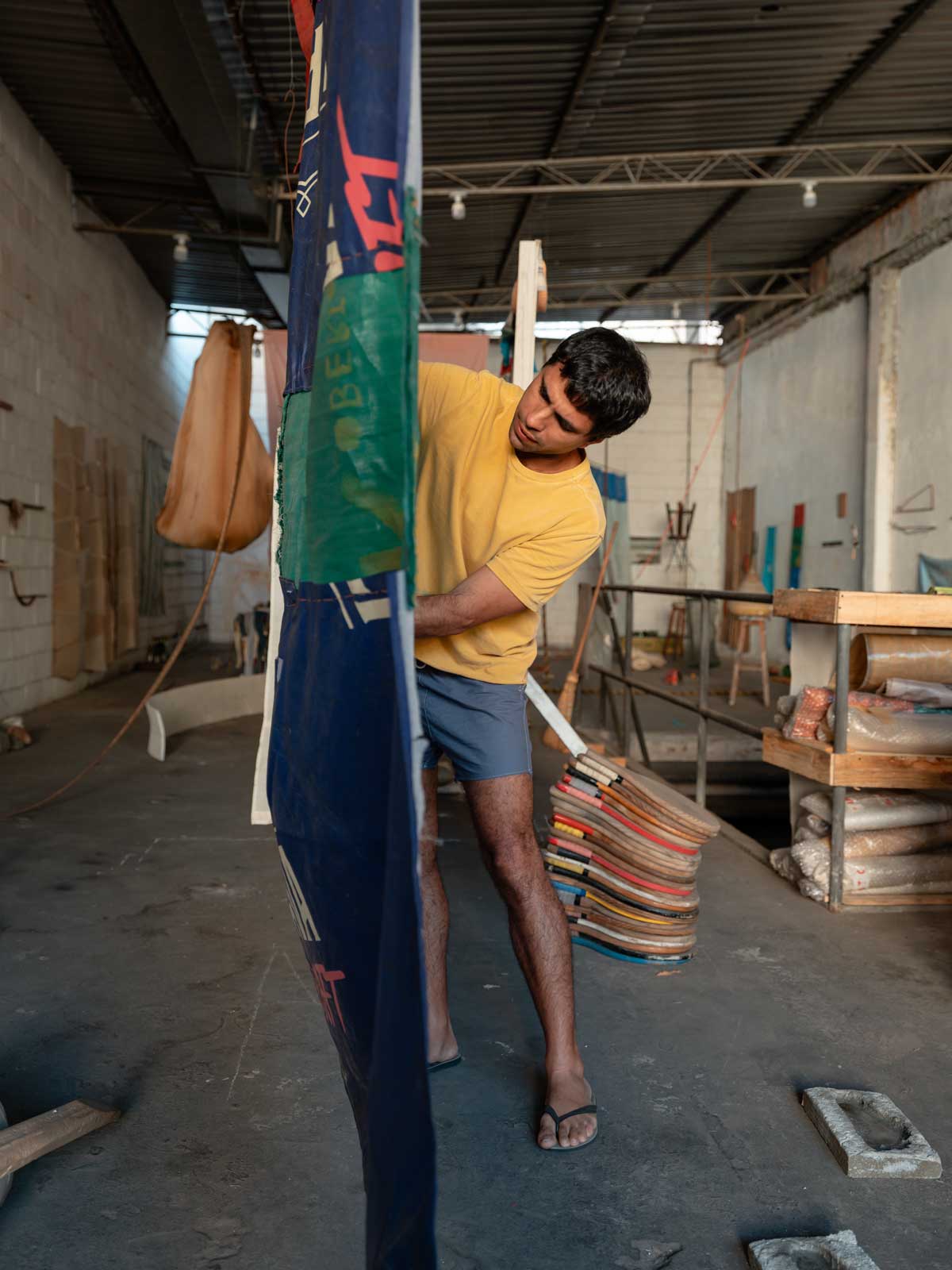
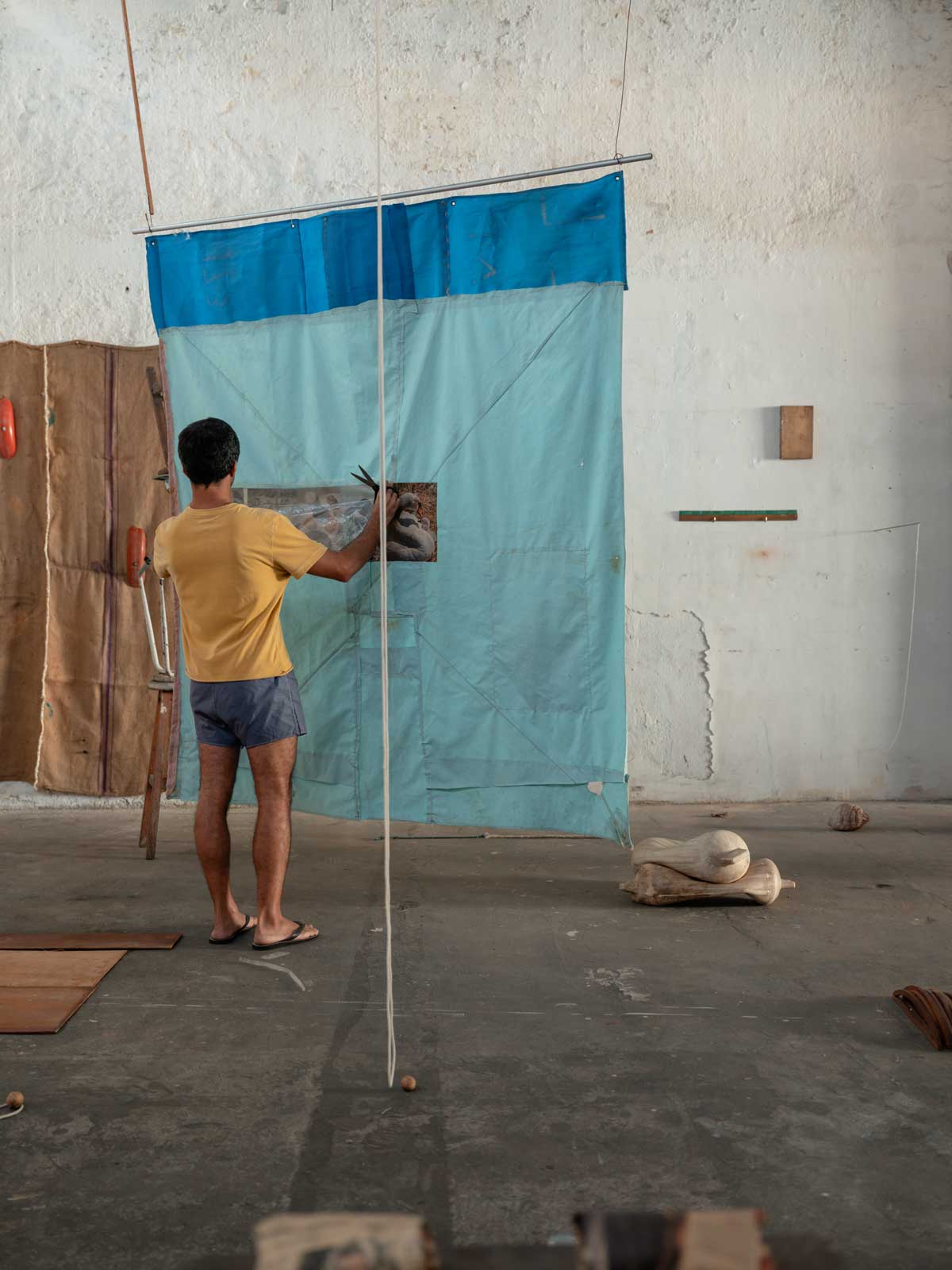
Zé Tepedino working on his studio, Rio de Janeiro, Brazil. Courtesy of the artist.
Improvisation is at the heart of his practice. It’s that make-shift, adaptive spirit of urban life—of living with what you have, that carries over from his public art interventions to his studio work. On Sundays, he can often be found wandering through the Shopping Chão — a shopping mall on the ground, a name locally given to informal street markets — in São Cristóvão. Rio’s lush forests and vibrant grit, provokes questions about waste, consumption, and the life of materials in art. Here, upcycling isn’t just about giving objects a second life; it’s about honoring the stories embedded in them, the human touch they’ve carried.
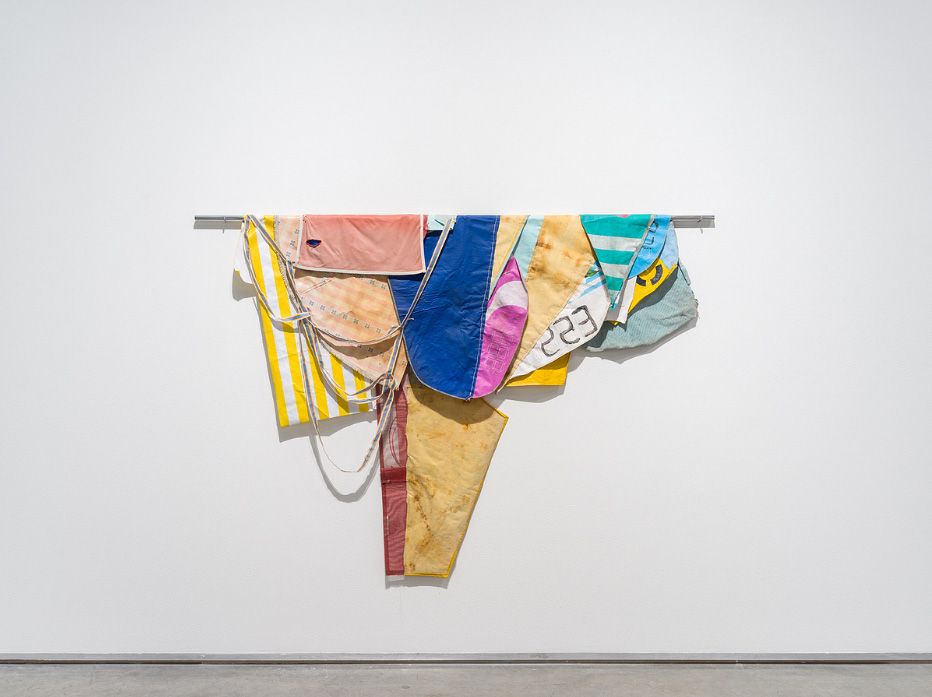
Zé Tepedino, Pássaros da cidade, 2024. Mixed fabrics and aluminum bar, 55 × 71 inches. Courtesy of the artist.
In this era marked by the extraction of people and resources, threatening waters, and the exhaustion of materials, Marina becomes a comment on the culture of excess—a world preoccupied with accumulation. A world where the luxury of one is built on the exploitation of another.
Marina suggests the power of transformation, the beauty in imperfection, and the possibilities that emerge when we reimagine the world around us.
Marina means “of the sea” in Latin.
Marina is the name on the keyholder for Zé’s studio.
Marina is luxury and exclusivity.
Marina was probably found in a Shopping Chão.
Excerpt from exhibition Marina, 2024-25. Text commissioned by Gallery Isabelle, Dubai.
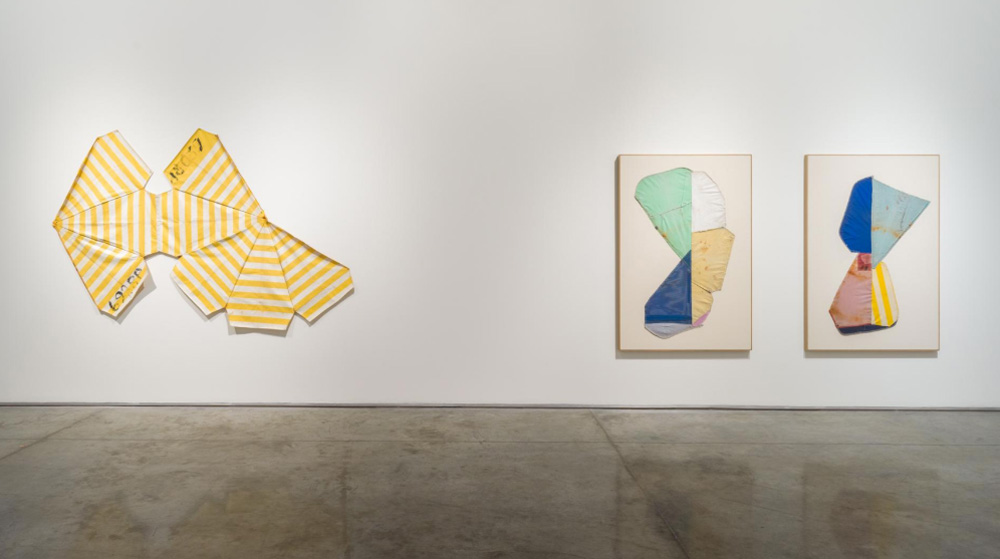
Zé Tepedino, Marina’s exhibition at Isabelle Gallery, Dubai, 2024-25. Curated by Amanda Abi Khalil. Courtesy of the artist.
Amanda Abi Khalil is the founder of Platform, a non-profit initiative dedicated to shifting artistic and curatorial discourse toward socially engaged and context-driven practices through residencies, research projects, and commissioned works.
Abi Khalil holds a Master 1 in Sociology and Anthropology from Paris 7 – Denis Diderot University, as well as a Master’s degree in Aesthetics, Arts, and Culture, with a specialization in Cultural Projects for Public Spaces.
Her recent curatorial projects include Undertow, a touring exhibition across the Mediterranean presented within the Art Explora Festival and co-curated with Danielle Makhoul; ArtParis Art Fair 2023; A Casa é Sua: migração e hos(ti)pitalidade fora do lugar at Paço Imperial, Rio de Janeiro; www.covideo19.art; Living Room (UIT): Use It Together at ISCP, New York; Chou Hayda, an audio guide created with Annabel Daou and the people of Beirut for the National Museum of Beirut; Art at AUBMC, a series of public art commissions for the new Medical Center at AUH; When All Seemingly Stands Still at GreyNoise, Dubai; Kurz / Dust, co-curated with Anna Ptak at CCA Ujazdowski Castle, Warsaw; Simple Past, Perfect Futures: Images in Countershot at CENTQUATRE, Paris; and Pippera, Pipperoo, Pipperum at Meinblau, Berlin, among others.
She has held teaching positions at the American University of Beirut (AUB), the Lebanese Academy of Fine Arts (ALBA), and Saint Joseph University (USJ) in Beirut. Throughout her career, has curated exhibitions, public art commissions, and socially engaged projects in collaboration with international art institutions. Previously, she served as curator at Hangar Umam D&R in Beirut, an independent art space focused on archive-based practices.
In 2016, she was nominated for the ICI Independent Curatorial Vision Award and, in 2019, received the Soros Art Fellowship from the Soros Art Foundation.
As a curator-in-residence, she has been hosted by Instituto Inclusartiz (Rio de Janeiro), the ISCP Jane Farver Residency (New York), and the Delfina Foundation (London). In her capacity as a consultant, she collaborates with academic institutions, museums, art fairs, and cultural organizations including Forensic Architecture at Goldsmiths, University of London; the Joan Mitchell Foundation (New York); the Académie Royale des Beaux-Arts (Beirut); Kunsthall Bergen; Kunsthall Stavanger; the Beirut Museum of Art; CEC ArtsLink (New York); Alserkal Avenue (Dubai); Art Basel; FIAC (Paris); Art Dubai; Artissima (Turin); AFAC and Al Mawred (Arab region); CENTQUATRE (Paris); the Edinburgh Art Festival; the British Council; and the Goethe-Institut, among others.
Amanda currently serves as a board member of Comadre (Brazil) and sits on the acquisitions committee of the Saradar Foundation (Lebanon). Her curatorial research focuses on social practice, public art, and experimental exhibition-making, particularly in relation to hospitality, radical care, and migration across and between contexts such as the Middle East, North Africa, and Latin America.
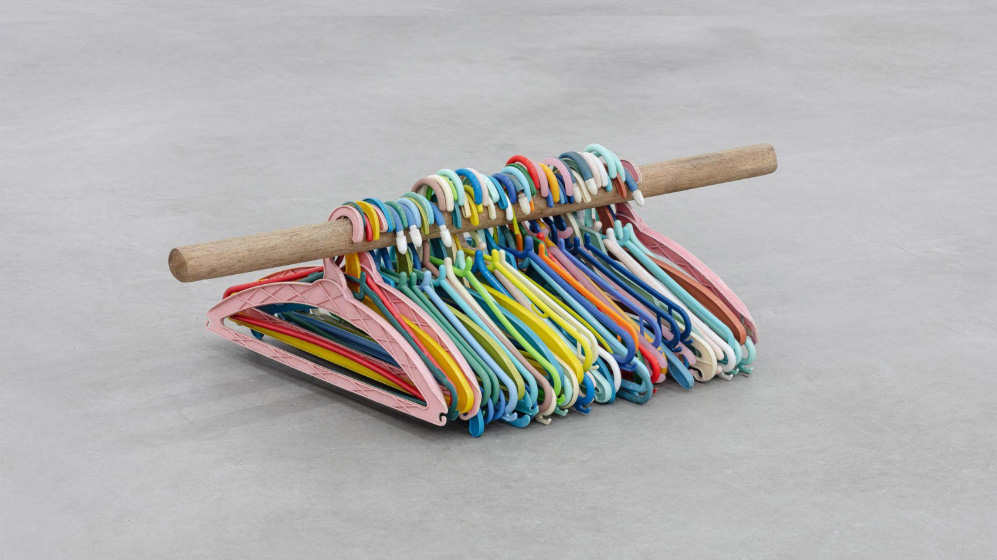
Zé Tepedino, Chafariz, 2022. Hangers and wood, 9.8 × 31.5 × 15.7 inches. Courtesy of the artist.
Zé Tepedino’s work begins with a careful observation of his surroundings. In his daily journey, he encounters prosaic materials, spaces, and situations—elements he chooses to revisit poetically, reorganize, or sometimes simply highlight.
He recombines diverse elements found between the city and the beach, the chaotic and the calm, seeking connections between the worlds unfolding before him. Through simple operations, he creates arrangements that offer a fresh perception of the overly familiar.
Regardless of the medium, Tepedino understands his work as action—whether in large-scale landscape installations or monotypes on paper. Employing various techniques—sewing, painting, sculpting—he formalizes ideas that treat the creative process as a co-author. His practice engages different times and traditions, proposing new ways of seeing the world around us.
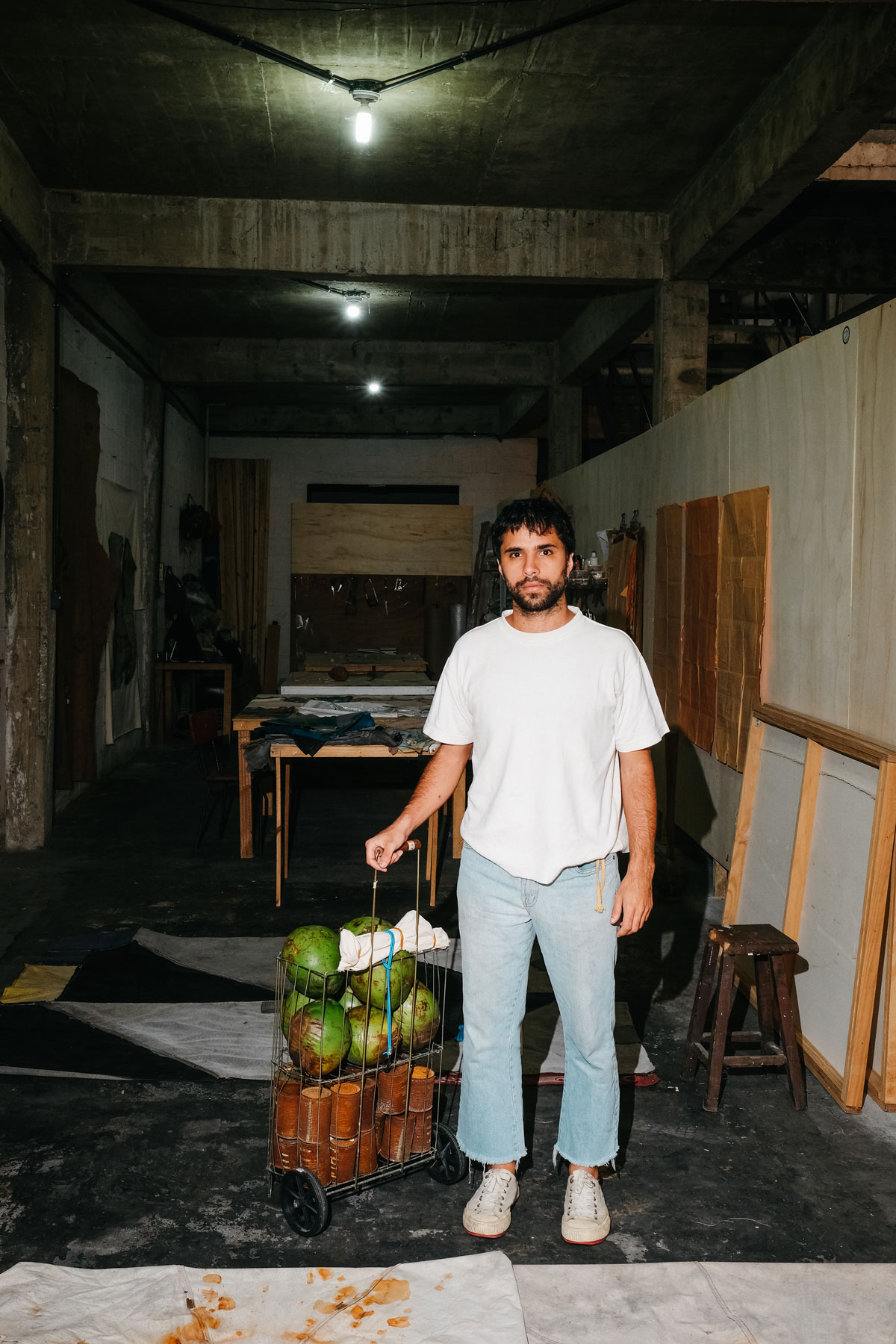
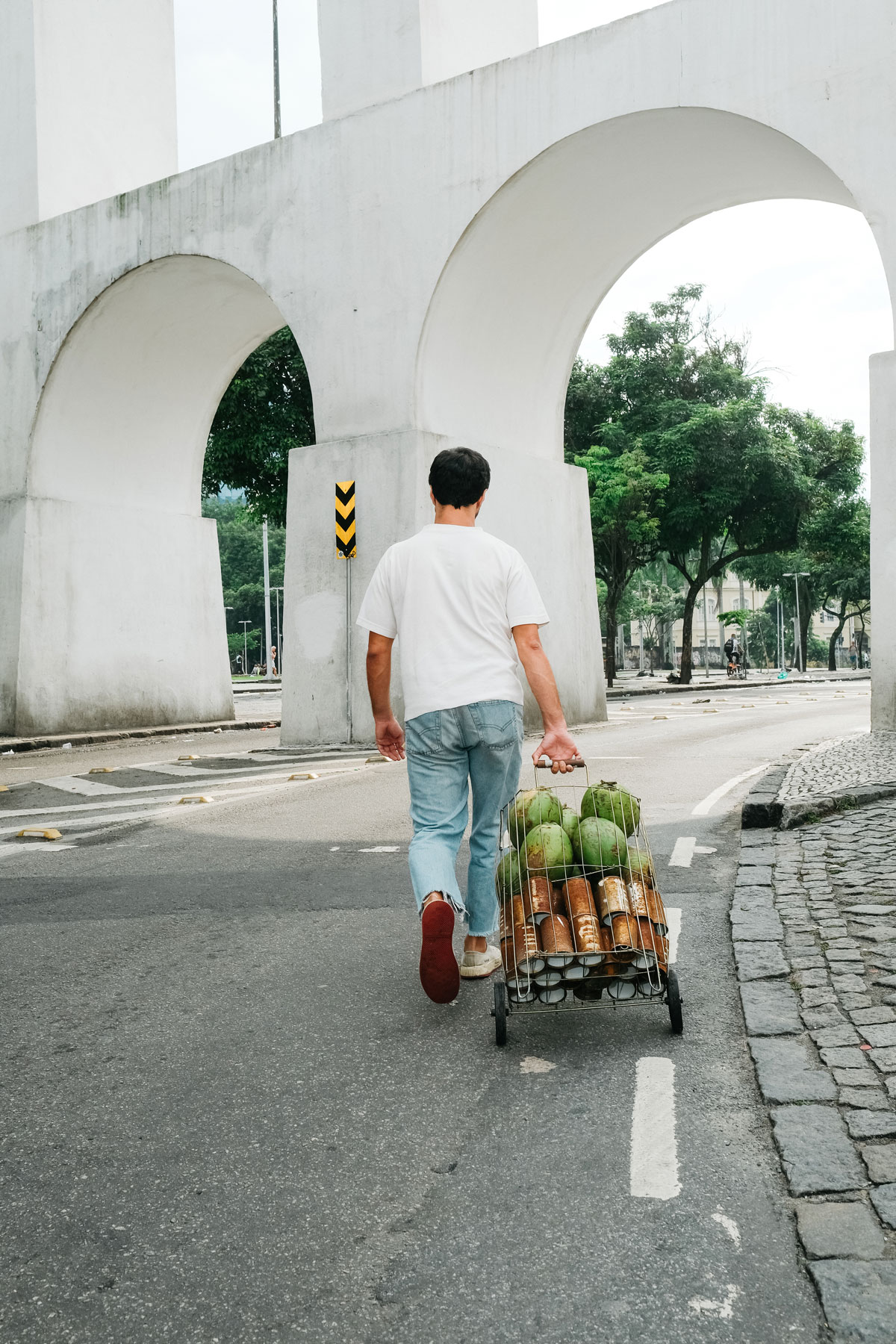
Zé Tepedino collecting material, Rio de Janeiro, Brazil. Courtesy of the artist.